

Master National Politics like a Native: Comparing Presidential and Parliamentary Systems in Korean
Phase 1: Empathy (Interactive Opening)
안녕하세요! It’s your favorite Daily Hangul editor and cultural navigator here! 👋 Have you ever found yourself watching a gripping Korean political thriller like Chief of Staff (보좌관) or The Whirlwind (돌풍) and thought, “Wow, the way they talk about power, bills, and elections in Korean is so intense—but I don’t fully get how their system actually works?”
Many of our C1-level learners tell us that while they can comfortably chat about K-dramas or order food, entering a discussion about Korean society, elections, or comparing the presidential system (대통령제) with the parliamentary system (의원내각제) feels like hitting a massive linguistic wall. You want to sound sophisticated, express nuanced political views, and debate naturally with Korean friends or colleagues without sounding like a dry academic textbook.
Don’t worry! Today, we are going to break down the essential high-level Korean vocabulary and cultural nuances of political structures. By the end of this guide, you’ll be able to dissect government systems like a seasoned political analyst, all while keeping that natural, friendly Korean flow. Let’s dive in! 🚀
Phase 2: Deep Dive into 3 Essential Political Terms
To speak confidently about government systems, you need to master these three foundational terms and understand how they actually live in the Korean language.
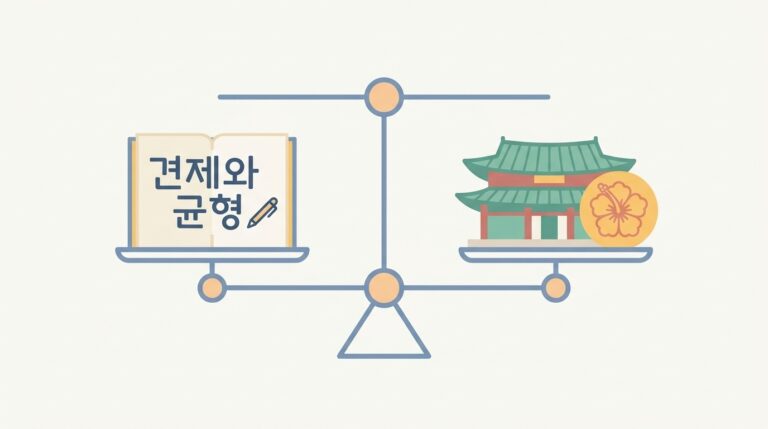
1. 견제와 균형 (gyeon-je-wa gyun-hyeong)
- Pronunciation: gyuhn-jeh-wah gyoon-hyeong (Sounds like “gyun” as in ‘gun’ but with a ‘y’ sound, and “hyeong” like ‘hyung’ for older brother)
- Meaning: Checks and Balances (Literal: Check/Restraint and Balance)
- K-Culture Moment: You’ll hear this phrase constantly in political news broadcasts and historical dramas when the National Assembly (국회) clashes with the Blue House/Yongsan Presidential Office over a vetoed bill.
- Editor’s Insight: In Korean political discourse, 견제 (restraint/check) is often used as an active verb (견제하다). To sound like a native, use the phrase “삼권분립을 통한 견제와 균형” (Checks and balances through the separation of powers).
- Situation Spectrum: Casual: 🚫 | Semi-formal: ⚠️ | Formal: ✅
- 🤔 Think About It: Does your home country emphasize “견제” (checking the executive power) or “협치” (collaborative governing) more in its daily politics?
2. 여소야대 (yeo-so-ya-dae)
- Pronunciation: yuh-so-yah-dae (Rhymes with “yo-so-ya-day”)
- Meaning: A divided government / Legislative gridlock (Literal: “Ruling party is small, opposition party is large”)
- K-Culture Moment: This is a crucial four-character idiom (사자성어) that dominates Korean election night broadcasts. When the ruling party fails to win a majority in the National Assembly, news anchors will sigh and announce, “이번 총선 결과로 여소야대 국국면이 형성되었습니다.”
- Editor’s Insight: This word is the ultimate cheat code for sounding like a political insider. Instead of saying “The president’s party doesn’t have many seats,” simply say 여소야대.
- Situation Spectrum: Casual: ⚠️ | Semi-formal: ✅ | Formal: ✅
- 🤔 Think About It: How does a “여소야대” situation in Korea differ from a divided congress/parliament in your own country?
3. 책임정치 (chaek-im-jeong-chi)
- Pronunciation: chaek-im-jung-chee (Think “check-im” + “jeong-chi” [politics])
- Meaning: Responsible politics / Accountability in government
- K-Culture Moment: In debates comparing government types, advocates for the parliamentary system (의원내각제) always champion 책임정치, arguing that a cabinet must resign if they lose the public’s trust, unlike a president with a fixed term.
- Editor’s Insight: 책임 means responsibility or accountability. When combined with 정치, it refers to a system where politicians actually take fall-guy accountability for policy failures.
- Situation Spectrum: Casual: ⚠️ | Semi-formal: ✅ | Formal: ✅
- 🤔 Think About It: Which system do you think guarantees 책임정치 better: the Presidential system or the Parliamentary system?
Phase 3: Textbook Korean vs. Real-Life Native Korean
Let’s look at how textbooks teach political comparisons versus how Koreans actually talk about them in real life during a debate.
Situation 1: Expressing that a system has too much concentrated power
- 📖 Textbook Korean: “대통령 중심제는 권력이 대통령 일인에게 집중되는 경향이 있습니다.” (The presidential system tends to concentrate power in a single president.)
- 🗣️ 진짜 Korean: “대통령제는 아무래도 제왕적 대통령(imperial president) 제도가 되기 쉽죠. 권력이 한곳으로 너무 쏠리니까요.” (The presidential system easily turns into an ‘imperial presidency’. Power just concentrates too much in one spot.)
- 💡 Why the difference? While the textbook is grammatically correct, natives use the vivid socio-political term 제왕적 대통령 (Imperial President) to criticize the absolute authority of the executive branch in Korea.
Situation 2: Describing political instability or constant changes
- 📖 Textbook Korean: “의원 내각제 하에서는 정부가 자주 교체될 수 있습니다.” (Under a parliamentary system, the government can be replaced frequently.)
- 🗣️ 진짜 Korean: “내각제는 정국이 불안정해지면 내각이 해산되거나(cabinet dissolution) 총리가 수시로 바뀌는 단점이 있어요.” (The downside of the parliamentary system is that if the political situation gets unstable, the cabinet dissolves or the prime minister changes constantly.)
- 💡 Why the difference? Using the precise political term 정국 (political situation) and 내각 해산 (cabinet dissolution) elevates your Korean to a C1 professional level instantly.
Phase 4: K-Culture Deep Dive & Non-Verbal Manners
4-1. The Art of Debate Body Language in Korea
When discussing sensitive topics like politics in Korean, non-verbal cues are just as important as your vocabulary:
* The Head Nod (끄덕임): Even if you strongly disagree with someone’s political take, always nod slightly while they speak and say “아, 무슨 말씀이신지 알겠어요 (Ah, I see what you mean)” before offering your counterpoint. Directly saying “그건 틀렸어요 (That’s wrong)” is considered highly aggressive.
* Tone Down the Hand Gestures: Unlike Western debating styles with sharp finger-pointing, keep your hands open and low. Pointing at someone during a political discussion is seen as a sign of anger.
4-2. Cultural Context: The Korean Obsession with the “5-Year Single Term”
Korea operates on a unique 5-year single-term presidential system (5년 단임제). Unlike the US where a president can serve two terms (8 years), Korean presidents get exactly one shot. Why? Because of Korea’s intense modern history of transitioning from dictatorship to democracy in 1987. Knowing this historical context makes your political arguments in Korean sound incredibly empathetic and deep.
Phase 5: Real-Life Roleplay Scenario
Setting: A trendy cafe in Yeouido (the political district of Seoul). You (Min-woo) are having a deep conversation with your politically-minded Korean friend, Seo-yeon, after watching a presidential election debate on TV.
Characters:
- 서연 (Seo-yeon): A sharp, politically active office worker who prefers the stability of the parliamentary system.
- 민우 (Min-woo – You): A thoughtful analyst who weighs the pros and cons of both systems.
서연: 민우 씨, 어제 대통령 후보 토론회 봤어요? 저는 볼 때마다 우리나라 대통령제에 한계를 느껴요.
      (Min-woo, did you watch the presidential debate yesterday? Every time I watch, I feel the limitations of our presidential system.)

민우: 🎭 (sighing gently) 맞아요, 서연 씨. 권한이 대통령 한 명에게 너무 쏠려 있어서 '제왕적 대통령제'라는 말이 나오는 것도 이해가 가요.
      (Exactly, Seo-yeon. I understand why people call it an 'imperial presidency' since power is so heavily concentrated in one person.)

서연: 그렇죠? 그래서 저는 권력 분산이 잘 되는 의원 내각제가 차라리 더 낫지 않나 싶어요.
      (Right? That's why I think a parliamentary system, which distributes power better, might actually be better.)

민우: 🎭 (nodding thoughtfully) 의원 내각제는 다수당이 내각을 구성하니까 '책임정치'를 구현하기에는 확실히 유리하겠네요.
      (Since the majority party forms the cabinet, the parliamentary system definitely has an advantage in realizing 'responsible politics'.)

서연: 맞아요! 하지만 한국 사회에서 내각제를 도입하면 정당 간의 갈등 때문에 정국이 매일 요동치지 않을까요?
      (True! But if we introduce a parliamentary system in Korean society, wouldn't the political situation fluctuate daily due to conflicts between parties?)

민우: 🎭 (smiling slightly) 그럴 수도 있죠. 연립정부가 자주 깨지면 내각 해산이나 조기 총선으로 사회적 비용이 더 클 수도 있어요.
      (That's possible. If coalition governments break up often, the social cost of cabinet dissolutions or snap general elections could be even higher.)

서연: 역시 민우 씨는 양쪽 측면을 아주 균형 있게 보시네요! 삼권분립의 본질을 잘 짚어주셨어요.
      (As expected, Min-woo, you view both sides so closely and balanced! You really captured the essence of the separation of powers.)

민우: 🎭 (modestly gesturing) 과찬이세요. 결국 어떤 제도든 '견제와 균형'이 제대로 작동하는 게 가장 중요한 것 같아요.
      (You flatter me. In the end, whichever system it is, I think the most important thing is that 'checks and balances' work properly.)
🔀 Interactive Branching Point
If Seo-yeon asks: “그럼 민우 씨는 만약 개헌(constitutional amendment)을 한다면 어떤 제도를 지지하시겠어요?” How do you answer?
- Option A: “저는 안정적인 국정 운영을 위해 현행 대통령제를 유지하되, 권한을 좀 줄여야 한다고 봐요.” (Keep presidential, but reduce power.)
- 👉 Best! Demonstrates deep understanding of current Korean constitutional reform debates (개헌 논의).
- Option B: “저는 그냥 미국처럼 4년 중임제로 바꾸는 게 제일 좋다고 생각해요.” (Switch to a 4-year double-term system like the US.)
- 👉 Good & Realistic. This is a highly discussed alternative in Korea to solve the “lame duck” (레임덕) problem.
- Option C: “정치는 다 똑같아서 아무거나 상관없어요.” (Politics is all the same, so it doesn’t matter.)
- 👉 Risk! It kills the conversation instantly. Avoid sounding politically indifferent (정치적 무관심) when practicing C1 Korean.
Phase 6: 10-Second Emotional Shadowing Drill
Practice saying these high-level sentences with the exact emotional pauses used by native speakers. The / indicates a micro-pause for breath and dramatic effect.
- Sentence 1: [🤔 Thoughtful and analytical expression]
- “대통령제는 / 강력한 리더십이 장점이지만, / 여소야대 국면에서는 / 국정 운영이 마비될 위험이 있죠.”
- dae-tong-ryeong-je-neun / gang-ryeok-han ri-deo-sip-i jang-jeom-i-ji-man / yeo-so-ya-dae guk-myeon-eo-seo-neun / guk-jeong un-yeong-i ma-bi-doel wi-heom-i it-jyo.
- Sentence 2: [🔥 Passionate and persuasive tone]
- “결국 핵심은 / 제도의 종류보다 / 권력의 독점을 막는 / 견제와 균형이 / 제대로 작동하느냐입니다!”
- gyeol-guk haek-sim-eun / je-do-ui jong-ryu-bo-da / gwon-ryeok-ui dok-jeom-eul mak-neun / gyeon-je-wa gyun-hyeong-i / je-dae-ro jak-dong-ha-neu-nya-im-ni-da!
Phase 7: K-Culture Mini Dictionary
- 개헌 (gae-heon) | Constitutional Amendment
- Changing the constitution. In Korea, talking about “개헌” usually means discussing whether to change the presidential term or switch to a parliamentary system.
- 레임덕 (re-im-deok) | Lame Duck
- A president losing authority toward the end of their term. Koreans use this English loanword daily in political news.
- 협치 (hyeop-chi) | Governance / Political Cooperation
- Literally “cooperative governing.” Used when urging the ruling and opposition parties to work together rather than fight.
- 국정 운영 (guk-jeong un-yeong) | State Administration / Governing the State
- The act of running the country’s executive affairs.
Phase 8: The Political Observer’s Survival Kit
Survival Phrases
- Phrase 1: “이번 선거 판세가 어떻게 되나요?” (What is the outlook for this election?)
- Phrase 2: “출구조사 결과가 어떻게 나왔어요?” (How did the exit poll results turn out?)
- Phrase 3: “여당과 야당이 합의점을 찾았으면 좋겠네요.” (I hope the ruling and opposition parties find common ground.)
Editor’s Travel Note
When visiting Seoul, if you want to experience the heart of Korean democracy, take the subway to National Assembly Station (국회의사당역) on Line 9. You can download the Naver Map App to find the best walking path around the beautiful National Assembly building. If you go during spring, the road behind the assembly is one of the most famous cherry blossom spots in Seoul! (Disclaimer: Access to some parts of the National Assembly building may require pre-booked guided tours.)
Phase 9: “Going Deeper” (A Slice of Korean Thought)
In Western political theory, government systems are often discussed as dry mechanical structures. However, in Korea, politics is deeply emotional and communal. The transition to the current system in 1987 was won through painful democratic struggles (민주화 운동). Therefore, when Koreans debate the Presidential system versus the Parliamentary system, they aren’t just discussing efficiency; they are reflecting on historical trauma, national pride, and the collective desire to prevent any single person from holding absolute power again.
💬 Your Turn: Does your home country use a Presidential system, a Parliamentary system, or a hybrid? How do people in your culture view the balance of power? Let us know in the comments below!
Phase 10: FAQ & Common Mistakes
Q: What is the difference between 여당 (yeo-dang) and 야당 (ya-dang)?
A: 여당 (Yeo-dang) is the ruling party—the political party that currently holds the presidency. 야당 (Ya-dang) refers to all opposition parties. An easy way to memorize: ‘여’ (Yeo) comes from 여당, representing the ‘with’ (with-power) party, and ‘야’ (Ya) means wild/outside, representing those outside the presidential office.
Q: Is 의원 내각제 (ui-won nae-gak-je) used in Korea?
A: No, Korea currently uses a presidential system (대통령제). However, Korea did briefly have a parliamentary system during the Second Republic (1960–1961) following the April 19 Revolution.
Q: Can I use the word ‘정치질’ (jeong-chi-jil) in formal debates?
A: Absolutely not! While 정치 means politics, adding the suffix -질 (which implies degrading action) makes 정치질 a slang word meaning “office politics, playing mind games, or scheming behind people’s backs.” Keep it for casual gossip about office drama, never for actual national politics!
🚨 Common Mistakes Alert!
- Saying “대통령 대표” instead of “대통령”
- Wrong: 대통령 대표가 법안을 거부했습니다.
- Correct: 대통령이 법안을 거부했습니다. (The president vetoed the bill. ‘대통령’ itself means the head of state; do not attach ‘대표’ [representative].)
- Confusing 국회 (National Assembly) and 정부 (Government)
- In Korea, 국회 (Legislature) and 정부 (Executive branch) are strictly distinguished during political debates. Make sure not to use them interchangeably.
Phase 11: Action Mission!
- 🥉 Bronze Mission: Write one sentence in the comments comparing the two systems using the term 견제와 균형.
- 🥈 Silver Mission: Screenshot our Emotional Shadowing Drill and practice it out loud three times. Share your progress with a study buddy!
- 🥇 Gold Mission: Watch a 5-minute Korean news clip about the next National Assembly (국회) session and try to spot the terms 여당, 야당, and 국정.
Phase 12: Interactive Quiz Challenge
Test your knowledge of high-level Korean political terms!
1. Match the term to its definition:
- A. 여소야대
- B. 책임정치
- C. 제왕적 대통령
👉 Click to reveal the Answer & Explanation
- A -> A divided legislature where the ruling party has fewer seats than the opposition.
- B -> Responsible politics where the governing party takes ultimate accountability.
- C -> Imperial President referring to an over-concentration of executive power.
2. True or False:
- Korea has a 4-year double-term presidential system like the United States. (T/F)
👉 Click to reveal the Answer & Explanation
Answer: False!
Korea has a 5-year single-term system (5년 단임제). A president cannot run for re-election under any circumstances.







