

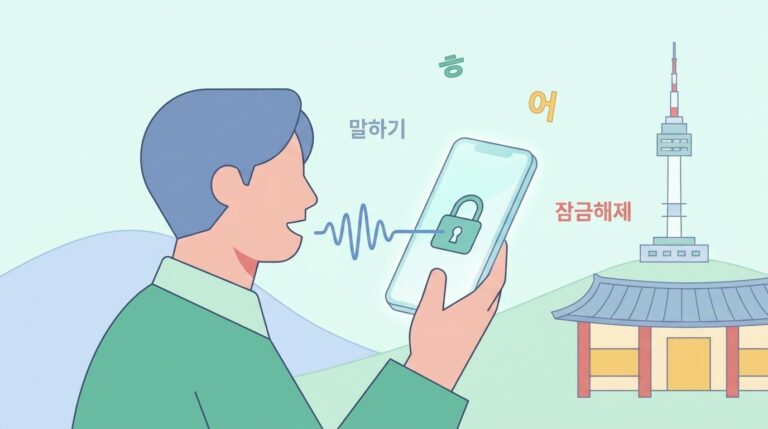
Master Voice ID and Biometric Authentication in Korean: A C1-Level Deep Dive
Phase 1: Empathy (스토리 몰입형 오프닝)
안녕하세요! 매일한글 (Daily Hangul) editor here, your reliable Korean culture navigator! 🇰🇷✨
Imagine this: You are standing in front of a futuristic, unmanned convenience store (무인 편의점) in the heart of Seoul late at night. You try to use your pre-registered voice ID to authenticate and purchase a warm drink, but the system prompts you with: “목소리를 다시 인증해 주세요 (Please authenticate your voice again).” Suddenly, under the pressure of the quiet night, your accent slips, or you use a textbook phrase that the AI just doesn’t grasp.
At the C1 level, you aren’t just learning how to say “hello.” You are navigating high-tech Korean infrastructure—smart banking apps, automated customer centers, and voice-activated IoT systems. Today, we are bridging the gap between high-tech Korean vocabulary and natural native speech so you can unlock voice ID and biometric authentication systems with absolute confidence.
Phase 2: 핵심 표현 3선 심층 분석 (Three Key Expressions)
1. 본인 인증 (bon-in in-jeung)
- Pronunciation: bon-in een-jeung (Sounds like “bone-in” + “inn-jung”)
- Meaning: Identity verification / Biometric authentication
- K-Culture Moment: You will hear this constantly on Korean mobile banking apps (like Toss or KakaoBank) and when setting up a smart home system. It’s the ultimate gatekeeper phrase in Korea’s hyper-secure digital ecosystem.
- Editor’s Insight: While “인증” means verification or certification, prefixing it with “본인” (oneself) highlights the strict security culture in Korea.
- Situation Spectrum: Casual (⚠️ – too formal for casual chat) / Semi-formal (✅) / Formal (✅)
- 🤔 Think About It: How does your home country handle digital security? In Korea, “본인 인증” is a daily ritual tied tightly to your resident registration or phone number.
2. 목소리 등록 (mok-so-ri deung-rok)
- Pronunciation: mokh-so-ree deung-rok (Sounds like “mock-story” + “dung-rock”)
- Meaning: Voice registration / Voice enrollment
- K-Culture Moment: Seen in sci-fi K-dramas or when configuring AI assistants like Samsung’s Bixby or KT’s GiGA Genie.
- Editor’s Insight: “목소리” is the native Korean word for voice, whereas “음성” (eum-seong) is the Sino-Korean counterpart. “목소리 등록” sounds warmer and is preferred in user-friendly UI/UX designs.
- Situation Spectrum: Casual (✅) / Semi-formal (✅) / Formal (✅)
- 🤔 Think About It: Why do you think tech companies prefer using native Korean terms like “목소리” instead of “음성” in their consumer-facing setups?
3. 인식률이 떨어지다 (in-sik-ryul-i tteol-eo-ji-da)
- Pronunciation: een-sheek-ryu-ri tteor-eo-jee-dah
- Meaning: The recognition rate is low / The system is failing to recognize (my voice)
- K-Culture Moment: When a voice-activated GPS in a Korean taxi keeps misunderstanding your destination, you tell your friend: “인식률이 너무 떨어져 (The recognition rate is so bad).”
- Editor’s Insight: This is a sophisticated C1-level expression. Instead of saying “인식 안 돼 (It doesn’t work),” using “인식률이 떨어지다” pinpoints technical inefficiency with professional nuance.
- Situation Spectrum: Casual (✅) / Semi-formal (✅) / Formal (✅)
- 🤔 Think About It: How do you politely complain about technology in your native language without sounding overly frustrated?
Phase 3: 교과서 한국어 vs 진짜 한국어 (Textbook vs. Real Korean)
Situation 1: When the voice recognition system fails to understand you.
- 📖 교과서 한국어: “기계가 내 목소리를 인식하지 못합니다.” (The machine does not recognize my voice.)
- 🗣️ 진짜 한국어: “보이스 ID가 계속 버벅거리네.” (The Voice ID keeps glitching/lagging.)
- 💡 왜 다를까? “버벅거리다” is an onomatopoeic slang term meaning to stutter or lag. Native Koreans use it constantly when apps or voice portals freeze or misbehave.
Situation 2: Confirming that biometric authentication is complete.
- 📖 교과서 한국어: “생체 인증이 완료되었습니다.” (Biometric authentication has been completed.)
- 🗣️ 진짜 한국어: “인증 한 방에 통과했어!” (Passed the authentication in one go!)
- 💡 왜 다를까? “한 방에” (in one shot/one go) expresses relief and speed, reflecting Korea’s fast-paced “빨리빨리” (hurry-hurry) culture.
Phase 4: K-Culture 딥다이브 & 비언어적 매너 (Cultural Deep-Dive)
4-1. 눈치 (Nunchi) & Tech Etiquette
When setting up voice ID in public spaces in Korea, maintain a moderate volume. Shouting at your phone violates the public peace. Instead, lean in closer to the microphone, cup your hand around it, and speak with clear, standard pronunciation (표준어) rather than conversational slang.
4-2. The Era of Smart-Home K-Dramas
In modern K-dramas, you often see characters returning to their high-end Gangnam apartments and saying, “지니야, 나 왔어 (Genie, I’m home)” to turn on the lights. Voice ID is no longer just security; it’s an extension of lifestyle and status in urban Korea.
Phase 5: 실전 롤플레이 시나리오 (Interactive Roleplay)
Setting: You are calling the customer service center of a major Korean tech company, “Mirae Tech,” to set up your Voice ID for secure bank transfers.
- 지우 (Customer Service AI / Agent): 안녕하세요, 미래테크 고객센터 AI 상담사 지우입니다. 무엇을 도와드릴까요?
- You: 저기, 모바일 뱅킹에 보이스 ID를 등록하려고 하는데요.
- 지우: 🎭 (차분하고 친절한 목소리로) 아, 편리한 목소리 인증 서비스군요! 먼저 본인 인증 절차가 필요합니다. 휴대폰 화면의 인증 버튼을 눌러주세요.
- You: 네, 버튼 눌렀어요. 이제 목소리 등록을 하면 되나요?
- 지우: 맞습니다. 이제 안내음에 따라 “내 목소리가 열쇠입니다”라고 편안하게 말씀해 주세요.
- You: (심호흡을 하고) “내 목소리가 열쇠입니다.”
- 지우: 🎭 (인식 중이라는 신호음이 울린 후) 죄송합니다. 주위 소음 때문에 인식률이 떨어져 등록에 실패했습니다. 조용한 곳에서 다시 시도해 주시겠어요?
- You: 아, 알겠습니다. 조용한 방으로 이동해서 다시 해볼게요.
🔀 Choose Your Next Step!
- [Option A] “지금 방으로 들어왔어요. 다시 발음해 볼게요!” (I’ve entered the room. I will pronounce it again!)
- 💡 Best: Polite, clear, and proactive. Excellent transition.
- [Option B] “이거 원래 이렇게 잘 안 돼요?” (Does this usually not work well?)
- 💡 Risk: A bit passive-aggressive. AI might apologize, but it ruins the polite vibe.
- [Option C] “그냥 안 할래요. 귀찮아요.” (I just won’t do it. It’s a hassle.)
- 💡 Bad: Ends the interaction prematurely. No learning progress made!
Phase 6: 10초 감정 섀도잉 드릴 (Shadowing Drill)
Practice these sentences with the exact emotional markers and pauses (/) for a native-like rhythm!
- [😊 자신감 있게 – Confidently]
- “내 목소리가 / 바로 / 본인 인증 / 열쇠야!”
- nae mok-so-ri-ga / ba-ro / bon-in in-jeung / yeol-쇠-ya!
- [🥺 답답하고 속상하게 – Frustratedly]
- “아무리 말해도 / 인식이 안 돼서 / 진짜 / 답답해 죽겠어!”
- a-mu-ri mal-hae-do / in-si-gi an dwae-seo / jin-jja / dap-dap-hae juk-ges-seo!
Phase 7: K-Culture 미니 사전 (Mini-Dictionary)
- 생체 정보 (saeng-che jeong-bo) | Biometric Data | Used when discussing face, fingerprint, or voice scans in legal/tech terms.
- 보안 등급 (bo-an deung-geup) | Security Level | Crucial for banking setups; voice ID often elevates your security level.
- 오류 코드 (o-ryu ko-deu) | Error Code | The screen message when voice validation fails.
- 기기 연동 (gi-gi yeon-dong) | Device Syncing | Linking your voice ID across your smartphone, smartwatch, and car.
Phase 8: 여행자를 위한 생존 키트 (Survival Kit)
Survival Vocab TOP 3
- “목소리 인식 잘 안 돼요.” (The voice recognition isn’t working well.) – Useful when calling support.
- “비밀번호로 대체할게요.” (I will substitute it with a password instead.) – To bypass frustrating AI loops.
- “지문 등록은 어디서 해요?” (Where do I register my fingerprint?) – Alternative biometric setup.
📌 Editor’s Travel Note: When traveling in Seoul, download the T-money Go App to experience biometric taxi bookings and scooter rentals. Ensure your phone’s microphone is clean, as Seoul’s bustling subway noise can interfere with your voice commands.
Phase 9: “한 발 더 깊이” (Cultural Essay)
Korea is one of the most digitally integrated societies in the world. This means “본인 인증” (personal authentication) is deeply tied to a single identity key—your phone number linked to your residency card. While this makes transactions seamless, it also creates high standards for technological accuracy. Foreigners sometimes face hurdles because their registered names in the telecom system must match their passport names exactly, down to the capitalization and spacing. It shows how precision is highly valued in Korea’s digital infrastructure.
💬 Your Turn: Have you ever used voice recognition in Korean? Tell us about your experience in the comments below!
Phase 10: FAQ & 오해 방지 (FAQ Schema)
Q: Can I use conversational Korean (반말) when registering my voice ID?
A: No, most automated systems in Korea are trained on standard, polite Korean (존댓말). For the best recognition rate, read the prompt sentences exactly as written on the screen.
Q: What should I do if my voice verification keeps failing because of my accent?
A: Pronounce the final consonants (받침) clearly. Western speakers often drop or soften final sounds like ‘ㅇ’, ‘ㄱ’, or ‘ㅂ’.
Q: Is voice ID legally accepted for large financial transfers in Korea?
A: Yes, but it is usually combined with secondary biometric checks (like face or fingerprint ID) to maintain high security standards.
🚨 흔한 실수 (Common Mistakes) Warning Board
- Mistake: Pronouncing “인증” as in-jung (인정, which means “acknowledgment”).
- Correct Action: Keep the ‘으’ sound flat and clear: in-jeung.
Phase 11: 액션 미션 (Action Mission)
- 🥉 Bronze: Open your smartphone’s voice assistant (Bixby, Google, or Siri) and change the language to Korean.
- 🥈 Silver: Say “하이 빅스비” or “헤이 구글” and ask: “오늘 서울 날씨 어때?” (How is the weather in Seoul today?)
- 🥇 Gold: Successfully set up a secure voice command on any of your personal smart devices in Korean!
Phase 12: 인터랙티브 퀴즈 챌린지 (Quiz)
1. What does “인식률이 떨어지다” mean?
💡 Click to reveal the answer!
Answer: The voice recognition rate is low/poor.
Explanation: 인식률 (recognition rate) + 떨어지다 (to fall/drop).*
2. True or False: You should shout when your voice ID fails in public.
💡 Click to reveal the answer!
Answer: False.
Explanation: This violates Korean ‘Nunchi’ and public etiquette. Instead, move to a quieter space or speak closer to the microphone.*







