

Master the Art of Korean ‘Built-in’ Tech: Conversing Like a Native Seoulite in the IoT Era
Phase 1: Empathy (스토리 몰입형 오프닝)
안녕하세요! Welcome back, language lovers! It’s your favorite Seoulite editor from Daily Hangul.
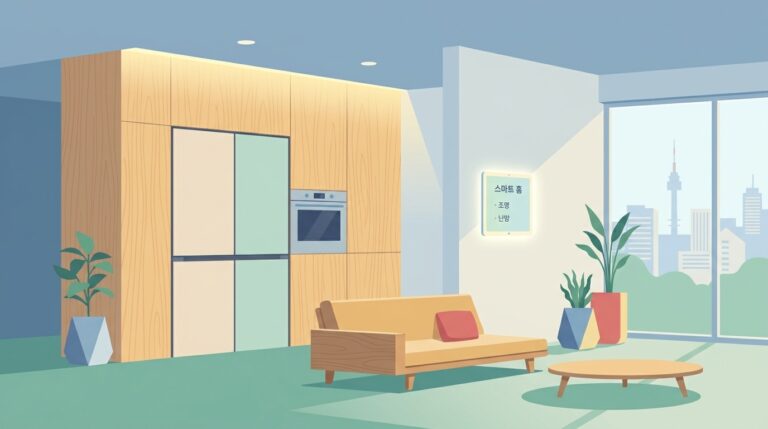
Imagine walking into a sleek, ultra-minimalist apartment in Hannam-dong. The walls are seamless, the fridge is completely hidden behind custom panels, and a single voice command dims the lights while brewing your espresso. This isn’t just a scene from your favorite K-Drama; it’s the reality of modern Korean living spaces. Korea has evolved from simple ‘built-in’ (빌트인) trends to a hyper-connected smart home ecosystem (스마트홈 생태계).
However, if you’ve ever tried discussing high-end interior design or smart home integration with a Korean contractor, designer, or even a tech-savvy friend, you know that standard textbook Korean simply doesn’t cut it. C2-level mastery requires navigating the highly nuanced, blended vocabulary of English loanwords, Sino-Korean technical terms, and the subtle, unspoken social cues of high-end urban living. Let’s master this sophisticated world together!
Phase 2: Core Expression Deep Dive (핵심 표현 3선 심층 분석)
1. 가전과 가구의 일체감 (Gajeon-gwa gagu-ui ilchegam)
- Pronunciation: Gah-jeon-gwah gah-goo-ee eel-cheh-gahm (Sounds like “all-chair-gahm” with a soft ‘g’)
- Meaning: The seamless unity of appliances and cabinetry (Literally: “One-body feeling between home appliances and furniture”).
- K-Culture Moment: Used constantly in high-end Korean interior design shows like Seoul Check-in or architecture vlogs on YouTube when praising built-in kitchens where the refrigerator doesn’t protrude at all.
- Editor’s Insight: 일체감 (unity/oneness) is the ultimate aesthetic goal in modern Korean interior design. If your appliances stick out even an inch, you’ve lost the 일체감.
- Situation Spectrum: Casual ⚠️ | Semi-formal ✅ | Formal ✅
- 🤔 Think About It: Why does Korean culture value such sleek, hidden lines in housing? It relates to the premium placed on spatial efficiency in densely populated cities like Seoul.
2. 공간을 깎아 먹다 (Gonggan-eul kkak-a meokda)
- Pronunciation: Gong-gahn-eul kkah-kah muk-dah (Rhymes with “sock-ah muck-dah” but with a tensed ‘kk’ sound)
- Meaning: To eat away at or clutter valuable living space.
- K-Culture Moment: When a designer looks at a bulky, free-standing washing machine and sighs because it ruins the flow of a small utility room.
- Editor’s Insight: 깎아 먹다 usually means “to erode or waste” (like wasting savings). Applying this to physical space shows a highly native, casual yet sophisticated command of spatial economics.
- Situation Spectrum: Casual ✅ | Semi-formal ✅ | Formal 🚫
- 🤔 Think About It: How does your native language describe an object that takes up too much physical space? Is the metaphor as active as “eating” the space?
3. 이질감이 전혀 없다 (Ijilgam-i jeonhyeo eopda)
- Pronunciation: Ee-jeel-gahm-ee jun-hyeo up-dah (Soft ‘j’, rhyming with “un-he-oh”)
- Meaning: Absolutely seamless; no sense of incompatibility or mismatch.
- K-Culture Moment: Discussing how a smart wall pad blends so perfectly into a marble wall that you barely notice it’s a digital screen.
- Editor’s Insight: 이질감 refers to a feeling of difference, alienation, or foreignness. Saying something has “no 이질감” is the highest compliment for IoT integration.
- Situation Spectrum: Casual ✅ | Semi-formal ✅ | Formal ✅
- 🤔 Think About It: How does the strive for “zero friction” in design reflect the broader Korean societal push for rapid, seamless technological adaptation?
Phase 3: Textbook Korean vs. Real Native Korean (교과서 한국어 vs 진짜 한국어)
Let’s look at how typical advanced textbooks teach these concepts versus how affluent, design-conscious Koreans actually speak.
Scenario 1: Discussing Built-in Kitchens
- 📖 Textbook: “가전제품을 벽 안에 넣어서 방을 넓게 만듭니다.” (I put home appliances inside the wall to make the room wide.)
- 🗣️ 진짜 한국어: “가전을 빌트인으로 매립해서 주방 라인을 완전하게 칼각으로 맞췄어요.”
- 💡 Why the difference? C2 speakers use technical terms like 매립하다 (to recess/embed) and trendy slang like 칼각 (razor-sharp alignment, mimicking military-style crisp lines) to describe high-end finishes.
Scenario 2: Smart Home/IoT Automations
- 📖 Textbook: “스마트폰으로 불을 켜고 끌 수 있는 기능이 있습니다.” (There is a function to turn the lights on and off with a smartphone.)
- 🗣️ 진짜 한국어: “조명이랑 가전들이 IoT로 연동돼서 터치 한 번으로 시나리오 제어가 가능해요.”
- 💡 Why the difference? Modern Koreans do not just talk about “turning lights on.” They discuss 연동 (interlinking/integration) and 시나리오 제어 (scene control/scenario automation).
Phase 4: K-Culture Deep Dive & Non-Verbal Nuance
4-1. The Art of the “Nunchi” Nod and the Hand Sweep
When discussing high-end interior finishes with Korean professionals:
1. The ‘Line’ Sweep: Use your flat hand to sweep horizontally along a counter or wall. This non-verbally emphasizes your obsession with 라인 (clean visual lines).
2. The Appreciative “Um-” Nod: When looking at hidden paneling, slowly nod while letting out a deep, low-pitched “음…” (Mmm). It conveys that you appreciate the quiet luxury of hidden technology.
4-2. The “Space Efficiency” Obsession in K-Dramas
In dramas like Penthouse or Crash Course in Romance, the homes of wealthy characters always feature invisible kitchens (hidden behind pocket doors) and voice-activated curtains. In Korea, true luxury isn’t about massive, bulky items; it is about invisible technology—devices that serve you flawlessly without claiming visual real estate.
Phase 5: Real-Life Roleplay Scenario (실전 롤플레이)
Character Setup
- 민우 (Min-woo): An elite interior designer in Seoul known for his minimalist, high-tech apartments.
- 유진 (Yujin): A discerning client (you) looking to remodel a newly purchased luxury apartment in Seongsu-dong.
Dialogue:
- 민우: “유진 씨, 이번 성수동 현장은 미니멀리즘의 끝판왕으로 가고 싶어요. 가전들이 겉으로 드러나면 지저분하거든요.”
(Yujin, I want to go for the ultimate peak of minimalism for this Seongsu project. It looks messy when appliances are exposed.) -
유진: “🎭 (적극적으로 동감하며) 맞아요, 민우 디자이너님. 저도 가전이랑 가구 사이에 이질감이 전혀 없는 디자인을 원해요.”
(Exactly, Designer Min-woo. I also want a design where there is absolutely no sense of mismatch between the appliances and the furniture.) -
민우: “그렇다면 냉장고와 식기세척기 모두 도어 패널형으로 가구에 매립해서 전체적인 일체감을 살리는 걸 추천합니다.”
(Then, I recommend recessing both the refrigerator and dishwasher into the cabinetry with custom door panels to bring out a sense of total unity.) -
유진: “🎭 (눈을 빛내며) 좋네요. 그런데 세탁기랑 건조기 타워는 다용도실 공간을 너무 깎아 먹지 않을까요?”
(Sounds great. But wouldn’t the washer and dryer tower eat away too much space in the utility room?) -
민우: “그 부분은 벽 안쪽으로 슬라이딩 도어를 달아서 평소에는 완전히 가릴 수 있게 설계할 겁니다.”
(For that part, we will install a sliding door inside the wall so it can be completely hidden when not in use.) -
유진: “🎭 (안도의 한숨을 쉬며) 다행이네요. 아, 그리고 거실 커튼이랑 조명도 스마트홈 IoT로 싹 다 연동할 수 있죠?”
(What a relief. Oh, and we can link all the living room curtains and lighting via smart home IoT, right?) -
민우: “당연하죠. 월패드나 스마트폰 앱 하나로 일괄 제어가 가능하게 세팅해 드릴게요.”
(Of course. I will set it up so you can control everything collectively via a wall pad or a smartphone app.) -
유진: “🎭 (만족스러운 미소를 지으며) 완벽해요! 역시 민우 님께 맡기길 잘했네요. 주방 라인은 꼭 칼각으로 잡아주세요!”
(Perfect! I’m so glad I trusted you, Min-woo. Please make sure the kitchen lines are razor-sharp!)
🔀 Interactive Choice Point
Now, how would you respond if Min-woo asks you:
“스마트 가전 브랜드는 국내 대기업 투톱(Samsung vs. LG) 중 어떤 생태계로 연동하고 싶으세요?”
(Which smart appliance ecosystem do you want to link: Samsung SmartThings or LG ThinQ?)
- Option A: “아무거나 상관없어요. 디자인 예쁜 걸로 골라주세요.” (Whatever is fine. Just pick the pretty one.)
- Option B: “저는 스마트싱스(SmartThings) 플랫폼으로 통일해서 제어하고 싶어요. 연동성이 더 편하더라고요.”
- Option C: “그냥 옛날식으로 리모컨 여러 개 쓸래요. 기계는 직접 눌러야 제맛이죠.”
🧐 Expert Feedback
- Option A (Risk): Too passive for a C2 speaker. While polite, you lose the chance to show your sophisticated understanding of IoT ecosystems.
- Option B (Best): Excellent! Specifying the platform (스마트싱스) and using words like 통일해서 제어하다 (control in a unified manner) and 연동성 (connectivity/compatibility) shows superb linguistic and cultural command.
- Option C (Bad): While valid as a personal preference, it completely contradicts the high-tech, minimalist design theme you just agreed to, creating a funny cultural mismatch!
Phase 6: 10-Second Emotion Shadowing Drill (10초 감정 섀도잉)
Practice saying these high-level sentences with the exact emotional cadence of a native Seoul speaker. The / indicates a micro-pause for rhythmic breathing.
- [😊 Expressing Satisfied Admiration]
“가구랑 / 가전이 / 이질감이 전혀 없이 / 딱 떨어지네요!”
(Gagu-rang / gajeon-i / ijilgam-i jeonhyeo eopsi / ttak tteoreojineyo!) -
[😒 Annoyed by Clunky Space-Wasting Design]
“프리스탠딩 가전은 / 은근히 / 공간을 많이 깎아 먹어서 / 싫더라고요.”
(Free-standing gajeon-eun / eungeonhi / gonggan-eul mani kkak-a meogaseo / silteoragoyo.)
Phase 7: K-Culture Mini-Dictionary (핵심 키워드 4선)
- 칼각 (Kal-gak): Razor-sharp, perfect alignment. Originally a military term for perfectly folded blankets, now used by interior designers to describe perfect cabinetry edges.
- 매립 (Maerip): Embedding or recessing. In interior design, this refers to installing lights, outlets, or appliances flush with the wall.
- 앱 연동 (Aep yeondong): App synchronization. Connecting appliances to a centralized smartphone app for smart home control.
- 일체감 (Ilchegam): A feeling of oneness. The ultimate goal of modern Korean interior design where nothing feels out of place.
Phase 8: The Smart Traveler’s Survival Kit
If you are renting a high-end Airbnb in Seoul or staying at an IoT-integrated residence, these phrases will save you:
- Expression 1: “이 조명, 스마트폰으로 어떻게 연동하나요?” (How do I link this light to my smartphone?)
- Expression 2: “보일러랑 에어컨 원격 제어 되나요?” (Can the boiler and A/C be controlled remotely?)
- Expression 3: “기가지니, 커튼 좀 닫아줘.” (Giga Genie, close the curtains – works for KT’s famous AI assistant in many apartments/hotels!)
🗺️ Editor’s Travel Note
When staying in Korea, download the Naver Map App to find trendy interior showrooms in Seongsu-dong or Nonhyeon-dong. Most high-end showrooms require a reservation via Naver Booking, so make sure your Korean mobile number or social login is ready!
Phase 9:
Frequently Asked Questions (FAQ)
Q: What does "가전과 가구의 일체감 (Gajeon-gwa gagu-ui ilchegam)" mean in Korean and how do you pronounce it?
A: In Korean, "가전과 가구의 일체감 (Gajeon-gwa gagu-ui ilchegam)" is pronounced [Gah-jeon-gwah gah-goo-ee eel-cheh-gahm (Sounds like "all-chair-gahm" with a soft 'g'] and means: The seamless unity of appliances and cabinetry (Literally: "One-body feeling between home appliances and furniture").
Q: What does "공간을 깎아 먹다 (Gonggan-eul kkak-a meokda)" mean in Korean and how do you pronounce it?
A: In Korean, "공간을 깎아 먹다 (Gonggan-eul kkak-a meokda)" is pronounced [Gong-gahn-eul kkah-kah muk-dah (Rhymes with "sock-ah muck-dah" but with a tensed 'kk' sound] and means: To eat away at or clutter valuable living space.
Q: What does "이질감이 전혀 없다 (Ijilgam-i jeonhyeo eopda)" mean in Korean and how do you pronounce it?
A: In Korean, "이질감이 전혀 없다 (Ijilgam-i jeonhyeo eopda)" is pronounced [Ee-jeel-gahm-ee jun-hyeo up-dah (Soft 'j', rhyming with "un-he-oh"] and means: Absolutely seamless; no sense of incompatibility or mismatch.







