

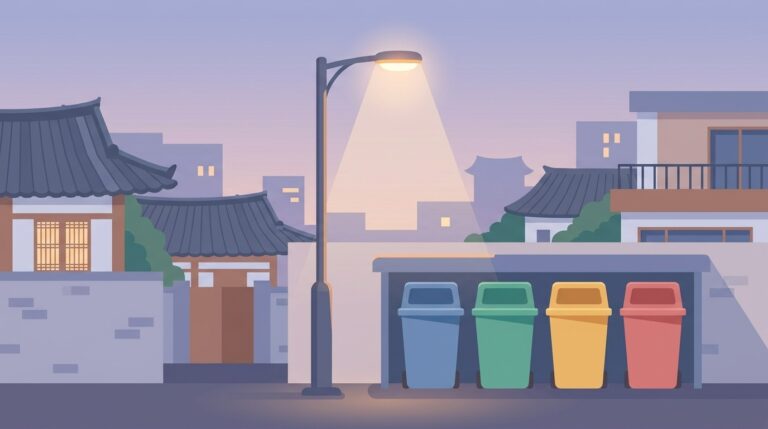
Master Seoul’s Trash Timing: Don’t Let ‘Sseuregi’ Ruin Your K-Stay!
Phase 1: Empathy (Welcome to the K-Life!)
안녕하세요! (An-nyeong-ha-se-yo!) I’m your Daily Hangul editor and your personal K-culture navigator!
Imagine this: You’ve just finished a late-night drama marathon in your cozy Seoul Airbnb. You’ve got empty ramen cups and chicken boxes piled up. You proudly bag them, walk outside to the collection spot, and BAM! A neighbor politely but firmly points to their watch, or you see a sign covered in red text. You realize… you missed the secret trash window! 😱
In Korea, disposing of trash (sseuregi) isn’t just about throwing things away; it’s a finely-tuned community ritual with strict time slots. Missing the window means your trash sits on the street all day, which is a major social no-no (and can lead to fines!). Don’t worry, your Korean bestie is here to help you decode the timing like a local!
Phase 2: Top 3 Essential Expressions for Trash Timing
Here are the three golden phrases you need to survive trash day. Let’s look at them step-by-step:
1. 언제 버려요? (Eon-je beoryeo-yo?)
- Pronunciation: Eon-je (sounds like “eon-je” as in “on-jay”) beo-ryeo-yo (sounds like “buh-ryuh-yo”).
- Meaning: “When do I throw it away?”
- K-Culture Moment: You will hear this in roommate sitcoms or reality shows like I Live Alone when a celebrity is trying to clean up their messy house.
- Editor’s Insight: This is the ultimate survival question. It’s simple, direct, and polite. You can point to a trash bag and ask your landlord or neighbor this exact phrase.
- Situation Spectrum: Casual (⚠️ 언제 버려? – Eon-je beoryeo?) | Semi-formal (✅ 언제 버려요? – Eon-je beoryeo-yo?) | Formal (🚫 언제 버립니까? – Eon-je beorim-nikka? – too robotic for daily life)
- 🤔 Think About It: In your home country, is trash collected at any time, or do you have strict neighborhood hours like Korea?
2. 저녁에 내놓으세요. (Jeo-nyeog-e nae-no-eu-se-yo.)
- Pronunciation: Jeo-nyeok-ey (sounds like “juh-nyuk-eh”) nae-noh-eu-seh-yo (sounds like “neh-noh-eu-say-yo”).
- Meaning: “Please put it out in the evening.”
- K-Culture Moment: This is what a friendly neighborhood grandmother (halmeoni) will tell you when she sees you carrying trash during the day.
- Editor’s Insight: In Korea, trash is usually collected late at night or early in the morning. Therefore, residents are asked to put their bags out “in the evening” (usually between 6 PM and 11 PM) so the streets stay clean during the day.
- Situation Spectrum: Casual (⚠️ 저녁에 내놔 – Jeo-nyeok-e nae-nwa) | Semi-formal (✅ 저녁에 내놓으세요 – Jeo-nyeog-e nae-no-eu-se-yo) | Formal (🚫 저녁에 배출하십시오 – Jeo-nyeog-e bae-chul-ha-sip-si-o – written on signs)
- 🤔 Think About It: Why do you think Korean cities prefer nighttime trash disposal over daytime collection?
3. 몇 시에 나가요? (Myeot si-e na-ga-yo?)
- Pronunciation: Myeot shi-ey (sounds like “myut shee-eh”) na-ga-yo (sounds like “nah-gah-yo”).
- Meaning: “What time does it go out?” (Literally: “What time does it go out?”)
- K-Culture Moment: Common in family K-Dramas where a parent yells at their kids to take the trash out before the collection truck arrives.
- Editor’s Insight: Use this when you want to know the exact hourly window for your specific building or street.
- Situation Spectrum: Casual (⚠️ 몇 시에 나가? – Myeot si-e na-ga?) | Semi-formal (✅ 몇 시에 나가요? – Myeot si-e na-ga-yo?) | Formal (🚫 배출 시간은 언제입니까? – Bae-chul si-gan-eun eon-je-im-nikka? – very formal)
- 🤔 Think About It: How does asking “What time does it go out?” show a sense of community responsibility?
Phase 3: Textbook Korean vs. Real-Life Korean
Let’s compare textbook phrases with how real Koreans talk about trash timing!
Scenario 1: Asking about the trash day
- 📖 Textbook Korean: 쓰레기 배출 요일이 언제입니까? (Sseuregi baechul yoiri eonjeimnikka? – “When is the waste discharge day?”)
- 🗣️ Real-Life Korean: 쓰레기 언제 버려요? (Sseuregi eonje beoryeoyo? – “When do we throw away trash?”)
- 💡 Why the difference? No one says “waste discharge day” (baechul yoil) in daily conversation unless they are reading a formal city government manual! Just use “언제 버려요?” (When do I throw it away?).
Scenario 2: Saying “Put it out at night”
- 📖 Textbook Korean: 야간에 쓰레기를 배출하십시오. (Yagane sseuregireul baechulhasipsio. – “Please discharge trash during the night.”)
- 🗣️ Real-Life Korean: 밤에 밖에 두세요. (Bame bakke duseyo. – “Just leave it outside at night.”)
- 💡 Why the difference? Yagan (nighttime) and baechul (discharge) are Sino-Korean vocabulary used on official warning signs. Real people use bam (night) and bakke duseyo (leave outside).
Phase 4: K-Culture Deep Dive & Non-Verbal Manners
4-1. The “Nunchi” of Trash Disposal
In Korea, Nunchi (눈치)—the art of sensing other people’s feelings and thoughts—is key.
* The Gentle Bow: If a neighbor corrects your trash timing, don’t panic! Smile, bow your head slightly, and say: “아, 몰랐어요. 죄송합니다!” (Ah, mol-las-seo-yo. Joe-song-ham-ni-da! – “Oh, I didn’t know. I’m sorry!”).
* Don’t leave it in daylight: Leaving a bright yellow food-trash bag on the street at 2 PM is considered bad manners because of the smell and visual clutter. Always wait for sunset!
4-2. The K-Drama Reality
If you watch slice-of-life K-Dramas, you’ll often see characters gathering at the neighborhood trash disposal spot. It’s actually a local social hub where neighbors exchange gossip or where romantic leads have cute “accidental” meetings while holding smelly bags!
Phase 5: Real-Life Roleplay Scenario
Meet Min-su (민수), your friendly resident building manager (officetel owner). He is very clean and loves his building!
Scenario: Asking Min-su about when to take out the trash.
- Min-su: 안녕하세요! 혹시 쓰레기 버리려고요?
(An-nyeong-ha-se-yo! Hok-si sseuregi beori-ryeo-go-yo?)
🎭 Friendly, pointing at the bag in your hand
“Hello! By any chance, are you trying to throw away trash?” -
You: 네, 맞아요. 언제 버려요?
(Ne, ma-ja-yo. Eon-je beoryeo-yo?)
🎭 Smiling politely, holding the bag
“Yes, that’s right. When do I throw it away?” -
Min-su: 아, 우리 건물은 저녁에 내놓으세요.
(Ah, uri geon-mul-eun jeo-nyeog-e nae-no-eu-se-yo.)
🎭 Pointing to the street outside after sunset
“Ah, for our building, please put it out in the evening.” -
You: 아하! 몇 시에 나가요?
(A-ha! Myeot si-e na-ga-yo?)
🎭 Nodding, looking curious
“Ah! What time does it go out?” -
Min-su: 저녁 7시부터 밤 11시 사이에 두시면 돼요.
(Jeo-nyeok ilgop-si-bu-teo bam yeol-han-si sa-i-e du-si-myeon dwae-yo.)
🎭 Showing the numbers with his fingers
“You can just leave it out between 7 PM and 11 PM.” -
You: 아, 알겠습니다! 낮에는 안 돼요?
(Ah, al-get-sum-ni-da! Na-je-neun an dwae-yo?)
🎭 Tilted head, seeking clarification
“Ah, I see! Is daytime not allowed?” -
Min-su: 네, 낮에는 단속을 해요. 밤에만요!
(Ne, na-je-neun dan-sog-eul hae-yo. Ba-me-man-yo!)
🎭 Shaking his index finger gently
“Yes, they patrol/inspect during the day. Only at night!” -
You: 알려주셔서 감사합니다!
(Al-ryeo-ju-syeo-seo gam-sa-ham-ni-da!)
🎭 Giving a polite 30-degree bow
“Thank you for letting me know!”
🔀 Interactive Choice Point
Min-su tells you daytime dumping is fined. What do you do?
* A. “지금 바로 나갈게요!” (I’ll go out right now! and run outside at 1 PM)
* B. “네, 저녁에 버릴게요!” (Yes, I will throw it away in the evening!)
* C. “괜찮아요, 몰래 버려요.” (It’s okay, I’ll discard it secretly.)
Feedback:
- Best Choice: B! Perfect! You respected the neighborhood rules and saved yourself a fine.
- Bad Choice: A! Oh no! Min-su just told you daytime dumping is inspected. You might get caught and fined!
- Risk Choice: C! Extreme Danger! Korean neighborhoods are full of CCTV cameras (CCTV) specifically watching trash spots. Don’t risk it!
Phase 6: 10-Second Emotion Shadowing Drill
Let’s practice speaking with real Korean feelings! Pay attention to the pauses (/) and emotional cues:
[😊 Politely asking]
“저기요… / 언제 버려요?”
(Jeo-gi-yo… / Eon-je beoryeo-yo?)
“Excuse me… / When do I throw it away?”-
[😲 Realizing the rule]
“아! / 저녁에 내놓으세요? / 알겠습니다!”
(Ah! / Jeo-nyeog-e nae-no-eu-se-yo? / Al-get-sum-ni-da!)
“Ah! / Put it out in the evening? / Got it!” -
[⏰ Checking the clock]
“몇 시에 / 나가요?”
(Myeot si-e / na-ga-yo?)
“At what time / does it go out?”
Phase 7: K-Culture Mini Dictionary
- 일반 쓰레기 (Il-ban Sseuregi) | General Trash | Non-recyclable daily waste that goes into official local plastic bags.
- 음식물 쓰레기 (Eum-sik-mul Sseuregi) | Food Waste | Leftover food that must be separated and disposed of in special yellow bags or bins.
- 재활용 (Jae-hwal-yong) | Recycling | Plastics, paper, cans, and glass. Usually collected on specific days of the week!
- 종량제 봉투 (Jong-ryang-je Bong-tu) | Pay-As-You-Throw Bag | The official government-mandated trash bags you must buy at local convenience stores.
Phase 8: Traveler’s Survival Kit
Survival Phrases TOP 3
- 이거 어디에 버려요? (I-geo eo-di-e beoryeo-yo?) – “Where do I throw this away?” (Great for public spaces or cafes!)
- 오늘 쓰레기 버리는 날이에요? (O-neul sseuregi beori-neun nal-i-e-yo?) – “Is today trash day?”
- 봉투 어디서 사요? (Bong-tu eo-di-seo sa-yo?) – “Where can I buy the bags?”
📌 Editor’s Travel Note:
To buy trash bags, head to any local convenience store (GS25, CU, 7-Eleven) and ask for “일반 쓰레기 봉투 주세요” (Il-ban sseuregi bong-tu ju-se-yo). Keep in mind that trash bags from Mapo-gu cannot be used in Gangnam-gu! Always use the bag matching your current district. Check your location using the Naver Map App to confirm your district’s name!
Phase 9: “Going Deeper” (Cultural Reflection)
Korea’s strict trash system reflects the high value placed on joint responsibility and community harmony. In a crowded city like Seoul, keeping public spaces clean requires everyone’s active participation. This is why neighbors monitor the trash spots together. It is not just about waste; it is a way of showing respect to those who share your living space.
💬 Your Turn: Does your country have a similar community-based cleaning culture? Tell us in the comments below!
Phase 10: FAQ & Common Mistakes
Q: Can I put my trash out in normal plastic shopping bags?
A: No! You must use the official 종량제 봉투 (district-specific bags). If you use normal grocery bags, the collection truck will leave them behind, and you could face a fine up to 300,000 KRW!
Q: Is trash collected on weekends?
A: In most Seoul districts, trash is not collected on Friday nights or Saturday nights. Always double-check with your host, as weekend dumping is often strictly forbidden!
Q: What should I do with recyclables?
A: Recyclables must be washed clean, sorted by material (plastic, paper, glass), and put out in clear plastic bags during the same evening hours!
🚨 Common Mistakes Alert!
- Mistake 1: Putting trash out at 10 AM. (Correct Action: Keep it inside until after 6 PM!)
- Mistake 2: Using a bag purchased in a different city district. (Correct Action: Buy bags from your local neighborhood convenience store!)
- Mistake 3: Mixing food scraps into general trash. (Correct Action: Separate food completely into designated food waste bags!)
Phase 11: Action Mission!
- 🥉 Bronze Mission: Say “언제 버려요?” out loud 3 times in front of your mirror.
- 🥈 Silver Mission: Go to a convenience store in Korea and successfully ask for “쓰레기 봉투 주세요” (Please give me trash bags).
- 🥇 Gold Mission: Take a photo of your local neighborhood trash guide board and try to spot the words 배출 시간 (Disposal Time)!
Phase 12: Interactive Quiz Challenge!
1. What does “언제 버려요?” mean?
- A) Where do I buy this?
- B) When do I throw it away?
- C) How much is this?
Reveal Answer & Explanation
Answer: B! “언제” (Eon-je) means “When”, and “버려요” (beoryeo-yo) means “throw away”.
2. True or False: You can throw away trash at 12 PM (noon) in Seoul streets if it is in the correct bag.
- A) True
- B) False
Reveal Answer & Explanation
Answer: B (False)! Even with the right bag, you must respect the evening hours (저녁에 내놓으세요) to keep streets clean during the daytime!






