

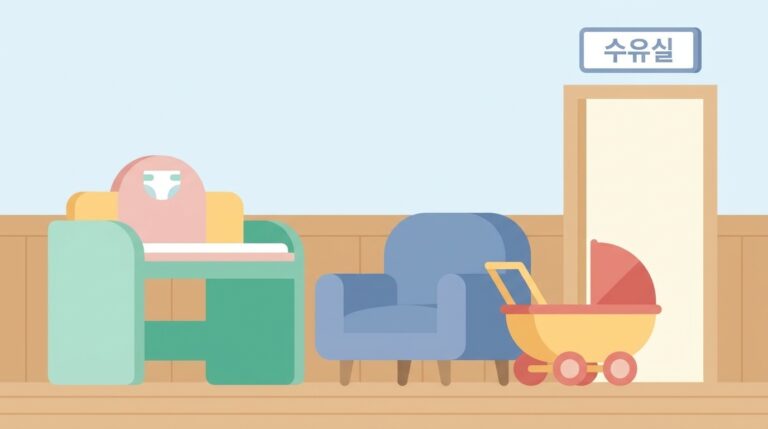
How to Find a Nursing Room in Korea: Your Ultimate ‘Suyu-sil’ Guide
Phase 1: Empathy (Welcome to Daily Hangul!)
안녕하세요! (Annyeonghaseyo!) Welcome back to your favorite Korean-learning corner. I’m your Daily Hangul editor and local culture navigator!
Imagine this: You’re exploring a beautiful, bustling shopping mall in Starfield COEX or stepping off the KTX at Seoul Station. Your baby is crying, hungry, and needs a diaper change right away. You look around, but everything is in Korean. You feel a sudden wave of panic. Where do I go? What do I ask?
If you’ve ever felt overwhelmed trying to find family facilities in Korea, you are not alone! Many of our international learners have shared how stressful it can be to navigate parenting needs in a foreign country. Today, we’re going to unlock the exact phrases and cultural hacks you need to find a 수유실 (suyu-sil – nursing/baby care room) smoothly and stress-free. Let’s dive in!
Phase 2: Deep Dive into 3 Essential Phrases
1. 수유실이 어디에 있어요? (Suyu-sil-i eo-di-e isseo-yo?)
- Pronunciation: soo-yoo-sheel-ee eo-dee-eh ees-suh-yo? (Sounds like “soo-yoo” + “sheel” with a soft ‘sh’ sound, followed by “where is it?”)
- Meaning: Where is the nursing room / baby care room?
- K-Culture Moment: You’ll hear this in large department stores (백화점) or subway stations when parents approach information desks.
- Editor’s Insight: 수유실 (Suyu-sil) literally translates to “lactation/nursing room,” but in Korea, it refers to the entire baby care suite, which usually includes diaper changing stations, nursing pods, hot water dispensers, and bottle sterilizers.
- Situation Spectrum:
- Casual: 수유실 어디 있어? (⚠️ Only with close friends)
- Semi-formal: 수유실이 어디에 있어요? (✅ Best for general staff)
- Formal: 수유실이 어디에 있습니까? (🚫 Too stiff for daily use)
- 🤔 Think About It: In your home country, is there a specific word for baby care rooms, or are they just called “family restrooms”?
2. 기저귀 갈 곳이 있나요? (Gijeogwi gal got-i innayo?)
- Pronunciation: ghee-juh-gwee gal got-ee een-nah-yo?
- Meaning: Is there a place to change diapers?
- K-Culture Moment: Often used in smaller cafes or restaurants where a dedicated “nuyu-sil” might not exist, but they might have a fold-down table in the restroom.
- Editor’s Insight: 기저귀 (gijeogwi) means diaper, and 갈 곳 (gal got) means a place to change. This is a very soft, polite way of asking without sounding too demanding.
- Situation Spectrum:
- Casual: 기저귀 갈 데 있어? (⚠️)
- Semi-formal: 기저귀 갈 곳이 있나요? (✅ Highly recommended)
- Formal: 기저귀 교환대가 설치되어 있습니까? (🚫 Sounds like a building inspector!)
- 🤔 Think About It: Korean restrooms in subway stations are increasingly equipped with diaper boards. Why do you think public infrastructure prioritizes this?
3. 유모차 대여소는 어디인가요? (Yumocha daeyeoso-neun eodi-ingayo?)
- Pronunciation: yoo-mo-cha dae-yuh-so-noon eo-dee-een-gah-yo?
- Meaning: Where is the stroller rental service?
- K-Culture Moment: Seen at theme parks like Everland or large premium outlets where parents rent high-quality strollers for the day.
- Editor’s Insight: Large Korean malls offer stroller rentals, often for free or a tiny deposit, if you show your ID or hotel key!
- Situation Spectrum:
- Casual: 유모차 빌리는 데 어디야? (⚠️)
- Semi-formal: 유모차 대여소는 어디인가요? (✅ Perfect)
- Formal: 유모차 대여 장소를 안내해 주시겠습니까? (🚫 Too formal)
- 🤔 Think About It: Renting strollers easily reflects Korea’s service-oriented shopping culture. How does this compare to your country?
Phase 3: Textbook Korean vs. Real-Life Korean
Situation 1: Asking a mall employee
- 📖 Textbook: 수유실 위치를 알려주십시오. (Suyu-sil wichi-reul allyeo-jusipsio. – Please inform me of the nursing room location.)
- 🗣️ Real-Life: 혹시 수유실이 몇 층에 있어요? (Hoksi suyu-sil-i myeot cheung-e isseo-yo? – By any chance, which floor is the nursing room on?)
- 💡 Why the difference? Real Koreans love using 혹시 (hoksi – by any chance) to soften their questions. It sounds much friendlier and less demanding!
Situation 2: Checking if there is a diaper changing table inside a restroom
- 📖 Textbook: 화장실 안에 기저귀 교환대가 존재합니까? (Hwajangsil ane gijeogwi gyohwandae-ga jonjaehamnika? – Does a diaper changing table exist inside the restroom?)
- 🗣️ Real-Life: 여자 화장실에 기저귀 교환대 있어요? (Yeoja hwajangsil-e gijeogwi gyohwandae isseo-yo? – Is there a diaper changing table in the women’s restroom?)
- 💡 Why the difference? Nobody uses “존재합니까 (exist)” in casual conversation. Just use “있어요? (is there?)” to sound natural.
Phase 4: K-Culture Deep Dive & Non-Verbal Etiquette
4-1. Nunchi & Gestures
When approaching an information desk, it’s polite to slightly bow your head and say “저기요…” (Jeogiyo… / Excuse me…) while slightly raising your hand. If you have a crying baby, don’t panic! Koreans are generally very understanding of parents. Pointing to your baby or making a “patting the diaper” motion can instantly communicate your need if your Korean temporarily slips your mind.
4-2. Korean Baby Care Culture (K-Travel)
In Korea, luxury department stores (like Shinsegae or Hyundai) have premium 유아휴게실 (Yua-hyuge-sil – Infant Lounge). They are not just rooms; they are beautifully decorated oases with dim lighting, sleeping rooms, high chairs, bottle warmers, and sometimes even nursing room concierges who offer free wet wipes!
Phase 5: Real-Life Roleplay Scenario
Setting: You are on the 3rd floor of a giant shopping mall in Seoul. Your baby starts crying. You see a friendly mall guide (NPC) wearing a uniform.
Dialogue (8 Turns)
- You: 저기요, 혹시 이 건물에 수유실이 있나요?
(Jeogiyo, hoksi i geonmul-e suyu-sil-i innayo?)
“Excuse me, by any chance, is there a nursing room in this building?” -
Guide (NPC):
🎭 Smiles warmly네, 고객님! 5층에 유아휴게실이 있습니다.
(Ne, gogaeknim! O-cheung-e yua-hyuge-sil-i isseumnida.)
“Yes, customer! There is an infant lounge on the 5th floor.” -
You: 아, 5층이요? 어떻게 가야 해요?
(Ah, o-cheung-i-yo? Eotteoke gaya haeyo?)
“Ah, the 5th floor? How do I get there?” -
Guide (NPC):
🎭 Points to the left저쪽 엘리베이터를 타시고 5층에서 내리시면 바로 보입니다.
(Jeocciok ellibeiteo-reul tasigo o-cheung-eseo naerisimyeon baro boimnida.)
“Take that elevator over there, get off on the 5th floor, and you will see it right away.” -
You: 유모차를 가지고 갈 수 있죠?
(Yumocha-reul gajigo gal su itjyo?)
“I can take my stroller there, right?” -
Guide (NPC):
🎭 Nods reassuringly네, 유모차 진입이 가능하고 내부도 아주 넓습니다.
(Ne, yumocha jinip-i ganeunghago naebudo aju neolpseumnida.)
“Yes, stroller entry is possible, and the inside is very spacious.” -
You: 정말 다행이네요. 감사합니다!
(Jeongmal dahaeng-ineyo. Gamsahamnida!)
“What a relief. Thank you!” -
Guide (NPC):
🎭 Bows politely아닙니다. 좋은 시간 보내세요!
(Animnida. Joeun sigan bonaeseyo!)
“Not at all. Have a wonderful time!”
🔀 Interactive Choice Point
What will you say to the guide to find out if you need a coin or key to enter?
- A. “비밀번호가 필요해요?” (Do I need a password?)
- 💡 Feedback (Risk): Some private nursing rooms have digital locks, but public ones in malls are usually open. Asking this is okay, but they might find it unnecessary.
- B. “그냥 들어가면 되나요?” (Can I just walk in?)
- 💡 Feedback (Best): Very natural! The guide will let you know if you need to register at the desk first.
- C. “열쇠 주세요.” (Give me the key.)
- 💡 Feedback (Bad): Too direct and polite-less! It sounds like a demand.
Phase 6: 10-Second Emotion Shadowing Drill
Practice saying these out loud with emotional cues! The / represents a natural pause.
[🥺 Desperate & Worried]
저기요… / 혹시 기저귀 갈 곳이 / 있을까요?
(Jeo-gi-yo… / hok-si gi-jeo-gwi gal got-i / is-seul-kka-yo?)-
[😊 Relieved & Happy]
아! / 5층에 / 수유실이 있군요! / 감사합니다!
(Ah! / o-cheung-e / su-yu-sil-i it-gun-yo! / gam-sa-hap-ni-da!)
Phase 7: K-Culture Mini Dictionary
- 유아휴게실 (Yua-hyuge-sil) | Infant Lounge | The premium term used in department stores instead of just ‘suyu-sil’.
- 기저귀 교환대 (Gijeogwi gyohwandae) | Diaper Changing Table | The fold-down plastic beds found in restrooms.
- 유모차 (Yumocha) | Stroller / Pram | Literally “infant mother car.”
- 가족화장실 (Gajok-hwajangsil) | Family Restroom | A larger, gender-neutral restroom equipped with child toilets and diaper stations.
Phase 8: Travel Survival Kit
Survival Phrases TOP 3
- 수유실 어디예요? (Suyu-sil eodi-yeyo? – Where is the nursing room?)
- 여기에 유모차 둘 수 있어요? (Yeogi-e yumocha dul su isseo-yo? – Can I leave my stroller here?)
- 전자레인지 사용할 수 있나요? (Jeonjareinji sayong-hal su innayo? – Can I use the microwave? To warm baby food)
Editor’s Travel Note
Before heading out, download Naver Map (네이버 지도). Instead of searching “nursing room” in English, type “수유실” in the search bar to find the nearest locations in subway stations, parks, and malls instantly! Note: Facility availability may change without notice, especially in older subway lines.
Phase 9:
Frequently Asked Questions (FAQ)
Q: What does "수유실이 어디에 있어요? (Suyu-sil-i eo-di-e isseo-yo?)" mean in Korean and how do you pronounce it?
A: In Korean, "수유실이 어디에 있어요? (Suyu-sil-i eo-di-e isseo-yo?)" is pronounced [soo-yoo-sheel-ee eo-dee-eh ees-suh-yo? (Sounds like "soo-yoo" + "sheel" with a soft 'sh' sound, followed by "where is it?"] and means: Where is the nursing room / baby care room?
Q: What does "기저귀 갈 곳이 있나요? (Gijeogwi gal got-i innayo?)" mean in Korean and how do you pronounce it?
A: In Korean, "기저귀 갈 곳이 있나요? (Gijeogwi gal got-i innayo?)" is pronounced [ghee-juh-gwee gal got-ee een-nah-yo?] and means: Is there a place to change diapers?
Q: What does "유모차 대여소는 어디인가요? (Yumocha daeyeoso-neun eodi-ingayo?)" mean in Korean and how do you pronounce it?
A: In Korean, "유모차 대여소는 어디인가요? (Yumocha daeyeoso-neun eodi-ingayo?)" is pronounced [yoo-mo-cha dae-yuh-so-noon eo-dee-een-gah-yo?] and means: Where is the stroller rental service?







