

When Your Tech Needs a Wait: Navigating Long Repairs in Korea (B1 Level)
Phase 1: Empathy (The “Oh No, My Screen!” Moment)
안녕하세요! It’s your Korean bestie and Daily Hangul editor. 🙋♀️
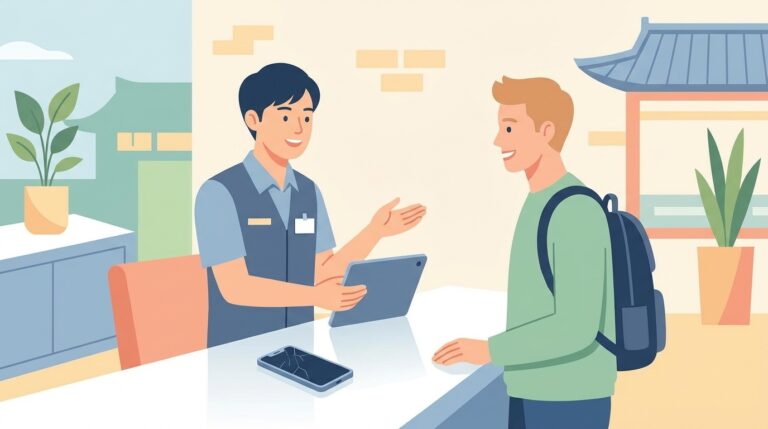
Imagine this: You are in Seoul, sipping a beautiful dalgona latte, and you’re about to post a gorgeous picture on Instagram. Suddenly, your phone slips. CRACK. The screen goes black. You rush to a sleek, high-tech Korean Service Center (서비스 센터 – seobiseu senteo), expecting that famous Korean fast-paced “Ppalli-Ppalli” (빨리빨리) magic.
But then, the technician looks at your phone, sighs gently, and says: “부품이 없어서 수리가 좀 오래 걸려요.” (We don’t have the part, so the repair will take a while.)
Your heart sinks. How long is “a while”? What do you say next? Don’t worry! Today, we are going to master the exact Korean expressions you need when your electronics are on life support and the parts are backordered. Let’s dive in!
Phase 2: Top 3 Key Expressions Deep Dive
1. 부품이 없어서 수리가 오래 걸려요 (bupumi eopseoseo suriga orae geollyeoyo)
- Pronunciation: Boo-pum-ee up-suh-suh soo-ree-gah oh-rae gul-lyuh-yo (Think of “boo” like a ghost, and “pum” like a plum without the ‘l’).
- Meaning: Since there are no parts, the repair will take a long time.
- K-Culture Moment: You will hear this often in Korean dramas when a character’s beloved vintage camera or imported laptop breaks down. The technician behind the counter will scratch their head and deliver this line with a sympathetic smile.
- Editor’s Insight: 부품 (bupum) means “spare parts” or “components.” 오래 걸리다 (orae geollyeoyo) is the go-to phrase for anything that takes time (from a commute to a pizza delivery).
- Situation Spectrum: Casual: ⚠️ | Semi-formal: ✅ | Formal: ✅
- 🤔 Think About It: In your home country, do repair centers usually have all the parts in stock, or is waiting 1-2 weeks the norm?
2. 얼마나 기다려야 돼요? (eolmana gidaryeoya dwaeyo?)
- Pronunciation: Uhl-mah-nah gee-dah-ryuh-yah dwae-yo? (Rhymes with “play-yo”).
- Meaning: How long do I have to wait?
- K-Culture Moment: This is the universal phrase of impatience in Korea! Whether you are waiting for a table at a famous K-BBQ restaurant in Hongdae or waiting for your phone repair, this is your golden ticket phrase.
- Editor’s Insight: This combines 얼마나 (how much/long) and 기다려야 되다 (must wait). It’s polite but gets straight to the point.
- Situation Spectrum: Casual: ⚠️ | Semi-formal: ✅ | Formal: ✅
- 🤔 Think About It: Koreans love efficiency. Asking this question politely shows you respect their schedule but also need to plan your day!
3. 임대폰 받을 수 있을까요? (imdaepon badeul su isseulkkayo?)
- Pronunciation: Eem-dae-pon bah-deul soo ee-seul-kah-yo?
- Meaning: Could I get a rental/loaner phone?
- K-Culture Moment: Korea is highly connected. Being without a phone for 3 days feels like 3 years! Most major service centers (especially Samsung or LG) offer a “rental phone” service for a small fee or even for free.
- Editor’s Insight: 임대 (imdae) means rental/lease, and 폰 (pon) is phone. You can use 임대 for other items too, but 임대폰 is a lifesaver phrase for tourists and expats.
- Situation Spectrum: Casual: 🚫 | Semi-formal: ✅ | Formal: ✅
- 🤔 Think About It: How would you survive a day in Seoul without a smartphone? No maps, no mobile pay! That’s why this phrase is pure gold.
Phase 3: Textbook Korean vs. Real-Life Korean
Situation 1: Asking how long the repair will take
- 📖 Textbook Korean: 수리 기간이 어떻게 됩니까? (Suri gigani eotteoke doemnikka? – What is the repair period? – Very stiff and robotic)
- 🗣️ Real-Life Korean: 얼마나 걸릴까요? (Eolmana geollilkkayo? – Around how long will it take?)
- 💡 Why the difference? The textbook version is too formal and sounds like a written contract. Real Koreans prefer the softer, softer “~을까요?” ending which sounds friendly and conversational.
Situation 2: Expressing that you are busy and need it fast
- 📖 Textbook Korean: 저는 바쁩니다. 빨리 해주십시오. (Jeoneun bappeumnida. Ppalli haejusipsio. – I am busy. Do it quickly. – Sounds rude and demanding)
- 🗣️ Real-Life Korean: 제가 곧 출국해야 해서 그런데, 조금만 서둘러 주실 수 있나요? (Jega got chulgukhaeya haeseo georeonde, jogeumman seodulleo jusil su innayo? – I am leaving the country soon, so could you please hurry a little bit if possible?)
- 💡 Why the difference? Giving a polite reason (even if you aren’t leaving the country, you can say “I need it for work/school”) softeners the request. The phrase ~해서 그런데 (It’s because… so…) is the ultimate polite Korean way to set up a request.
Phase 4: K-Culture Deep Dive & Non-Verbal Manners
4-1. The “Anxious but Polite” Body Language
When a Korean technician tells you the repair will take long, do not raise your voice or sigh loudly. Instead, try the “Korean Polite Nod & Head Tilt.”
* The Gesture: Slightly tilt your head to one side, press your lips together slightly, and nod slowly. This shows: “I understand your situation, but I am in a bit of a pickle.”
* The Hands: When handing over your broken device or receiving it back, always use two hands. It shows immense respect to the worker.
4-2. The “Ppalli-Ppalli” Culture and AS (After-Sales Service)
In Korea, “AS” (pronounced Ah-Esu) is a huge deal. Korea has some of the best customer service in the world. Tech companies take pride in fixing things within hours. So, if they tell you “it will take long,” it usually means the part really is out of stock in the entire region!
Phase 5: Real-Life Roleplay Scenario
Setting: A bustling Samsung/Apple Service Center in Gangnam. You are talking to Min-su, a kind but busy technician.
- Min-su (Technician): 🎭 Checking your laptop screen 고객님, 액정이 깨졌는데… 지금 부품이 없어서 수리가 좀 오래 걸려요.
(Gogengnim, aekjeongi kkaejeonneunde… jigeum bupumi eopseoseo suriga jom orae geollyeoyo.)
(Customer, the screen is broken… but we don’t have the part right now, so the repair will take a while.) - You: 🎭 Worried face 아, 정말요? 얼마나 기다려야 돼요?
(A, jeongmalyo? Eolmana gidaryeoya dwaeyo?)
(Oh, really? How long do I have to wait?) - Min-su (Technician): 🎭 Typing on his computer 본사에서 부품을 받아야 해서 일주일 정도 걸릴 것 같습니다.
(Bonsaeseo bupumeul badaya haeseo iljuil jeongdo geollil geot gatseumnida.)
(We have to get the part from headquarters, so it looks like it will take about a week.) - You: 🎭 Gasping slightly 일주일요? 제가 노트북으로 매일 일을 해야 해서 그런데요…
(Iljuilyo? Jega noteubugeuro maeil ireul haeya haeseo georeondeyo…)
(A week? It’s just that I have to work on my laptop every day…) - Min-su (Technician): 🎭 Sympathetic look 아, 그러시군요. 힘드시겠네요…
(A, geureosigunyo. Himdeusigenneyo…)
(Oh, I see. That must be difficult for you…) - You: 혹시 임대 노트북이나 다른 방법이 있을까요?
(Hoksi imdae noteubugina dareun bangbobi isseulkkayo?)
(By any chance, is there a rental laptop or another way?) - Min-su (Technician): 🎭 Smiling 아! 다행히 오늘 반납된 임대 기기가 하나 있네요. 대여해 드릴까요?
(A! Dahaenghi oneul bannapdoen imdae gigiga hana inneyo. Daeyeohae deurilkkayo?)
(Ah! Fortunately, there is one rental device returned today. Shall I rent it to you?) - You: 🎭 Relieved smile 네, 감사합니다! 정말 다행이네요.
(Ne, gamsahamnida! Jeongmal dahaengineyo.)
(Yes, thank you! What a relief.)
🔀 Interactive Choice Point
What if there is no rental device? How do you respond?
* A) “그럼 그냥 수리하지 마세요.” (Then just don’t repair it. – Takes laptop back angrily)
* B) “혹시 다른 지점에는 부품이 있을까요?” (By any chance, would other branches have the part?)
* C) “빨리 해주세요! 제발요!” (Please do it fast! Please! – Whining)
💡 Feedback:
- Choice A (Bad): Too aggressive. The technician might feel uncomfortable, and your laptop remains broken!
- Choice B (Best!): Very smart. Service centers in Seoul are closely connected. If Gangnam doesn’t have it, Hongdae or Myeongdong branch might!
- Choice C (Risk): While cute in K-dramas, in real life, it puts unnecessary pressure on the staff when they physically don’t have the part.
Phase 6: 10-Second Emotion Shadowing Drill
Let’s practice speaking with real Korean emotion! Notice where to pause (/).
- [🥺 Saddened & Desperate]
- 부품이 없어서… / 오래 걸린다고요? ㅠㅠ
- Bupumi eopseoseo… / orae geollindagoyo?
- (There are no parts… / and it takes a long time? ㅠㅠ)
- [🙏 Polite Asking]
- 제가 노트북이 / 꼭 필요해서 그런데, / 조금만 서둘러 주실 수 있나요?
- Jega noteubugi / kkok piryohaeseo georeonde, / jogeumman seodulleo jusil su innayo?
- (I absolutely need my laptop… / so, could you please hurry just a little bit?)
Phase 7: K-Culture Mini Dictionary
- 액정 (Aek-jeong) | Screen / LCD
- The most common thing that breaks. If you crack your phone screen, say: “액정이 깨졌어요” (aek-jeongi kkae-jeot-suh-yo).
- 대여/임대 (Daeyeo/Imdae) | Rental / Loaner
- 대여 is more common for books/bikes, while 임대 is used for official tech/property rentals.
- 기사님 (Gisanim) | Technician / Driver
- The respectful title you call the repair person. Do not call them “저기요” (excuse me). Call them 기사님 (Gi-sah-neem) to get instant friendly service!
- 수리비 (Suri-bi) | Repair Cost
- Before agreeing to a long repair, ask: “수리비가 얼마나 나올까요?” (How much will the repair cost run?)
Phase 8: Travel Survival Kit
Survival Expressions TOP 3
- 혹시 오늘 수리 완료되나요? (Hoksi oneul suri wanryodoenayo?)
- Pro Tip: “Is there any chance the repair can be finished today?” Use this if you are in a rush.
- 임대폰 신청하고 싶어요. (Imdaepon sincheonghago sipeoyo.)
- Pro Tip: “I want to apply for a rental phone.”
- 연락처 남겨 드릴게요. (Yeollakcheo namgyeo deurilgeyo.)
- Pro Tip: “I will leave my contact number (so you can call when it’s done).”
Editor’s Travel Note:
To find the nearest service center in Korea, do not use Google Maps (it is not updated well in Korea due to security laws). Download Naver Map (네이버 지도) or KakaoMap (카카오맵) and search for “서비스센터” plus your brand name (e.g., “삼성전자 서비스센터” or “애플 공인서비스센터”). Note: App store links and interfaces may change over time.
Phase 9: “Going One Step Deeper” (Cultural Insight)
In many Western cultures, if a part is missing, the customer simply accepts the 2-week estimate and moves on. However, in Korea’s competitive business landscape, “Service” (서비스) is a battleground. Companies offer loaner devices because they know that losing access to KakaoTalk or high-speed work tools for even one day can cause major stress to a Korean customer. This reflects the high-trust, fast-paced nature of modern Korean society.
💬 Your Turn: Would you be willing to wait a week for a phone repair without a loaner phone? Let me know in the comments below!
Phase 10: FAQ & Common Mistakes
Q: Can I get my foreign-bought iPhone or Samsung phone fixed in Korea?
A: Yes, but be careful! If your phone model was not released in Korea, the service center will not have the parts in stock at all. In this case, the repair might take weeks as they have to import the part.
Q: Is the rental phone free?
A: Major telecom companies (SKT, KT, LGU+) and manufacturers offer free rental phones for a certain period (e.g., up to 14 days) if you are their customer. However, you might have to pay a small deposit or insurance fee.
Q: How do I ask for a receipt for my travel insurance?
A: Simply say: “영수증이랑 수리 내역서 끊어주세요.” (Yeongsujeung-irang suri naeyeokseo kkeunheojuseyo. – Please print the receipt and repair report.)
🚨 Common Mistakes Alert!
- Mistake 1: Saying “핸드폰 빌려주세요” (Handpon billyeojuseyo – Lend me a phone).
- Why: It sounds like you want to borrow the technician’s personal phone! Use 임대폰 or 대여폰 instead.
- Mistake 2: Using informal “반말” (Banmal) to the technician because you are stressed.
- Correct Action: Always end your sentences with ~요 or ~습니다. The kinder you are, the faster they will try to help you!
Phase 11: Action Mission
- Bronze Mission: Write the phrase “얼마나 기다려야 돼요?” on a sticky note and say it out loud 3 times.
- Silver Mission: Share this post on your Instagram Story and tag @DailyHangul with your favorite Korean electronic brand!
- Gold Mission: Next time you watch a modern K-drama, look for a scene where someone’s phone screen is cracked. Note down what they do!
Phase 12: Interactive Quiz Challenge
Test your skills! Click to see the answers.
1. What does “부품” (bupum) mean?
- A) Screen
- B) Part/Component
- C) Cost
Click to reveal Answer
Correct Answer: B) Part/Component. (Screen is 액정, and Cost is 비용/수리비.)
2. Which phrase is the most natural way to ask “How long do I have to wait?” in a polite way?
- A) 얼마나 기다려야 돼요?
- B) 빨리 하세요.
- C) 기다릴게요.
Click to reveal Answer
Correct Answer: A) 얼마나 기다려야 돼요? (B is too rude, and C means “I will wait” without asking the time.)
3. True or False: If you buy a phone abroad, you can always get it fixed within 1 hour in Seoul.
- A) True
- B) False
Click to reveal Answer
Correct Answer: B) False. Foreign-purchased models often lack local spare parts, meaning you will likely hear: “부품이 없어서 오래 걸려요!”







