

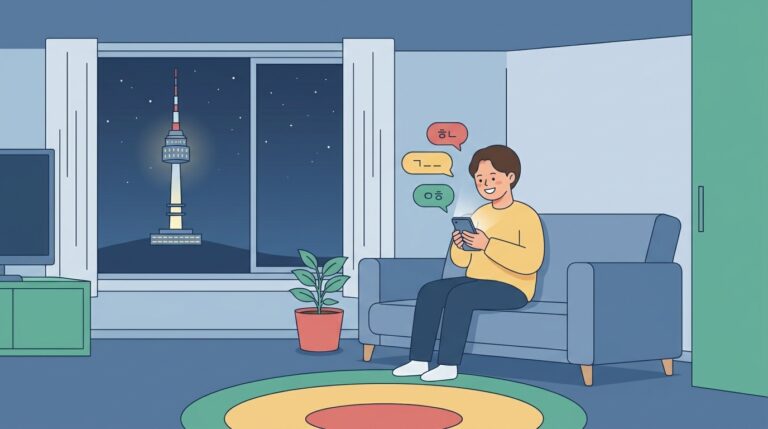
Beat the Solo Blues: How to Find Your ‘Sojung’ (Small but Certain) Crew in Korea
안녕하세요! (Annyeonghaseyo!) I’m your Daily Hangul editor and your local culture navigator.
If you are living alone in Korea—or planning to—you might already know that South Korea has seen a massive surge in 1인 가구 (il-in gagu – single households). While the freedom of having your own oneroom (studio apartment) is amazing, there comes a night when the silence is a bit too loud, and even the tastiest delivery chicken feels lonely.
Our lovely learner, Sarah from Chicago, recently told me: “Editor-nim, I tried to join a local running club, but everyone seemed so close, and I didn’t know how to ask to join them for the post-run dinner without looking desperate!”
If you’ve felt that pinch of loneliness (외로움 – oeroum), don’t worry. Today, we’re diving into the exact Korean expressions, cultural nuances, and social etiquette you need to beat the solo blues and find your tribe through 동호회 (donghohoe – interest-based clubs).
Phase 2: Core Expressions Deep Dive
To navigate Korea’s social club scene, you need more than textbook vocabulary. Here are three essential expressions that will instantly make you sound warm, approachable, and culturally savvy.
1. 소모임 (Somoim)
- Pronunciation: [So-mo-im] (Sounds like “So” + “More” without the ‘r’ + “Im”)
- Meaning: Small group / Casual meetup (Literally: “Small Gathering”)
- K-Culture Moment: In K-Dramas like My Liberation Notes, characters often seek out a “somoim” to escape their tedious daily routines and find deeper connections.
- Editor’s Insight: While 동호회 (donghohoe) sounds slightly official or large-scale, 소모임 implies a cozy, low-pressure, neighborhood-based gathering.
- Situation Spectrum: Casual (✅) | Semi-formal (✅) | Formal (⚠️)
- 🤔 Think About It: In your home country, do people prefer large organized clubs or small, casual neighborhood meetups? How does the size of a group change how you express yourself?
2. 뒤풀이 (Dwipuri)
- Pronunciation: [Dwi-pu-ri] (Sounds like “Dwee” + “Poo” + “Ree”)
- Meaning: After-party / Post-meeting dinner and drinks
- K-Culture Moment: The actual club activity (hiking, photography, board games) is often just the opening act. The real bonding happens during the dwipuri over local food.
- Editor’s Insight: Missing the dwipuri is missing 90% of the socializing. It is highly casual, and saying “뒤풀이 가요!” (Let’s go to the after-party!) shows you are open to making real friends.
- Situation Spectrum: Casual (✅) | Semi-formal (✅) | Formal (🚫)
- 🤔 Think About It: Why do you think eating and drinking together (식구 – ‘eating mouth/family’) is so crucial for bonding in Korean culture?
3. 번개 (Beongae)
- Pronunciation: [Beon-gae] (Sounds like “Bun” + “Gae” as in gate without ‘te’)
- Meaning: Flash meetup / Impromptu gathering (Literally: “Lightning”)
- K-Culture Moment: When someone in a club chat suddenly posts, “오늘 저녁 번개 하실 분?” (Anyone up for a flash dinner tonight?), it’s an invitation to a spontaneous hangout.
- Editor’s Insight: This word comes from the speed of lightning. It’s perfect for single households who suddenly feel lonely on a rainy Tuesday evening.
- Situation Spectrum: Casual (✅) | Semi-formal (⚠️) | Formal (🚫)
- 🤔 Think About It: Are you more of a planner, or do you enjoy spontaneous ‘lightning’ meetups with acquaintances?
Phase 3: Textbook Korean vs. Real-Life Korean
Let’s compare textbook phrases with what Koreans actually say in modern social settings.
Scenario 1: Asking to join a group chat/club
- 📖 Textbook Korean: “제가 그 동호회에 가입해도 되겠습니까?” (Je-ga geu dong-ho-hoe-e ga-ip-hae-do doe-gess-seup-ni-ka?) – “May I register for that association?” (Too formal, sounds like a job application!)
- 🗣️ Real-Life Korean: “저도 혹시 단톡방에 들어가도 돼요?” (Jeo-do hok-si dan-tok-bang-e deol-eo-ga-do dwae-yo?) – “Is it okay if I join the group chat too?”
- 💡 Why the difference? Modern Korean socializing happens almost entirely on KakaoTalk group chats (단톡방 – dantokbang). Joining the chat is the real sign of initiation.
Scenario 2: Suggesting a casual hangout
- 📖 Textbook Korean: “우리 여가 시간에 만날까요?” (U-ri yeo-ga si-gan-e man-nal-ka-yo?) – “Shall we meet during our leisure time?” (Awkward and robotic.)
- 🗣️ Real-Life Korean: “우리 주말에 커피 한잔해요!” (U-ri ju-mal-e keo-pi han-jan-hae-yo!) – “Let’s grab a coffee this weekend!”
- 💡 Why the difference? “커피 한잔” (a cup of coffee) is a universal, low-pressure invitation to chat and get closer.
Phase 4: K-Culture Deep Dive & Non-Verbal Manners
4-1. The Art of “Nunchi” (눈치) at the Dwipuri Table
When you attend your first dwipuri (after-party), your 눈치 (nunchi – situational quick-wittedness) is your best friend.
* The Water and Spoon Duty: When you sit down at a restaurant, look around. Before the food arrives, open the drawer at the side of the table, take out the spoons, chopsticks, and tissues, and set them nicely for the people sitting near you. Pour water for others first. This small, non-verbal gesture screams: “I am considerate and ready to be part of this community!”
4-2. The “Somoim” App Phenomenon
In Korea, single households heavily rely on mobile apps to find their niche. The most famous one is actually called 소모임 (Somoim App). From clay crafting and indie movie watching to climbing Han River bridges, these apps let you filter groups by your neighborhood (동네 – dongne). It’s the ultimate tool to combat loneliness without the pressure of long-term commitment.
Phase 5: Real-Life Roleplay Scenario
Setting: You just finished a photography club meetup in Mapo-gu. The leader, Min-ho, is packing up his camera and looks at you.
- Character: 민호 (Min-ho) – The friendly, outgoing club leader who wants to make sure everyone feels included.
1. 민호: "오늘 출사 정말 즐거웠죠? 다들 사진 잘 찍으시더라고요!"
   (Min-ho: "Today's shoot was really fun, right? Everyone took such great photos!")

2. 너 (You): "네, 정말 재미있었어요. 서울에 이런 곳이 있는 줄 몰랐어요."
   (You: "Yes, it was really fun. I didn't know there was a place like this in Seoul.")

3. 민호: "[smiling] 다행이네요! 참, 이제 다들 저녁 먹으러 갈 건데, 같이 가실래요?"
   (Min-ho: "Glad to hear that! By the way, we are all going to grab dinner now, would you like to come along?")

4. 너 (You): "[excitedly] 아, 저도 정말 가고 싶어요! 혹시 어떤 음식 먹으러 가요?"
   (You: "Oh, I'd love to go! What kind of food are we having?")

5. 민호: "날씨도 쌀쌀한데 따뜻한 김치전골 어때요? 다들 찬성했어요!"
   (Min-ho: "Since the weather is chilly, how about warm Kimchi hotpot? Everyone agreed!")

6. 너 (You): "[nodding] 우와, 완전 좋아요! 저 뜨거운 국물 진짜 좋아해요."
   (You: "Wow, absolutely love it! I really like hot soup.")

7. 민호: "잘됐네요! 그럼 이동하면서 단톡방에 초대해 드릴게요. 번개 모임 자주 하니까요."
   (Min-ho: "Great! I'll invite you to our group chat while we walk. We do flash meetups often.")

8. 너 (You): "[gratefully] 네, 초대해 주세요! 앞으로 자주 참여할게요."
   (You: "Yes, please invite me! I'll participate often from now on.")
🔀 Interactive Choice Point
After dinner, Min-ho asks: “우리 2차로 가볍게 맥주 한잔 더 하러 갈 건데, 피곤하시면 먼저 들어가셔도 돼요! 어떻게 하실래요?” (We are going for a second round of light beers, but if you’re tired, you can head home! What would you like to do?)
- A) “저도 2차 갈래요! 아직 안 피곤해요.” (I want to go to the second round too! I’m not tired yet.)
- B) “저는 피곤해서 먼저 들어갈게요. 안녕히 계세요.” (I’m tired so I will go home first. Goodbye.)
- C) “아… 저 가야 하나요? 다른 분들은 다 가시나요?” (Ah… do I have to go? Is everyone else going?)
💡 Feedback:
- Select A (Best): Perfect! Joining the “2차” (second round) is where deep conversations happen. It shows high social energy and willingness to bond.
- Select B (Bad): While totally acceptable if you are exhausted, saying a blunt “안녕히 계세요” sounds slightly cold. Better: “아쉽지만 제가 내일 아침 일찍 일이 있어서 먼저 들어갈게요! 단톡방에서 인사 나눠요!” (Sadly, I have something early tomorrow so I’ll head out first! Let’s talk in the chat!)
- Select C (Risk): This sounds hesitant and puts pressure on Min-ho. Be confident in your boundaries!
Phase 6: 10-Second Emotion Shadowing Drill
Practice saying these with the right emotional inflection to sound like a local!
[😊 Excitedly & Warmly]
*
Frequently Asked Questions (FAQ)
Q: What does "소모임 (Somoim)" mean in Korean and how do you pronounce it?
A: In Korean, "소모임 (Somoim)" is pronounced [So-mo-im] and means: Small group / Casual meetup (Literally: "Small Gathering")
Q: What does "뒤풀이 (Dwipuri)" mean in Korean and how do you pronounce it?
A: In Korean, "뒤풀이 (Dwipuri)" is pronounced [Dwi-pu-ri] and means: After-party / Post-meeting dinner and drinks
Q: What does "번개 (Beongae)" mean in Korean and how do you pronounce it?
A: In Korean, "번개 (Beongae)" is pronounced [Beon-gae] and means: Flash meetup / Impromptu gathering (Literally: "Lightning")







