

Finding the Perfect Meetup Spot in Korea: Let’s Decide Where to Meet!
Phase 1: Empathy (Welcome, My Chingu! 👋)
안녕하세요! (An-nyeong-ha-se-yo!) I’m your Daily Hangul Editor and your personal cultural navigator.
Imagine this: You and your Korean friend, Minjun, are planning to grab coffee this weekend. You both want to meet up, but when you open KakaoTalk, you suddenly freeze. How do I ask where to meet without sounding like a robotic textbook?
Choosing a meeting spot in Korea isn’t just about sharing GPS coordinates; it’s a social dance! Whether you’re navigating the bustling exit gates of Hongdae Station or finding a quiet cafe in Gangnam, knowing how to suggest and agree on a location is a game-changer.
Based on feedback from hundreds of our A2 learners, transitioning from “Where are you?” to “Where should we meet?” can feel intimidating. Don’t worry! Today, we will master 3 magical expressions that will make you sound like a local, dive into some cool K-Drama meetup etiquette, and practice with an interactive roleplay. Let’s get started!
Phase 2: Deep-Dive into 3 Essential Expressions
Let’s look at three core expressions you can use to decide on a meeting place.
1. 어디서 만날까요? (Eo-di-seo man-nal-kka-yo?)
- Pronunciation: Eo-di-seo (like “uh-dee-suh”) man-nal-kka-yo (like “mahn-nahl-kkah-yo”). Think of “eo” as the “u” in “up”.
- Meaning: Where shall we meet? / Where should we meet?
- K-Culture Moment: You hear this in almost every romance K-Drama right before the lead characters have their first official date outside of work. It is polite, soft, and open-ended.
- Editor’s Insight: The ending
-(으)ㄹ까요?(-eul-kka-yo?) is a beautiful way to ask “Shall we…?” or “Should we…?” in Korean. It invites the other person’s opinion instead of just giving an order. - Situation Spectrum: Casual (⚠️ – use “어디서 만날까?” instead) | Semi-formal (✅) | Formal (✅)
- 🤔 Think About It: In your native language, do you ask “Where are we meeting?” or “Where would you like to meet?” How does changing the tone affect the friendship?
2. 역 앞에서 봐요. (Yeok ap-e-seo bwa-yo.)
- Pronunciation: Yeok (sounds like “yuck” but with a shorter ‘u’) ap-e-seo (ahp-eh-suh) bwa-yo (bwah-yo).
- Meaning: Let’s meet in front of the station. (Directly: “Let’s see [each other] in front of the station.”)
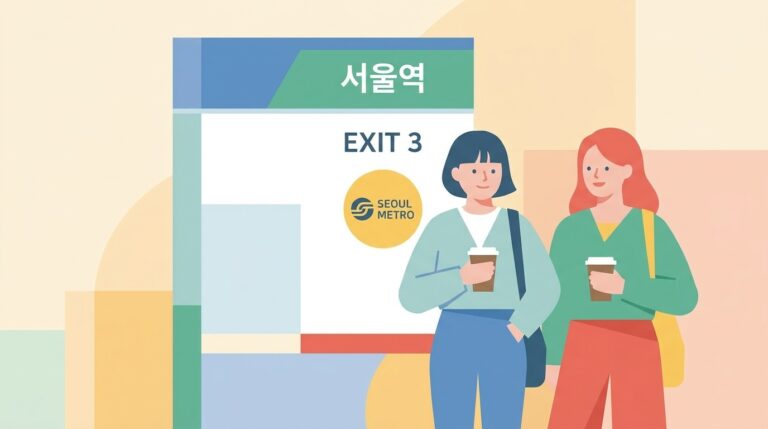
- K-Culture Moment: Korean subway stations are massive hubs. Saying “Let’s meet at Hongdae” is a recipe for getting lost. Instead, Koreans specify “in front of the station exit” (e.g., “Hongdae Station Exit 9”).
- Editor’s Insight: The word
보다(bo-da) means “to see,” but in social contexts, it is used exactly like “to meet” (만나다). It sounds very friendly and natural! - Situation Spectrum: Casual (✅ – “역 앞에서 봐”) | Semi-formal (✅) | Formal (🚫)
- 🤔 Think About It: Why do you think subway exits are the ultimate meeting landmarks in Korea? (Hint: Korean subways have incredible underground shopping centers and clear exit numbers!)
3. 중간에서 만나요. (Jung-gan-e-seo man-na-yo.)
- Pronunciation: Jung-gan-e-seo (joong-gahn-eh-suh) man-na-yo (mahn-nah-yo).
- Meaning: Let’s meet halfway. (Directly: “Let’s meet in the middle.”)
- K-Culture Moment: If you live in north Seoul (Gangbuk) and your friend lives in south Seoul (Gangnam), traveling all the way to one side is a big ask. Suggesting “중간” (the middle/halfway point) shows great empathy and “nunchi” (tact).
- Editor’s Insight:
중간(jung-gan) means “middle”. It’s a lifesaver phrase when you want to be considerate of travel times. - Situation Spectrum: Casual (✅) | Semi-formal (✅) | Formal (⚠️)
- 🤔 Think About It: How important is “meeting halfway” in your culture? Is it considered rude to make someone travel all the way to your neighborhood?
Phase 3: Textbook Korean vs. Real Korean
Let’s see how school textbook Korean compares to what we actually say on KakaoTalk!
Scenario A: Asking where to meet
- 📖 Textbook: “우리는 어디에서 만납니까?” (U-ri-neun eo-di-e-seo man-nam-ni-ka? – Where do we meet?)
- 🗣️ Real Korean: “우리 어디서 볼까요?” (U-ri eo-di-seo bol-kka-yo? – Where shall we meet/see each other?)
- 💡 Why is it different? The textbook version is grammatically correct but extremely stiff, sounding like a military interview. Real Koreans drop particles like
에서into서and use the warmer볼까요?ending.
Scenario B: Confirming the spot
- 📖 Textbook: “스타벅스 커피숍 안에서 만납시다.” (Seu-ta-beok-seun keo-pi-syop an-e-seo man-nap-si-da. – Let us meet inside the Starbucks coffee shop.)
- 🗣️ Real Korean: “스타벅스 앞에서 봐요!” (Seu-ta-beok-seun ap-e-seo bwa-yo! – See you in front of Starbucks!)
- 💡 Why is it different? The double-consonant command
-읍시다can sound a bit pushy. Real Koreans prefer the softer-아요/어요ending to suggest meetups.
Phase 4: K-Culture Deep-Dive & Non-Verbal Manners
4-1. Subway Exit Culture & “Nunchi” (눈치)
In Korea, saying “Let’s meet at Gangnam Station” is a trap. Gangnam Station has 12 exits, and it is crowded 24/7!
* The Gesture: When Koreans arrive at the spot, they don’t just stand around. They will text, “나 9번 출구 앞이야!” (I’m in front of Exit 9!).
* Subway Etiquette: Never block the actual card-scanning gates while waiting. Walk up to the designated exit number outside or wait near the stairs to keep passenger traffic flowing smoothly.
4-2. The “Cafe Meetup” Code
If you suggest meeting inside a cafe, the rule of thumb in Korea is: the first person to arrive orders their drink first. Do not sit at a table for 20 minutes waiting for your friend without ordering, as cafe spaces are premium. It’s perfectly fine to say, “나 먼저 들어가서 음료 시킬게!” (I’ll go in first and order a drink!).
Phase 5: Real-Life Roleplay Scenario
Meet Ji-a, your energetic Korean classmate who loves trying out trendy bakeries in Yeonnam-dong. You are planning to meet her this Saturday.
Ji-a: 우리 토요일에 맛있는 빵 먹으러 가요! (U-ri to-yo-il-e mas-in-neun ppang meog-eun-eo ga-yo!)
      [🎭 Smiling warmly, holding her phone]
      "Let's go eat delicious bread this Saturday!"

You: 좋아요! 어디서 만날까요? (Jo-a-yo! Eo-di-seo man-nal-kka-yo?)
      [🎭 Texting back quickly with a happy face]
      "Great! Where shall we meet?"

Ji-a: 홍대입구역 어때요? (Hong-dae-ip-gu-yeok eo-ttae-yo?)
      [🎭 Sending a cute bread emoji]
      "How about Hongdae Station?"

You: 홍대입구역 3번 출구 앞에서 봐요. (Hong-dae-ip-gu-yeok sam-beon chul-gu ap-e-seo bwa-yo.)
      [🎭 Noding in agreement]
      "Let's meet in front of Hongdae Station Exit 3."

Ji-a: 오, 좋아요! 2시에 만날까요? (O, jo-a-yo! Du-si-e man-nal-kka-yo?)
      [🎭 Typing eagerly]
      "Oh, great! Shall we meet at 2 o'clock?"

You: 네, 2시에 중간에서 만나요! (Ne, du-si-e jung-gan-e-seo man-na-yo!)
      [🎭 Realizing that 2 PM is perfect]
      "Yes, let's meet halfway at 2!"

Ji-a: 네! 토요일에 봐요! (Ne! To-yo-il-e bwa-yo!)
      [🎭 Waving goodbye icon]
      "Yes! See you on Saturday!"

You: 네, 그때 봐요! (Ne, geu-ttae bwa-yo!)
      [🎭 Sending a heart sticker]
      "Yes, see you then!"
🔀 Interactive Choice Point
Ji-a texts you: “Our meeting spot is too far from your dorm. Do you want to change it?”
- Option A: “아니요, 괜찮아요! 중간에서 만나요.” (No, I’m fine! Let’s meet halfway.)
- Option B: “네, 싫어요.” (Yes, I hate it.)
- Option C: “네, 신촌역 앞에서 봐요!” (Yes, let’s meet in front of Sinchon Station!)
💡 Feedback on Your Choice:
- Selecting Option A (Best): Perfect! It shows you are considerate (“괜찮아요”) and offers a fair alternative (“중간에서 만나요”).
- Selecting Option B (Bad): Oops! “싫어요” (I hate it / I don’t want to) sounds extremely aggressive and blunt in Korean.
- Selecting Option C (Risk): Good compromise! Suggesting a nearby landmark like Sinchon Station (near Hongdae) keeps the plans moving smoothly.
Phase 6: 10-Second Emotion Shadowing Drill
Let’s practice speaking with real Korean feelings! Pay attention to the pauses (/) and the emotional cues.
- [😊 Energetic & Excited]
- 우리 / 어디서 / 볼까요?
- U-ri / eo-di-seo / bol-kka-yo?
- (Let’s meet up! Where should we see each other?)
- [🥺 Considerate & Polite]
- 음… / 중간에서 / 만나요!
- Eum… / jung-gan-e-seo / man-na-yo!
- (Hmm… let’s meet halfway!)
- [✨ Confident & Direct]
- 홍대역 / 3번 출구 / 앞에서 봐요!
- Hong-dae-yeok / sam-beon chul-gu / ap-e-seo bwa-yo!
- (See you in front of Hongdae Station Exit 3!)
Phase 7: K-Culture Mini-Dictionary
- 출구 (Chul-gu) | Exit | Used with numbers (e.g., 1번 출구 – Exit 1) to pinpoint exactly where you are standing at a subway station.
- 중간 (Jung-gan) | Middle / Halfway | Essential for negotiating locations when friends live far apart.
- 역 (Yeok) | Station | Attached to the end of place names, like 홍대입구역 (Hongdae Station) or 서울역 (Seoul Station).
- 앞 (Ap) | In front of | The most common spatial preposition used when specifying meetup points (e.g., 가게 앞 – in front of the shop).
Phase 8: The Traveler’s Survival Kit
Survival Phrases TOP 3
- 여기 어디예요? (Yeo-gi eo-di-ye-yo?)
- Pro Tip: If you are lost, show this phrase to a local or a police officer to ask “Where is this place?”
- 거기 어떻게 가요? (Geo-gi eo-tteo-ke ga-yo?)
- Pro Tip: “How do I get there?” Ideal when you cannot find the exit your friend suggested.
- 길을 잃었어요. (Gil-eul il-eot-seo-yo.)
- Pro Tip: “I am lost.” Send this on KakaoTalk if you exit the wrong side of the station.
🗺️ Editor’s Travel Note
Do not use Google Maps in Korea! It does not update pedestrian walking routes accurately. Instead, download the Naver Map App or KakaoMap App before your trip. You can search exit numbers directly and send your live location pin to your friends easily!
Phase 9:
Frequently Asked Questions (FAQ)
Q: What does "어디서 만날까요? (Eo-di-seo man-nal-kka-yo?)" mean in Korean and how do you pronounce it?
A: In Korean, "어디서 만날까요? (Eo-di-seo man-nal-kka-yo?)" is pronounced [Eo-di-seo (like "uh-dee-suh"] and means: Where shall we meet? / Where should we meet?
Q: What does "역 앞에서 봐요. (Yeok ap-e-seo bwa-yo.)" mean in Korean and how do you pronounce it?
A: In Korean, "역 앞에서 봐요. (Yeok ap-e-seo bwa-yo.)" is pronounced [Yeok (sounds like "yuck" but with a shorter 'u'] and means: Let's meet in front of the station. (Directly: "Let's see [each other] in front of the station.")
Q: What does "중간에서 만나요. (Jung-gan-e-seo man-na-yo.)" mean in Korean and how do you pronounce it?
A: In Korean, "중간에서 만나요. (Jung-gan-e-seo man-na-yo.)" is pronounced [Jung-gan-e-seo (joong-gahn-eh-suh] and means: Let's meet halfway. (Directly: "Let's meet in the middle.")







