

Phase 1: Empathy (Welcome, My Friend!)
안녕하세요! (An-nyeong-ha-se-yo!) Hello! I’m your Lead Editor and your personal K-Culture Navigator at Daily Hangul.
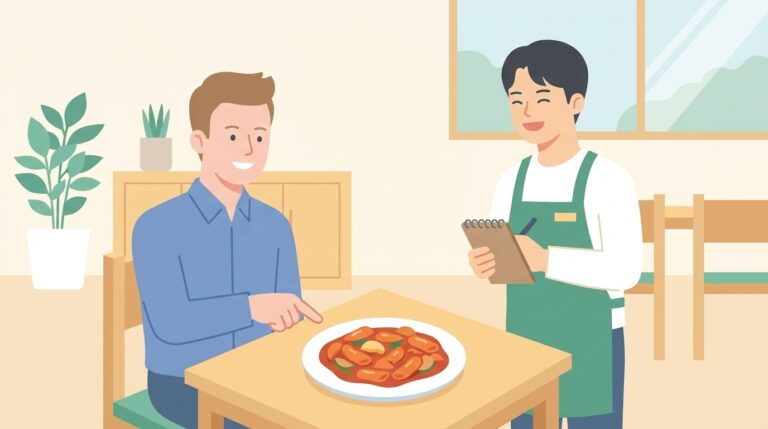
Imagine this: You’ve just walked into a cozy, bustling restaurant in Hongdae, Seoul. The rich aroma of sizzling Korean BBQ or freshly cooked Tteokbokki fills the air. Your stomach rumbles. You look at the menu, but it’s mostly in Korean, or maybe you are just too nervous to pronounce those complex food names. The waiter approaches, smiling, waiting for your order. Your heart starts racing. Do you just point and hope for the best?
Don’t panic! Every single Korean learner has been exactly where you are right now. The secret to unlocking almost any menu in Korea doesn’t require you to memorize fifty different food items overnight. It lies in one magical, ultra-simple phrase that instantly signals: “I want this, please!”
Today, we are mastering “이거 주세요 (I-geo ju-se-yo)”. By the end of this quick guide, you’ll be ordering your meals in Seoul with absolute confidence, just like a local. Let’s dive in!
Phase 2: Deep Dive into the Top 3 Key Expressions
1. 이거 주세요 (I-geo ju-se-yo)
- Pronunciation: ee-geo joo-seh-yo (Sounds like “ee-go” as in go, plus “joo-say-yo”)
- Meaning: “This one, please.”
- K-Culture Moment: You see this in almost every food vlog or K-Drama. Think of the main characters pointing at a sizzling plate of cheese-buldak (spicy chicken) and saying this with sparkling eyes.
- Editor’s Insight: This is your ultimate survival weapon. 이거 (I-geo) means “this,” and 주세요 (ju-se-yo) comes from the verb meaning “to give,” wrapped in a polite request form. When you point at a picture on the menu and say this, you are 100% safe.
- Situation Spectrum: Casual: ✅ | Semi-formal: ✅ | Formal: ⚠️
- 🤔 Think About It: In English, we often say “I’ll have this” or “Can I get this?” focusing on what I am doing. In Korean, saying “주세요 (please give me)” focuses on the polite interaction between you and the host. How does this shift your perspective on Korean dining etiquette?
2. 메뉴판 주세요 (Me-nyu-pan ju-se-yo)
- Pronunciation: meh-nyoo-pan joo-seh-yo (Sounds like “Menu-pan” + “joo-say-yo”)
- Meaning: “Please give me the menu.”
- K-Culture Moment: You walk into a traditional restaurant where the menu isn’t on the table but plastered on the wall. You need a physical or English menu to understand.
- Editor’s Insight: 메뉴판 (Me-nyu-pan) literally means “menu board/plate.” Adding 주세요 (ju-se-yo) makes it a polite request. It’s the perfect icebreaker phrase as soon as you sit down.
- Situation Spectrum: Casual: ✅ | Semi-formal: ✅ | Formal: ✅
3. 여기요! (Yeo-gi-yo!)
- Pronunciation: yuh-gi-yo! (Sounds like “yuh-ghee” as in yeoman + “yo”)
- Meaning: “Excuse me!” / “Over here, please!”
- K-Culture Moment: In K-Dramas, you’ll see customers raising a hand slightly and calling out “여기요!” confidently to get the server’s attention in a noisy restaurant.
- Editor’s Insight: Many beginners hesitate to yell in a restaurant because it feels rude in Western culture. But in Korea, there are often no assigned table servers. Calling out “여기요!” is highly expected and polite!
- Situation Spectrum: Casual: ✅ | Semi-formal: ✅ | Formal: ⚠️
Phase 3: Textbook Korean vs. Real-Life Korean
Let’s compare what you see in dusty old grammar books with what we actually say in the streets of Seoul!
Scenario A: Requesting Water
- 📖 Textbook Korean: 물을 가져다주십시오. (Mul-eul ga-jeo-da-ju-sip-si-o.) – “Please bring water.”
- 🗣️ Real-Life Korean: 물 좀 주세요! (Mul jom ju-se-yo!) – “Water, please!”
- 💡 Why the difference? The textbook version is overly stiff and sounds like an official military command. In real life, inserting 좀 (jom), which means “a little/please,” softens your request and makes you sound incredibly natural and polite.
Scenario B: Ordering One of Something
- 📖 Textbook Korean: 이것을 한 개 주문하겠습니다. (I-geot-eul han gae ju-mun-ha-get-seum-ni-da.) – “I will order one unit of this.”
- 🗣️ Real-Life Korean: 이거 하나 주세요! (I-geo ha-na ju-se-yo!) – “One of this, please!”
- 💡 Why the difference? Native Koreans prefer short, breezy expressions. Swapping the stiff 이것을 (i-geot-eul) for 이거 (i-geo) and using the friendly native number 하나 (ha-na) flows much better.
Phase 4: K-Culture Deep Dive & Non-Verbal Manners
4-1. The Art of Hand Gestures & “Nunchi” (눈치)
When you say “이거 주세요,” your non-verbal cues are just as important as your pronunciation:
* The Two-Handed Hand-off: When pointing to a menu, try to keep your body slightly leaned forward to show eagerness. If you are pointing with your index finger, keep your other hand politely resting near your elbow or chest. This is a subtle sign of deep respect.
* Eye Contact: Make brief, warm eye contact with the server as you point, then nod slightly as you finish with “주세요.”
4-2. The Magic Table Drawer & Water Self-Service
When you sit down, you might look for napkins and spoons on the table and find nothing. Look closely at the side of the table! There is almost always a hidden drawer containing napkins, chopsticks, and spoons. Also, look out for signs that say 물은 셀프입니다 (Mul-eun sel-peu-im-ni-da), which means “Water is self-service.” You’ll grab your own cup and water bottle from the fridge!
Phase 5: Real-Life Roleplay Scenario
Setting: A trendy Tteokbokki (spicy rice cake) joint in Insadong.
Your Character: You (an excited traveler).
NPC: Min-ji (The friendly restaurant staff member).
- Min-ji (Staff): 어서 오세요! 몇 분이세요?
(Eo-seo o-se-yo! Myeot bun-i-se-yo?)
🎭 Smiling warmly and gesturing toward an empty table.
“Welcome! How many people?” - You: 두 명이에요. 메뉴판 주세요.
(Du myeong-i-e-yo. Me-nyu-pan ju-se-yo.)
🎭 Holding up two fingers and gesturing politely.
“Two people. Menu, please.” - Min-ji (Staff): 네, 여기 있습니다. 주문하시겠어요?
(Ne, yeo-gi it-seum-ni-da. Ju-mun-ha-si-get-eo-yo?)
🎭 Handing over a colorful menu.
“Yes, here you go. Are you ready to order?” - You: (Pointing at the classic Tteokbokki picture) 이거 하나 주세요.
(I-geo ha-na ju-se-yo.)
🎭 Pointing clearly with your finger.
“One of this, please.” - Min-ji (Staff): 떡볶이 하나요? 알겠습니다. 음료수는요?
(Tteok-bok-ki ha-na-yo? Al-get-seum-ni-da. Eum-ryo-su-neun-yo?)
🎭 Writing it down on a small order pad.
“One Tteokbokki? Got it. Any drinks?” - You: 콜라 하나 주세요.
(Kol-la ha-na ju-se-yo.)
🎭 Smiling politely.
“One Cola, please.” - Min-ji (Staff): 네, 콜라 하나 추가요. 잠시만 기다려 주세요.
(Ne, kol-la ha-na chu-ga-yo. Jam-si-man gi-da-ryeo ju-se-yo.)
🎭 Bowing slightly.
“Sure, one Cola added. Please wait a moment.” - You: 감사합니다!
(Gam-sa-ham-ni-da!)
🎭 Bowing your head slightly in return.
“Thank you!”
🔀 Interactive Choice Points
What do you do next when the food is ready but you need a napkin?
* Choice A: Yell “Hey!” across the room.
* Choice B: Find the drawer under your table, or politely raise your hand and say “저기요, 휴지 좀 주세요 (Jeo-gi-yo, hyu-ji jom ju-se-yo – Excuse me, tissues please).”
* Choice C: Walk to the kitchen and grab it yourself.
Feedback:
- Choice A (Bad): 🚫 Oh no! Yelling “Hey” is considered quite rude in Korea. Stick to “저기요” (Jeo-gi-yo).
- Choice B (Best): ✅ Perfect! You checked the magical side drawer first or politely used “저기요” with “주세요” to ask for tissues. Incredibly natural!
- Choice C (Risk): ⚠️ Unless there is a sign saying “Self-service,” going into the kitchen area might surprise the staff. Best to ask first!
Phase 6: 10-Second Emotional Shadowing Drill
To sound like a true local, you need to master the rhythm and emotion of the words. Try reading these aloud!
- [😊 Bright & Polite]
이거 / 하나 / 주세요!
(I-geo / ha-na / ju-se-yo!)
Focus on rising tones on “-geo” and “-yo”. -
[🙋 Confident & Seeking Attention]
여기요! / 주문할게요!
(Yeo-gi-yo! / Ju-mun-hal-ge-yo!)
Start strong on “Yeo” and let it flow smoothly. -
[🥺 Soft & Grateful]
감사합니다! / 잘 먹겠습니다!
(Gam-sa-ham-ni-da! / Jal meok-get-seum-ni-da!)
Say “잘 먹겠습니다” (I will eat well) before taking your first bite.
Phase 7: K-Culture Mini Dictionary
- 반찬 (Ban-chan) | Side dishes | Traditional small dishes served with your main meal. They are free and refillable!
- 주문 (Ju-mun) | Order | The act of placing your food order.
- 이모님 (I-mo-nim) | Auntie | A highly affectionate, friendly way to call a middle-aged female server in casual, traditional restaurants. It instantly melts hearts!
- 계산대 (Gye-san-dae) | Checkout counter | The place near the exit where you pay. In Korea, you rarely pay at your dining table; you take your bill slip to the front exit to pay.
Phase 8: Survivor’s Travel Kit
Survival Phrases TOP 3
- 이거 매워요? (I-geo mae-wo-yo?) – “Is this spicy?”
- Pro Tip: Essential if you cannot handle fiery Korean chili flakes!
- 물 좀 더 주세요. (Mul jom deo ju-se-yo.) – “More water, please.”
- Pro Tip: Keep this handy when eating spicy food!
- 포장해 주세요. (Po-jang-hae ju-se-yo.) – “Please wrap this up (To-go/Take-out).”
- Pro Tip: Use this when you have delicious leftovers you want to eat at your hotel.
Editor’s Travel Note
Before stepping foot into a restaurant, make sure to download the Naver Map App for reliable navigation, as Google Maps does not work perfectly in South Korea.
Note: Restaurant details, operating hours, and payment terminal technologies in Korea are subject to change over time.
Phase 9: “A Step Deeper” (Thoughtful Reflection)
In English, ordering food is often transactional: “I’ll have the burger.” In Korean, the constant use of “주세요” (Please give me) reflects a deeply rooted culture of mutual respect and polite petitioning. When you say “이거 주세요,” you aren’t just demanding food; you are entering a polite contract of hospitality with your host.
💬 Your Turn: How does your native language handle ordering food? Do you find Korean’s polite verbs easier or harder? Tell us in the comments below!
Phase 10: FAQ & Common Mistakes
Q: Can I use “이거 주세요” for drinks too?
A: Absolutely! You can use it for anything you can point at—food, clothing in a boutique, or coffee in a cafe. Just point and say “이거 주세요.”
Q: Do I need to use Korean numbers with this?
A: For absolute beginners, just pointing and saying “이거 주세요” (This, please) is plenty. If you want to specify “one,” say “이거 하나 주세요” (I-geo ha-na ju-se-yo).
Q: Is it rude to call out “여기요” loudly?
A: Not at all! In a busy Korean restaurant, servers expect you to call out. It’s actually considered proactive and normal. Just keep your tone friendly!
🚨 Common Mistakes Alert!
- Mistake 1: Saying “이거 봐라” (I-geo bwa-ra). This means “Look at this!” in an informal, bossy way. Don’t mix it up with 주세요!
- Mistake 2: Snapping fingers to get attention. This is highly disrespectful in Korean dining culture. Always use “여기요” (Yeo-gi-yo) instead.
- Mistake 3: Waiting for the bill at the table. In most Korean casual spots, you must take your table paper slip to the counter near the door to pay.
Phase 11: Action Mission & Engagement
- Bronze Mission 🥉: Practice saying “이거 주세요” in front of the mirror 3 times using the 10-Second Shadowing Drill!
- Silver Mission 🥈: Next time you watch a K-Drama eating scene, try to spot the characters saying “여기요” or “주세요.”
- Gold Mission 🥇: Go to your local Korean restaurant or bakery, point to your favorite item, and order it entirely in Korean using “이거 주세요!”
Phase 12: Interactive Quiz Challenge
Test your new skills below!
1. What is the most polite way to call a server over to your table?
- A) Hey!
- B) 여기요! (Yeo-gi-yo!)
- C) 이거 주세요 (I-geo ju-se-yo)
2. Fill in the blank: “One Cola, please” -> “콜라 ______ 주세요.”
- A) 하나 (ha-na)
- B) 두 (du)
- C) 여기 (yeo-gi)
3. True or False: You should always wait at your table for the waiter to bring the payment card machine.
- A) True
- B) False
🎉 Click here to see the answers!
- Correct Answer: B) 여기요! (This is the natural, polite way to call your server!)
- Correct Answer: A) 하나 (ha-na) (This is the native Korean number for “one” item.)
- Correct Answer: B) False (In Korea, you usually take your bill to the front register/counter to pay!)






