

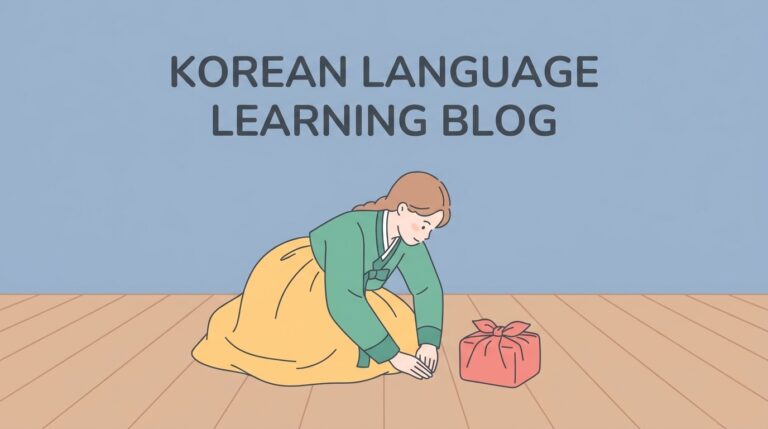
Master Seollal Bowing: How to Do Sebae Like a Local Without Feeling Awkward!
Phase 1: Empathy (Welcome to the Warmth of Seollal!)
안녕하세요! (An-nyeong-ha-se-yo!) I am your friendly K-culture navigator and chief editor at Daily Hangul.
Imagine this: It’s Lunar New Year (설날 – Seollal). You are visiting your Korean partner’s family or friends. Everyone is dressed in gorgeous, colorful Hanbok (traditional clothing). Suddenly, the elders sit in a row, and everyone prepares to bow. Your heart starts racing. How low do I bend? What do I do with my hands? What on earth do I say to not sound like a robot?
If the thought of performing the traditional bow (세배 – Sebae) makes you break into a cold sweat, don’t worry! You are not alone. Many of our absolute beginner students at Daily Hangul worry about making a cultural faux pas. Today, we’re going to break down Sebae into super-easy, bite-sized steps. By the end of this guide, you’ll bow with ultimate confidence and warm the hearts of any Korean elder! Let’s dive in!
Phase 2: Top 3 Must-Know Expressions
Let’s learn the exact words to say right after you finish your bow.
1. 새해 복 많이 받으세요! (Sae-hae bok man-hi bat-euse-yo!)
- Pronunciation: Say-hay bok mahn-hee bah-deu-seh-yo! (Sounds like “Say-hey, folk mahn-hee bah-deu-say-yo!”)
- Meaning: “Please receive a lot of good fortune in the New Year!”
- K-Culture Moment: This is the ultimate Seollal anthem. You’ll hear this on every K-Drama family scene, variety show, and even on K-Pop idols’ social media greetings!
- Editor’s Insight: Bok (복) means luck, blessing, or fortune. In Korea, we don’t just say “Happy New Year”; we literally wish that a shower of blessings falls upon the other person.
- Situation Spectrum: Casual: ⚠️ | Semi-formal: ✅ | Formal: ✅
- 🤔 Think About It: In English, we simply say “Happy New Year.” Why do you think Korean culture focuses so much on “receiving blessings” (복) from the elders?
2. 건강하세요! (Geon-gang-ha-se-yo!)
- Pronunciation: Gun-gahng-hah-seh-yo! (Sounds like “Gun-gong-hah-sey-yo!”)
- Meaning: “Please be healthy!”
- K-Culture Moment: Usually said to grandparents or elderly relatives right after the main bow to wish them a long, pain-free life.
- Editor’s Insight: While grammatically “건강하다” is an adjective and shouldn’t technically be used as an imperative command in textbook grammar, in real life, everyone uses “건강하세요!” to express warm wishes for health.
- Situation Spectrum: Casual: ⚠️ | Semi-formal: ✅ | Formal: ✅
- 🤔 Think About It: Why is health always the first wish we offer to our elders in Asian cultures?
3. 감사합니다! (Gam-sa-ham-ni-da!)
- Pronunciation: Gahm-sah-hahm-nee-dah! (Sounds like “Gahm-sah-hahm-nee-da”)
- Meaning: “Thank you!”
- K-Culture Moment: You say this with a huge smile when the elders hand you the legendary 세뱃돈 (Sebae-don)—the New Year’s pocket money!
- Editor’s Insight: Keep this ready! Saying thank you immediately shows you respect the gesture of receiving a blessing and financial gift.
- Situation Spectrum: Casual: ⚠️ | Semi-formal: ✅ | Formal: ✅
- 🤔 Think About It: How do you show gratitude for monetary gifts in your home culture?
Phase 3: Textbook vs. Real Life Korean
Let’s look at how textbooks teach Seollal vs. how Koreans actually speak!
Scenario 1: Greeting Elders
- 📖 Textbook Korean: “새해 복 많이 받으십시오.” (Sae-hae bok man-hi bat-eusi-psio. – Extremely stiff, like a military officer.)
- 🗣️ Real Life Korean: “새해 복 많이 받으세요!” (Sae-hae bok man-hi bat-euse-yo! – Soft, polite, warm, and highly respectful.)
- 💡 Why the difference? The “-십시오” ending is too formal for family settings. “-세요” strikes the perfect balance of deep respect and family warmth.
Scenario 2: Receiving Pocket Money (Sebae-don)
- 📖 Textbook Korean: “돈을 주셔서 감사합니다.” (Don-eul ju-syeo-seo gam-sa-ham-ni-da. – “Thank you for giving me money.” Sounds incredibly transactional and dry!)
- 🗣️ Real Life Korean: “우와, 감사합니다! 잘 쓸게요!” (U-wa, gam-sa-ham-ni-da! Jal sseul-ge-yo! – “Wow, thank you! I will use it well!”)
- 💡 Why the difference? Expressing excitement (“우와!”) and promising to spend it wisely (“잘 쓸게요”) sounds much sweeter and more genuine to Korean grandparents!
Phase 4: K-Culture Deep Dive & Non-Verbal Manners
4-1. Hands and Knees: The Art of the Perfect Bow (Sebae)
Did you know your gender determines which hand goes on top during Sebae?
* For Men: Place your right hand over your left hand.
* For Women: Place your left hand over your right hand.
* The Process: Raise your hands to chest level, bend your knees slowly (left knee first, then right knee), bow down deeply so your back is parallel to the floor, hold for 2 seconds, then rise up gracefully. Keep your eyes lowered to show respect!
4-2. The Golden Rule of Sebae-don (Pocket Money)
When an elder hands you the money envelope, always receive it with both hands. Receiving anything with one hand from an elder is considered quite impolite in Korea. Keep a gentle bow in your head while receiving it!
Phase 5: Real-Life Roleplay Scenario
Let’s practice! You are at Korean grandmother’s (Halmoni) cozy living room on Seollal morning.
- Characters:
- 민우 (Min-woo): Your friendly Korean host.
- 할머니 (Halmoni): Warm, smiling Korean grandmother wearing a beautiful Hanbok.
- 유진 (You): An A1-level Korean learner trying Sebae for the first time!
The Conversation
- 민우: “유진아, 이제 할머니께 세배하자!”
(Yu-jin-a, i-je hal-meo-ni-kke se-bae-ha-ja!)
(🎭 Gently pulling your sleeve toward the living room mat)
“Yujin, let’s do Sebae to Grandmother now!” -
유진: “응, 준비됐어!”
(Eung, jun-bi-dwaess-eo!)
(🎭 Taking a deep breath and placing your hands in position)
“Yeah, I’m ready!” -
할머니: “아이구, 우리 유진이 한복이 참 곱네!”
(A-i-gu, u-ri Yu-jin-i han-bok-i cham gop-ne!)
(🎭 Smiling warmly, looking at your beautiful clothes)
“Oh my, our Yujin’s Hanbok is so beautiful!” -
유진: (🎭 Slowly bending down on knees, bowing deeply to the floor for 2 seconds, then rising up)
-
유진: “새해 복 많이 받으세요!”
(Sae-hae bok man-hi bat-euse-yo!)
(🎭 Smiling brightly with your hands gathered politely)
“Please receive a lot of good fortune in the New Year!” -
할머니: “그래, 새해에는 더 건강하고 행복하거라.”
(Geu-rae, sae-hae-e-neun deo geon-gang-ha-go haeng-bok-ha-geo-ra.)
(🎭 Nodding happily and pulling out a shiny white envelope)
“Yes, be healthier and happier in the New Year.” -
유진: “네, 할머니도 건강하세요!”
(Ne, hal-meo-ni-do geon-gang-ha-se-yo!)
(🎭 Accepting the envelope carefully with both hands)
“Yes, Grandmother, please be healthy too!” -
할머니: “허허, 고맙다!”
(Heo-heo, go-map-da!)
(🎭 Chuckling happily)
“Hoho, thank you!”
🔀 Interactive Choice Point
After Halmoni hands you the envelope, what do you do?
- A) Open the envelope immediately in front of her to count the money.
- B) Receive it with both hands, bow your head slightly, say “감사합니다!”, and put it away politely.
- C) Refuse it loudly saying, “No, no, I cannot take your money!” and push her hand away.
Feedback:
- Select A (Risk 🚨): Oh no! Opening cash gifts immediately in front of the giver is considered bad etiquette in Korea. Keep the mystery for later!
- Select B (Best Choice ✅): Perfect! Receiving with both hands and expressing gratitude shows beautiful Korean manners!
- Select C (Bad ❌): While modest, aggressively pushing away an elder’s Sebae-don blessing can make the atmosphere very awkward. Accept it politely after a brief polite hesitation!
Phase 6: 10-Second Emotional Shadowing Drill
Let’s practice the rhythm of your voice. Pause briefly at the slashes (/).
[😊 Excited & Polite]
새해 복 / 많이 받으세요!
(Sae-hae bok / man-hi bat-euse-yo!)-
[🥺 Warm & Caring]
할머니, / 건강하세요!
(Hal-meo-ni, / geon-gang-ha-se-yo!) -
[💖 Cheerful & Grateful]
우와, / 정말 감사합니다!
(U-wa, / jeong-mal gam-sa-ham-ni-da!)
Phase 7: K-Culture Mini Dictionary
- 세배 (Sebae): The traditional deep bow performed to elders on Lunar New Year to wish them blessings.
- 세뱃돈 (Sebae-don): The pocket money given by elders to younger family members in return for their Sebae bows.
- 떡국 (Tteok-guk): Rice cake soup eaten on Seollal. Eating a bowl of Tteok-guk symbolically makes you one year older!
- 덕담 (Deok-dam): Words of blessing, wisdom, and encouragement spoken by elders to the youth during Seollal.
Phase 8: Survivor’s Kit for Travelers
Top 3 Survival Phrases
- 세배 어떻게 해요? (Se-bae eo-tteo-ke hae-yo?) – “How do I bow?” (Ask your Korean friend before entering the room!)
- 이거 드세요. (I-geo deu-se-yo.) – “Please eat this.” (Use this when serving food or tea to elders.)
- 새해 복 많이 받으세요! (Sae-hae bok man-hi bat-euse-yo!) – “Happy New Year!” (Your golden ticket to everyone’s heart.)
💡 Editor’s Travel Note:
If you are traveling during Seollal, cities like Seoul become very quiet because people visit their hometowns. Public transit tickets sell out weeks in advance! If you need to check train and bus schedules, make sure to download the KorailTalk App beforehand to avoid being stranded. Note: Holiday operating schedules are subject to change, so always check official announcements.
Phase 9: “Going One Step Deeper”
In many Western cultures, age is just a number, and communication is highly horizontal. In Korea, however, age and generational hierarchy represent wisdom and life experience. Sebae is not just a physical bend of the body; it is a beautiful moment where the younger generation bows low to lower their ego, and the older generation showers them with love, hope, and financial support. It’s a reciprocal circle of respect.
💬 Your Turn: How does your culture celebrate the New Year? Do you have a similar tradition of honoring elders? Tell us in the comments below! We read every single one!
Phase 10: FAQ & Common Mistakes
Q: Can I wear jeans while doing Sebae?
A: It is highly recommended to wear neat trousers, a long skirt, or traditional Hanbok. Avoid tight jeans, short skirts, or sweatpants, as you will be kneeling directly on the floor.
Q: Do I bow to my friends too?
A: No! Sebae is strictly reserved for family elders (grandparents, parents, aunts, uncles). For friends, a polite standing bow and saying “새해 복 많이 받으세요!” is perfect.
Q: What if I am not Korean? Do elders still expect me to do this?
A: They don’t expect it, which is why they will be absolutely thrilled and deeply touched if you try! It shows you respect their heritage.
🚨 Common Mistakes Alert!
- Mistake 1: Bowing with the wrong hand on top. (Remember: Men = Right hand on top, Women = Left hand on top!)
- Mistake 2: Bowing twice. (Bowing twice is done only at funerals! For Sebae, you bow exactly once.)
- Mistake 3: Saying “안녕” (An-nyeong) to elders. (Always use polite endings like “안녕하세요” or “받으세요”.)
Phase 11: Action Mission & K-Culture Challenge
- 🥉 Bronze Mission: Practice the hand position (left on top for female, right on top for male) in front of your mirror.
- 🥈 Silver Mission: Record yourself saying “새해 복 많이 받으세요!” using our emotional shadowing guide and share it with a Korean friend.
- 🥇 Gold Mission: Use this phrase live during this upcoming Lunar New Year to a Korean colleague, neighbor, or family member!
🎮 K-Culture Search Mission
Watch a clip of your favorite K-Pop group’s Seollal Greeting video on YouTube. Count how many times they say “새해 복 많이 받으세요!” and watch how gracefully they bow!
Phase 12: Interactive Quiz Challenge
Test your Seollal knowledge below!
1. Which hand goes on top for a female doing Sebae?
- A) Right hand
- B) Left hand
See Answer & Explanation
Correct Answer: B) Left hand
For women, the left hand goes on top. For men, the right hand goes on top. It’s a simple rule that instantly makes you look like a pro!
2. True or False: You should bow twice to living elders on Seollal.
- A) True
- B) False
See Answer & Explanation
Correct Answer: B) False
Bowing twice is reserved for ancestral memorial services or funerals. For Sebae, you bow exactly once!







