

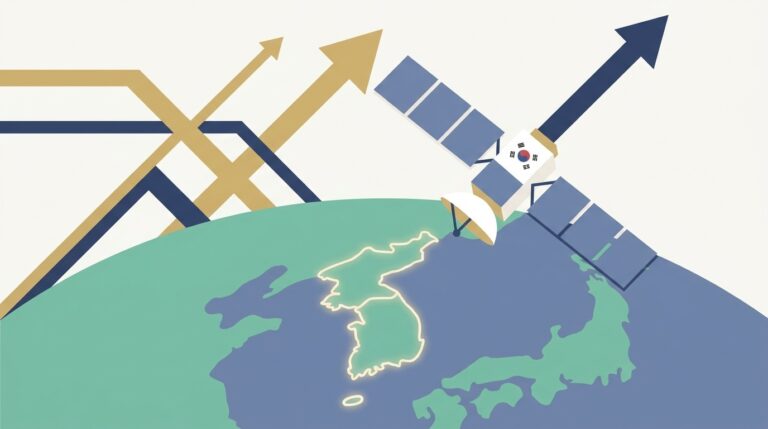
C2 Level Korean Mastery: Navigating the ‘New Space’ Era (뉴스페이스 시대)
안녕하세요! Daily Hangul editor here! 👋 Your trusty native Korean bestie and cultural navigator, ready to guide you through the stars.
Today, we are diving deep into a topic that is literally out of this world: The New Space Era (뉴스페이스 시대) and the fierce competition among private aerospace giants.
If you are operating at a C2 (Advanced/Mastery) level, you already know how to order food or ask for directions. But can you hold your own in a high-stakes debate about satellite constellations, reusable rockets, or corporate space duels?
When foreign executives or researchers join panels in Seoul, they often complain: “I know the technical terms in English, but I lack the sophisticated Korean framing to sound like an industry visionary.” Don’t worry! This guide is built from real-world collaborative workshops in Daejeon’s Daedeok Innopolis (Korea’s aerospace hub) to help you sound incredibly articulate, culturally nuanced, and visionary.
Phase 2: Core Expressions Deep Dive (핵심 표현 3선)
1. 독점 체제를 깨뜨리다 (dok-jeom che-jae-reul kkae-tteu-ri-da)
- Pronunciation: Dok-jeom che-jae-reul kkae-tteu-ri-da (Sounds like “dok-jum che-jae-rul kket-teu-ree-dah”)
- Meaning: To break a monopoly system.
- K-Culture Moment: You will hear this phrase constantly in Korean tech documentaries (like SBS Special or KBS Docu Insight) discussing how domestic startups challenge traditional aerospace conglomerates (chaebols) or global giants like SpaceX.
- Editor’s Insight: The verb 깨뜨리다 (to smash/break) adds a dramatic, dynamic flair compared to the standard 깨다. It implies a disruptive, revolutionary force entering a stagnant market.
- Situation Spectrum: Casual (⚠️ – too heavy) | Semi-formal (✅) | Formal (✅)
- 🤔 Think About It: How does your native language describe “market disruption”? In Korean, using physical verbs like ‘smash’ (깨뜨리다) or ‘shake’ (흔들다) highlights the intense kinetic energy of competitive market shifts.
2. 가성비를 극대화하다 (ga-seong-bi-reul geuk-dae-hwa-ha-da)
- Pronunciation: Ga-seong-bi-reul geuk-dae-hwa-ha-da (Sounds like “gah-sung-bee-rul guk-dae-hwah-hah-dah”)
- Meaning: To maximize cost-efficiency (value for money).
- K-Culture Moment: While ‘가성비’ started as consumer slang for cheap, good-quality food, in the context of the New Space era, even K-aerospace engineers seriously use it to describe the drastic cost reduction of reusable launch vehicles (재사용 발사체).
- Editor’s Insight: At the C2 level, pairing the colloquial noun 가성비 (cost-performance ratio) with the highly formal verb 극대화하다 (to maximize) showcases your ability to bridge high-tech industry discourse with realistic, pragmatic Korean business mindsets.
- Situation Spectrum: Casual (✅) | Semi-formal (✅) | Formal (✅)
- 🤔 Think About It: Why is efficiency so culturally valued in Korea? It stems from the rapid economic development era (한강의 기적), where maximizing limited resources was a matter of survival.
3. 우주 영토를 선점하다 (u-ju yeong-to-reul seon-jeom-ha-da)
- Pronunciation: U-ju yeong-to-reul seon-jeom-ha-da (Sounds like “oo-joo yung-toh-rul sun-jum-hah-dah”)
- Meaning: To preemptively occupy space territory.
- K-Culture Moment: Often used in Korean sci-fi cinematic blockbusters like The Space Sweepers (승리호) or news editorials discussing orbit allocations and lunar mining rights.
- Editor’s Insight: 영토 (territory) is traditionally terrestrial. Combining it with 우주 (space) and 선점하다 (to preemptively occupy/secure) creates a powerful, geopolitically charged metaphor that captures the urgency of the modern space race.
- Situation Spectrum: Casual (🚫) | Semi-formal (⚠️) | Formal (✅)
- 🤔 Think About It: Does the concept of “preemptive occupation” sound aggressive or proactive in your culture? In Korea, it represents strategic survival and forward-thinking vision.
Phase 3: Textbook Korean vs. Real-Life Korean
Situation 1: Discussing SpaceX’s market dominance
- 📖 Textbook: SpaceX는 우주 산업에서 매우 강력한 기업입니다. (SpaceX is a very powerful company in the space industry.)
- 🗣️ 진짜 한국어 (C2 Master): SpaceX가 우주 수송 시장의 판도를 바꾸며 독주하고 있습니다. (SpaceX is dominating the market, completely shifting the paradigm of space transportation.)
- 💡 Why the difference? Textbooks teach dry descriptions. Real-life business Korean utilizes dynamic idioms like 판도를 바꾸다 (to change the playing field/ paradigm shift) and 독주하다 (to run alone in the lead/dominate).
Situation 2: Emphasizing the cost reduction of rockets
- 📖 Textbook: 발사 비용을 낮추는 것이 매우 중요합니다. (Lowering launch costs is very important.)
- 🗣️ 진짜 한국어 (C2 Master): 발사 단가를 획기적으로 낮추는 것이 뉴스페이스 경쟁의 핵심 승부처입니다. (Drastically slashing launch unit costs is the ultimate game-changer in the New Space race.)
- 💡 Why the difference? C2 speakers use highly precise business terms like 발사 단가 (launch unit cost) and 승부처 (the decisive point of a match/game-changer) instead of basic verbs.
Phase 4: K-Culture Deep Dive & Non-Verbal Etiquette
4-1. Executive Non-Verbal Cues in Korean Tech Circles
When pitching or debating in Korea’s aerospace sector (such as at KARI – Korea Aerospace Research Institute):
* The “Thoughtful Nod” (끄덕임): Avoid aggressive, fast nodding, which can look impatient. A slow, deep nod while saying “음… 그렇군요” (Hmm… I see) shows intellectual respect and deep consideration of their technical stance.
* The Two-Handed Handout: When presenting satellite constellation blueprints or business cards, always present them with both hands, body slightly bent (about 15 degrees) as a sign of respect for their institutional standing.
4-2. The “Nuri-ho” (누리호) National Pride
Korea successfully launched its indigenous rocket, Nuri-ho (누리호). In Korean business culture, referring to this achievement shows you aren’t just looking at global companies like Blue Origin or SpaceX, but you genuinely respect Korea’s local engineering grit. Mentioning “누리호 발사 성공” as a milestone of domestic engineering will instantly win the hearts of your Korean counterparts.
Phase 5: Real-Life Roleplay Scenario
Setting: A high-level VIP networking lounge at the Seoul Aerospace Symposium.
Characters:
* 민우 (Min-woo): Chief Strategy Officer at a Korean aerospace startup.
* You (C2 level foreign researcher/investigator): A global aerospace consultant.
- 민우: 이번 뉴스페이스 포럼에서의 발표, 아주 인상 깊게 들었습니다. 한국의 발사체 스타트업들과의 협력 가능성에 대해 어떻게 보시나요?
(I found your presentation at the New Space forum highly impressive. How do you view the potential for collaboration with Korean launch vehicle startups?) -
You: 과찬이십니다, 민우 상무님. 한국 스타트업들의 기술적 집념이 글로벌 시장의 판도를 바꿀 잠재력이 있다고 봅니다.
(You flatter me, Director Min-woo. I believe the technical grit of Korean startups has the potential to change the global playing field.) -
민우: 🎭 (미소를 지으며 찻잔을 내려놓고) 좋게 봐주셔서 감사합니다. 하지만 글로벌 대기업들과의 가격 경쟁에서 살아남을 수 있을지가 늘 숙제입니다.
(Thank you for looking at us favorably. However, whether we can survive the price competition with global conglomerates is always our homework/challenge.) -
You: 결국 발사 단가의 획기적인 절감과 틈새시장의 선점이 핵심 승부처가 되겠지요.
(Ultimately, a drastic reduction in launch unit costs and preemptive occupation of niche markets will be the key game-changer.) -
민우: 맞습니다. 저희도 초소형 위성 군집(Constellation) 부문에서 가성비를 극대화하는 솔루션을 개발 중입니다.
(Exactly. We are also developing solutions to maximize cost-performance in the ultra-small satellite constellation sector.) -
You: 대기업들이 간과하는 커스텀 서비스를 제공한다면, 충분히 독점 체제를 깨뜨릴 수 있을 것입니다.
(If you provide customized services that conglomerates overlook, you will easily be able to break their monopoly.) -
민우: 아주 예리한 지적이십니다. 저희 기술 백서를 한번 검토해 주실 수 있으실까요?
(That is a very sharp observation. Would you mind reviewing our technical white paper?) -
You: 기꺼이 검토하겠습니다. 양국의 우주 영토 확장에 기여할 수 있는 기회가 되길 바랍니다.
(I would be glad to review it. I hope this becomes an opportunity to contribute to expanding the space territories of both our countries.)
🔀 Interactive Choice Point
How do you respond when Min-woo asks you for a follow-up private meeting?
- Option A: “일정이 바쁘니 이메일로 서류만 보내주세요.” (Send only documents via email since my schedule is busy.)
- Option B: “좋습니다! 다음 주에 대전 연구소로 직접 방문하여 심도 있게 논의하시죠.” (Great! Let’s meet directly at the Daejeon lab next week for a deep-dive discussion.)
- Option C: “네, 기회 되면 나중에 봐요.” (Yeah, let’s meet later if there’s a chance.)
Feedback on Choices:
- Option A (Risk): Too cold and transactional. In Korea, face-to-face trust-building (신뢰 구축) in high-tech sectors is paramount.
- Option B (Best): Offering to go down to Daejeon (the hub of aerospace R&D) shows immense dedication, professional courtesy, and deep cultural understanding.
- Option C (Bad): “나중에 봐요” (Let’s meet later) is too casual and non-committal for a professional C2 interaction.
Phase 6: 10-Second Emotion Shadowing Drill
Practice these high-level sentences with realistic emotional delivery! Pay attention to the pauses (/) and intonation indicators.
- [💪 Determined and Confident]
독자적인 / 기술력 확보 없이는 / 우주 영토를 / 선점할 수 없습니다.
(Without securing independent technological power, / we cannot / preemptively occupy / space territory.) -
[📈 Visionary and Strategic]
단순한 비용 절감을 넘어 / 가성비를 극대화하는 것이 / 뉴스페이스 시대의 / 핵심 생존 전략입니다.
(Beyond simple cost reduction, / maximizing cost-efficiency / is the core survival strategy / of the New Space era.)
Phase 7: K-Culture Mini-Dictionary
- 민간 주도 (Min-gan Ju-do) | Private-sector-led
- Shift from government-led (정부 주도) aerospace projects to commercially viable, entrepreneurial ventures.
- 독자 기술 (Dok-ja Gi-sul) | Proprietary/Independent Technology
- A source of massive pride for Korean engineers; doing things without relying on foreign licenses.
- 위성 군집 (Wi-seong Gun-jib) | Satellite Constellation
- Operating dozens or hundreds of small satellites in low Earth orbit for telecommunications and observation.
- 우주 강국 (U-ju Gang-guk) | Space Powerhouse
- Korea’s national strategic goal to become one of the top global nations in space technology.
Phase 8: Traveler’s Survival Kit (For Industry Experts)
Survival Phrases for Daejeon Aerospace District:
- “KARI(한국항공우주연구원) 본관으로 가주세요.”
- Pronunciation: KARI bon-gwan-eu-ro ga-ju-sae-yo.
- Pro Tip: Use this when taking a taxi from Daejeon Station.
- “보안 서약서는 어디서 작성하나요?”
- Pronunciation: Bo-an seo-yak-seo-neun eo-di-seo jak-seong-ha-na-yo?
- Pro Tip: “Where do I sign the NDA/security pledge?” Essential for entering aerospace facilities.
- “오늘 발표 자료는 대외비인가요?”
- Pronunciation: Oh-neul bal-pyo ja-ryo-neun dae-oe-bi-in-ga-yo?
- Pro Tip: “Is today’s presentation material confidential?” Shows impeccable professional ethics.
Editor’s Travel Note: When visiting aerospace labs in Daejeon, download the Kakao T Taxi App beforehand. English addresses can be tricky in industrial research complexes, so pinning the exact institute building name on the app will save your schedule!
Phase 9:
Frequently Asked Questions (FAQ)
Q: What does "독점 체제를 깨뜨리다 (dok-jeom che-jae-reul kkae-tteu-ri-da)" mean in Korean and how do you pronounce it?
A: In Korean, "독점 체제를 깨뜨리다 (dok-jeom che-jae-reul kkae-tteu-ri-da)" is pronounced [Dok-jeom che-jae-reul kkae-tteu-ri-da (Sounds like "dok-jum che-jae-rul kket-teu-ree-dah"] and means: To break a monopoly system.
Q: What does "가성비를 극대화하다 (ga-seong-bi-reul geuk-dae-hwa-ha-da)" mean in Korean and how do you pronounce it?
A: In Korean, "가성비를 극대화하다 (ga-seong-bi-reul geuk-dae-hwa-ha-da)" is pronounced [Ga-seong-bi-reul geuk-dae-hwa-ha-da (Sounds like "gah-sung-bee-rul guk-dae-hwah-hah-dah"] and means: To maximize cost-efficiency (value for money).
Q: What does "우주 영토를 선점하다 (u-ju yeong-to-reul seon-jeom-ha-da)" mean in Korean and how do you pronounce it?
A: In Korean, "우주 영토를 선점하다 (u-ju yeong-to-reul seon-jeom-ha-da)" is pronounced [U-ju yeong-to-reul seon-jeom-ha-da (Sounds like "oo-joo yung-toh-rul sun-jum-hah-dah"] and means: To preemptively occupy space territory.







