

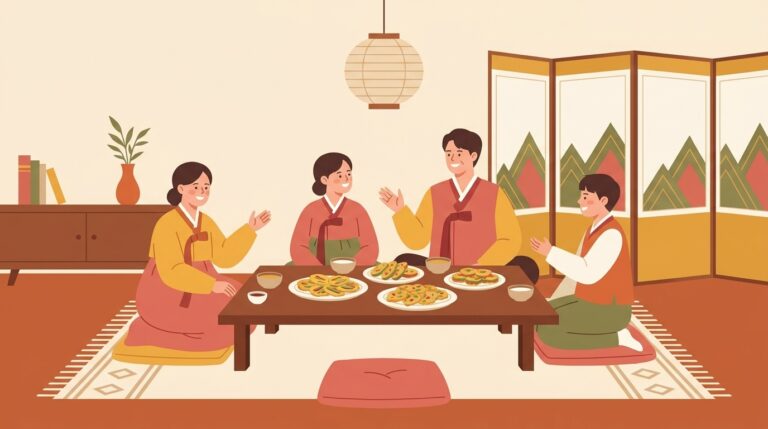
Phase 1: Empathy (Welcome to the Seollal Chaos!)
안녕하세요! (Annyeonghaseyo!) I’m your Daily Hangul editor and your personal Korean culture navigator.
Imagine this: It’s Seollal (설날 – Korean Lunar New Year). You step into a Korean household, and instead of a quiet, formal bow, you are hit with a wave of delicious smells of savory jeon (pan-fried delicacies), the loud clinking of plates, and a wall of sound—kids running around, aunts gossiping in the kitchen, and uncles passionately debating over a game of Yut Nori (윳놀이).
It is beautifully, wonderfully chaotic. In Korean, we call this 시끌벅적하다 (sikkeulbeokjeokhada).
If you’ve ever felt overwhelmed by the sheer volume of a Korean family gathering or worried about how to describe this warm, loud chaos to your friends without sounding rude, you are not alone! Many of our intermediate learners ask: “How do I describe a crowded, noisy, yet loving family gathering naturally?” Today, you’ll learn the exact phrases to express this lively atmosphere like a true local.
Phase 2: Top 3 Core Expressions Deep Dive
1. 시끌벅적하다 (Sikkeulbeokjeokhada)
- Pronunciation: [Sik-keul-beok-jeok-ha-da] (Sounds like “seek-ul-buck-juck-ha-da”)
- Meaning: Bustling, lively, and noisy (in a cheerful, crowded way).
- K-Culture Moment: You’ll hear this in slice-of-life K-Dramas like Reply 1988 when the whole neighborhood gathers in one living room to watch TV and eat together.
- Editor’s Insight: Unlike the English word “noisy” which often has a negative nuance, 시끌벅적하다 usually implies a warm, lively, and energetic atmosphere filled with people.
- Situation Spectrum: Casual (✅) | Semi-formal (✅) | Formal (⚠️ – use 시끌벅적합니다)
- 🤔 Think About It: Is there a word in your native language that describes a noise that actually makes you feel warm and happy inside?
2. 정신없다 (Jeongsin-eopda)
- Pronunciation: [Jeong-sin-eop-da] (Sounds like “jung-shin-up-da”)
- Meaning: Mindless, frantic, or hectically busy (literally: “to have no spirit/mind”).
- K-Culture Moment: Often used when a character is trying to cook five dishes at once while greeting incoming relatives, looking disheveled but smiling.
- Editor’s Insight: It is the perfect word to describe how your brain feels during a big family holiday. It’s not necessarily bad; it just means there is too much happening at once!
- Situation Spectrum: Casual (✅) | Semi-formal (✅) | Formal (⚠️)
- 🤔 Think About It: How does your culture view the chaos of holidays? Is “having no mind” seen as a fun family trait or pure stress?
3. 북적북적하다 (Bukjeokbukjeokhada)
- Pronunciation: [Buk-jeok-buk-jeok-ha-da] (Sounds like “book-juck-book-juck-ha-da”)
- Meaning: Crowded with people moving around busily; bustling.
- K-Culture Moment: Think of a traditional market scene during Seollal preparation, filled with shoppers bargaining for fresh ingredients.
- Editor’s Insight: This is a mimetic word (의태어) that mimics the visual movement of a crowd shifting and bustling around. It paints a very vivid picture!
- Situation Spectrum: Casual (✅) | Semi-formal (✅) | Formal (🚫)
- 🤔 Think About It: How do visual words in Korean make you picture a scene differently than in English?
Phase 3: Textbook Korean vs. Real-Life Korean
Situation 1: Describing a crowded living room
- 📖 Textbook Korean: “친척들이 많이 와서 거실이 복잡합니다.” (Many relatives came, so the living room is complicated/crowded.)
- 🗣️ 진짜 한국어: “친척들 다 모이니까 거실이 진짜 북적북적하네요!” (Since all the relatives are here, the living room is really bustling!)
- 💡 Why the difference? 복잡하다 (bopjap-hada) can sound cold or indicate a traffic jam/complicated problem. 북적북적하다 captures the warm, human energy of a family gathering.
Situation 2: Expressing that you are overwhelmed by the holiday rush
- 📖 Textbook Korean: “저는 지금 바쁩니다.” (I am busy right now.)
- 🗣️ 진짜 한국어: “명절이라 집이 진짜 정신없어요.” (Because of the holiday, the house is truly chaotic/frantic.)
- 💡 Why the difference? 바쁘다 (bappeuda) just means you have a lot of tasks. 정신없다 expresses your actual mental state amidst the lovely holiday chaos.
Phase 4: K-Culture Deep Dive & Non-Verbal Manners
4-1. The Art of Seollal Body Language
When the house is 시끌벅적, non-verbal communication is key.
* The Head Tilt & Smile: If an elder is talking to you from across a noisy room, nod slightly with a warm smile. It shows you are engaged even if you can’t hear every word over the TV and sizzle of the kitchen.
* The Active Listener’s “Ah~”: In Korean family gatherings, reacting with “아~ 진짜요?” (Ah~ really?) while leaning in slightly goes a long way in showing respect and warmth.
4-2. The Holiday Rhythm: Food and Games
In Korean culture, the noise of Seollal is driven by two things: Jeon (전) being fried on a large electric griddle on the living room floor, and the loud thuds of Yut Nori (윷놀이) sticks hitting the blanket. The chaos is a sign of a healthy, blessed family. If a house is quiet during Seollal, it’s actually considered a bit sad!
Phase 5: Real-Life Roleplay Scenario
Setting: You are visiting your Korean friend Minjun’s house during Seollal. The house is packed, children are laughing, and the kitchen is buzzing.
Characters:
* Minjun (민준): Your warm-hearted Korean friend who is slightly worried you might find his family too loud.
* You (Foreign Friend): A polite visitor experiencing a traditional Korean Seollal for the first time.
- 민준: (Sweating slightly, holding a plate of Jeon) “어휴, 우리 집 진짜 시끄럽지? 미안해, 명절이라 좀 정신이 없어.”
(Phew, our house is really loud, right? I’m sorry, because of the holiday it’s a bit hectic.) - You: (Laughing, shaking head) “아니에요! 오히려 시끌벅적해서 진짜 명절 같아요!”
(No way! On the contrary, because it’s so bustling, it feels like a real holiday!) - 민준: (Relieved, smiling) “다행이다! 저기 삼촌들이 윷놀이 시작하려나 봐. 같이 할래?”
(That’s a relief! Looks like my uncles are starting Yut Nori over there. Want to join?) - You: “네, 좋아요! 근데 저 룰을 잘 몰라요. 가르쳐 주세요.”
(Yes, I’d love to! But I don’t know the rules well. Please teach me.) - 민준: “쉽게 배울 수 있어! 던지기만 하면 돼. 가자!”
(You can learn easily! You just have to throw. Let’s go!) - You: (Walking to the living room) “와, 거실에 친척분들이 다 모여 계시네요. 정말 북적북적해요!”
(Wow, all your relatives are gathered in the living room. It’s really bustling!) - 민준: “응, 매년 이래. 귀가 아플 정도야!”
(Yeah, it’s like this every year. It hurts my ears!) - You: (Smiling warmly) “하하, 그래도 분위기가 너무 따뜻하고 좋아요.”
(Haha, but the atmosphere is so warm and nice.)
🔀 Choose Your Next Move!
- Option A: “너무 조용하면 심심하잖아요!” (If it’s too quiet, it’s boring!)
- Feedback (Best): Perfect! This shows you appreciate the energetic holiday spirit and makes the host feel proud of their lively family.
- Option B: “조금 피곤하네요.” (I am a bit tired.)
- Feedback (Risk): Honest, but might make the host feel uncomfortable or worried that they made you feel unwelcome.
- Option C: “시끄러우니까 조용히 해주세요.” (Since it’s loud, please be quiet.)
- Feedback (Bad): Oops! This is highly impolite in a family setting, especially to elders during a traditional holiday.
Phase 6: 10-Second Emotional Shadowing Drill
Practice reading these aloud with the correct emotion and rhythm! The / represents a natural pause.
- [😊 Expressing warm excitement]
“친척들이 다 모이니까 / 진짜 시끌벅적하고 / 좋네요!”
Chin-cheok-deul-i da mo-i-ni-kka / jin-jja sik-keul-beok-jeok-ha-go / jon-nae-yo!
(Since all the relatives are gathered, it’s really bustling and nice!) -
[🤯 Expressing playful overwhelm]
“우와, / 사람이 너무 많아서 / 진짜 정신없어요!”
U-wa, / sa-ram-i neo-mu manh-ah-seo / jin-jja jeong-sin-eop-seo-yo!
(Wow, there are so many people, it’s truly chaotic!)
Phase 7: K-Culture Mini Dictionary
- 윷놀이 (Yut Nori) | A traditional Korean board game played during Seollal using four wooden sticks instead of dice. It gets extremely loud and competitive!
- 전 (Jeon) | Savory Korean pancakes fried on a griddle. Cooking these is usually a group effort, contributing to the busy kitchen vibes.
- 세뱃돈 (Sebaetdon) | New Year’s money given by elders to children/young adults after receiving a formal bow (세배).
- 귀성길 (Gwiseonggil) | The massive rush of people traveling back to their hometowns during holidays, causing legendary traffic jams.
Phase 8: Survivor’s Kit for Travelers
Survival Phrases TOP 3
- “새해 복 많이 받으세요!” (Sae-hae bok manh-i bad-eu-se-yo!) | “Happy New Year!” (The ultimate Seollal greeting).
- “음식이 진짜 맛있어요!” (Eum-sik-i jin-jja mas-iss-eo-yo!) | “The food is really delicious!” (Guaranteed to make aunts smile).
- “제가 좀 도와드릴까요?” (Je-ga jom do-wa-deu-ril-kka-yo?) | “Shall I help you a bit?” (The polite way to offer help in a chaotic kitchen).
Editor’s Travel Note
During Seollal, Seoul temporarily becomes quiet as everyone heads to the provinces, but public transit can be tricky. Make sure to download the Naver Map App to check operating hours of buses and subways, as schedule changes often occur during national holidays. Note: Holiday operating hours may vary slightly; check the app’s real-time notices!
Phase 9: “Going One Step Deeper” (Cultural Reflection)
In Western cultures, holidays are often associated with quiet, cozy family dinners. In Korea, however, the concept of a successful holiday is deeply rooted in 정 (Jeong)—a feeling of collective warmth and bonding. A home that is 시끌벅적하다 signifies prosperity, health, and strong family ties. The noise is not an annoyance; it is the sound of life and connection.
💬 Your Turn: How does your family celebrate major holidays? Is it quiet and relaxed, or is it beautifully chaotic and 시끌벅적 like Seollal? Let us know in the comments below!
Phase 10: FAQ & Common Mistakes
Q: Can I use “시끄럽다” (sikkeureopda) to describe a family gathering?
A: It is risky. 시끄럽다 simply means “noisy” or “loud” and can sound like you are complaining. Use 시끌벅적하다 instead, as it highlights the lively, happy atmosphere of the crowd.
Q: What is the difference between “북적북적하다” and “복잡하다”?
A: 북적북적하다 focuses on a lively, bustling crowd of people (warm feeling). 복잡하다 refers to a complicated situation or a heavily congested space (neutral/stressful feeling).
Q: When is the best time to say “정신없다” without sounding rude?
A: You can say it when you want to politely explain why you are slightly distracted or busy. For example, “명절이라 정신이 없어서 연락을 늦게 드렸어요” (I was so hectic due to the holiday that I am replying late).
🚨 Common Mistakes Alert!
- Wrong: 거실이 너무 시끄러워요! (The living room is too noisy! – Sounds like a complaint.)
- Correct: 거실이 정말 시끌벅적하네요! (The living room is so bustling!)
- Wrong: 명절은 진짜 복잡해요. (Holidays are very complicated.)
- Correct: 명절이라 집이 북적북적해요. (Since it’s the holiday, the house is bustling.)
Phase 11: Action Mission!
- 🥉 Bronze: Say “시끌벅적하다” out loud 3 times focusing on the double consonants (ㄲ, ㅃ, ㅉ).
- 🥈 Silver: Write a sentence in the comments below describing your favorite busy place (e.g., a local market or festival) using 북적북적하다.
- 🥇 Gold: Next time you watch a K-Drama holiday scene, identify at least one moment where the characters look 정신없다 and write down what made them hectic!
Phase 12: Interactive Quiz Challenge
Test your Seollal knowledge!
1. Which word best describes a warm, lively, and crowded holiday house?
- A) 시끄럽다
- B) 조용하다
- C) 시끌벅적하다
2. Fill in the blank:
“설날이라 온 가족이 모여서 정말
____________ (bustling/crowded with people).”
3. True or False:
“정신없다” always means you are angry and stressed out. (T / F)
🔍 Click here to reveal the Answers & Explanations!
- Answer: C) 시끌벅적하다
- Explanation: C is the perfect word to describe a lively, cheerful crowd. A (시끄럽다) can sound too negative/annoyed.
- Answer: 북적북적해요 (or 북적북적합니다)
- Explanation: 북적북적하다 mimics the bustling movement of many relatives gathered in one place.
- Answer: False
- Explanation: 정신없다 simply means you are extremely busy or hectic. It’s often used in a lighthearted way to describe holiday preparations!
- Explanation: 정신없다 simply means you are extremely busy or hectic. It’s often used in a lighthearted way to describe holiday preparations!







