

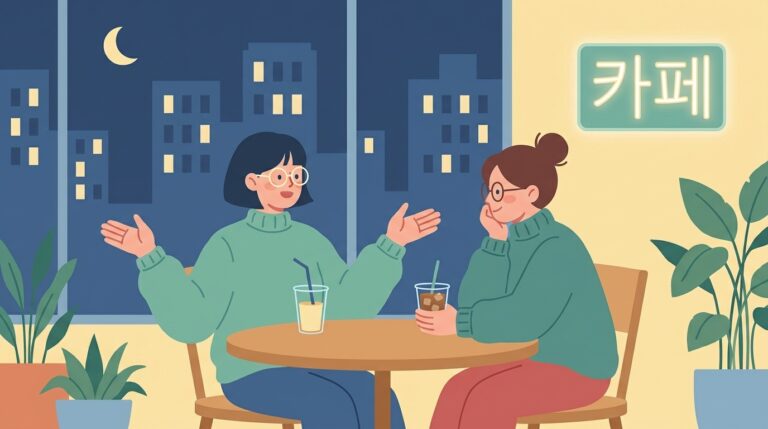
Stress Relief over Coffee: How to Spill the Tea with Your Korean Besties
Phase 1: Empathy (Welcome to the Ultimate Chattering Session!)
안녕하세요! (Annyeonghaseyo!) Your friendly neighborhood Korean editor at Daily Hangul is here!
We’ve all been there. You’ve had an incredibly long week. Your boss is micromanaging, your project deadline is looming, and your energy meter is at an absolute zero. You don’t need a fancy spa day; you just need to sit down in a cozy, dim-lit Korean café with your absolute best friend, order a freezing cold Ah-Ah (Iced Americano), and just talk it all out.
In Korea, we call this 수다 (suda – chattering/gossiping), and it is arguably the country’s most popular, budget-friendly therapy. But if you’re an intermediate Korean learner, you might find yourself stuck using textbook phrases like “저는 스트레스가 많아요” (I have a lot of stress), which sounds a bit too formal and detached for a late-night gossip session.
Today, we are diving deep into the cozy world of casual, emotional stress-venting in Korean. By the end of this guide, you’ll be venting like a native, complete with the perfect dramatic sighs and subtle cultural gestures!
Phase 2: Core Expressions Deep-Dive
Let’s look at three highly expressive, natural phrases that Koreans use to vent to their close friends.
1. 답답해 죽겠어 (dap-dap-hae juk-get-eo)
- Pronunciation: Dap-dap-hae jook-get-uh (Sounds like “dap-dap” – the sound of your chest being muffled or heavy, followed by “juk-get-eo” which literally means “I’m going to die”).
- Meaning: “I feel so suffocated/frustrated I could die!”
- K-Culture Moment: You will see this in almost every K-Drama when the main lead is frustrated by a misunderstanding or a stagnant situation at work. They will usually thump their chest gently while saying this.
- Editor’s Insight: “답답하다” is a unique Korean sensory word. It describes both physical stuffiness (like a room with no windows) and emotional frustration (when something isn’t going your way and you can’t do anything about it).
- Situation Spectrum: Casual (✅) / Semi-formal (⚠️ – only with very close senior coworkers) / Formal (🚫)
- 🤔 Think About It: Is there a single word in your language that perfectly bridges physical stuffiness and emotional frustration like “답답하다” does?
2. 말도 안 돼 (mal-do an dwae)
- Pronunciation: Mal-do an dweh (Say “mal” like the first syllable of “mall”, and “dwae” like “wet” without the ‘t’).
- Meaning: “No way!” / “That makes absolutely no sense!”
- K-Culture Moment: Used constantly in variety shows like Running Man when a ridiculous betrayal happens, accompanied by dramatic zoom-ins on the cast’s shocked faces.
- Editor’s Insight: Literally translated as “It cannot even become words.” Use this as an active listener to show your friend that you are 100% on their side and equally outraged by their situation.
- Situation Spectrum: Casual (✅) / Semi-formal (⚠️) / Formal (🚫)
- 🤔 Think About It: How does showing dramatic disbelief help strengthen friendships in your culture?
3. 스트레스 풀려 (seuteureseu pul-lyeo)
- Pronunciation: Seu-teu-reh-seu pool-lyuh (The “pul” part sounds like “pool” but with a shorter, crisper vowel).
- Meaning: “My stress is being relieved/undone.”
- K-Culture Moment: Usually sighed with relief after taking the first sip of a cold beer at a Han River picnic, or after singing your heart out in a Noraebang (Karaoke).
- Editor’s Insight: The verb “풀리다” means to be untied or unraveled (like a knot). To Koreans, stress is a tight knot in your chest, and chatting with friends helps “untie” it.
- Situation Spectrum: Casual (✅) / Semi-formal (✅) / Formal (⚠️ – as “스트레스가 풀립니다”)
- 🤔 Think About It: Why do you think Korean culture visualizes stress as a tight “knot” (풀리다) rather than something you “reduce” or “lose”?
Phase 3: Textbook Korean vs. Real-Life Korean
Let’s upgrade your textbook Korean to sound like a native friend!
Situation 1: Expressing that you had a very rough day at work.
- 📖 Textbook: “오늘 회사에서 스트레스를 많이 받았습니다.” (I received a lot of stress at work today.)
- 🗣️ Real-Life: “오늘 회사에서 진짜 멘붕 왔어.” (I seriously had a mental breakdown at work today.)
- 💡 Why the difference? “멘붕” (men-bung) is a portmanteau of “멘탈” (mental) and “붕괴” (collapse). It’s the ultimate modern slang for when a situation completely overwhelms you.
Situation 2: Asking your friend to listen to your problems.
- 📖 Textbook: “제 이야기를 들어주시겠습니까?” (Would you please listen to my story?)
- 🗣️ Real-Life: “나 오늘 대박 속상한 일 있어. 들어봐봐.” (Something super upsetting happened today. Listen to this.)
- 💡 Why the difference? Real friends don’t ask for permission to talk; they use soft commands like “들어봐봐” (listen-listen) to instantly hook the listener’s attention.
Phase 4: K-Culture Deep-Dive & Non-Verbal Manners
4-1. The Art of “Reaction” (리액션)
In Korean friend groups, being a good vent partner is 10% talking and 90% reacting.
* The Nod & Sigh: When your friend is venting, nod your head deeply, furrow your brow, and let out a soft “아… 진짜?” (Ah… really?).
* The Hand Clap: When they say something incredibly shocking, clap your hands once dramatically before expressing disbelief. It shows you are physically engaged in their story.
4-2. The Healing Menu: Maeun Eumsik (매운 음식)
When Koreans say “스트레스 풀러 가자” (Let’s go relieve some stress), they almost always head to a restaurant serving ridiculously spicy food. The burning sensation of Yeopgi Tteokbokki (엽기떡볶이) or Maeun Dakbal (Spicy Chicken Feet) releases endorphins that physicalize the stress relief. If you can’t handle spice, a sweet Croffle (Croissant-Waffle) at a trendy café in Yeonnam-dong is the next best choice!
Phase 5: Real-Life Roleplay Scenario
Meet Minji (민지), your Korean university classmate who is currently overwhelmed with group projects. You are meeting her at a café near Sinchon.
민지: 아... 나 진짜 요즘 조과제 때문에 스트레스 받아 미치겠어.
      (Ah... Na jin-ja yo-jeum jo-gwa-je ttae-mun-e seu-teu-reh-seu ba-da mi-chi-get-eo.)
      [🎭 Sighing deeply while resting her chin on her hand]
      "Ugh... I'm seriously going crazy from stress because of my group projects lately."

유저 (You): 진짜? 왜 무슨 일 있어?
            (Jin-ja? Wae mu-sun il is-seo?)
            [🎭 Looking concerned and leaning in closer]
            "Really? Why, did something happen?"

민지: 프리라이더(무임승차자)가 두 명이나 있어. 나 혼자 다 하는 중이야.
      (Free-rider-ga du myeong-i-na is-seo. Na hon-ja da ha-neun jung-i-ya.)
      [🎭 Shaking her head in disbelief]
      "There are literally two free-riders in my group. I'm doing everything by myself."

유저 (You): 헐, 진짜 말도 안 돼! 너무 답답하겠다.
            (Heol, jin-ja mal-do an dwae! Neo-mu dap-dap-ha-get-da.)
            [🎭 Clapping your hands once with a shocked expression]
            "What?! That makes absolutely no sense! You must feel so suffocated."

민지: 응, 진짜 대화방에서 읽씹(읽고 씹기) 하더라니까?
      (Eung, jin-ja dae-hwa-bang-e-seo ilk-ssip ha-deo-ra-ni-kka?)
      [🎭 Frowning as she shows you her phone screen]
      "Yeah, they literally read my messages and left me on read in the group chat!"

유저 (You): 와, 진짜 너무했다. 그냥 교수님한테 다 말해버려!
            (Wa, jin-ja neo-mu-haet-da. Geu-nyang gyo-su-nim-han-te da mal-hae-beo-ryeo!)
            [🎭 Making a fist to show solidarity]
            "Wow, that's way too much. Just go tell the professor everything!"

민지: 그럴까? 하... 그래도 너한테 다 털어놓으니까 속이 좀 시원하다.
      (Geu-reol-kka? Ha... Geu-rae-do neo-han-te da teo-reo-no-eu-ni-kka sog-i jom si-won-ha-da.)
      [🎭 Smiling gently, taking a sip of her iced coffee]
      "Should I? *Sigh*... Still, venting it all out to you makes me feel so much better."

유저 (You): 그치? 우리 단 거 먹고 스트레스 확 풀자!
            (Geu-chi? U-ri dan geo meok-go seu-teu-reh-seu hwak pul-ja!)
            [🎭 Pointing excitedly at the cake display counter]
            "Right? Let's eat something sweet and blow all this stress away!"
🔀 Interactive Choice Points
Now, how would you respond to Minji when she says she is doing all the work alone? Choose your path:
- A. “참고 열심히 해봐.” (Just endure it and work hard.)
- 🚫 Risk (Bad): Too robotic and realistic! Minji wanted emotional empathy, not a lecture on work ethic. The mood might turn icy.
- B. “헐, 진짜 양심 없다. 걔네 이름 빼버려!” (Whoa, they have no conscience. Drop their names!)
- ✅ Best (Perfect): High-level emotional alignment! Using “양심 없다” (no conscience) shows you are completely on her team.
- C. “원래 그룹 과제는 다 그래.” (That’s how group projects always are.)
- ⚠️ Caution (So-so): While true, this dismisses her feelings. It might make her feel like she’s complaining too much.
Phase 6: 10-Second Emotion Shadowing Drill
Let’s practice the dramatic rhythm of venting. Pause at the / marks and put 100% of your soul into the emotional bracket cues!
[🥺 Incredibly annoyed and whiny]
아… 나 / 진짜 / 스트레스 받아 / 미치겠어!
(Ah… na / jin-ja / seu-teu-reh-seu ba-da / mi-chi-get-eo!)-
[😮 Shocked and outraged on behalf of your friend]
헐, / 진짜 / 말도 안 돼! / 걔네 / 너무했다!
(Heol, / jin-ja / mal-do an dwae! / Gyae-ne / neo-mu-haet-da!) -
[😌 Deeply relieved and refreshed]
휴… / 다 얘기하니까 / 속이 / 시원하다!
(Hyu… / da yae-gi-ha-ni-kka / sog-i / si-won-ha-da!)
Phase 7: K-Culture Mini-Dictionary
- 수다 (Suda): Idle chatter or gossiping. It’s the ultimate social lubricant in Korea.
- 속앓이 (Sok-al-i): Bottling up worries inside without telling anyone. (Literally: “inner-illness”).
- 읽씹 (Ilk-ssip): Reading a message and ignoring it (Left on read). Highly offensive in tight Korean social circles!
- 소화제 (Sohwaje): Literally digestive medicine, but figuratively used to describe a friend or situation that instantly clears away your worries and makes you feel lighter.
Phase 8: Survivor Kit for Travelers
Survival Phrases TOP 3
- 매운 것 당겨 (Mae-un geot dang-gyeo): “I’m craving something spicy.” (Say this when you’re stressed).
- 맥주 한잔 고? (Maek-ju han-jan go?): “Beer tonight, go?” (The easiest invitation to a venting session).
- 내 말이! (Nae mal-i!): “Exactly my point!” / “That’s what I’m saying!” (The absolute best reaction word to support your friend).
Editor’s Travel Note
If you are feeling stressed during your trip to Seoul, don’t stay in your hotel room. Download the Naver Map App and search for a local “Coin Noraebang” (코인노래방). For just 1,000 KRW, you can sing three songs at the top of your lungs in a private booth. It is the ultimate solo Korean stress reliever!
Phase 9:
Frequently Asked Questions (FAQ)
Q: What does "답답해 죽겠어 (dap-dap-hae juk-get-eo)" mean in Korean and how do you pronounce it?
A: In Korean, "답답해 죽겠어 (dap-dap-hae juk-get-eo)" is pronounced [Dap-dap-hae jook-get-uh (Sounds like "dap-dap" - the sound of your chest being muffled or heavy, followed by "juk-get-eo" which literally means "I'm going to die"] and means: "I feel so suffocated/frustrated I could die!"
Q: What does "말도 안 돼 (mal-do an dwae)" mean in Korean and how do you pronounce it?
A: In Korean, "말도 안 돼 (mal-do an dwae)" is pronounced [Mal-do an dweh (Say "mal" like the first syllable of "mall", and "dwae" like "wet" without the 't'] and means: "No way!" / "That makes absolutely no sense!"
Q: What does "스트레스 풀려 (seuteureseu pul-lyeo)" mean in Korean and how do you pronounce it?
A: In Korean, "스트레스 풀려 (seuteureseu pul-lyeo)" is pronounced [Seu-teu-reh-seu pool-lyuh (The "pul" part sounds like "pool" but with a shorter, crisper vowel] and means: "My stress is being relieved/undone."







