

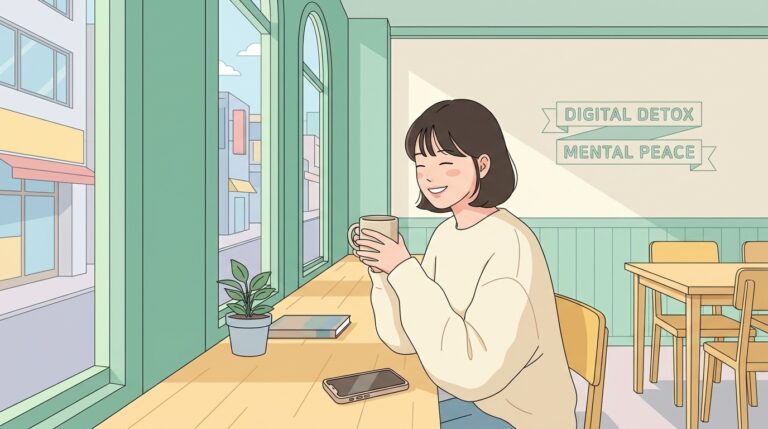
Step Away from the Feed: Navigating ‘SNS Fatigue’ and Account Deactivation in Korea (SNS 피로감과 계정 비활성화)
Phase 1: Empathy (공감) — The Digital Detox Dilemma
안녕하세요! Daily Hangul editor and your trusted K-culture navigator here!
Have you ever found yourself mindlessly scrolling through Instagram, KakaoStory, or Threads, only to feel an inexplicable sense of emptiness? You see your friends dining at the trendiest cafes in Seongsu-dong, or a colleague posting their third luxury vacation of the year with hashtags like #소확행 (Small but Certain Happiness) and #갓생 (God-Life/Productive Life). Suddenly, a wave of exhaustion hits you.
You are not alone. In Korea, one of the most hyper-connected societies in the world, a growing number of people are experiencing ‘SNS 피로감’ (SNS Fatigue). To protect their mental peace, many are choosing to temporarily disappear from the digital world—a phenomenon known as ‘계정 비활성화’ (Account Deactivation) or simply ‘비활’ (Bi-hwal).
Our advanced C2 learners often tell us: “I want to explain why I’m taking a break from social media to my Korean friends, but translating ‘I’m deactivating my account because of digital fatigue’ sounds so clinical and stiff!”
Today, we are going to dive deep into the highly nuanced, sophisticated vocabulary and cultural subtexts that Korean urbanites use when they decide to go ‘off the grid.’ By the end of this guide, you’ll be able to discuss digital burnout, social media envy, and personal boundaries with the eloquence and depth of a native speaker.
Phase 2: In-Depth Analysis of 3 Key Expressions (핵심 표현 3선 심층 분석)
1. 현타가 오다 (Hyeonta-ga Oda)
- Pronunciation: [Hyeon-ta-ga o-da] (Sounds like “hyon-tah-gah oh-dah”)
- Meaning: To hit a reality check; to experience a sudden wave of disillusionment or clarity after being obsessed with something trivial (e.g., social media curation).
- K-Culture Moment: In K-Dramas, you’ll often see a character scrolling through their feed at 2 AM, looking at others’ glamorous lives, then looking down at their own instant ramen bowl and sighing: “아, 진짜 현타 온다…” (Ah, I’m getting a massive reality check…).
- Editor’s Insight: Originating from ‘현자타임’ (Wise Man Time), this slang has evolved into a highly versatile C2-level term. It describes that precise moment of cognitive dissonance when you realize the digital world you are obsessing over is merely an illusion.
- Situation Spectrum:
- Casual: ✅ (Extremely common among friends)
- Semi-formal: ⚠️ (Can be used in casual office chats, but avoid in official reports)
- Formal: 🚫
- 🤔 Think About It: How does your native language express that sudden, sobering realization that you’ve been wasting time on digital illusions? Is it as visceral as ‘현타’?
2. 계정을 비활성화하다 / 비활타다 (Gyejeong-eul Bihwalseonghwa-hada / Bihwal-tada)
- Pronunciation: [Gye-jeong-eul Bi-hwal-seong-hwa-ha-da / Bi-hwal-ta-da] (Sounds like “gyuh-jung-eul bee-hwal-sung-hwa-hah-dah”)
- Meaning: To deactivate an account / (Slang) To go into deactivation mode.
- K-Culture Moment: On modern web dramas, characters don’t just say they deleted an app. They say, “나 인스타 비활탔어” (I went into Insta deactivation mode) to signal that they are taking a mental health break without permanently deleting their memories.
- Editor’s Insight: While ‘비활성화하다’ is the formal IT term, the colloquial verb construction ‘비활(을) 타다’ (using ‘타다’ which usually means ‘to ride’ or ‘to catch an vibe/trend’) shows an active lifestyle choice. It implies a temporary, trendy retreat rather than a permanent digital death.
- Situation Spectrum:
- Casual: ✅ (Use ‘비활타다’ with peers)
- Semi-formal: ✅ (Use ‘계정 비활성화했어요’ with colleagues)
- Formal: ✅ (Use ‘계정 비활성화’ in technical/academic contexts)
- 🤔 Think About It: Why do you think modern societies need a ‘temporary’ death (deactivation) rather than a permanent exit (deletion) from social media?
3. 피로감을 호소하다 (Pirogam-eul Hoso-hada)
- Pronunciation: [Pee-ro-gam-eul Ho-so-hada] (Sounds like “pee-roh-gahm-eul ho-soh-hah-dah”)
- Meaning: To complain of/express deep fatigue or exhaustion (typically toward a systemic or social issue).
- K-Culture Moment: You will see this headline daily in Korean editorials: “MZ세대, 끊임없는 비교에 SNS 피로감 호소” (MZ Generation expresses fatigue over constant social media comparison).
- Editor’s Insight: At the C2 level, you should move beyond simple verbs like ‘힘들다’ (to be hard) or ‘피곤하다’ (to be tired). ‘호소하다’ (to appeal/plead/complain of) elevates your speech, showing that the fatigue is a serious, felt burden that you are actively voicing.
- Situation Spectrum:
- Casual: ⚠️ (Sounds a bit too dramatic for casual banter unless used ironically)
- Semi-formal: ✅ (Perfect for intellectual discussions)
- Formal: ✅ (Standard journalistic and academic expression)
- 🤔 Think About It: In Korean culture, directly stating physical or emotional fatigue through ‘호소하다’ often invites empathy and validation from the collective group. How does your culture view admitting digital burnout?
Phase 3: Textbook Korean vs. Real Korean (교과서 한국어 vs. 진짜 한국어)
Situation 1: Explaining why you aren’t active on Instagram lately
- 📖 Textbook Korean: “소셜 미디어를 너무 많이 해서 피곤해요. 그래서 당분간 사용하지 않기로 했습니다.”
(I am tired because I used social media too much. So I decided not to use it for a while.) - 🗣️ 진짜 한국어: “인스타 피드 보고 있으면 남이랑 끊임없이 비교하게 돼서 현타 오더라고요. 그래서 그냥 당분간 비활타기로 했어요.”
(Looking at my Insta feed, I kept constantly comparing myself to others, which gave me a total reality check. So I just decided to go into deactivation mode for the time being.) - 💡 Why the difference? The textbook version is grammatically flawless but sounds like an automated email responder. The real Korean version uses ‘현타 오다’ and ‘비활타다’ to convey the emotional driver behind the digital detox in a way that resonates instantly with modern Koreans.
Situation 2: Discussing digital boundaries at work with colleagues
- 📖 Textbook Korean: “메신저 연락이 밤늦게 오면 스트레스를 받습니다.”
(I get stressed when messenger contacts come late at night.) - 🗣️ 진짜 한국어: “퇴근 후에도 끊임없이 울리는 단톡방 때문에 디지털 피로감을 호소하는 직장인들이 정말 많아요. 저도 가끔은 알림을 꺼두고 디지털 디톡스를 하려고 노력해요.”
(There are so many office workers expressing digital fatigue due to group chats that keep ringing even after work. I also try to turn off notifications and do a digital detox sometimes.) - 💡 Why the difference? C2 speakers should be able to articulate social phenomena. Using terms like ‘디지털 피로감’ and ‘디지털 디톡스’ frames your personal preference as a universally understood social issue, making your boundary-setting sound professional and logical.
Phase 4: K-Culture Deep Dive & Non-verbal Etiquette (K-컬처 딥다이브)
4-1. The Art of “읽씹” (Read-and-Ignore) and Digital Satiety
In Korea’s fast-paced digital culture, leaving someone on ‘Read’ (읽고 씹기, abbreviated as ‘읽씹’) or leaving a message unread for too long (‘안읽씹’) can sometimes carry heavy social consequences. When someone ‘비활탄다’ (deactivates), it is often a polite, preemptive strike. By deactivating, they signal to their social circle: “It’s not that I am ignoring you specifically; I have temporarily opted out of the entire system for my own well-being.”
4-2. Cultural Code: The ‘God-Life’ (갓생) vs. ‘Salami’ Burnout
While the concept of ‘갓생’ (living a highly productive, perfect life) dominates Korean social media, it has created a massive backlash of silent exhaustion. Modern K-Dramas like Our Blues or Summer Strike show characters who literally pack up, deactivate their digital lives, and move to remote seaside towns just to breathe. Admitting you are doing a digital detox is no longer seen as being anti-social; it is respected as a highly sophisticated act of self-care.
Phase 5: Real-Life Roleplay Scenario (실전 롤플레이 시나리오)
Context:
Ji-woo (a trendy Seoulite who is chronically online) notices that her close friend, Sophia (the user/C2 learner), has suddenly vanished from Instagram. They meet at a cafe in Hapjeong to catch up.
Characters:
- 지우 (Ji-woo): Chronically online, sensitive to digital trends, worries easily.
- 소피아 (Sophia – You): Seeking digital peace, reflective, highly articulate.
지우: (커피를 마시며 걱정스러운 눈빛으로) 소피아, 너 인스타 계정 해킹당했어? 피드가 아예 안 뜨더라.
      (Sophia, did your Insta get hacked? Your feed isn't showing up at all.)

소피아: (안도하는 듯이 웃으며) 아, 해킹당한 거 아니고, 내가 직접 비활탄 거야.
        (Ah, it's not hacked, I actually went into deactivation mode myself.)

지우: (눈을 동그랗게 뜨며) 진짜? 왜? 너 인스타로 소통하는 거 좋아했잖아. 무슨 일 있었어?
      (Really? Why? You used to love communicating via Insta. Did something happen?)

소피아: (차분하게 손짓하며) 특별한 일은 없었고... 그냥 매일 폰만 붙잡고 남들 사는 거 보니까 나도 모르게 현타가 오더라고.
        (Nothing special... It's just that holding my phone every day and looking at how others live, I unconsciously got a total reality check.)

지우: (깊이 공감하며 고개를 끄덕인다) 아... 무슨 느낌인지 재질 재질 RGRG(알지알지). 나도 가끔 피드 보면서 '나만 정체되어 있나' 싶을 때 있거든.
      (Ah... I totally get what you mean, I feel you. Sometimes when I look at the feed, I wonder, 'Am I the only one stagnant?')

소피아: 맞아. 남들의 '하이라이트 릴'이랑 내 '비하인드 씬'을 비교하게 되니까 디지털 피로감을 많이 호소하게 되더라고.
        (Exactly. Because I end up comparing other people's 'highlight reels' with my 'behind-the-scenes,' I found myself expressing a lot of digital fatigue.)

지우: 현명하다, 소피아. 나도 가끔은 비활타고 디지털 디톡스 좀 해야겠어. 폰 중독에서 벗어나기가 쉽지 않네.
      (You are wise, Sophia. I should also deactivate sometimes and do a digital detox. It's not easy to break away from phone addiction.)

소피아: (미소를 지으며) 응, 확실히 비활타니까 내 호흡대로 하루를 살게 돼서 마음이 편해. 너도 일주일만 딱 해봐!
        (Yeah, definitely, ever since I deactivated, I live the day at my own pace, so my mind is at ease. You should try it for just one week!)
🔀 Interactive Branching Points
How would you respond if Ji-woo asks: “But what if people think you are ignoring them?” (그래도 연락 안 되면 사람들이 섭섭해하지 않아?)
- Option A (The Diplomatic Approach): “진짜 친한 사람들은 내 번호 아니까 연락할 수 있어.” (The real friends have my number, so they can contact me.)
- Feedback: Best. Grounded and clear. It emphasizes genuine connection over superficial digital ties.
- Option B (The Overly Indifferent Approach): “신경 안 써. 귀찮아.” (I don’t care. It’s too annoying.)
- Feedback: Bad. Sounds a bit cold and dismissive in Korean, which might make Ji-woo feel self-conscious about her own digital habits.
- Option C (The Philosophical Approach): “인간관계도 가지치기가 필요한 법이니까.” (Relationships need pruning too, after all.)
- Feedback: Risk. Highly sophisticated, but can sound overly cynical or dramatic depending on your tone.
Phase 6: 10-Second Emotional Shadowing Drill (10초 감정 섀도잉 드릴)
To master C2-level emotional delivery, practice pausing and exaggerating the intonation of these phrases.
- Sentences 1 (With a sigh of realization):
- “매일 / 남들 / 잘 사는 것만 보니까 / 진짜 / 현타가 오더라고요.“
- Intonation Landmark:
[🥺 Exhausted & reflective]Slowly drop your pitch at ‘현타가 오더라고요’ to show authentic fatigue.
- Sentences 2 (With a bright, liberating smile):
- “당분간 / 비활타고 / 나만의 시간에 / 집중해 보려고요!”
- Intonation Landmark:
[😊 Relieved and empowering]Keep the tone high and bouncy on ‘비활타고’ to express freedom.
Phase 7: K-Culture Mini-Dictionary (K-컬처 미니 사전)
- 눈팅 (Nunting): | Lurking / Silent scrolling | Reading posts or stories without leaving any trace, likes, or comments.
- 공공의 안녕 (Gong-gong-ui Annyeong): | Public peace / Personal peace | While historically meaning public security, youth ironically use it to describe their internal state of mental peace: “내 안녕을 위해 비활탄다.”
- 인만추 (In-man-chu): | Seeking relationships naturally on social media (인스타 만남 추구) | Opposite of meeting organically in real life; explains why digital detoxes can sometimes feel like social isolation.
- 도파민 중독 (Dopamine Jungdok): | Dopamine addiction | The absolute buzzword in Korea right now, used to describe the constant craving for short-form content (Shorts, Reels).
Phase 8: Traveler’s Survival Kit (여행자를 위한 생존 키트)
Even during a digital detox, a traveler in Korea needs essential utilities to navigate physically.
Survival Expressions for the Digital Minimalist
- “여기 와이파이 비밀번호가 어떻게 돼요?”
- Rom: Yeogi wifi bimilbeonhoga eotteoke doeyo?
- Pro Tip: Essential even for minimalists to check maps.
- “충전 좀 부탁드려도 될까요?”
- Rom: Chungjeon jom butakdeuryeodo doelkkayo?
- Pro Tip: In Korean cafes, they will often gladly charge your phone behind the counter.
- “길 좀 여쭤봐도 될까요?”
- Rom: Gil jom yeojjeobwado doelkkayo?
- Pro Tip: If you deactivated your maps for a true analog detox, ask a local directly with this polite phrase.
Editor’s Travel Note:
If you want a physical, real-world detox without getting lost, we recommend installing the Naver Map App (네이버 지도) for flawless pedestrian navigation in Seoul, and Kakao T (카카오 T) for booking taxis. Even when your social accounts are deactivated, these survival apps will keep you safe!
Phase 9: “Going Deeper” — Reflections on Korea’s Hyper-Connectivity
Korea is globally praised for its lightning-fast internet and seamless digital infrastructure. However, this absolute connectivity means that the boundary between private life and social scrutiny is incredibly thin. The pressure to present a curated, successful self online—coupled with the collective consciousness of Korean society—makes ‘비활성화’ (deactivation) a vital psychological shield. It is a modern coping mechanism where stepping back is the only way to move forward.
💬 Your Turn: Have you ever felt ‘SNS fatigue’? Would you ever ‘비활타다’ (deactivate) to protect your mental peace? Let us know in the comments below!
Phase 10: FAQ & Common Mistakes (자주 묻는 질문과 오해 방지)
Q: Is ‘비활타다’ used in professional writing?
A: No. ‘비활타다’ is highly colloquial slang. In professional settings, academic essays, or news articles, you must use ‘계정을 비활성화하다’ (to deactivate an account) or ‘소셜 미디어 사용을 중단하다’ (to cease social media usage).
Q: What is the difference between ‘탈퇴’ and ‘비활성화’?
A: ‘탈퇴’ (Tal-toey) means permanent deletion/membership withdrawal. ‘비활성화’ (Bi-hwal-seong-hwa) means temporary deactivation. Be careful: if you tell your friend “나 인스타 탈퇴했어,” they will think you deleted your account forever!
Q: Can I use ‘현타 오다’ to a superior at work?
A: It is highly discouraged. ‘현타 오다’ is slang. If speaking to a boss, express the same feeling of reality check by saying: “현실을 직시하게 되었습니다” (I came to face reality) or “제 자신을 돌아보게 되었습니다” (I came to reflect on myself).
🚨 Common Mistakes Warning Board
- Mistake 1: Saying “나 비활성화했어” without a noun.
- Correct Action: Say “나 계정 비활성화했어” (I deactivated my account) or simply use the slang “나 비활탔어.”
- Mistake 2: Confusing ‘피곤하다’ (physically sleepy) with ‘피로감을 느끼다’ (experiencing mental/systemic fatigue).
- Correct Action: For social media burnout, use “SNS 피로감을 느껴요.”
- Mistake 3: Saying “인스타를 꺼놨어” to mean deactivation.
- Correct Action: “인스타 꺼놨어” just means you turned off notifications. Use “인스타 비활 걸어놨어” (I put my Insta on deactivation).
Phase 11: Action Mission & K-Culture Hunt
- Bronze Mission: Say “나 요즘 SNS 피로감 느껴” (I feel SNS fatigue these days) aloud 3 times with a dramatic sigh.
- Silver Mission: Send a message to your language exchange partner: “나 당분간 디지털 디톡스 하려고 비활탈까 봐.” (I think I might deactivate to do a digital detox for a while.) and observe their reaction.
- Gold Mission: Go to Instagram or Threads, find a Korean post about digital detoxing, and write a comment: “진짜 현타 올 때가 있죠. 저도 가끔 비활타요.” (There are times when reality hits hard. I also deactivate sometimes.)
🎮 K-Culture Mission: Watch a modern slice-of-life K-Drama (like Work Later, Drink Now). Listen carefully for when characters mention their phones, and see if you can catch the word ‘현타’ or ‘비활’!
Phase 12: Interactive Quiz Challenge (인터랙티브 퀴즈)
1. Situation Quiz
Your friend says they deleted their social media permanently because they were sick of it. Which word did they most likely use?
* A) 비활
* B) 탈퇴
* C) 로그아웃
👉 Click to reveal the Answer & Explanation
Correct Answer: B) 탈퇴 (Tal-toey)
Explanation: ‘탈퇴’ means permanent account deletion/withdrawal. ‘비활’ is temporary, and ‘로그아웃’ is simply logging out.
2. Fill-in-the-blank
“남들의 화려한 일상과 내 일상을 비교하다 보니 결국
_______________(이)가 와서 계정을 비활성화했다.”
(Comparing others’ glamorous lives with mine, I eventually got a reality check and deactivated my account.)
👉 Click to reveal the Answer & Explanation
Correct Answer: 현타 (Hyeonta)
Explanation: ‘현타가 오다’ is the perfect colloquial expression to describe that sudden reality check/disillusionment from digital comparisons.
3. True or False
True or False: ‘비활타다’ is an appropriate phrase to use in a job interview when describing how you handle stress.
👉 Click to reveal the Answer & Explanation
Correct Answer: False
Explanation: ‘비활타다’ is casual slang. In a job interview, you should say “스트레스 관리를 위해 일시적으로 소셜 미디어를 멀리하고 책을 읽습니다” (I temporarily distance myself from social media to manage stress and read books).






