

Mastering Seollal: Bow Like a Local and Get Sebaetdon on Korean New Year
Phase 1: Empathy (Welcome to the Seollal Family Circle!)
안녕하세요! Hello! I’m your lead editor at Daily Hangul.
Imagine this: You’ve been invited to your Korean friend’s family home for Seollal (설날 – Lunar New Year). The fragrant, savory aroma of freshly pan-fried Jeon (pancakes) and rich Tteokguk (rice cake soup) fills the cozy living room. The laughter of relatives echoes around you.
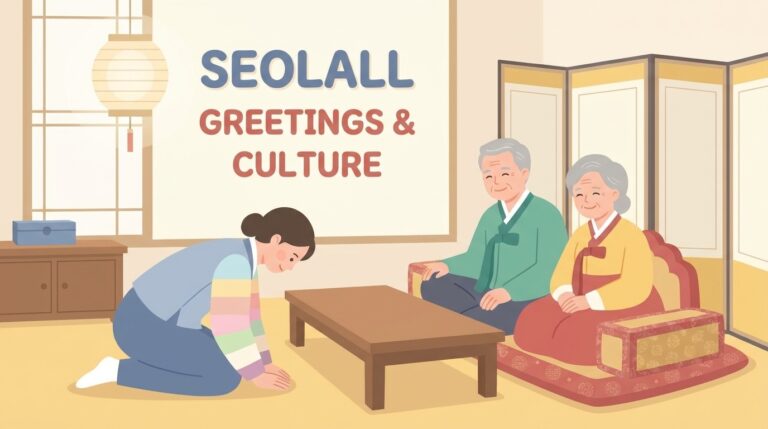
Suddenly, a hush falls over the room. The grandparents sit gracefully on silk cushions. Everyone begins lining up to perform a deep, formal bow on the floor. Your heart starts pounding. Which knee goes down first? Where do my hands go? What on earth do I say to the elders?
If you’ve felt a wave of panic thinking about traditional Korean etiquette, you are not alone. Many of our intermediate learners have shared how terrifying it feels to navigate these highly formal family rituals. But don’t worry! This guide is your ultimate cheat sheet, designed to help you bow with absolute grace, deliver heartfelt wishes, and receive that coveted crisp envelope of cash (세뱃돈 – Sebaetdon) like a true family member. Let’s dive in!
Phase 2: Deep Dive into 3 Key Expressions
1. 새해 복 많이 받으세요 (Sae-hae bok man-hi bat-eu-se-yo)
- Pronunciation: Sae-hae bok mah-nee bah-deu-seh-yo (Sounds like “Say-hay bok mah-nee bah-deu-say-yo”)
- Meaning: Direct: “Please receive a lot of good fortune in the New Year.” / Nuance: The classic, indispensable Lunar New Year greeting.
- K-Culture Moment: This is the phrase shouted in unison by K-pop idols in their annual holiday Hanbok greetings on YouTube.
- Editor’s Insight: This isn’t a passive “Happy New Year.” By saying this, you are actively wishing blessings, luck, and prosperity upon the listener.
- Situation Spectrum: Casual (⚠️ only with close friends in informal ban말: 새해 복 많이 받아), Semi-formal (✅), Formal (✅ 새해 복 많이 받으십시오)
- 🤔 Think About It: While English speakers simply wish a “happy” year, Koreans focus on receiving and sharing blessings (복). How does this reflect the deep-rooted collectivist warmth of Korean society?
2. 건강하고 행복하세요 (Geon-gang-ha-go haeng-bok-ha-se-yo)
- Pronunciation: Gun-gang-hah-go haeng-bok-hah-seh-yo
- Meaning: Direct: “Please be healthy and happy.” / Nuance: A warm, loving follow-up wish typically said to elders right after the bow.
- K-Culture Moment: In family K-dramas, you’ll see a young grandchild say this, prompting the grandmother to smile warmly and reach into her pocket for the money envelope.
- Editor’s Insight: It is simple, sweet, and highly effective. Elders prioritize health above all else, so wishing them 건강 (health) is the ultimate sign of care.
- Situation Spectrum: Casual (⚠️), Semi-formal (✅), Formal (✅ 건강하고 행복하시기를 바랍니다)
- 🤔 Think About It: Why is physical well-being always placed before emotional happiness in traditional Korean wishes?
3. 세배 드렸습니다 (Sae-bae deu-ryeot-seum-ni-da)
- Pronunciation: Sae-bae deu-ryeot-sum-nee-dah
- Meaning: Direct: “I have offered you a formal bow.” / Nuance: Politely announcing or speaking about the act of bowing to elders.
- K-Culture Moment: When uncles and aunts arrive late, you might tell them you’ve already paid your respects to the grandparents using this polite past-tense phrase.
- Editor’s Insight: The verb 드려요 is the humble counterpart of 주다 (to give). Using it frames your physical bow as a respectful gift of honor.
- Situation Spectrum: Casual (🚫), Semi-formal (✅), Formal (✅)
- 🤔 Think About It: Respect is woven deeply into Korean grammar. How does choosing a humble verb over a standard one change the atmosphere of a room?
Phase 3: Textbook Korean vs. Real Korean
Situation 1: Wishing elders a long, healthy life
- 📖 Textbook Korean: “만수무강 하십시오.” (Man-su-mu-gang ha-ship-si-o – “Live for ten thousand years without illness.”)
- 🗣️ Real Korean: “올해도 건강하게 저희 곁에 있어 주세요.” (Ol-hae-do geon-gang-ha-ge jeo-hui gyeot-e isseo ju-se-yo – “Please stay healthy by our side again this year.”)
- 💡 Why the difference? While “만수무강” is grammatically correct, it sounds incredibly archaic—like you are a character in a historical K-Drama (사극) addressing the King! Modern Koreans prefer natural, emotional warmth that emphasizes the bond between family members.
Situation 2: Receiving the Sebaetdon (New Year money)
- 📖 Textbook Korean: “돈을 주셔서 감사합니다.” (Don-eul ju-shyeo-seo gam-sa-ham-ni-da – “Thank you for giving me money.”)
- 🗣️ Real Korean: “덕담 감사합니다. 유용하게 잘 쓸게요!” (Deok-dam gam-sa-ham-ni-da. Yu-yong-ha-ge jal sseul-ge-yo! – “Thank you for the warm words of wisdom. I will use it wisely!”)
- 💡 Why the difference? Directly mentioning cash (돈) can come across as slightly impolite or greedy. Referring instead to their 덕담 (blessings/advice) shows maturity, highlighting that you value their wisdom more than the envelope’s contents.
Phase 4: K-Culture Deep Dive & Non-Verbal Manners
4-1. Nunchi & Gesture (How to Do the Perfect Saebae Bow)
To pull this off seamlessly, you must master the precise physical mechanics of Sae-bae (세배):
1. The Hand Secret (Gong-su): Pay close attention! For boys, place your left hand over your right hand. For girls, place your right hand over your left hand. (Reversing this is actually done at funerals, so this detail is crucial!).
2. The Descent: Bring your hands up to chest level, then slowly bend your knees. Lower your left knee first, then your right knee. Sit down gently on your heels.
3. The Bow: Bend forward from the waist, bringing your head down toward the back of your hands. Keep your hips low. Hold this deep posture for 2 seconds.
4. The Rise: Slowly raise your upper body. Stand up by lifting your right knee first. Keep your hands together in front of you and bow your head slightly.
4-2. Cultural Code Analysis
On Seollal, Sebaetdon is not just a commercial transaction. It represents a beautiful generational cycle of support. Elders give money to symbolize their investment in the younger generation’s future, education, and health, while the young offer physical bows to demonstrate their respect and gratitude.
Phase 5: Real-Life Roleplay Scenario
The Setting
You are visiting Min-jun’s family home on New Year’s morning. The living room is lined with beautiful silk screens, and Halmoni (할머니 – Grandmother) is waiting warmly to receive your greeting.
The Dialogue
- Halmoni: “어머, 알렉스도 왔네! 어서 와라.” (Oh, Alex is here too! Welcome.)
- Alex: (bowing slightly) “안녕하세요, 할머니! 초대해 주셔서 감사합니다.” (Hello, Halmoni! Thank you so much for inviting me.)
- Halmoni: “자, 다들 모였으니 세배하자꾸나.” (Now that everyone is gathered, let’s do Saebae.)
- Alex: (Places right hand over left hand, slowly kneeling down) “할머니, 새해 복 많이 받으세요.” (Halmoni, please receive many blessings in the New Year.)
- Halmoni: (Smiling warmly) “그래, 고맙다. 우리 알렉스도 올해 건강하고 한국어 공부도 대박 나거라!” (Yes, thank you. May our Alex also be healthy and strike gold with his Korean studies this year!)
- Alex: (Bending head slightly) “네, 할머니 덕담 감사합니다. 건강하게 저희 곁에 있어 주세요.” (Yes, thank you for your blessings, Halmoni. Please stay healthy by our side.)
- Halmoni: (Reaching into her pocket and pulling out a crisp white envelope) “자, 이건 우리 알렉스 세뱃돈이다.” (Here, this is Alex’s Sebaetdon.)
- Alex: (Receiving with both hands and bowing) “우와, 정말 감사합니다, 할머니! 잘 쓰겠습니다!” (Wow, thank you so much, Halmoni! I will use it well!)
🔀 Interactive Choice Points
Scenario: Halmoni hands you the envelope of Sebaetdon. How do you react?
- Option A: Reach out quickly with one hand and say “Thanks, Halmoni!”
- Feedback (Bad): 🚫 This is a major cultural mistake. Receiving items from elders with one hand is seen as rude and impatient.
- Option B: Bow your head, receive the envelope with both hands, and express gratitude for her 덕담 (blessings).
- Feedback (Best): ✅ Absolutely flawless! You showed incredible respect, utilized proper non-verbal manners, and made Halmoni extremely proud.
- Option C: Refuse the envelope aggressively multiple times, waving your hands, and run to the kitchen.
- Feedback (Risk): ⚠️ While mild politeness is okay, refusing too dramatically can make the host feel uncomfortable and disrupt the joyful holiday mood.
Phase 6: 10-Second Emotional Shadowing Drill
Practice matching the exact rhythm, pauses (/), and emotional tones of native speakers!
[😊 Joyful & Polite]“새해 복 / 많이 / 받으세요! 🙇♂️”- (Sae-hae bok / man-hi / bat-eu-se-yo!)
[🥺 Sincere & Loving]“올해도 / 건강하게 / 저희 곁에 / 있어 주세요. ❤️”- (Ol-hae-do / geon-gang-ha-ge / jeo-hui gyeot-e / isseo ju-se-yo.)
[😄 Ecstatic & Grateful]“우와, / 세뱃돈 / 감사합니다! / 잘 쓸게요! 🧧”- (U-wa, / se-baet-don / gam-sa-ham-ni-da! / jal sseul-ge-yo!)
Phase 7: K-Culture Mini Dictionary
- 덕담 (Deok-dam) | Sincere words of blessing, encouragement, or life advice spoken by elders during Seollal.
- Usage: “할머니 덕담 덕분에 힘이 나요.” (I feel energized thanks to grandmother’s warm blessings.)
- 세뱃돈 (Sebaetdon) | The traditional pocket money gifted to younger family members after they bow.
- Usage: “세뱃돈 모아서 카메라 살 거예요.” (I’m going to save my Sebaetdon to buy a camera.)
- 한복 (Hanbok) | The traditional, elegant Korean dress worn during special holidays and ceremonies.
- Usage: “설날에는 고운 한복을 입어요.” (We wear beautiful Hanbok on Seollal.)
- 떡국 (Tteokguk) | Sliced rice cake soup. Traditionally, eating a bowl marks turning one year older.
- Usage: “떡국 한 그릇 더 먹으면 두 살 먹나요?” (If I eat one more bowl of Tteokguk, do I turn two years older?)
Phase 8: Survival Kit for Travelers
Survival Phrases TOP 3
- 배불러요, 잘 먹었습니다! (Bae-bul-leo-yo, jal meok-eot-seum-ni-da!)
- “I’m full, I ate wonderfully!” (The best compliment to give the family cook after the feast.)
- 도와드릴까요? (Do-wa-deu-ril-kka-yo?)
- “May I help you?” (Say this in the kitchen to win the hearts of all the aunts instantly.)
- 새해 건강하세요! (Sae-hae geon-gang-ha-se-yo!)
- “Have a healthy New Year!” (An easy, bulletproof alternative greeting.)
Editor’s Travel Note
During Seollal, Seoul can become incredibly quiet as millions of people travel to their hometowns. Public transit hours might shift during the holidays (highly recommended to check real-time updates as holiday schedules can change). Make sure you download the Naver Map App to easily check which local restaurants and traditional markets remain open during the festive season!
Phase 9: “한 발 더 깊이” (Deep Reflections on Community)
In Western cultures, turning a year older is an individual milestone marked by your personal birthday. But in Korea, aging is historically viewed as a collective journey. On Seollal, everyone eats a bowl of Tteokguk and grows one year older together as a community. The humble bow of Saebae reminds us of our place within a beautiful, continuous lineage. It is an act that whispers: “I am here today because of your love, hard work, and wisdom.”
💬 Your Turn: Does your country have a holiday where you pay respect to family elders or receive blessings? Share your own cultural traditions with us in the comments below!
Phase 10: FAQ & Avoiding Common Mistakes
Q: Do I absolutely have to wear a traditional Hanbok to perform Saebae?
A: Not at all! While wearing a Hanbok is beautiful, modern Korean families are relaxed. Simply dress in neat, respectful smart-casual attire (avoid sweats or overly revealing clothing).
Q: Is it okay for a non-Korean guest to receive Sebaetdon?
A: Yes, absolutely! Korean elders find it incredibly endearing when foreign guests show respect for their local traditions. They will happily offer you blessings and an envelope.
Q: What should I do with the envelope the moment I receive it?
A: Never open the envelope or count the money in front of the elders! Put it directly and politely into your bag or pocket with both hands.
🚨 Common Mistakes Guardrail
- Mistake 1: Having the wrong hand on top during the bow.
- Correct Action: Keep your left hand on top if you are male, and your right hand on top if you are female.
- Mistake 2: Accepting the envelope with just one hand.
- Correct Action: Always extend both hands with a gentle bow of your head when receiving anything from an elder.
- Mistake 3: Rushing the physical bow.
- Correct Action: Move slowly and gracefully. Let your head rest near your hands for a full two seconds before standing up.
Phase 11: Action Mission & Engagement
- Bronze Mission: Stand in front of a mirror and practice your hand placement (Left on top for boys, Right on top for girls) and your low bow.
- Silver Mission: Record yourself practicing the emotional shadowing drill phrase: “새해 복 많이 받으세요!” and post it to your social media, tagging us at #DailyHangul.
- Gold Mission: Visit a local Korean cultural center or a Korean friend’s family during this upcoming Seollal and perform a real Saebae bow!
- 🎮 K-Culture Mission: Watch a family scene in a Korean show (like Reply 1988) and notice how the characters hold their hands during their holiday greetings.
Phase 12: Interactive Quiz Challenge
Test your Seollal survival knowledge!
- Which hand goes on top for girls when performing Saebae?
- True or False: It is polite to open your Sebaetdon envelope immediately to check how much money you received.
- Complete the phrase: “새해 복 많이 _______!”
🔍 Click here to reveal the answers and explanations!
- Answer: Right hand. (Girls place their right hand on top, while boys place their left hand on top during joyous events!)
- Answer: False. (Opening the cash envelope in front of the giver is considered highly impolite. Store it away carefully with both hands first!)
- Answer: 받으세요 (bat-eu-se-yo). (The full phrase is “새해 복 많이 받으세요!”)







