

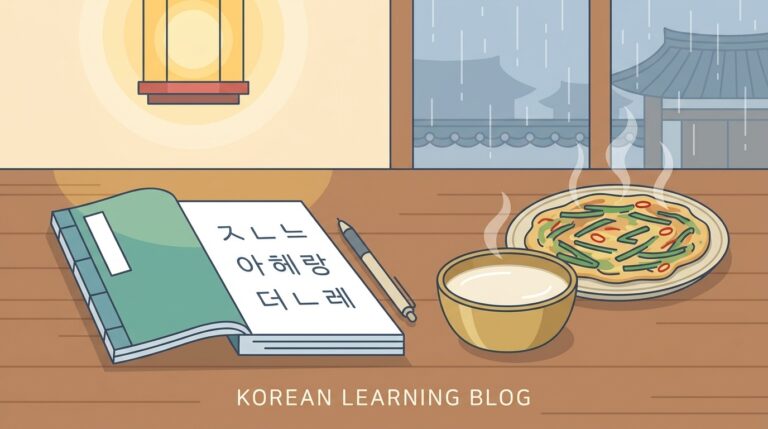
Why Do Koreans Crave Makgeolli and Pajeon on Rainy Days? Your Ultimate Guide to Korean Rainy Day Drinking Culture
안녕하세요! 매일한글 에디터입니다. (Hello! I’m your Daily Hangul Editor, your trusty Korean bestie and local culture guide!)
Have you ever noticed how the mood in Korea shifts the moment dark clouds roll in and raindrops start hitting the pavement? Suddenly, group chats light up with one specific invitation: “비도 오는데 막걸리에 파전 고?” (It’s raining, shall we go grab Makgeolli and Pajeon?)
For Koreans, rainy days aren’t just a gloomy weather report; they are an instant social cue. If you’ve ever felt a bit lost or intimidated by the unique etiquette, slang, and sudden shift in dining plans that happen when it rains in Korea, don’t worry! This guide is built from years of sharing drinks under cozy tin roofs in Seoul, designed to help you master intermediate-level Korean conversational flow while fitting right into a traditional tavern (minsokjujeom).
By the end of this post, you’ll know exactly what to say, how to pour like a native, and why this cozy culinary pairing is an essential part of the Korean soul.
Phase 2: 3 Key Expressions Deep Dive
1. 비도 오는데 막걸리에 파전 어때요? (Bi-do o-neun-de mak-geol-li-e pa-jeon eo-ttae-yo?)
- Pronunciation: Bee-doh oh-neun-deh mahk-geol-lee-eh pah-jeon-eh eo-tteh-yo? (Pro-tip: Flow the “Bi-do” softly, like a sigh of relief looking out the window.)
- Meaning: Since it’s raining anyway, how about some Makgeolli and Pajeon?
- K-Culture Moment: You will hear this in almost every slice-of-life K-Drama (like Reply 1988 or Hospital Playlist) where coworkers look outside the office window, sigh happily, and head straight to a cozy local tavern.
- Editor’s Insight: The particle “~도” (too/also) attached to “비” (rain) adds a beautiful nuance of “under these circumstances” or “since it’s raining anyway, why not treat ourselves?” It turns a dreary rainy afternoon into a perfect excuse for cozy comfort food.
- Situation Spectrum: Casual ✅ | Semi-formal ✅ | Formal ⚠️
- 🤔 Think About It: In your home country, is there a specific food or drink that everyone instantly craves when the weather changes? Why do you think weather influences our social eating habits so deeply?
2. 기분이 센치하네요 (Gi-bun-i sen-chi-ha-ne-yo)
- Pronunciation: Gee-boon-ee sen-chee-hah-neh-yo (Sounds like the English word “sentimental” shortened with a Korean accent: sen-chee.)
- Meaning: I’m feeling a bit sentimental / nostalgic / moody.
- K-Culture Moment: Characters sitting near a cafe window listening to indie music or looking wistfully out of a taxi window on a rainy evening.
- Editor’s Insight: “센치하다” comes from the English word “sentimental.” It is used to describe that pleasant, slightly melancholy, cozy mood that rainy weather brings. It’s highly conversational and perfect for bonding over drinks.
- Situation Spectrum: Casual ✅ | Semi-formal ✅ | Formal 🚫
- 🤔 Think About It: Why does rain make us feel nostalgic? Sharing this feeling of vulnerability is actually a fast track to building Jeong (deep connection) with your Korean friends.
3. 한 잔 더 받으세요 (Han jan deo ba-deu-se-yo)
- Pronunciation: Hahn jahn duh bah-deu-seh-yo (Say “ba-deu-se-yo” gently, while slightly bowing your head to show respect.)
- Meaning: Please have another glass.
- K-Culture Moment: Pouring drinks for others at a traditional tavern using both hands as a sign of respect and friendship.
- Editor’s Insight: In Korea, you rarely pour your own drink (자작 – jajak is often avoided in social settings). Offering to pour for someone else with “한 잔 더 받으세요” is a classic way to show care and keep the conversation flowing smoothly.
- Situation Spectrum: Casual ✅ | Semi-formal ✅ | Formal ✅
- 🤔 Think About It: How does the rule of not pouring your own drink change the social dynamic of a dinner table compared to Western culture?
Phase 3: Textbook Korean vs. Real Korean
Situation 1: Suggesting a drink on a rainy day
- 📖 Textbook Korean: “비가 오니까 같이 술을 마십시다.” (Bi-ga o-ni-kka gat-i sul-eul ma-sip-si-da.)
- Translation: Since it is raining, let us drink alcohol together. (Sounds like a robotic military command!)
- 🗣️ 진짜 (Real) Korean: “비도 촉촉하게 오는데 막걸리나 한잔할까요?” (Bi-do chok-chok-ha-ge o-neun-de mak-geol-li-na han-jan-hal-kka-yo?)
- Translation: Since it’s raining softly/damply, shall we grab a glass of Makgeolli?
- 💡 Why the difference? The word “촉촉하다” (moist/damp) adds a poetic, cozy atmosphere, and the particle “~나” in “막걸리나” softly suggests Makgeolli as a casual, friendly option rather than a heavy demand.
Situation 2: Accepting another drink when you’re feeling good
- 📖 Textbook Korean: “네, 술을 더 마시겠습니다.” (Ne, sul-eul deo ma-si-get-seum-ni-da.)
- Translation: Yes, I will drink more alcohol. (Very stiff and clinical.)
- 🗣️ 진짜 (Real) Korean: “좋죠! 비 오는 날에는 술이 술술 들어가네요!” (Joh-jyo! Bi o-neun nal-e-neun sul-i sul-sul deul-eo-ga-ne-yo!)
- Translation: Sounds great! On rainy days, the drinks just slide down so smoothly!
- 💡 Why the difference? “술술” is a wonderful Korean onomatopoeia describing something flowing smoothly or effortlessly. Saying “술이 술술 들어간다” shows you are enjoying the drink, the company, and the cozy rainy day vibe.
Phase 4: K-Culture Deep-dive & Non-verbal Manners
4-1. Nunchi (눈치) & Traditional Drinking Gestures
When drinking Makgeolli, manners are key, but they are easy to master once you know the physical cues!
* The Two-Hand Rule: When someone pours Makgeolli into your bowl (Makgeolli is traditionally served in wide brass or ceramic bowls, not glasses), hold the bowl with both hands. Your right hand should hold the bowl, and your left hand should gently support your right wrist or forearm.
* The Turn-Away (고개 돌리기): If you are drinking with someone older or of higher social status, turn your head slightly away to the side when taking a sip, and cover your mouth slightly with your hand. This is a sign of deep respect.
* The Gentle Shake: Makgeolli is unfiltered rice wine, meaning the sediment settles at the bottom. Before opening the bottle, gently swirl it in a circular motion. Warning: Do not shake it violently like champagne, or it will erupt! Gently turn it upside down and back a few times.
4-2. The Science and History Behind the Cravings
Why Makgeolli and Pajeon? There are two fascinating theories:
1. The Sound Connection: The sound of rain sizzling against the ground sounds almost identical to the sound of Pajeon (green onion pancake) frying in hot oil on a flat-top grill. This auditory association triggers an instant psychological craving!
2. The Farmer’s Break: Historically, Korea was an agricultural society. On rainy days, farmers couldn’t work in the fields. Naturally, they gathered indoors to rest, making quick pancakes with whatever green onions (pa) and flour they had, washing it down with cheap, nourishing, homemade rice wine (makgeolli). Today, this historic comfort has turned into modern cozy nostalgia.
Phase 5: Real-life Roleplay Scenario
Meet Your Drinking Partner: Minjun (민준)
Minjun is your friendly, outgoing Korean coworker. He’s a foodie who knows all the best local spots and loves rainy day vibes. Tonight, he has dragged you to a retro, dimly lit traditional tavern (minsokjujeom) filled with the warm aroma of sizzling oil and sweet rice wine.
[Setting: A cozy traditional tavern with rain pattering on the window pane. Yellow lantern lights glow warmly.]

민준: 비가 진짜 많이 오네요. 이런 날에는 퇴근하고 바로 집에 가기 너무 아쉽죠!
      (Bi-ga jin-jja man-i o-ne-yo. I-reon nal-e-neun toe-geun-ha-go ba-ro jib-e ga-gi neo-mu a-swip-jyo!)
      "It's really raining hard. On a day like this, it feels like such a waste to just go straight home after work!"

유저: 🎭 [Nod your head with an excited smile]
      맞아요. 비도 오는데 막걸리에 파전 어때요?
      (Ma-ja-yo. Bi-do o-neun-de mak-geol-li-e pa-jeon eo-ttae-yo?)
      "Exactly. Since it's raining anyway, how about Makgeolli and Pajeon?"

민준: 🎭 [Claps his hands in delight]
      역시! 제 마음을 읽으셨네요! 여기 모듬전이랑 막걸리 한 병 주세요!
      (Yeok-si! Je ma-eum-eul ilg-eu-syeot-ne-yo! Yeo-gi mo-deum-jeon-i-rang mak-geol-li han byeong ju-se-yo!)
      "I knew it! You read my mind! Auntie, over here, one assorted pancake platter and a bottle of Makgeolli, please!"

[The waiter serves a cold bottle of Makgeolli and two yellow brass bowls.]

민준: 🎭 [Gently swirls the Makgeolli bottle and opens it carefully]
      자, 먼저 한 잔 받으세요!
      (Ja, meon-jeo han jan ba-deu-se-yo!)
      "Here, let me pour you a glass first!"

유저: 🎭 [Hold your brass bowl with both hands, supporting your right wrist with your left hand]
      감사합니다. 비가 오니까 기분이 괜히 싱숭생숭하네요.
      (Gam-sa-ham-ni-da. Bi-ga o-ni-kka gi-bun-i gwaen-hi sing-sung-saeng-sung-ha-ne-yo.)
      "Thank you. Since it's raining, I feel a bit restless and sentimental for some reason."

민준: 🎭 [Nods warmly and pours his own bowl]
      원래 비 오는 날에는 마음이 말랑말랑해지는 법이에요. 자, 짠할까요? 건배!
      (Won-lae bi o-neun nal-e-neun ma-eum-i mal-lang-mal-lang-hae-ji-neun beop-i-e-yo. Ja, jjan-hal-kka-yo? Geon-bae!)
      "It's natural for your heart to get soft on rainy days. Well, shall we clink? Cheers!"

유저: 🎭 [Gently clink your bowl against Minjun's, keeping yours slightly lower than his as a sign of respect]
      건배! 와, 진짜 시원하고 맛있어요!
      (Geon-bae! Wa, jin-jja si-won-ha-go mas-it-eo-yo!)
      "Cheers! Wow, this is really cool and delicious!"

민준: 🎭 [Takes a bite of a hot pancake and smiles]
      그쵸? 전도 드셔보세요. 비 소리 들으면서 먹으니까 더 맛있지 않아요?
      (Geu-chyo? Jeon-do deu-syeo-bo-se-yo. Bi so-ri deul-eon-myeon-seo meog-eu-ni-kka deo mas-it-ji an-a-yo?)
      "Right? Try some pancake too. Doesn't it taste even better when eating while listening to the sound of rain?"
🔀 Choose Your Path! How will you respond to Minjun?
- Option A: “네, 비 소리랑 전 굽는 소리가 똑같아서 신기해요!”
- (Yes, it’s fascinating because the sound of rain and the sound of frying pancakes are identical!)
- Option B: “저는 비 오는 날이 싫어요. 옷이 젖어서 불편해요.”
- (I hate rainy days. It’s uncomfortable because my clothes get wet.)
- Option C: “술이 너무 맛있어서 취할 것 같아요. 한 잔 더 주세요!”
- (The drink is so delicious I think I might get drunk. Give me another glass!)
🧐 Feedback on Your Choice:
- Best Choice – Option A: 🌟 Beautiful! You connected the acoustic science theory we learned in Phase 4-2 to your response. This shows deep cultural empathy and will make Minjun absolutely love chatting with you!
- Risk Choice – Option B: ⚠️ While honest, this totally breaks the romantic, cozy rainy day vibe (분위기 깨기). Minjun might feel a bit awkward continuing his poetic rain talk.
- Bad Choice – Option C: 🚫 Drinking too fast or asking someone to continuously pour for you without returning the favor can look a bit bad in Korean social settings. Pace yourself and remember to pour for Minjun too!
Phase 6: 10-Second Emotion Shadowing Drill
To sound truly natural, you need to master the emotional flow and pausing of these sentences. Try speaking these out loud, pausing at the / marks!
- [😊 Expressing excited anticipation]
- 비도 / 촉촉하게 오는데, / 우리 / 막걸리나 / 한잔할까요?
- Bi-do / chok-chok-ha-ge o-neun-de, / u-ri / mak-geol-li-na / han-jan-hal-kka-yo?
- [🥺 Softly and sentimentally]
- 비가 오니까 / 기분이 / 괜히 / 센치해지네요.
- Bi-ga o-ni-kka / gi-bun-i / gwaen-hi / sen-chi-hae-ji-ne-yo.
- [🍻 Energetically raising a glass]
- 역시 / 비 오는 날에는 / 술이 / 술술 들어가네요! / 건배!
- Yeok-si / bi o-neun nal-e-neun / sul-i / sul-sul deul-eo-ga-ne-yo! / Geon-bae!
Phase 7: K-Culture Mini Dictionary
- 전 (Jeon | Pancake)
- Usage: Traditional Korean pan-fried pancake. Common types include Pajeon (green onion), Kimchijeon (kimchi), and Gamjajeon (potato). It is the ultimate drinking snack (안주 – anju).
- 막사 (Mak-sa | Makgeolli + Cider mix)
- Usage: A popular sweet cocktail made by mixing Makgeolli with Chilsung Cider (a lemon-lime soda). Highly recommended if you find pure Makgeolli a bit too heavy!
- 이모님 (Imonim | Auntie)
- Usage: Literally means “maternal aunt,” but widely used to affectionately and respectfully call female servers or owners in casual traditional restaurants and taverns.
- 낮술 (Nat-sul | Daytime drinking)
- Usage: Drinking alcohol during the day. Since rain often brings a dark, twilight-like atmosphere even at 2 PM, rainy days are a famously excused time for a little nat-sul.
Phase 8: Traveler’s Survival Kit
Survival Phrases TOP 3
- “여기 모듬전 하나랑 막걸리 주세요.” (Yeo-gi mo-deum-jeon ha-na-rang mak-geol-li ju-se-yo.)
- Meaning: “Over here, one assorted pancake and a Makgeolli, please.” (Use this to order instantly without struggling with a complicated menu.)
- “어떤 막걸리가 제일 인기 많아요?” (Eo-tteon mak-geol-li-ga jeil in-gi man-a-yo?)
- Meaning: “Which Makgeolli is the most popular here?” (Great for exploring regional craft Makgeollis!)
- “이모님, 여기 물 좀 주실 수 있을까요?” (I-mo-nim, yeo-gi mul jom ju-sil su is-seul-kka-yo?)
- Meaning: “Auntie, could we get some water here please?” (Crucial for pacing yourself.)
Editor’s Travel Note 🗺️
If you find yourself in Seoul on a rainy day, open your Naver Map app and search for “민속주제점” (Minsokjujeom) or “전집” (Jeon-jib) near you. Neighborhoods like Insa-dong or the alleys of Mapo are famous for having ancient, retro wooden taverns where the atmosphere is absolutely unbeatable.
Note: Public transportation in Seoul runs later on rainy days, but taxis can be extremely difficult to catch. Keep an eye on the subway schedule! (Information current as of mid-2024, subject to change).
Phase 9: “One Step Deeper” (Sociological Insight)
In Western cultures, rain often signals a time to go home, cancel plans, and curl up alone under a blanket. In Korea, however, rain acts as a collective social bridge. It is an invitation to share a cozy, slightly melancholic space with others.
This behavior is rooted in the concept of 정 (Jeong)—the warm feeling of attachment, bonding, and mutual understanding. By gathering to eat hot, sizzling food while listening to the rain, Koreans transform a gloomy weather day into an intimate communal experience. It’s a beautiful way of saying, “We are all feeling a bit sentimental today, so let’s be sentimental together.”
💬 Your Turn: Does your country have a unique tradition or a specific comfort food that everyone seeks out when the weather gets gloomy? Let us know in the comments below! We’d love to hear your stories.
Phase 10: FAQ & Avoiding Common Mistakes
Q: Can I shake the Makgeolli bottle vigorously like a cocktail shaker?
A: Absolutely not! Because Makgeolli contains natural carbonation from fermentation, shaking it hard will build up gas pressure. The moment you open the cap, sweet sparkling wine will spray all over you, your friends, and the wooden table. Always tilt it gently back and forth to mix the white sediment, or slowly open and close the cap a little bit at a time to let the gas escape first.
Q: Is Makgeolli very high in alcohol? I don’t want to get too drunk.
A: Generally, Makgeolli is quite mild, usually ranging between 5% and 8% ABV (Alcohol by Volume)—similar to or slightly higher than beer. However, because it is sweet and smooth, it is easy to drink fast! Drink slowly and always pair it with heavy, carb-rich food like Pajeon to protect your stomach.
Q: Do I have to drink the sediment at the bottom of the bottle?
A: It is highly recommended because that’s where all the rich, sweet rice flavor and healthy lactobacillus reside! However, some locals prefer a clean, clear drink, so they pour only the top clear liquid (청주 – Cheongju) without mixing the sediment. You can try both ways to see which style suits your palate!
🚨 Common Mistakes Warning Board
- Drinking directly from the bottle: 🚫 Traditional alcohol should always be poured into a glass or bowl first. Drinking from the bottle is considered bad manners.
- Pouring for yourself first: 🚫 Always check if your friend’s bowl is empty before filling your own. If you pour for yourself while others’ bowls are empty, you look impatient.
- Clinking your bowl higher than an elder’s: 🚫 When toast-clinking (건배), ensure the rim of your bowl touches slightly below the rim of the older person’s bowl to show respect.
Phase 11: Action Missions
- Bronze Medal Mission (Solo): Go to your local Asian market, buy a bottle of Makgeolli, and practice mixing the sediment gently upside down three times without making it overflow.
- Silver Medal Mission (Social): Next time it rains in your area, message a friend in Korean: “비도 오는데 막걸리에 파전 어때요?” and share a photo of your cozy meal on social media!
- Gold Medal Mission (Real Life): Visit a traditional Korean tavern (minsokjujeom), order a mo-deum-jeon (assorted pancake), and use both hands to receive a pour from the server while saying “감사합니다!” with a respectful nod.
🎮 K-Culture Mission: Watch a K-drama episode on a rainy scene. Count how many times characters mention Makgeolli or Pajeon, and write down the exact phrase they used in our comments section!
Phase 12: Interactive Quiz Challenge
Test your knowledge of Korean rainy day drinking culture! Let’s see if you can get a perfect score.
Q1. What is the main reason why Koreans crave Pajeon (green onion pancake) when it rains?
- A) It has special vitamins that combat rainy day depression.
- B) The sound of rain cooking on pavement sounds like pancake batter sizzling in oil.
- C) Blue green onions only grow on rainy days.
Q2. Fill in the blank: “비가 오니까 기분이 괜히 ________네요.” (Since it’s raining, I feel a bit sentimental/moody.)
- A) 촉촉하
- B) 싱숭생숭하
- C) 센치해지
Q3. True or False: It is polite to pour your own Makgeolli first before offering to pour for others.
- A) True
- B) False
🎉 Click here to check the answers and explanations!
Answer Key & Explanations
- Q1 Answer: B
- Explanation: It’s the sound connection! The acoustic frequency of rain falling is incredibly similar to the sound of frying food, which triggers our appetite.
- Q2 Answer: C
- Explanation: “센치해지다” (to become sentimental/moody) perfectly fits the emotional vibe of looking out at the rain. While “싱숭생숭하다” (restless/fidgety) also works, “센치해지다” directly translates to the sentimental cozy rainy feeling!
- Q3 Answer: B (False)
- Explanation: In Korea, you should always serve others first. Pouring for yourself is called “자작” (jajak) and is generally avoided in polite company.







