

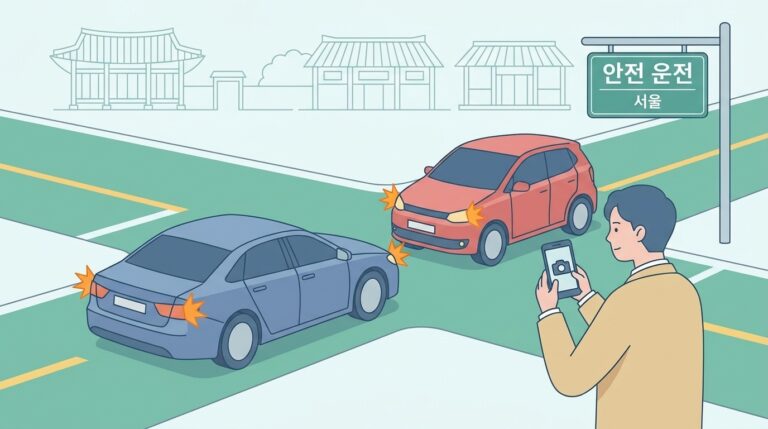
Dealing with a Car Accident in Korea: High-Level Guide to Photographic Evidence and Insurance Claims
안녕하세요! Your “Daily Hangul” senior editor here! 🚗💨
Imagine this: You’re driving through the scenic roads of Jeju Island or navigating the bustling, neon-lit streets of Gangnam when—screeech, thud!—a minor fender bender happens. Your heart races, and suddenly, those polite “K-drama” phrases slip right out of your mind. In Korea, handling a traffic accident involves a very specific sequence of actions, and at a C2 (Mastery) level, you need to handle it not just with correct grammar, but with absolute cultural and legal finesse.
Today, we’re diving deep into the high-stakes world of taking photographic evidence (사진 촬영) and submitting insurance claims (보험 접수). Based on composite case studies of expats who have been in this exact spot, we’ll teach you how to protect your rights, coordinate with insurance adjusters, and sound like a seasoned local while doing so.
Phase 2: Advanced Expressions Deep Dive
1. 현장을 보존하다 (Hyeon-jang-eul bo-jon-ha-da)
- Pronunciation: Hyeon-jang-eul bo-jon-ha-da (Sounds like “Heon-jahng-ul bo-john-hah-dah”)
- Meaning: To preserve the scene of the accident.
- K-Culture Moment: You often see this in Korean crime and legal dramas like Stranger (비밀의 숲), where investigators demand that nobody touch a single item to keep the evidence intact.
- Editor’s Insight: In Korea, unless the accident is blocking major traffic on a highway, it’s highly recommended to keep the vehicles in their exact post-collision positions until you’ve taken panoramic photos and marked the tire spots.
- Situation Spectrum: Casual 🚫 | Semi-formal ⚠️ | Formal ✅
- 🤔 Think About It: How does the cultural emphasis on precision and legal protocol in Korea compare to your home country’s post-accident etiquette?
2. 과실 비율을 따지다 (Gwa-sil bi-yul-eul tta-ji-da)
- Pronunciation: Gwa-sil bi-yul-eul tta-ji-da (Sounds like “Gwah-sheel bee-yool-ul ttah-jee-dah”)
- Meaning: To determine the fault ratio (percentage of negligence).
- K-Culture Moment: In reality TV shows covering traffic accidents like Han Moon-chul’s Black Box (한문철의 블랙박스 몇 대 몇), experts dissect dashcam footage to argue over whether an accident is a 100:0 or an 80:20 split.
- Editor’s Insight: In Korea, accidents are rarely determined to be 100% one party’s fault unless it’s a rear-end collision at a red light. You will constantly hear insurance agents arguing over this 과실 비율.
- Situation Spectrum: Casual ⚠️ | Semi-formal ✅ | Formal ✅
- 🤔 Think About It: Why do you think Korean insurance systems favor fractional fault ratios (e.g., 70:30) rather than simple black-and-white blame?
3. 보험 접수번호를 발급받다 (Bo-heom jeop-su-beon-ho-reul bal-geup-bat-da)
- Pronunciation: Bo-heom jeop-su-beon-ho-reul bal-geup-bat-da (Sounds like “Boh-hum jup-soo-bun-ho-rul bahl-gup-baht-dah”)
- Meaning: To be issued an insurance claim receipt number.
- K-Culture Moment: If you are injured, the hospital or car repair shop will immediately ask for this number. It acts as a financial guarantee that the insurance company is covering the costs.
- Editor’s Insight: This is the ultimate “golden ticket” of post-accident administration. Once you have this number, you don’t have to pay out of pocket at the hospital or the mechanic.
- Situation Spectrum: Casual 🚫 | Semi-formal ✅ | Formal ✅
- 🤔 Think About It: How does this seamless digital integration between insurance companies, hospitals, and repair shops reflect Korea’s fast-paced, tech-driven “Pali-Pali” (빨리빨리) culture?
Phase 3: Textbook Korean vs. Real-World Korean
Let’s compare stiff textbook phrasing with what native speakers actually say on the road.
Situation 1: Suggesting that both parties call their insurance companies immediately
- 📖 Textbook: “우리 서로의 보험 회사에 전화를 걸도록 합시다.” (Uri seoro-ui boheom hoesae jeonhwareul geoldorok hapsida. – “Let us make calls to our respective insurance companies.”)
- 🗣️ Real-World: “양측 다 보험 불러서 처리하는 게 깔끔하겠네요.” (Yang-cheuk da bo-heom bul-leo-seo cheo-ri-ha-neun ge kkal-kkeum-ha-get-neyo. – “It’d be cleanest for both sides to call our insurance and handle it through them.”)
- 💡 Why it’s different: Koreans prefer the word 부르다 (to call/summon) when referring to insurance dispatch agents (보험 출동 기사). The word 깔끔하다 (neat/clean) is frequently used to describe a hassle-free, legally sound resolution.
Situation 2: Asking the other driver to send their insurance claim number
- 📖 Textbook: “귀하의 보험 접수번호를 저에게 송부해 주시기 바랍니다.” (Gwiha-ui boheom jeopsubeonhoreul jeoege songbuhae jusigi baramnida. – “I hope you send your insurance claim number to me.”)
- 🗣️ Real-World: “대인·대물 접수번호 나오면 문자로 좀 찍어주세요.” (Dae-in, dae-mul jeop-su-beon-ho na-o-myeon mun-ja-ro jom jjig-eo-ju-se-yo. – “Once the personal injury and property damage claim numbers are out, please text them to me.”)
- 💡 Why it’s different: Real-world negotiations split claims into 대인 (personal injury) and 대물 (property damage). 찍어주다 is a highly colloquial verb meaning “to shoot over a text/message.”
Phase 4: K-Culture Deep Dive & Non-Verbal Manners
4-1. Nunchi & Body Language
When an accident occurs in Korea, Nunchi (눈치 – situational quick-wittedness) is your best asset.
* Avoid loud confrontations: In the past, people would shout and raise their voices to “win” the argument. Today, doing so will immediately brand you as aggressive (블랙컨슈머 or 진상). Stay incredibly calm, speak in a low tone, and use polite honorifics (존댓말).
* The Photo Protocol: When taking photos of the scene, do not just photograph the damaged parts. You must walk 10 to 15 meters back and take wide-angle photos showing the lanes, the direction of the front wheels, and the presence of any nearby CCTV cameras.
4-2. Culture Code: Black Box Culture
Korea has one of the highest densities of dashcams (known locally as Black Box – 블랙박스) in the world. Almost 99% of vehicles have them. Pointing out the presence of a black box (블랙박스 영상 확인하시죠) is the ultimate equalizer. It signals to the other driver that you have objective proof, which immediately stops any attempts to twist the story.
Phase 5: Interactive Roleplay Scenario
The Setup: You are driving a rented vehicle in Seoul when a taxi scrapes your bumper while changing lanes. Both drivers pull over. You need to negotiate calmly and obtain the necessary details.
Characters:
- You (C2 Speaker): Articulate, calm, and legally aware.
- Mr. Park (Taxi Driver – 박 기사님): Experienced, slightly defensive but reasonable when addressed professionally.
Dialogue:
- You: “기사님, 갑자기 끼어드시면 피할 수가 없잖아요. 일단 차 세우고 현장 보존부터 하겠습니다.”
(Gi-sa-nim, gap-ja-gi kki-eo-deu-si-myeon pi-hal su-ga eop-ja-na-yo. Il-dan cha se-u-go hyeon-jang bo-jon-bu-teo ha-get-seum-ni-da.)
(Sir, I couldn’t avoid it when you cut in so suddenly. Let’s park the cars and preserve the scene first.)
🎭 [Frowning slightly but keeping a respectful, steady tone] -
Mr. Park: “아니, 내가 깜빡이 켜고 들어갔는데 뒤에서 그렇게 달리면 어떡해요?”
(A-ni, nae-ga kkam-ppa-gi kyeo-go deu-reo-gat-neun-de dwi-e-seo geu-reoh-ge dal-li-myeon eo-tteok-hae-yo?)
(Hey, I turned on my indicator and merged, what do you expect me to do if you speed up from behind?)
🎭 [Gesticulating towards his car indicator] -
You: “블랙박스 녹화되고 있으니까 과실 비율은 보험사에서 판단할 겁니다. 바퀴 방향이랑 접촉 부위 사진 먼저 찍을게요.”
(Beul-laek-bak-seu nok-hwa-de-go i-seu-ni-kka gwa-sil bi-yul-eun bo-heom-sa-e-seo pan-dan-hal geom-ni-da. Ba-kwi bang-hyang-i-rang jjeop-chok bu-wi sa-jin meon-jeo jjig-eul-ge-yo.)
(The dashcam is recording, so the insurance companies will judge the fault ratio. I’m going to take photos of the wheel directions and the impact point first.)
🎭 [Calmly taking out your smartphone to take wide-angle photos] -
Mr. Park: “에이, 바쁜데… 그냥 대충 우리끼리 현금으로 합의하면 안 될까요?”
(E-i, ba-ppeun-de… geu-nyang dae-chung u-ri-kki-ri hyeon-geum-eu-ro hap-ui-ha-myeon an doel-ka-yo?)
(Come on, we’re busy people… Can’t we just settle this roughly with cash between ourselves?)
🎭 [Scratching his head, trying to downplay the damage] -
You: “렌터카라 사설 합의는 어렵습니다. 양측 다 보험사 직원 부르는 게 서로에게 가장 깔끔합니다.”
(Ren-teo-ka-ra sa-seol hap-ui-neun eo-ryeop-seum-ni-da. Yang-cheuk da bo-heom-sa jik-won bu-reu-neun ge seo-ro-e-ge ga-jang kkal-kkeum-ham-ni-da.)
(Since this is a rental car, a private settlement is difficult. Calling our insurance agents is the cleanest way for both of us.)
🎭 [Shaking your head politely but firmly] -
Mr. Park: “알겠어요. 그럼 그쪽 보험사에 먼저 연락하세요. 저도 우리 조합에 접수할 테니까요.”
(Al-get-seo-yo. Geu-reom geu-jjeok bo-heom-sa-e meon-jeo yeon-rak-ha-se-yo. Jeo-do u-ri jo-hap-e jeop-su-hal te-ni-kka-yo.)
(Alright. Go ahead and call your insurance company first. I’ll register it with our taxi association association as well.)
🎭 [Sighing and reaching for his phone] -
You: “네, 저 접수했습니다. 나중에 대인·대물 접수번호 나오면 꼭 문자로 보내주십시오.”
(Ne, jeo jeop-su-haet-seum-ni-da. Na-jung-e dae-in, dae-mul jeop-su-beon-ho na-o-myeon kkok mun-ja-ro bo-nae-ju-sip-si-o.)
(Yes, I’ve registered the claim. Please make sure to text me the personal injury and property damage claim numbers once they are issued.)
🎭 [Typing on your phone to confirm your dispatch status] -
Mr. Park: “예, 걱정 마세요. 접수되는 대로 바로 찍어 드릴 테니까 현장 정리하고 차 좀 뺍시다.”
(Ye, geok-jeong ma-se-yo. Jeop-su-doe-neun dae-ro ba-ro jjig-eo deu-ril te-ni-kka hyeon-jang jeong-ri-ha-go cha jom ppaep-si-da.)
(Yes, don’t worry. I’ll shoot them over as soon as it’s registered. Let’s clear the scene and move the cars now.)
🎭 [Nodding in agreement]
🔀 Choose Your Path!
What would you do if Mr. Park insisted on moving the cars before you could take photos?
* A) Say: “네, 차가 막히니까 일단 빼고 나중에 찍죠.” (Move the car immediately without photos)
* B) Say: “잠시만요, 바퀴 방향이랑 차선 물리게 전체 샷만 찍고 바로 빼겠습니다. 1분도 안 걸려요.”
* C) Say: “사진 찍기 전에는 절대 못 움직입니다! 경찰 부를 겁니다!” (Refuse to move and threaten to call police immediately)
Feedback:
- A is Bad: ⚠️ Without photographic evidence showing the lane lines (차선) and wheel angles (바퀴 방향), the fault ratio might be calculated against you later.
- B is Best: You protect your evidence quickly while remaining cooperative to avoid traffic jams.
- C is Risk: 🚫 Highly confrontational. Moving the vehicle to clear traffic is a legal obligation in minor accidents; stalling traffic unnecessarily can lead to fines.
Phase 6: 10-Second Emotional Shadowing Drill
Practice saying these high-stress sentences with the exact emotional intonation of a native speaker. Pay attention to the pause markers (/).
[🤨 Firm and protective of one's rights]
“사진 찍을 때까지 / 현장 보존해 주세요. / 제 블랙박스에도 / 다 찍혔습니다.”
(Sa-jin jjig-eul ttae-kka-ji / hyeon-jang bo-jon-hae ju-se-yo. / Je beul-laek-bak-seu-e-do / da jjig-hyeot-seum-ni-da.)-
[🙄 Slightly exasperated but highly professional]
“사설 합의는 / 절대 안 되고요, / 양측 다 보험 접수해서 / 처리하는 게 / 가장 깔끔합니다.”
(Sa-seol hap-ui-neun / jeol-dae an doe-go-yo, / yang-cheuk da bo-heom jeop-su-hae-seo / cheo-ri-ha-neun ge / ga-jang kkal-kkeum-ham-ni-da.)
Phase 7: K-Culture Mini-Dictionary
- 과실 (Gwa-sil) | Negligence / Fault | Used in legal terms to define who is responsible for an accident. “과실이 크다” means one has a higher share of negligence.
- 현장 조입 (Hyeon-jang jo-ip) | Scene Dispatch | The arrival of the insurance company’s mobile agent at the accident scene to take photos and coordinate.
- 대물 배상 (Dae-mul bae-sang) | Property Damage Compensation | The branch of insurance that covers damage done to other vehicles, structures, or objects.
- 합의금 (Hap-ui-geum) | Settlement Money | Compensation paid to wrap up an injury claim, usually negotiated directly with the other party’s insurance agent.
Phase 8: Traveler’s Survival Kit
Top 3 Survival Phrases
- “보험사 직원 불렀나요?” (Bo-heom-sa jik-won bul-leot-na-yo?) – “Did you call your insurance agent?” (Pro Tip: Essential to ask if the other driver is just sitting in their car waiting).
- “견인차 부르지 마세요. 우리 보험사 견인 부를게요.” (Gyeon-in-cha bu-reu-ji ma-se-yo. U-ri bo-heom-sa gyeon-in bu-rel-ge-yo.) – “Do not call a private tow truck. We will call our own insurance tow truck.” (Pro Tip: Private tow trucks in Korea can charge exorbitant fees; always use your own insurance company’s towing services).
- “렌터카 회사에 사고 접수해야 합니다.” (Ren-teo-ka hoe-sa-e sa-go jeop-su-hae-ya ham-ni-da.) – “I need to report this accident to the rental car company.”
Editor’s Travel Note
Before renting a car in Korea, make sure you download the Naver Map App for accurate navigation and real-time speed camera warnings. Also, keep your rental company’s customer service number saved on your phone. In the event of an accident on a toll road or expressway, turn on your hazard lights (비상등), evacuate to a safe zone behind the guardrails, and call the Korea Expressway Corporation (1588-2504) for free emergency towing to a safe spot.
Note: Travel hotlines and emergency services contacts are subject to change; verify before driving.
Phase 9: “Going One Step Deeper” (Cultural Essay)
In many Western cultures, a car accident is accompanied by an immediate exchange of driver’s licenses and insurance policy cards. In Korea, however, individuals rarely exchange personal insurance cards directly on the street. Instead, they rely on 현장 출동 서비스 (On-site mobile dispatch service). The minute an accident occurs, both drivers call their respective insurance hotlines, and dedicated agents arrive on motorcycles or small cars within 10 to 15 minutes. These agents handle the photo-taking, negotiate with the other party’s agent, and issue the claim numbers. This system minimizes direct, emotional confrontations between drivers, reflecting the Korean society’s preference for mediated, professional resolution rather than direct conflict.
💬 Your Turn: Have you ever experienced a traffic dispute in another country? How does the concept of having a professional agent resolve it on the spot sound to you? Let us know in the comments below!
Phase 10: FAQ & Avoiding Misunderstandings
Q: Can I just settle minor scratches with cash on the spot without involving insurance?
A: While it is technically possible, it is highly discouraged. In Korea, some drivers might accept cash at the scene and later claim medical expenses for whiplash or physical therapy. To prevent insurance fraud (보험 사기), always process the claim through your insurance company, or at least get a signed written agreement or a recorded text message confirming the settlement.
Q: What should I do if a private tow truck (렉카) arrives before my insurance company?
A: Strictly forbid them from hooking your car. Say, “제 보험사 견인차 올 때까지 걸지 마세요” (Do not hook it until my insurance tow truck arrives). Unofficial tow trucks often charge thousands of dollars for short-distance towing.
Q: Does the police always need to be called for a minor accident?
A: No. If there are no severe injuries and both parties agree on the insurance process, you do not need to call the police (112). However, if the other driver seems intoxicated, refuses to cooperate, or if it’s a major collision, call the police immediately.
🚨 Common Mistakes Warning Board
| Mistake | Consequence | Correct Action |
|---|---|---|
| Moving the vehicle immediately without taking photos. | Unable to prove the angle of collision or lanes. | Take 4-5 wide-angle photos showing tire directions and the road lanes first. |
| Signing an agreement with private tow truck drivers. | Paying exorbitant, unregulated towing fees. | Firmly refuse and wait for your official insurance company’s dispatch vehicle. |
| Failing to get the “Dae-in/Dae-mul” claim numbers. | Paying out-of-pocket medical and repair bills. | Request the insurance claim numbers via SMS (문자) before leaving the scene. |
Phase 11: Action Mission
- 🥉 Bronze: Practice reading the Shadowing Drill in Phase 6 out loud three times until you can say the words smoothly without stumbling.
- 🥈 Silver: Take a photo of your car (or a toy car) from 10 meters away using the “wide-angle” technique described in Phase 4-1, and share it on Instagram tagging
@DailyHangulwith the hashtag#현장보존. - 🥇 Gold: Next time you watch a Korean drama and see a car accident scene, write down whether the characters used “Textbook” or “Real-World” Korean in the comments section of our blog!
Phase 12: Interactive Quiz Challenge
Test your knowledge with these practical scenarios!
1. Scenario Quiz
You scratched a parked car in a narrow alley in Seoul. The owner is not around. What is the most culturally and legally appropriate C2-level action?
* A) Drive away since there are no CCTV cameras in sight.
* B) Leave a note on the windshield with your phone number and a polite apology.
* C) Call your insurance company immediately to report a single-car accident and request them to contact the owner through the license plate.
정답 및 해설 (Click to expand)
Correct Answer: C (and B as backup)
In Korea, leaving without notifying the owner or your insurance company after damaging a parked vehicle is considered “물피도주” (hit-and-run of property) and can result in heavy fines. Calling your insurance company on the spot to register the incident is the safest, most professional route.
2. Fill in the Blank
“과실 비율이 어떻게 되나요?” means “What is the ____________ ratio?”
정답 및 해설 (Click to expand)
Correct Answer: Negligence (or Fault)
과실 비율 is the ratio of fault determined by insurance companies to decide how much each party’s insurance will pay for the damages.
3. True/False Culture Quiz
In Korea, shouting loudly at the other driver immediately after an accident helps you get a better settlement because it shows confidence.
* True
* False
정답 및 해설 (Click to expand)
Correct Answer: False
Modern Korean society heavily disapproves of public outbursts (갑질 or 진상짓). Staying calm and requesting professional insurance dispatch is considered the standard of civilized behavior.







