

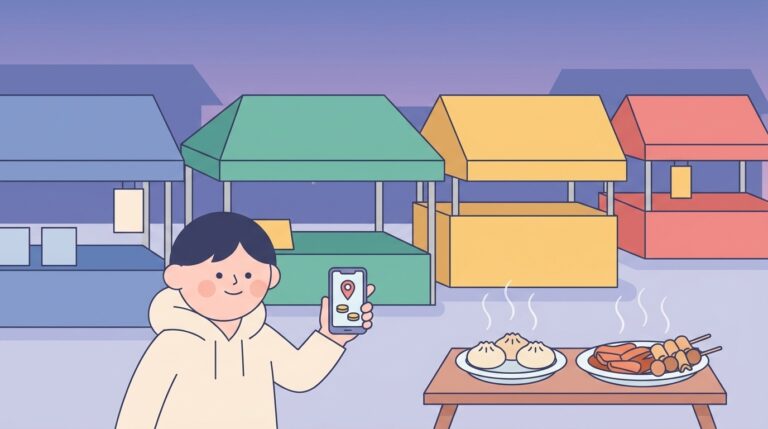
Avoid the dreaded ‘Bagaji’! Navigating Korean Festival Rip-Offs Like a True Local
Phase 1: Empathy (공감) — A Bitter Taste in a Beautiful Place
안녕하세요! It’s your Senior Editor and local cultural navigator from Daily Hangul (매일한글)!
Imagine this: The sun is setting over a gorgeous cherry blossom trail in Gyeongju. The air smells like sweet spring breeze and grilled pork skewers. You sit down at a cozy festival food stall, excited to enjoy the local vibes. You order a simple plate of pajeon (green onion pancake) and a small cup of makgeolli. But when the bill comes, your jaw drops. 40,000 KRW ($30 USD) for a single pancake?!
If this sounds like a nightmare, you are not alone. Lately, Korean social media and news outlets have been buzzing with controversy over 축제 바가지요금 (local festival overcharging). Even native Koreans are feeling frustrated by these ridiculous prices.
In this lesson, we are going to dive deep into the real-world Korean expressions you need to handle these awkward situations, express your frustration naturally, and negotiate like a seasoned local. Our B2-level members have told us that learning these cultural nuances completely changed how they interact with local vendors. Let’s make sure you never play the fool!
Phase 2: Core Expressions (핵심 표현 3선)
Let’s analyze the three most critical expressions you need to understand and use when dealing with festival overcharging.
1. 바가지를 쓰다 / 바가지 요금 (To get ripped off / Rip-off price)
- Pronunciation: [bagajireul sseuda] (Sounds like “bah-gah-jee-reul sseu-dah”)
- Meaning: Literally “to wear a gourd” -> To be overcharged or ripped off.
- K-Culture Moment: You will see this all over Korean news headlines whenever festival season starts: “또 기승을 부리는 축제 바가지요금” (Festival rip-off prices acting up again).
- Editor’s Insight: Why a gourd? Historically, merchants used gourds of various sizes to measure goods. Shady sellers would use oversized gourds to trick buyers into paying more. “Wearing” the gourd means you became the victim of that trick!
- Situation Spectrum: Casual ✅ | Semi-formal ✅ | Formal ⚠️
- 🤔 Think About It: Does your native language use a physical object (like a gourd) to describe being cheated out of money?
2. 창렬하다 (To be overpriced and of terrible quality/scant quantity)
- Pronunciation: [changryeol-hada] (Sounds like “chahng-ryeohl-hah-dah”)
- Meaning: Expensive but highly disappointing in portion or quality.
- K-Culture Moment: This is legendary Korean internet slang! It originated from a convenience store food line endorsed by a celebrity named Kim Chang-ryeol, which became famous for having almost no food inside the packaging. Now, anytime a festival meal looks tiny and sad compared to its high price, Koreans mutter, “진짜 창렬하다…”
- Editor’s Insight: This is a very powerful, modern slang. Use it with friends when reviewing places, but avoid using it directly to an older vendor’s face unless you want a fight!
- Situation Spectrum: Casual ✅ | Semi-formal ⚠️ | Formal 🚫
- 🤔 Think About It: Is there a brand or celebrity name in your country that became a synonym for “bad quality”?
3. 평판이 나빠지다 (To have one’s reputation ruined / worsen)
- Pronunciation: [pyeongpani nappajida] (Sounds like “pyuhng-pahn-ee nah-pah-jee-dah”)
- Meaning: For a business, region, or festival to lose its good name.
- K-Culture Moment: Community forums often write: “일부 상인들 때문에 지역 전체 평판이 나빠지네요.” (Because of a few greedy sellers, the whole region’s reputation is suffering.)
- Editor’s Insight: Korea is a highly collective society. Pointing out that an action harms the “collective reputation” (평판) is often a much more powerful argument to local councils than just complaining about your own money.
- Situation Spectrum: Casual ✅ | Semi-formal ✅ | Formal ✅
- 🤔 Think About It: How much does collective reputation influence business behavior in your home country?
Phase 3: Textbook Korean vs. Real Korean (교과서 vs. 진짜 한국어)
Let’s look at how textbooks teach dissatisfaction versus how natives actually talk at a bustling festival.
Situation 1: Expressing that the food portion is too small for the price
- 📖 Textbook: “이 음식은 가격에 비해 양이 너무 적습니다.”
(This food has too small a portion compared to the price.) - 🗣️ 진짜 한국어: “이거 가격 대비 너무 창렬한 거 아니에요? 양이 너무 적어요.”
(Isn’t this way too overpriced and skimpy? The portion is tiny.) - 💡 Why the difference? B2 speakers should know that “가격 대비” (compared to price) sounds much more natural than “가격에 비해,” and using “창렬하다” instantly shows you understand modern Korean social dynamics.
Situation 2: Confronting a vendor about an unlisted, high price
- 📖 Textbook: “메뉴판에 가격이 적혀 있지 않으니 깎아 주세요.”
(Since the price is not written on the menu, please give me a discount.) - 🗣️ 진짜 한국어: “메뉴판 가격이랑 다른데, 이거 완전 바가지잖아요. 좀 맞춰 주세요.”
(This is different from the menu price, this is a total rip-off. Work with me here on the price.) - 💡 Why the difference? Directly asking to “깎아 주세요” (discount) can sound childish. Asking them to “맞춰 주세요” (match/adjust the price fairly) while pointing out the “바가지” asserts your boundary firmly but dynamically.
Phase 4: K-Culture Deep Dive & Non-verbal Etiquette (문화 딥다이브)
4-1. The Art of “Nunchi” (눈치) and Body Language
When you suspect you’re being overcharged, don’t scream or slam the table. Instead, use these subtle Korean non-verbal cues:
1. The Head Tilt and Sigh (한숨): Look at the dish, slightly tilt your head to the side, and let out a soft “후… (sigh)”. This signal of quiet disappointment is incredibly effective in Korea.
2. The Smartphone Check: Intentionally pull out your phone and look closely at the food, then at your screen, as if you are about to write a live review on Naver Map App. Vendors dread negative online exposure!
4-2. The “Guerilla Markets” vs. Local Governance
Many of these rip-off stalls are run by “외지 상인” (outside merchants) who rent temporary booths just for the festival weekend. They don’t care about the local community’s future; they just want fast cash. Because of this, the Korean government and local municipalities have started implementing “Price Caps” and requiring electronic payment methods to save their tourism reputation.
Phase 5: Real-Life Roleplay (실전 롤플레이)
Setting: Min-ho (민호) and Sarah (사라 – B2 learner) are at a regional wild ginseng festival. They sit down at an outdoor tent. The vendor brings a tiny plate of pork belly and asks for 50,000 KRW.
Characters:
- 상인 (Vendor): An aggressive, fast-talking vendor trying to hustle tourists.
- 민호 (Min-ho): Sarah’s reliable Korean friend.
- 사라 (Sarah): A smart, fluent foreigner who refuses to be taken advantage of.
Dialogue:
- 상인: (plates the food roughly) 자~ 삼겹살 나왔습니다! 여기 5만 원이요. 선불입니다!
(Here is your pork belly! That’ll be 50,000 won. Pay upfront!) - 사라: 🎭 (shocked, looking at the tiny plate) 네? 사장님, 아무리 축제라지만 이 양에 5만 원은 진짜 너무 바가지 아니에요?
(Huh? Boss, even if it’s a festival, 50,000 won for this portion is a total rip-off, isn’t it?) - 상인: 아이고, 축제 자리 세가 비싸서 어쩔 수 없어~ 원래 다 이래! 그냥 좋게 먹고 가요.
(Oh come on, the booth rent at festivals is expensive, so we have no choice~ It’s like this everywhere! Just enjoy it and eat.) - 민호: 사장님, 요즘 뉴스 안 보셨어요? 이런 식으로 장사하시면 이 지역 전체 평판이 나빠져요.
(Boss, haven’t you seen the news lately? If you do business like this, the reputation of this entire region goes bad.) - 상인: (fidgeting) 아 참, 젊은 사람들이 깐깐하네… 그럼 사이다 서비스 하나 줄게, 됐지?
(Gosh, you young people are so picky… Fine, I’ll give you a free soda, okay?) - 사라: 사이다 한 병으로 해결될 수준이 아니에요. 양이 정말 창렬하잖아요. 카드 결제는 되죠?
(A bottle of soda doesn’t fix this. The portion is seriously skimpy. You accept card, right?) - 상인: (hesitant) 아… 현금이나 계좌이체만 받는데…
(Ah… we only take cash or bank transfers…) - 사라: 현금만 요구하시는 것도 불법인 거 아시죠? 카드 단말기 없으시면 신고할게요.
(You know requiring only cash is illegal, right? If you don’t have a card reader, I’ll report this.)
🔀 Interactive Choice Points
If the vendor continues to refuse card payments, what should Sarah do?
* Choice A: “이해해요. 그냥 계좌이체 해드릴게요.” (I understand. I’ll just transfer the money.)
* Choice B: “카드 결제 안 해주시면 그냥 나갈게요. 음식 손 안 댔어요.” (If you don’t take card, we are leaving. We haven’t touched the food.)
* Choice C: “경찰 부를 테니까 거기서 얘기해요!” (I’ll call the police, let’s talk there!)
Feedback:
- Choice A (Bad): You fell for the hustle. Tax evasion is a huge issue with temporary festival stalls. Don’t enable it!
- Choice B (Best): Since you haven’t eaten, leaving is your right, especially if they fail to provide card options which is heavily monitored by festival organizers.
- Choice C (Risk): Calling the police over a food price might be too escalatory. Better to report them to the “Festival Organizing Committee” (축제 조직위원회) or Korea Travel Hotline 1330 instead.
Phase 6: 10-Second Emotion Shadowing Drill (10초 감정 섀도잉)
To master these, you must mimic the native emotional rise and fall. Practice pausing at the / marks!
- [🥺 Indignant & Shocked]
- “아무리 축제라지만 / 이건 진짜 / 너무 바가지잖아요!”
- [A-mu-ri chuk-je-ra-ji-man / i-geon jin-jja / neo-mu ba-ga-ji-ja-na-yo!]
- [😒 Disappointed & Sarcastic]
- “소문 듣고 찾아왔는데 / 양이 진짜 / 너무 창렬하네요.”
- [So-mun deut-go cha-ja-wat-neun-de / yang-i jin-jja / neo-mu chang-ryeohl-ha-ne-yo.]
Phase 7: K-Culture Mini Dictionary (미니 사전)
| Word (한글/Romanization) | Translation | Everyday Usage & Nuance |
|---|---|---|
| 바가지 (Bagaji) | Gourd / Rip-off | Used universally when a price is unexpectedly high for both goods and services. |
| 창렬하다 (Changryeol-hada) | Overpriced / Cheap | Slang. Use with peers to criticize bad portions or terrible service. |
| 혜자스럽다 (Hyejaseureopda) | Extremely generous value | The exact opposite of ‘창렬하다’. Named after actress Kim Hye-ja, whose convenience store meals were incredibly filling. |
| 자정 노력 (Jajeong noryeok) | Self-purification / Self-cleanup efforts | Used by news media to describe how market associations are trying to clean up corrupt pricing. |
Phase 8: Travel Survival Kit (여행자를 위한 생존 키트)
Top 3 Survival Phrases
- “이거 메뉴판에 있는 가격이랑 다른데요?” (This is different from the price on the menu?)
- “카드 결제 영수증 좀 끊어주세요.” (Please print a card payment receipt.) -> Crucial for keeping proof of overcharging!
- “카드 단말기 없으면 신고 대상 아닌가요?” (Isn’t it illegal to not have a card reader?)
📌 Editor’s Travel Note:
If you ever experience extreme overcharging or merchant abuse, don’t argue forever. Take photos of the food, the menu, and the storefront. Then, call the Korea Tourism Organization’s 1330 Hotline (available 24/7 in English, Japanese, and Chinese) to report the merchant. They take tourism rip-offs extremely seriously!
Phase 9: Go Deeper (한 발 더 깊이) — The Conflict of ‘Jeong’ and Capitalism
Historically, Korean local markets were places of Jeong (정 – deep social connection and generosity), where sellers gave Deum (덤 – free extra food). However, the commercialization of modern festivals has turned temporary market stalls into highly aggressive capitalist venues. While many traditional sellers still embrace Jeong, the rising awareness of Bagaji is pushing the younger Korean generation to demand transparency, forcing traditional spaces to modernize and self-regulate.
💬 Your Turn: Have you ever felt ripped off at a festival or market in your own country? How did you handle it? Leave a comment below, and let’s discuss!
Phase 10: FAQ & Common Mistakes (자주 묻는 질문)
Q: Can I negotiate prices at traditional food stalls?
A: Generally, food prices at fixed menus are not negotiable. However, if the portion is shockingly small or different from what was advertised, pointing it out respectfully using phrases like “서비스 좀 주세요” (Please give me some extra service/freebie) is common.
Q: Is cash really not accepted anymore?
A: Cash is always accepted, but under Korean law, almost all registered merchants must offer credit card options or cash receipts. If a stall only insists on cash/bank transfer and refuses cards, they might be trying to avoid taxes.
Q: What is the difference between ‘창렬하다’ and ‘비싸다’?
A: ‘비싸다’ simply means expensive (e.g., a luxury handbag). ‘창렬하다’ means the price is high but the value/quality you get in return is incredibly low or stingy.
🚨 Common Mistakes Alert!
- Mistake 1: Saying “바가지 써요!” to a vendor.
- Why: This sounds grammatically awkward.
- Correction: Use “이거 너무 바가지잖아요!” (This is too much of a rip-off!).
- Mistake 2: Using “창렬하다” in highly formal settings or writing it on official complaints.
- Why: It’s internet slang.
- Correction: Use “과도하게 책정된 가격” (excessively set prices) or “부적절한 구성” (inappropriate portioning).
Phase 11: Action Mission (액션 미션)
- 🥉 Bronze Level: Read the Phase 6 Shadowing Drill out loud 3 times focusing on sounding highly annoyed.
- 🥈 Silver Level: Next time you eat a meal that has a tiny portion size, take a picture, post it to your SNS, and caption it: “오늘 저녁… 진짜 창렬하네요 ㅠㅠ #바가지”
- 🥇 Gold Level: Go to a local traditional market, purchase an item, and ask for a card receipt using: “카드 결제 영수증 주세요!”
Phase 12: Interactive Quiz (퀴즈 챌린지)
1. Fill in the blank:
When a festival vendor tries to charge you 30,000 KRW for a cup of cheap tteokbokki, you can say:
“이건 너무 ( )이/가 심하잖아요!”
2. True or False:
Is “창렬하다” appropriate to use when speaking to a corporate CEO in a business meeting?
👉 Click to reveal answers and explanations!
- Answer: 바가지 (or 바가지요금)
- Explanation: “이건 너무 바가지가 심하잖아요!” translates to “This rip-off is too severe!”
- Answer: False
- Explanation: “창렬하다” is highly casual internet slang. Using it in formal business meetings with superiors is inappropriate. Use terms like “가성비가 좋지 않다” (the cost-effectiveness is not good) instead.







