

The Sweet Warmth of Sharing: How to Give and Receive ‘Dol’ Rice Cakes Like a True Korean Neighbor
Phase 1: Empathy (An Invitation to the Sweetest Korean Office Ritual)
안녕하세요! (Annyeonghaseyo!) Your Korean bestie and Daily Hangul editor is here! 🌸
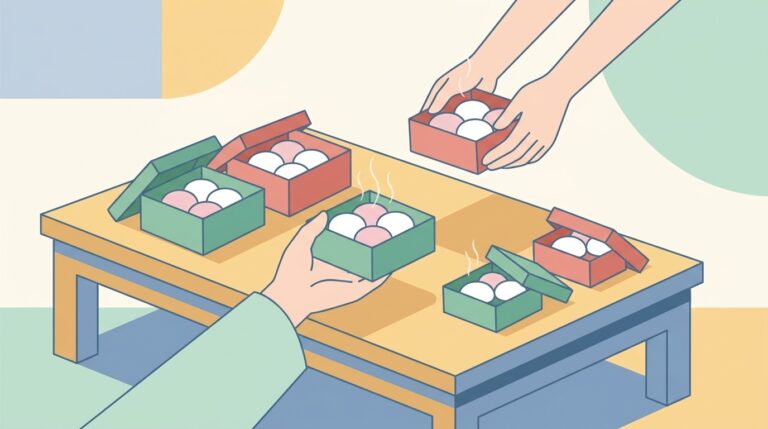
Imagine this: You’re sitting at your desk in a bustling Seoul office, sipping your morning iced Americano. Suddenly, a colleague walks up with a beaming smile, holding a beautifully wrapped, warm little box. Inside, there is a pillowy, snow-white rice cake decorated with a pink Chinese character (百, meaning ‘one hundred’ for 100 days, or perhaps a sweet little pattern for a first birthday).
They hand it to you with both hands and say some soft, happy words. Everyone else in the office starts cheering, “축하해요!” (Chukha-haeyo! – Congratulations!).
Suddenly, you freeze. What is this? Do I eat it now? What do I say to them? Do I need to buy a baby gift immediately?!
Don’t panic! You have just encountered 돌 떡 (Dol-tteok)—the celebratory rice cakes shared on a baby’s first birthday (돌, Dol). Sharing rice cakes is one of Korea’s most beautiful, deep-seated traditions of community warmth, known as 정 (Jeong). Whether you are receiving this sweet gesture from a coworker or looking to share some yourself to celebrate your own milestone, this guide will turn you into an culturally polished, high-Nunchi expert. Let’s dive in! 🎉
Phase 2: Deep Dive into 3 Core Expressions
Let’s look at the three most critical expressions you need to master this situation. These are tailored for intermediate (B1) learners, blending natural politeness with genuine warmth.
1. 저희 아기 첫돌이라서 떡 좀 돌려요. (Jeohui agi cheot-dol-iraseo tteok jom dollyeoyo.)
- Pronunciation: “Juh-hee ah-gee chut-dol-ee-rah-suh tteok jom dol-ryeo-yo.” (Tip: Pronounce “tteok” like the “tt” in “spaghetti” + “uck”)
- Meaning: “It’s our baby’s first birthday, so I’m passing around some rice cakes.”
- K-Culture Moment: You will see proud parents walking around their office floors, neighborhood security offices, or community centers carrying a heavy basket of fresh, warm rice cakes using this exact phrase.
- Editor’s Insight: The verb 돌리다 (dollida) literally means “to spin” or “rotate,” but in social contexts, it means “to distribute” or “to pass around” treats or gifts to a group of people. Adding 좀 (jom) makes the offer sound humble and polite, rather than boastful.
- Situation Spectrum: Casual ⚠️ | Semi-formal ✅ | Formal ✅
- 🤔 Think About It: In your culture, do people bring treats to share when they have a celebration, or do others buy treats for them? How does this reflect our views on community?
2. 아기 첫돌 정말 축하드려요! 건강하게 잘 자라기를 바랄게요. (Agi cheot-dol jeongmal chukha-deuryeoyo! Geon-gang-hage jal jaragireul baralgeyo.)
- Pronunciation: “Ah-gee chut-dol jung-mal chuk-ha-deu-ryeo-yo! Gun-gang-hah-ge jal jah-rah-gee-reul bah-ral-geh-yo.”
- Meaning: “Huge congratulations on the baby’s first birthday! I hope they grow up healthy and strong.”
- K-Culture Moment: This is the gold-standard reply when a coworker or neighbor hands you a box of Dol-tteok.
- Editor’s Insight: In Korean society, the ultimate and most deeply appreciated blessing for a child is 건강하게 잘 자라다 (to grow up healthy and well). It shows you care about the child’s well-being, which touches any parent’s heart.
- Situation Spectrum: Casual 🚫 | Semi-formal ✅ | Formal ✅
- 🤔 Think About It: Note how the blessing focuses heavily on “health” and “growth” rather than “happiness” or “success.” Why do you think historical context shaped this focus?
3. 덕분에 맛있게 잘 먹을게요. (Deok-bune masitge jal meogeulgeyo.)
- Pronunciation: “Deok-boo-neh mah-sheet-geh jal mug-eul-geh-yo.” (Tip: “Deok” sounds like “duck”)
- Meaning: “Thanks to you, I will really enjoy eating this!”
- K-Culture Moment: Used whenever someone treats you to food, but especially when receiving food shared to celebrate a happy family milestone.
- Editor’s Insight: 덕분에 (Deok-bune) is a gorgeous Korean grammar point meaning “thanks to you” or “by your grace.” It adds a layer of deep gratitude and humility, acknowledging that your happy snack time is entirely due to their kindness.
- Situation Spectrum: Casual ⚠️ | Semi-formal ✅ | Formal ✅
- 🤔 Think About It: How does using a phrase like “thanks to you” even for a small snack strengthen the social bond between colleagues?
Phase 3: Textbook Korean vs. Real Korean
Let’s look at how textbooks teach these moments versus how real, warm-hearted Koreans actually talk.
Situation 1: Offering the rice cakes to your team
- 📖 Textbook Korean: “이것은 제 아기의 돌 떡입니다. 드십시오.” (Igeoseun je agi-ui dol tteok-imnida. Deusipsio.)
- Why it’s awkward: It sounds like a robotic announcement or a military command. It feels very cold and distant.
- 🗣️ Real Korean: “저희 아기 돌이라서 떡 좀 준비했어요! 오며 가며 맛있게 드세요~” (Jeohui agi dol-iraseo tteok jom junbi-haesseoyo! Omyeo gamyeo masitge deuseyo~)
- Why it’s better: “오며 가며” (omyeo gamyeo) means “while coming and going.” It creates a relaxed, warm atmosphere where colleagues don’t feel pressured but feel warmly invited to grab a treat.
Situation 2: Accepting the rice cakes and reacting
- 📖 Textbook Korean: “감사합니다. 잘 먹겠습니다.” (Gamsahamnida. Jal meokgessumnida.)
- Why it’s awkward: While polite, it’s the generic phrase used before any meal. It completely ignores the baby and the momentous occasion of the first birthday!
- 🗣️ Real Korean: “헐, 대박! 벌써 돌이에요? 시간 진짜 빠르네요! 너무 축하드려요~” (Heol, daebak! Beolsseo dol-ieyo? Sigan jinja ppareuneyo! Neomu chukha-deuryeoyo~)
- Why it’s better: “벌써” (beolsseo – already) shows surprise and interest in the baby’s growth. Expressing surprise at how fast time flies is the universal language of loving connection in Korea!
Phase 4: K-Culture Deep Dive & Non-Verbal Manners
4-1. The Art of Two Hands & Soft Gazes
In Korea, non-verbal language speaks louder than words. When receiving Dol-tteok:
1. Two Hands, Always: Reach out with both hands to receive the box. Keep your elbows slightly tucked in—this shows deep respect.
2. The Micro-Bow: Give a gentle, 15-degree head bow as you receive the package, maintaining a warm, smiling eye contact for a brief second.
3. Placement: Don’t just toss the box onto your desk immediately. Hold it with care for a moment, look at the cute baby label or sticker, and make a positive comment about the baby’s photo if there is one!
4-2. The Secret History of Baek-seolgi (백설기)
Why rice cakes? In the past, infant mortality was tragically high due to poor medical access and harsh winters. Reaching the first year of life (돌, Dol) was an extraordinary triumph.
Parents would make 백설기 (Baek-seolgi)—a pure white, steamed rice cake. The stark white color symbolized clean, pure spirits, and a long, healthy life. There was a belief that sharing this rice cake with 100 people would guarantee the baby a long, prosperous life. So, when a colleague hands you a piece of Dol-tteok, they aren’t just giving you a snack; they are asking you to be one of the 100 people blessing their child. Isn’t that beautiful?
Phase 5: Real-Life Roleplay Scenario
Setting: You (Alex, an expat working at a creative agency in Mapo, Seoul) are sitting at your desk. Min-ji (your senior colleague/Sunbae) returns from maternal leave and approaches you with a beautiful pastel pink box.
Min-ji: 알렉스 씨! 오늘 우리 지우 돌이라서 회사에 떡 좀 돌려요.
       (Alex! Today is our Ji-woo's first birthday, so I'm passing around some rice cakes.)
       🎭 [Smiling warmly, handing you a warm little box with both hands]

Alex:   어머, 민지 선배님! 벌써 지우가 첫돌이에요? 시간 진짜 빠르네요!
       (Oh, Min-ji Sunbae! Is it already Ji-woo's first birthday? Time flies so fast!)
       🎭 [Receiving the box with both hands, eyes wide with happy surprise]

Min-ji: 그러니까요. 누워서 울기만 하던 게 엊그제 같은데 벌써 걸어 다녀요.
       (Right? It feels like just yesterday she was lying down crying, but she's already walking.)
       🎭 [Laughing softly with a proud mother's look]

Alex:   와, 지우가 아주 씩씩하고 건강하게 잘 자라고 있네요. 너무 축하드려요!
       (Wow, Ji-woo is growing up so strong and healthy. Huge congratulations!)
       🎭 [Looking closely at the cute sticker on the box with Ji-woo's face on it]

Min-ji: 고마워요. 오늘 아침에 낙원떡집에서 바로 받아온 거라 아직 따뜻해요.
       (Thank you. We got it fresh from Nakwon Tteokjib this morning, so it's still warm.)
       🎭 [Gently gesturing to the bottom of the box]

Alex:   와, 대박! 진짜 따뜻해요. 선배님 덕분에 맛있게 잘 먹을게요.
       (Wow, amazing! It really is warm. Thanks to you, Sunbae, I will really enjoy eating this.)
       🎭 [Slightly bowing head in appreciation]

Min-ji: 응, 일하다가 출출할 때 커피랑 같이 먹어요. 그럼 나 옆 부서에도 돌리고 올게요!
       (Yeah, eat it with coffee when you get hungry while working. Well, I'll go share some with the next department too!)
       🎭 [Waving cheerfully with her heavy basket of rice cakes]

Alex:   네, 선배님! 오늘 고생 많으셨어요. 지우 건강하게 잘 키우세요!
       (Yes, Sunbae! You worked hard today. Raise Ji-woo healthy and well!)
       🎭 [Waving back as she walks away, placing the warm tteok nicely on the desk]
🔀 Interactive Choice Point!
How would you respond if Min-ji asked you if you’d like to drop by her baby’s actual weekend Doljanchi party?
* Option A: “아, 주말에는 제가 너무 피곤해서 쉴게요.” (Ah, I’m too tired on weekends, so I will rest.)
* 👉 Feedback (Bad): Yikes! Even if true, saying this directly sounds incredibly cold and kills the festive mood instantly.
* Option B: “우와, 정말요? 초대해 주셔서 감사해요! 일정 확인해 보고 꼭 연락드릴게요!” (Wow, really? Thank you for inviting me! I’ll check my schedule and definitely get back to you!)
* 👉 Feedback (Best): Perfect! It shows immense gratitude, respects her invitation, and buys you time to check your schedule or prepare a small gift/congratulatory money envelope (축의금).
* Option C: “거기 가면 맛있는 거 많이 나와요?” (Does a lot of delicious food come out there?)
* 👉 Feedback (Risk): While Doljanchi buffets are famously delicious, asking about the food first makes you look like you are only interested in a free meal rather than celebrating the baby.
Phase 6: 10-Second Emotion Shadowing Drill
Let’s practice speaking like a native! Pay attention to the pauses (/) and the emotion guiding each sentence.
[😊 Proud and Humble Mom/Dad Tone]
“저희 / 아기 돌이라서 / 떡 좀 / 준비했어요~”
(Jeohui / agi dol-iraseo / tteok jom / junbi-haesseoyo~)-
[😲 Pleasant Surprise & High Energy]
“벌써 / 첫돌이에요? / 와, / 시간 진짜 / 빠르네요!”
(Beolsseo / cheot-dol-ieyo? / Wa, / sigan jinja / ppareuneyo!) -
[🙏 Heartfelt Gratitude & Sweet Voice]
“선배님 덕분에 / 오늘 오후 간식은 / 정말 맛있게 / 잘 먹을게요!”
(Sunbae-nim deok-bune / oneul ohu gansig-eun / jeongmal masitge / jal meogeulgeyo!)
Phase 7: K-Culture Mini Dictionary
| Word (Korean/Romanization) | English Meaning | Real-Life Cultural context |
|---|---|---|
| 첫돌 (Cheot-dol) | The First Birthday | The most critical milestone for a Korean baby. Traditionally celebrated with grand parties. |
| 수수경단 (Susu-gyeongdan) | Red Bean Millet Balls | Traditional reddish-brown, round rice cakes shared during Doljanchi to ward off evil spirits and bad luck. |
| 돌잡이 (Doljabi) | The Fortune-Telling Ritual | The highlight of the first birthday party where the baby chooses an object (pencil, money, thread, stethoscope) that predicts their future. |
| 답례품 (Dapryepum) | Thank-you Return Gift | Any small gift (rice cakes, hand soap, salt, towels) given to guests/colleagues to thank them for sharing blessings. |
Phase 8: Traveler & Expat Survival Kit
Top 3 Lifesaver Phrases for the Workplace
- 떡이 정말 쫄깃하고 맛있어요! (Tteok-i jeongmal jjolgit-hago masiseoyo!)
- Meaning: “The rice cake is so incredibly chewy and delicious!”
- Pro Tip: Koreans love the texture 쫄깃하다 (jjolgit-hada). Saying this is the ultimate compliment to the person who ordered the tteok!
- 아기가 엄마(아빠) 닮아서 너무 예쁠 것 같아요. (Agiga eomma (appa) dalmaraseo neomu yeoppeul geot gatayo.)
- Meaning: “The baby must be so beautiful since they look just like you (mom/dad).”
- Pro Tip: A foolproof compliment that will make any Korean coworker’s day.
- 축하해 주셔서 감사합니다. 덕분에 잘 치렀어요. (Chukha-hae jusyeoseo gamsahamnida. Deok-bune jal chireosseoyo.)
- Meaning: “Thank you for celebrating with us. Thanks to you, we finished the event successfully.”
- Pro Tip: Use this if you are the parent returning to work after your own baby’s Doljanchi.
📝 Editor’s Travel Note
If you want to experience the freshest, most authentic celebratory rice cakes in Seoul, look no further than the historical Insadong area or traditional markets. I highly recommend download the Naver Map App and searching for 낙원떡집 (Nakwon Tteokjib)—one of the oldest operating rice cake brands in Seoul. Note: Operating hours and seasonal rice cake availability can vary, so always double-check the latest details on the app before making your trip!
Phase 9: “한 발 더 깊이” (A Deeper Step into Korean Humanity)
In Western cultures, birthday celebrations are often private family affairs or parties focused purely on the child receiving gifts. In Korea, however, the act of 돌 떡 돌리기 (distributing first birthday rice cakes) shows that happiness is meant to be shared horizontally across the community.
This reflects 정 (Jeong)—the warm, unspoken social glue that binds Koreans together. By giving you rice cakes, the parents are offering you a piece of their family’s joy. By accepting it with joy and offering your blessing, you become an honorary member of that child’s support system. It is a beautiful manifestation of the African proverb, “It takes a village to raise a child,” active in the high-tech heart of 21st-century Seoul.
💬 Your Turn: Does your culture have a tradition of sharing specific food with neighbors or colleagues when a baby is born or reaches a milestone? Let me know in the comments below! I read every single one!
Phase 10: FAQ & Common Mistakes
Q: Do I need to give a cash gift or a baby present immediately when a colleague hands me Dol-tteok?
A: No, absolutely not! Dol-tteok given at the office is a free gesture of shared joy. You do not need to feel pressured to give anything back immediately. However, leaving a warm post-it note of congratulations on their desk or dropping a coffee coupon via KakaoTalk is a beautiful, high-Nunchi touch.
Q: What should I do if I am gluten-free or vegetarian? Can I decline the rice cake?
A: Most traditional Korean rice cakes like Baek-seolgi are made purely of rice flour, salt, sugar, and water, making them naturally gluten-free and vegan! However, to avoid breaking the celebratory atmosphere, always accept the box with two hands first. If you cannot eat it due to allergies, politely say thank you, and quietly give it to another colleague later.
Q: Should I eat the rice cake immediately, or can I save it for later?
A: Traditional Korean rice cakes have no preservatives and dry out incredibly fast. They taste best when warm and fresh on the day of receipt. If you can’t eat it immediately, freeze it as soon as possible, and steam/microwave it later to restore its chewiness.
🚨 Common Mistakes Alert!
- The Ghost Desk Drop: Leaving the rice cake box silently on a coworker’s desk without saying anything when they are away.
- Correct Action: Leave a small sticky note saying: “지우 첫돌 축하해요! 맛있게 먹을게요! – 알렉스” (Congrats on Ji-woo’s first birthday! I’ll eat it happily! – Alex).
- The Complainer: Saying “Oh, this is too heavy/sticky for me” to the parent.
- Correct Action: Focus on the gesture and use positive texture words like “엄청 쫄깃하네요!” (It’s so chewy!).
- Forgetting the Baby: Taking the box and only saying “Oh, free food! Thank you!” without mentioning the baby’s first birthday.
- Correct Action: Always prioritize the baby: “벌써 돌이에요? 축하해요!”
Phase 11: Action Missions
- 🥉 Bronze Mission: Practice saying “선배님 덕분에 맛있게 잘 먹을게요!” out loud 5 times in front of the mirror with a big, bright smile.
- 🥈 Silver Mission: Next time you are watching a family K-Drama (like Reply 1988 or My Mister), try to find a scene where neighbors share food in containers. Snap a photo and share your thoughts on your social media, tag us at
@DailyHangul! - 🥇 Gold Mission: If you have a happy event or trip, buy some small treats, walk up to your team, and distribute them with both hands saying, “~좀 준비했어요. 맛있게 드세요!”
- 🎮 K-Culture Mission: Go to YouTube, search for “돌잡이” (Doljabi), and watch a short video of a baby choosing an item. Write down in the comments below what the baby picked!
Phase 12: Interactive Quiz Challenge
Test your cultural Nunchi! Click on the boxes below to reveal the answers.
Q1. Which rice cake is traditionally shared to ward off bad luck and evil spirits during a baby’s first birthday?
Answer: 수수경단 (Susu-gyeongdan – Red Bean Millet Balls). The red color of the red bean paste was traditionally believed to repel evil spirits and keep the baby safe.
Q2. Complete the sentence naturally: “와, 벌써 아기 ____ 이에요? 정말 축하드려요!”
Answer: 돌 (Dol) or 첫돌 (Cheot-dol). It means “first birthday.” “벌써 아기 첫돌이에요?” is the ultimate polite reaction!
Q3. True or False: If a coworker gives you Dol-tteok, you must immediately purchase an expensive baby gift of equal value. (T/F)
Answer: False! Dol-tteok is a gift of pure sharing. A sincere congratulatory message and a warm smile are more than enough. If you are very close, a small gift like baby socks or a small monetary gift is optional but sweet.
Keep sharing, keep speaking, and stay warm! 다음에 또 만나요! (See you next time!) 🌸







