

Keeping Memories Alive: How to Ask for Dried Flowers in a Korean Flower Shop
Phase 1: Welcome to the World of Everlasting Flowers!
안녕하세요! (An-nyeong-ha-se-yo!) Hello! I’m your lead editor and your personal Korean culture guide from Daily Hangul.
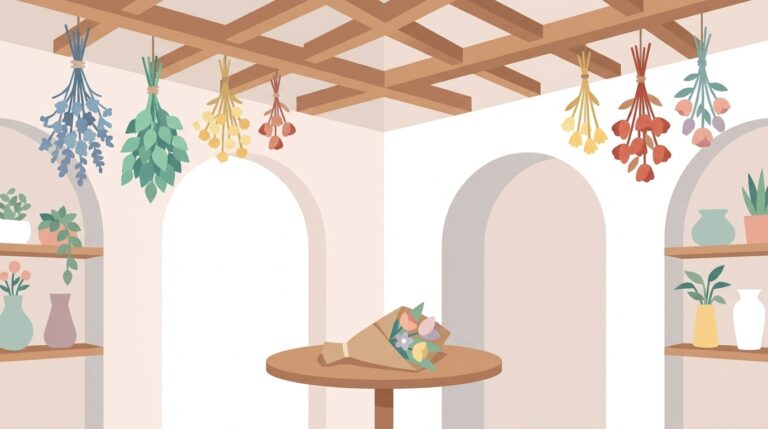
Have you ever watched a romantic K-Drama where the lead actor hands over a beautifully wrapped, rustic bouquet of flowers that look perfectly preserved? Or maybe you’ve walked past a cozy, wood-toned flower shop in Mapo-gu, Seoul, and noticed stunning, colorful flowers hanging upside down from the ceiling.
In Korea, 드라이 플라워 (dried flowers) are incredibly popular. Unlike fresh flowers that fade in a week, dried flowers represent “unchanging love” and “lasting memories.” They are the perfect, low-maintenance souvenir or gift! But when you step into a trendy Korean florist, how do you ask for them without just pointing and saying “This one”?
Today, we are going to unlock the perfect, natural Korean phrases to ask for dried flowers. By the end of this guide, you will feel like a confident local customer! Let’s dive in!
Phase 2: Three Key Expressions to Know
Here are the top three expressions you can use immediately in any Korean flower shop.
1. 드라이 플라워 있어요? (Deu-ra-i peul-ra-wo is-seo-yo?)
- Pronunciation: Deu-ra-i peul-ra-wo (sounds like “dry flower” but with a soft “eu” sound at the end of “dry” and a soft “peul” sound for “flow”) is-seo-yo? (sounds like “east-saw-yo?”)
- Meaning: Do you have dried flowers?
- K-Culture Moment: You walk into a cute florist in Hongdae. The shop is filled with fresh roses, but you want something travel-friendly. You make eye contact with the florist, smile, and ask this phrase!
- Editor’s Insight: This is the easiest, most versatile phrase. Even though it uses the English words “dry flower,” Koreans pronounce it in their phonetic system as 드라이 플라워.
- Situation Spectrum: Casual ✅ | Semi-formal ✅ | Formal ⚠️
- 🤔 Think About It: Why do you think Konglish (Korean-English hybrid words) like “드라이 플라워” are so widely used in modern Korean shops? How does it make learning Korean easier or harder for you?
2. 이거 드라이 플라워로 만들 수 있어요? (I-geo deu-ra-i peul-ra-wo-ro man-deul su is-seo-yo?)
- Pronunciation: I-geo (sounds like “ee-gaw”) deu-ra-i peul-ra-wo-ro (dry-flower-ro) man-deul su is-seo-yo? (sounds like “mahn-deul soo east-saw-yo?”)
- Meaning: Can you make this into dried flowers?
- K-Culture Moment: You found a gorgeous fresh lavender bouquet, but you want to take it home on a flight. You ask if they can dry it for you or if it’s a suitable type for drying.
- Editor’s Insight: The pattern ~수 있어요? (~su is-seo-yo?) means “Can you…?” or “Is it possible?”. It’s a lifesaver pattern for A2 learners!
- Situation Spectrum: Casual ✅ | Semi-formal ✅ | Formal ⚠️
- 🤔 Think About It: In your country, do people dry their own flowers, or do they buy them pre-made? How does asking for custom-dried flowers reflect the personalized customer service culture in Korea?
3. 오래 가는 꽃 추천해 주세요. (O-rae ga-neun kkot chu-cheon-hae ju-se-yo.)
- Pronunciation: O-rae (sounds like “oh-reh”) ga-neun (sounds like “gah-neun”) kkot (sounds like “kote” with a very sharp ‘k’) chu-cheon-hae (sounds like “choo-chuhn-hae”) ju-se-yo (sounds like “joo-seh-yo”).
- Meaning: Please recommend flowers that last a long time.
- K-Culture Moment: You want a gift for a friend’s housewarming party. You want something durable, whether it’s dried flowers or long-lasting fresh ones. This polite request lets the florist guide you.
- Editor’s Insight: 추천해 주세요 (chu-cheon-hae ju-se-yo) means “please recommend.” Florists love this because it lets them showcase their artistic expertise!
- Situation Spectrum: Casual ⚠️ | Semi-formal ✅ | Formal ✅
- 🤔 Think About It: Why is asking for a “recommendation” considered polite in Korean customer service? It shows trust in the seller’s expertise!
Phase 3: Textbook Korean vs. Real Korean
Let’s compare what dry textbooks teach you versus how Koreans actually talk!
Situation 1: Asking if they sell dried flowers
- 📖 Textbook Korean: 건조화가 있습니까? (Geon-jo-hwa-ga it-seup-ni-ka? – “Do dried blossoms exist?”)
- 🗣️ 진짜 Korean: 드라이 플라워 혹시 있어요? (Deu-ra-i peul-ra-wo hok-si is-seo-yo? – “By any chance, do you have dried flowers?”)
- 💡 Why is it different? Nobody says “건조화” (dried blossoms) in daily life unless it’s a scientific or highly formal botany context. Locals use “드라이 플라워”. Adding 혹시 (hok-si – by any chance) softens your question and makes you sound incredibly polite and natural!
Situation 2: Asking for a recommendation
- 📖 Textbook Korean: 무엇을 구매해야 합니까? (Mu-eot-eul gu-mae-hae-ya hap-ni-ka? – “What must I purchase?”)
- 🗣️ 진짜 Korean: 어떤 게 잘 나가요? (Eo-tteon ge jal na-ga-yo? – “Which one is popular / selling well?”)
- 💡 Why is it different? The textbook phrase sounds like a robotic translation. In Korea, asking “잘 나가요?” (literally: “Does it go out well?”) is the ultimate insider shortcut to ask what the best-sellers are!
Phase 4: K-Culture Deep Dive & Florist Etiquette
4-1. “Nunchi” (눈치) & Soft Gestures
When walking into a Korean flower shop, look around first to see if they have a dedicated section for dried flowers (usually hung on walls or arranged in baskets).
* The Soft Nod: When asking a question, a slight, gentle head nod shows respect.
* The Two-Hand Rule: If the florist hands you a bouquet or your card back, always receive it with both hands. This simple gesture of gratitude will instantly make the florist smile!
4-2. The K-Drama Flower Trend
Have you noticed how characters in dramas like Goblin or Crash Landing on You exchange unique bouquets? Dried flowers, especially cotton flowers (목화 – mok-hwa) and baby’s breath (안개꽃 – an-gae-kkot), became major trends because of K-Dramas. Giving cotton flowers symbolizes “mother’s love” and warmth, making it a highly popular graduation gift in Korea!
Phase 5: Real-Life Roleplay Scenario
Meet Ji-su, the friendly owner of a beautiful flower shop in Yeonnam-dong.
Setting: A cozy wooden flower shop filled with the sweet aroma of eucalyptus and dried lavender.
- Ji-su (Florist): 어서 오세요! 어떤 꽃 찾으세요?
(Eo-seo o-se-yo! Eo-tteon kkot cha-jeu-se-yo?)
“Welcome! What kind of flowers are you looking for?” - You: 저… 혹시 드라이 플라워 있어요?
(Jeo… hok-si deu-ra-i peul-ra-wo is-seo-yo?)
“Uh… by any chance, do you have dried flowers?” - Ji-su (Florist): 🎭 [Pointing to a beautiful wall hanging] 네! 저기 벽에 걸린 것들이 다 드라이 플라워예요. 선물하실 건가요?
(Ne! Jeo-gi byeok-e geol-rin geot-deul-i da deu-ra-i peul-ra-wo-yeo-yo. Seon-mul-ha-sil geon-ga-yo?)
“Yes! Those hanging on the wall over there are all dried flowers. Is it for a gift?” - You: 네, 친구 선물이에요. 오래 가는 꽃 추천해 주세요.
(Ne, chin-gu seon-mul-i-e-yo. O-rae ga-neun kkot chu-cheon-hae ju-se-yo.)
“Yes, it’s a gift for a friend. Please recommend flowers that last a long time.” - Ji-su (Florist): 🎭 [Smiling warmly, picking up a pink bouquet] 이 장미 드라이 플라워 어떠세요? 색도 예쁘고 정말 오래 가요.
(I jang-mi deu-ra-i peul-ra-wo eo-tteo-se-yo? Saek-do ye-ppeu-go jeong-mal o-rae ga-yo.)
“How about this dried rose? The color is pretty and it lasts really long.” - You: 우와, 정말 예쁘네요! 이걸로 할게요. 예쁘게 포장해 주세요.
(U-wa, jeong-mal ye-ppeu-ne-yo! I-geol-ro hal-ge-yo. Ye-ppeu-ge po-jang-hae ju-se-yo.)
“Wow, it’s really beautiful! I’ll take this one. Please wrap it nicely.” - Ji-su (Florist): 네, 예쁘게 포장해 드릴게요. 잠시만 기다려 주세요!
(Ne, ye-ppeu-ge po-jang-hae deu-ril-ge-yo. Jam-si-man gi-da-ryeo ju-se-yo!)
“Sure, I’ll wrap it beautifully for you. Just a moment, please!” - You: 감사합니다!
(Gam-sa-hap-ni-da!)
“Thank you!”
🔀 Interactive Choice Point
Imagine Ji-su asks you: “선물하실 건가요?” (Is it a gift?) How do you respond?
- A) “아니요, 제가 가질 거예요.” (No, I will keep it.)
- B) “네, 친구 선물이에요.” (Yes, it’s a gift for a friend.)
- C) “선물 필요 없어요.” (I don’t need a gift.)
Florist Feedback:
- Selecting A (Best for self-care): Great choice! Florists love when people buy flowers for themselves. Ji-su might wrap it in simple, eco-friendly paper perfect for carrying home.
- Selecting B (Best for gifting): Wonderful! If it’s a gift, Ji-su will add a premium ribbon and maybe even a tiny message card for free!
- Selecting C (Risk/Awkward): Oops! This sounds a bit cold. “선물 필요 없어요” sounds like “I don’t need a present (from you).” To say “I don’t need gift-wrapping,” say “포장 안 하셔도 돼요” (Po-jang an ha-syeo-do dwae-yo) instead!
Phase 6: 10-Second Emotion Shadowing Drill
Let’s practice speaking with real Korean feelings! Pay attention to the pauses (/) and the emotional cues.
- [🥺 Shy & Polite] 저… / 혹시 / 드라이 플라워 / 있어요?
(Jeo… / hok-si / deu-ra-i peul-ra-wo / is-seo-yo?) - [😊 Bright & Excited] 우와, / 진짜 / 예쁘네요! / 이걸로 할게요!
(U-wa, / jin-jja / ye-ppeu-ne-yo! / I-geol-ro hal-ge-yo!) - [🙏 Warm & Grateful] 예쁘게 / 포장해 주세요. / 감사합니다!
(Ye-ppeu-ge / po-jang-hae ju-se-yo. / Gam-sa-hap-ni-da!)
Phase 7: K-Culture Mini Dictionary
- 안개꽃 (An-gae-kkot) | Baby’s Breath
- Meaning: Literally “fog flower” because a bundle of it looks like beautiful, soft white fog. It is the most common flower dried in Korea.
- 포장 (Po-jang) | Wrapping / Packaging
- Meaning: Korea has a world-class flower wrapping aesthetic. Even a single stem looks like a work of art after “포장”.
- 꽃말 (Kkot-mal) | Flower Language / Meaning
- Meaning: Koreans love checking the hidden meanings of flowers before gifting them. For example, pink roses mean “happy love.”
- 인스타 감성 (In-seu-ta Gam-seong) | Instagram Vibe
- Meaning: Refers to aesthetic, trendy designs. Many dried flower shops in Korea are decorated with this exact “Instagrammable” look.
Phase 8: Traveler’s Survival Kit
Top 3 Survival Phrases
- 이거 얼마예요? (I-geo eol-ma-yeo-yo?) – How much is this?
- 봉투 필요해요. (Bong-tu pil-yo-hae-yo.) – I need a bag (to carry the flowers safely).
- 카드 돼요? (Ka-deu dwae-yo?) – Can I pay by card?
📌 Editor’s Travel Note
Looking for beautiful flower shops in Seoul? Use the Naver Map App instead of Google Maps, as Google Maps is not fully optimized in Korea. Simply type “꽃집” (Flower shop) or “드라이플라워” (Dried flowers) into the search bar to find top-rated local florists nearby! Note: Most Korean florists gladly accept international credit cards.
Phase 9: “One Step Deeper” (Thinking Points)
In many Western cultures, giving fresh, fragrant flowers is the golden standard, and dried flowers are sometimes viewed as “dead” or “dusty.” However, in Korea, dried flowers are celebrated as an art form that preserves the peak beauty of a moment. This reflects a deeper Korean cultural value of 정 (Jeong – deep attachment/affection). We do not want the beautiful moments shared with loved ones to fade away quickly; we want to preserve them and look at them every single day on our desks.
💬 Your Turn: Do you prefer fresh flowers that smell amazing but fade, or dried flowers that last forever? Let us know in the comments below!
Phase 10: FAQ & Common Mistakes
Q: Can I take dried flowers back to my home country on a plane?
A: It depends on your country’s customs regulations! Many countries have strict biosecurity laws regarding soil, seeds, and plant materials. Always check your country’s customs website before traveling. Dried flowers with seeds might be restricted!
Q: What is the difference between “드라이 플라워” (dried flowers) and “프리저브드 플라워” (preserved flowers)?
A: Great question! 드라이 플라워 are naturally air-dried flowers, which look rustic and slightly vintage. 프리저브드 플라워 (preserved flowers) are treated with chemicals to keep them looking fresh and soft to the touch for years. Both are widely sold in Korea!
Q: Is it okay to take photos inside a beautiful Korean flower shop?
A: Most florists don’t mind, but it is always polite to ask first! You can say: “사진 찍어도 돼요?” (Sa-jin jjik-eo-do dwae-yo? – Can I take photos?).
🚨 Common Mistakes Warning Board
- Mistake 1: Calling dried flowers “죽은 꽃” (Juk-eun kkot – Dead flowers).
- Correct Action: Never say this! It sounds morbid. Always use “드라이 플라워”.
- Mistake 2: Asking for “말린 꽃” (Mal-lin kkot) in a formal tone.
- Correct Action: While “말린 꽃” is grammatically correct, it sounds a bit like “dried fish” or “dried vegetables.” Stick to the trendy term “드라이 플라워”!
Phase 11: Action Missions
- 🥉 Bronze Mission: Read the expressions in Phase 2 out loud three times. Use the pronunciation guides!
- 🥈 Silver Mission: Go to Instagram, search the hashtag
#드라이플라워, and find your favorite design. Write down the Korean name of the flowers used in the caption! - 🥇 Gold Mission: Next time you visit Korea, walk into a local florist and use the phrase: “혹시 드라이 플라워 있어요?” to purchase a beautiful souvenir!
Phase 12: Interactive Quiz Challenge
Test your knowledge! Click on the toggles to check the correct answers.
1. Situational Judgment
You want to ask the florist to recommend a flower bouquet that will last for a long time. What should you say?
* A) 이거 얼마예요?
* B) 오래 가는 꽃 추천해 주세요.
* C) 사진 찍어도 돼요?
Reveal Answer & Explanation
Correct Answer: B) 오래 가는 꽃 추천해 주세요.
Explanation: B means “Please recommend flowers that last a long time.” A is for price, and C is for taking photos!
2. Fill in the Blank
Complete the natural Korean phrase: “Do you have dried flowers, by any chance?”
드라이 플라워 (____) 있어요?
Reveal Answer & Explanation
Correct Answer: 혹시 (hok-si)
Explanation: Adding “혹시” (by any chance) before “있어요?” makes your question sound much more polite and native-like!
3. True or False Culture Quiz
True or False: In Korea, calling dried flowers “죽은 꽃” (dead flowers) is a common and friendly way to order them.
Reveal Answer & Explanation
Correct Answer: False!
Explanation: Calling them “죽은 꽃” sounds very unnatural and slightly rude to the florist who worked hard to dry them beautifully. Always say “드라이 플라워”!
See you in the next lesson of Daily Hangul! 다음 주에 또 만나요! (See you next week!)






