

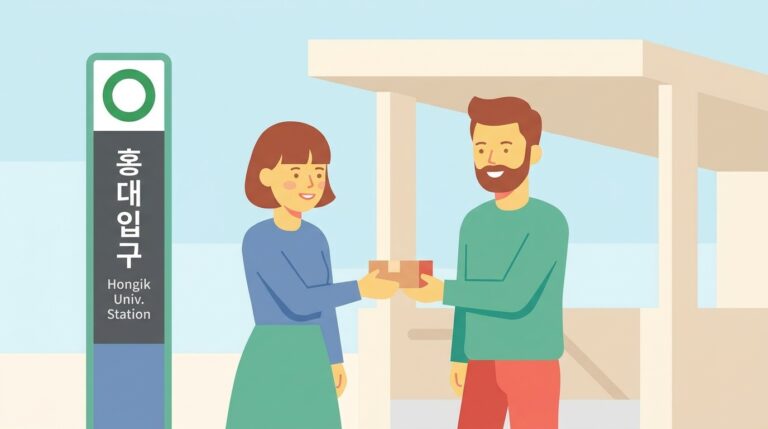
Let’s Meet at Exit 3! Your Super Simple Guide to Second-Hand Trading in Korea
Phase 1: Empathy (Welcome to the World of ‘Danggeun’!)
안녕하세요! (An-nyeong-ha-se-yo!) Hello there, my dear friend! I’m the Chief Editor of Daily Hangul, your personal guide to living and speaking like a true Seoulite.
Imagine this: You found the perfect second-hand vintage camera on Karrot Market (당근마켓)—Korea’s absolute favorite neighborhood trading app. You want to buy it, but your phone buzzes with a message from the seller: “Where should we meet?” Your heart stops. How do you suggest a safe, easy-to-find place in Korean without sounding like a textbook robot?
Don’t worry! Deciding on a meeting spot is the ultimate first step to a successful trade. Many of our foreign learners felt super nervous about this, but once they mastered our three magic phrases, they traded everything from K-pop albums to bicycles! Today, you’ll learn the exact friendly phrases Koreans use every single day.
Phase 2: Key Expressions Analysis
Let’s look at the three most important phrases you need to know.
1. 어디서 만날까요? (Where shall we meet?)
- Pronunciation: eo-di-seo man-nal-kka-yo? (Sounds like: “uh-dee-suh mahn-nahl-kkah-yo?”)
- Meaning: Where shall we meet?
- K-Culture Moment: You will hear this in almost every K-drama when two characters plan a casual coffee date or a quick meeting.
- Editor’s Insight: This is the ultimate, polite-yet-friendly way to ask for a location. The “-요” (yo) ending makes it perfect for strangers you meet online.
- Situation Spectrum: Casual (✅) | Semi-formal (✅) | Formal (⚠️)
- 🤔 Think About It: In English, we often say “Where do you want to meet?” which focuses on ‘you’. In Korean, we say “Where shall we meet?” (만날까요), reflecting Korea’s warm, group-oriented culture.
2. OO역 X번 출구에서 봐요. (Let’s meet at OO Station exit X.)
- Pronunciation: OO-yeok X-beon chul-gu-e-seo bwa-yo. (Sounds like: “OO-yuhk [Number]-buhn chool-goo-eh-suh bwah-yo.”)
- Meaning: Let’s meet at OO Station, Exit X.
- K-Culture Moment: Seoul’s subway system is so massive and punctual that subways are the #1 meeting spot for second-hand deals.
- Editor’s Insight: Just replace “OO” with the station name (e.g., 홍대입구역 / Hongdae) and “X” with the exit number (e.g., 3번 / Exit 3). It’s incredibly specific and safe!
- Situation Spectrum: Casual (✅) | Semi-formal (✅) | Formal (🚫)
- 🤔 Think About It: Why exit numbers? Korean subway stations have many exits (sometimes up to 12!), making exit numbers the most precise landmarks in the city!
3. 중간에서 만나요. (Let’s meet in the middle.)
- Pronunciation: jung-gan-e-seo man-na-yo. (Sounds like: “joong-gahn-eh-suh mahn-nah-yo.”)
- Meaning: Let’s meet halfway / in the middle.
- K-Culture Moment: Used when both the buyer and seller live a bit far from each other and want to show mutual respect.
- Editor’s Insight: Suggesting to meet halfway shows that you are considerate and polite (배려, bae-ryeo), which is highly valued in Korean society.
- Situation Spectrum: Casual (✅) | Semi-formal (✅) | Formal (⚠️)
- 🤔 Think About It: Is there a middle ground in your hometown where people usually trade? In Korea, it’s almost always a major transit station!
Phase 3: Textbook Korean vs. Real-Life Korean
Let’s see how school textbook Korean compares to what locals actually say!
- Situation 1: Asking where to meet
📖 Textbook:“어디에서 만나겠습니까?” (eo-di-e-seo man-na-get-seup-ni-ka? – Extremely formal, sounds like a business merger meeting!)🗣️ Real Korean:“어디서 만날까요?” (eo-di-seo man-nal-kka-yo? – Natural, friendly, and very polite.)💡 Why the difference?Locals prefer soft, approachable endings like “-까요?” when making friendly plans.
- Situation 2: Specifying the subway exit
📖 Textbook:“지하철역 입구로 오십시오.” (ji-ha-cheol-yeok ip-gu-ro o-sip-si-o. – Sounds like a GPS navigation voice.)🗣️ Real Korean:“OO역 X번 출구 앞이요!” (OO-yeok X-beon chul-gu ap-i-yo! – Short, clear, and perfectly polite with the ‘요’ ending.)💡 Why the difference?In quick texting, short phrases with a friendly tone (using ‘요’ or exclamation marks) are preferred.
Phase 4: K-Culture Deep-Dive & Non-Verbal Manners
4-1. Nunchi (눈치) & Meeting Manners
When you meet a seller at a subway exit, use your Nunchi (quick social wit)!
* The Visual Cue: Look for someone standing near the exit holding the item or holding an orange paper shopping bag (many Karrot traders use shopping bags to make themselves obvious!).
* The Gesture: When you lock eyes, do a gentle 45-degree bow with your head and say “안녕하세요!” (Hello!). It instantly builds trust.
4-2. The Karrot Market Phenom
In Korea, second-hand trading is not just about saving money; it’s a neighborhood culture. People trade tiny items worth $1 just to have a friendly interaction with a neighbor. It’s safe, warm, and highly respected!
Phase 5: Live Roleplay Scenario
Let’s practice! You are Alex (the buyer), and you are messaging Ji-won (the seller) on Karrot Market to buy a cute desk lamp.
- Characters:
- Ji-won (Seller): Friendly neighborhood resident.
- Alex (Buyer – You!): Looking for an easy trade.
The Chatting Board:
1. Ji-won: 안녕하세요! 스탠드 구매 가능해요. (Hello! The lamp is available for purchase.)
2. Alex: 🎭 [Smiling] 감사합니다! 어디서 만날까요? (Thank you! Where shall we meet?)
3. Ji-won: 저는 홍대 근처에 살아요. (I live near Hongdae.)
4. Alex: 🎭 [Thinking politely] 그럼 중간에서 만나요. (Then, let’s meet in the middle.)
5. Ji-won: 좋아요! 합정역 어때요? (Great! How about Hapjeong Station?)
6. Alex: 🎭 [Nodding] 좋습니다. 합정역 3번 출구에서 봐요. (Sounds good. Let’s meet at Hapjeong Station, Exit 3.)
7. Ji-won: 네, 오늘 저녁 7시에 만나요! (Okay, let’s meet at 7 PM tonight!)
8. Alex: 🎭 [Typing happily] 네, 그때 뵙겠습니다! (Yes, see you then!)
🔀 Choose Your Next Move! (Interactive Branch)
If Ji-won suddenly texts: “I can’t make it to Hapjeong. Can you come to my apartment lobby?”
* Choice A (Safe & Polite): “죄송해요, 지하철역이 더 편해요!” (Sorry, the subway station is more convenient for me!)
* Feedback: BEST! Always prioritize safety and your comfort. Subway exits are public and safe.
* Choice B (Too Aggressive): “싫어요. 못 가요.” (No. I can’t go.)
* Feedback: BAD! This sounds very cold and rude in Korean.
* Choice C (A bit risky but doable): “알겠습니다. 주소 알려주세요.” (Okay. Please give me the address.)
* Feedback: RISK! Only choose this if you are fully comfortable with the area.
Phase 6: 10-Second Shadowing Drill
Read these aloud while matching the emotion in the brackets! The / represents a tiny pause.
[😊 Friendly & Inquiring]- 어디서 / 만날까요?
- eo-di-seo / man-nal-kka-yo?
[🙋♂️ Clear & Decisive]- 합정역 / 3번 출구에서 / 봐요!
- Hap-jeong-yeok / sam-beon chul-gu-e-seo / bwa-yo!
[🤝 Warm & Considerate]- 중간에서 / 만나요.
- jung-gan-e-seo / man-na-yo.
Phase 7: K-Culture Mini-Dictionary
- 당근마켓 (Dang-geun-ma-ket) | Karrot Market
- Meaning: Korea’s absolute favorite hyper-local second-hand app. “당근” also means “carrot”!
- 직거래 (Jik-geo-rae) | In-person trade
- Meaning: Meeting face-to-face to trade items, highly preferred in Korea to avoid mail scams.
- 네고 (Ne-go) | Negotiation / Discount
- Meaning: Short for “negotiation.” Be careful! Asking for too much “네고” is considered bad manners.
- 반값택배 (Ban-kkap-taek-bae) | Half-price convenience store delivery
- Meaning: A genius Korean system where you send packages from one convenience store to another for half the normal price!
Phase 8: Survival Kit for Travelers
Top 3 Survival Phrases
- “지금 출발해요!” (ji-geum chul-bal-hae-yo!)
- Meaning: I am leaving now!
- “거의 다 왔어요.” (geo-ui da wat-seo-yo.)
- Meaning: I’m almost there.
- “출구 앞에 서 있어요.” (chul-gu ap-e seo it-seo-yo.)
- Meaning: I am standing in front of the exit.
🎒 Editor’s Travel Note
When navigating to your meeting spot, don’t use Google Maps (it doesn’t work well in Korea!). Instead, download the Naver Map App or KakaoMap App to find the exact subway exit numbers instantly. Korea’s public transit is extremely accurate, so if you say “7 PM,” try to be there by 6:55 PM!
Phase 9: “Going Deeper” (Cultural Reflection)
In many Western cultures, second-hand trading often involves driving to someone’s house or meeting in a random parking lot. In Korea, however, the subway station exit acts as a shared, safe community hub. It has CCTV, plenty of light, and constant foot traffic. This reflects Korea’s high-density urban structure and the cultural trust built around public spaces. Meeting at “Exit 3” is not just convenient; it’s a silent agreement of safety and mutual respect.
💬 Your Turn: What is the usual meeting spot for online deals in your country? Let me know in the comments below!
Phase 10: FAQ & Common Mistakes
Q: Can I ask the seller to bring the price down when we meet face-to-face?
A: No, that is a huge etiquette mistake in Korea! All negotiations (네고) should be agreed upon via chat before you meet. Asking for a discount in person is considered extremely rude.
Q: What if I can’t find the person at the exit?
A: Send a message describing your clothes! For example: “저 베이지색 코트 입고 있어요.” (I am wearing a beige coat.)
Q: Is it safe for a solo traveler to do in-person trades?
A: Yes! As long as you stick to bright, public subway exits during daytime or early evening, it is incredibly safe in Korea.
🚨 Common Mistakes Alert!
- Saying “거기서 봐요” (See you there) without specifying an exit.
- Correct Action: Always specify! “3번 출구에서 봐요” (See you at Exit 3).
- Being late without texting.
- Correct Action: Koreans value punctuality. If you are 5 minutes late, text: “5분 정도 늦을 것 같아요. 죄송합니다!” (I think I’ll be 5 minutes late. Sorry!)
- Using high-level formal ending “하십시오” to peers.
- Correct Action: Stick to “-요” (bwa-yo, man-na-yo) to sound natural and friendly.
Phase 11: Action Missions
- Bronze Medal: Read the three key phrases out loud 5 times using our pronunciation guides!
- Silver Medal: Open your maps app, pick your favorite Seoul subway station, and write down: “[Station Name]역 [Exit Number]번 출구에서 봐요!” in the comments below.
- Gold Medal: The next time you buy a concert ticket or a K-pop photocard from a Korean fan, suggest the meeting spot first using: “어디서 만날까요? OO역에서 만나요!”
-
🎮 K-Culture Mission: Watch a modern K-drama episode today and spot how many times characters meet right outside a subway exit! (Clue: It happens almost every episode!)
Phase 12: Interactive Quiz
Can you get a perfect score? Try these quick questions!
1. How do you say “Let’s meet in the middle” in friendly Korean?
- A) 어디서 만날까요?
- B) 중간에서 만나요.
- C) 여기서 봐요.
Click for the Answer!
Correct Answer: B
Explanation: “중간에서 만나요” (jung-gan-e-seo man-na-yo) means “Let’s meet in the middle.” A means “Where shall we meet?” and C means “Let’s meet here.”
2. True or False: It is perfectly fine to ask for a discount face-to-face at the meeting spot.
- True
- False
Click for the Answer!
Correct Answer: False
Explanation: All price negotiations should be finalized in the chat before meeting. Doing it in person is bad manners!







