

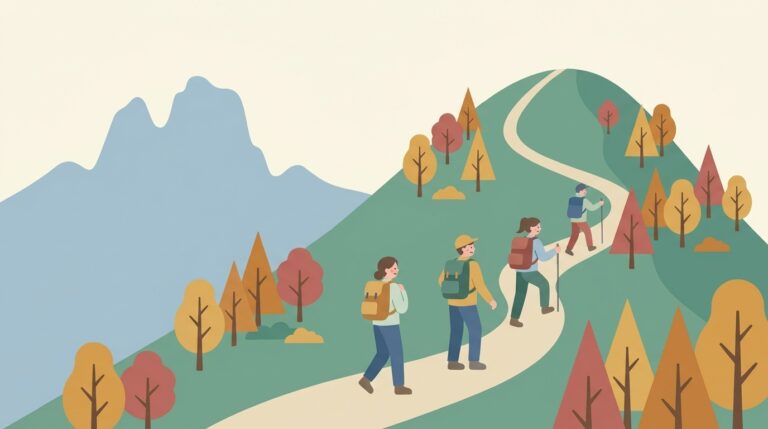
Hit the Trails Like a Local: Your Ultimate Guide to Korean Hiking Clubs
안녕하세요! Welcome back to Daily Hangul, your premium space for mastering not just the Korean language, but the vibrant lifestyle that goes with it. I’m your Lead Editor and resident cultural navigator. Today, we are putting on our hiking boots and conquering one of Korea’s most beloved national pastimes: hiking clubs (등산 동호회 – deung-san dong-ho-hoe).
If you’ve ever watched a K-drama, you’ve likely seen characters decked out in head-to-toe, neon-colored outdoor gear, scaling granite peaks, and rewarding themselves with savory pancakes and rice wine. But actually joining a local club? That can feel like standing at the sheer cliff face of Bukhansan without a harness. How do you introduce yourself? What are the unspoken rules of the trail?
Today, we are diving deep into the linguistic and cultural survival tools you need to sound like a seasoned hiker, connect with locals, and navigate the post-hike social scene like a pro. Let’s get started!
Phase 2: Core Expressions Deep-Dive
1. 등린이 (Deung-rin-i)
- Pronunciation: Deung-rin-ee (Sounds like “deung” + “rin” + “ee”)
- Meaning: Hiking newbie / Beginner hiker
- K-Culture Moment: In casual online club forums (like Naver Bands or Kakao Open Chats), new members introduce themselves using this term to set expectations: “안녕하세요! 저 완전 등린이인데 잘 부탁드립니다!” (Hi! I’m a complete hiking newbie, please go easy on me!)
- Editor’s Insight: This is a portmanteau of 등산 (deung-san, hiking) and 어린이 (eo-rin-i, child). In Korea, appending “-린이” to any hobby denotes a cute, humble way of saying you are a beginner. It immediately lowers social barriers and invites senior hikers to take care of you.
- Situation Spectrum: Casual (✅) / Semi-formal (✅) / Formal (🚫)
- 🤔 Think About It: How does your culture view beginners in a hobby group? Is there a similarly affectionate or humble term you use, or do you prefer to project confidence?
2. 안산하세요 (An-san-ha-se-yo)
- Pronunciation: An-san-ha-seh-yo (Sounds like “An” + “san” + “ha-say-yo”)
- Meaning: “Have a safe hike!”
- K-Culture Moment: You’ll hear this constantly on the trail. When passing other club members or even friendly strangers on a narrow path, a cheerful “안산하세요!” is the ultimate greeting.
- Editor’s Insight: This is a beautiful contraction of 안전한 (an-jeon-han, safe) and 등산 (deung-san, hiking). It shows Korea’s deep communal concern for safety on the rugged, rocky terrain of Korean mountains.
- Situation Spectrum: Casual (✅) / Semi-formal (✅) / Formal (⚠️ – is acceptable in club settings, but not for corporate offices)
- 🤔 Think About It: Why do you think Koreans place such a high emphasis on wishing safety to strangers on the trail compared to other casual encounters?
3. 뒷풀이 (Dwit-pul-i)
- Pronunciation: Dweet-pool-ee (Sounds like “Dweet” + “pool” + “ee”)
- Meaning: The after-party / After-activity gathering
- K-Culture Moment: In Korea, the hike isn’t over when you reach the bottom of the mountain. The true peak of the day is the dwit-pul-i at a rustic restaurant near the trailhead, feasting on 해물파전 (hae-mul-pa-jeon, seafood scallion pancake) and 막걸리 (mak-geol-li, Korean rice wine).
- Editor’s Insight: While hiking is great exercise, the dwit-pul-i is where relationships are cemented. Skipping the after-party in a Korean club is often seen as missing the main event. If you want to make local friends, always RSVP “yes” to this!
- Situation Spectrum: Casual (✅) / Semi-formal (✅) / Formal (⚠️)
- 🤔 Think About It: In your home country, do hobby groups have a mandatory or highly encouraged social ritual after the main activity? How does it differ from the Korean dwit-pul-i?
Phase 3: Textbook Korean vs. Real-Life Korean
Situation 1: Expressing your passion for hiking
- 📖 Textbook Korean: “저는 등산을 아주 좋아합니다.” (Jeo-neun deung-san-eul a-ju jo-ah-hap-ni-da. – “I like hiking very much.”)
- 🗣️ Real-Life Korean: “저 완전 산악인 다 됐어요!” (Jeo wan-jeon san-ak-in da dwaet-seo-yo! – “I’ve basically become a mountain person now!”)
- 💡 Why the difference? While the textbook phrase is grammatically perfect, it sounds robotic in a social club. Using the term 산악인 (san-ak-in, mountaineer/mountain person) jokingly shows that you are fully embracing the lifestyle and have high energy.
Situation 2: Suggesting the after-hike meal
- 📖 Textbook Korean: “등산이 끝났으니 같이 식사합시다.” (Deung-san-i kkeut-nas-seu-ni gat-i sik-sa-hap-si-da. – “Since the hike is finished, let’s eat together.”)
- 🗣️ Real-Life Korean: “하산하고 막걸리 한잔 때려야죠!” (Ha-san-ha-go mak-geol-li han-jan ttae-ryeo-ya-jyo! – “We have to smash a glass of makgeolli once we descend!”)
- 💡 Why the difference? 하산 (ha-san, descending the mountain) is the specific term used. The verb 때리다 (ttae-ri-da) literally means “to hit,” but colloquially, it means to intensely enjoy eating or drinking something. It shows you know the culture and are ready to relax.
Phase 4: K-Culture Deep-Dive & Non-Verbal Manners
4-1. Nunchi & Trail Etiquette
- The Trail Share (정, Jeong): When hiking with a Korean club, always pack extra snacks like sliced cucumbers, cherry tomatoes, or 김밥 (gimbap). When the group takes a break at a resting point (쉼터 – swim-teo), everyone will lay out their snacks to share. Offering your snacks and accepting theirs is a vital display of 정 (jeong, warm affection/bonding).
- Yielding on the Path: On narrow, rocky paths, hikers going up have the right of way. Stand to the side, hold your hiking poles close to your body, and offer a encouraging “먼저 가세요!” (meon-jeo ga-se-yo, “Go ahead first”).
4-2. Mountain Culture Codes
In Korea, hiking is heavily associated with the transition of seasons, especially autumn leaves (단풍 – dan-pung) and spring blossoms. Korean hiking clubs are highly organized, often renting entire tour buses to travel to famous mountains like Seoraksan or Jirisan. Wearing matching club ribbons on backpacks is a common way to identify members in crowded mountain areas.
Phase 5: Real-Life Roleplay Scenario
Setting: Bukhansan Mountain trail. You are hiking with the “Ansan Club” (안산 동호회). You are walking alongside Min-ho (the enthusiastic club leader) and Ji-su (a friendly veteran member).
- Min-ho (민호): 🎭 (Wiping sweat with a bright smile) “오늘 날씨 진짜 죽이네요! 여러분, 페이스 괜찮으세요?”
(O-neul nal-ssi jin-jja juk-i-nae-yo! Yeo-reo-bun, pe-i-seu gwen-chan-eu-se-yo?)
“The weather today is absolutely killer! Everyone, is your pace okay?” -
You (학습자): 🎭 (Breathing slightly hard but smiling) “네, 조금 힘든데 경치가 좋아서 날아갈 것 같아요!”
(Ne, jo-geum him-deun-de gyeong-chi-ga jo-a-seo nal-a-gal geot gat-a-yo!)
“Yes, it’s a bit tough, but the scenery is so beautiful I feel like I could fly!” -
Ji-su (지수): 🎭 (Handing you a chilled cucumber slice) “역시 젊은 피라 잘 가시네요! 자, 이거 드시면서 하세요. 산에서 먹는 오이가 진짜 꿀맛이에요.”
(Yeok-si jeolm-eun pi-ra jal ga-si-nae-yo! Ja, i-geo deu-si-myeon-seo ha-se-yo. San-e-seo meok-neun o-i-ga jin-jja kkul-mat-i-e-yo.)
“As expected of young blood, you are doing great! Here, eat this while we go. Cucumbers eaten on the mountain taste like absolute honey.” -
You (학습자): 🎭 (Taking the cucumber gratefully) “우와, 진짜 시원해요! 감사해요 지수 씨. 저 완전 ‘오이의 맛’에 눈떴어요.”
(U-wa, jin-jja si-won-hae-yo! Gam-sa-hae-yo Ji-su ssi. Jeo wan-jeon ‘o-i-ui mat’-e nun-tteot-seo-yo.)
“Wow, it’s so refreshing! Thank you, Ji-su. I’ve completely opened my eyes to the ‘taste of cucumber’.” -
Min-ho (민호): 🎭 (Pointing to a flat rock area ahead) “자, 저기 쉼터에서 잠깐 쉬면서 당 충전하고 가죠!”
(Ja, jeo-gi swim-teo-e-seo jam-kan swi-myeon-seo dang chung-jeon-ha-go ga-jyo!)
“Alright, let’s rest at that shelter up there for a bit and recharge our sugar levels!” -
You (학습자): 🎭 (Setting down your backpack) “좋아요! 제가 초콜릿 좀 챙겨왔는데 같이 드셔보세요.”
(Jo-a-yo! Je-ga cho-kol-lit jom chaeng-gyeo-wat-neun-de gat-i deu-syeo-bo-se-yo.)
“Great! I brought some chocolates, please have some together.” -
Ji-su (지수): 🎭 (Clapping hands) “센스 쟁이! 역시 우리 동호회 복덩이네요. 오늘 뒷풀이도 꼭 참석하실 거죠?”
(Sen-seu jaeng-i! Yeok-si u-ri dong-ho-hoe bok-deong-i-nae-yo. O-neul dwit-pul-i-do kkok cham-seok-ha-sil geo-jyo?)
“So thoughtful! You really are our club’s good luck charm. You’re definitely coming to the after-party today, right?” -
You (학습자): 🎭 (Cheerfully nodding) “당연하죠! 하산하고 막걸리 마시려고 아침부터 기다렸어요!”
(Dang-yeon-ha-jyo! Ha-san-ha-go mak-geol-li ma-si-ryeo-go a-chim-bu-teo gi-da-ryeot-seo-yo!)
“Of course! I’ve been waiting since this morning to descend and drink makgeolli!”
🔀 Interactive Choice Point
Min-ho asks you: “오늘 우리 코스가 조금 험한데, 정상까지 완등할 수 있겠어요?” (“Our course today is a bit rough, do you think you can summit to the peak?”)
- Choice A: “정상까지 꼭 가고 싶습니다! 끝까지 노력하겠습니다!”
- Choice B: “당연하죠, 저 ‘등린이’ 타이틀 오늘 떼고 가겠습니다!”
- Choice C: “너무 힘들면 그냥 중간에 내려가서 막걸리나 마실래요.”
💡 Feedback on Your Choice
- Best Choice – Choice B (Highly Recommended): It uses the cultural term 등린이 playfully, showing confidence while maintaining a fun, humble vibe. The club members will love your spirit!
- Safe Choice – Choice A (Good): Polite, enthusiastic, and determined. Perfect for semi-formal club structures.
- Risky Choice – Choice C (Not Recommended): While funny, saying you’ll quit early just to drink alcohol might make you look like you don’t respect the hiking effort, especially to older, veteran members.
Phase 6: 10-Second Shadowing Drill
Practice these natural sentences. Pay attention to the pauses (/) and the emotional cues!
- “오늘 / 날씨도 좋은데 / 안산해요!”
- [😊 Bright, smiling, energetic]
- O-neul / nal-ssi-do jo-eun-de / an-san-hae-yo!
- “혹시 / 하산하고 / 뒷풀이 가실 거예요?”
- [🥺 Curious, hopeful, looking forward to connecting]
- Hok-si / ha-san-ha-go / dwit-pul-i ga-sil geo-yeo-yo?
Phase 7: K-Culture Mini-Dictionary
- 완등 (Wan-deung): Successfully reaching the summit of a mountain. Used with pride in group chats alongside photos.
- 정상석 (Jeong-sang-seok): The large stone monument at the mountain peak indicating its name and altitude. It is an absolute rule to take a “proof shot” (인증샷) holding this stone.
- 등산 스틱 (Deung-san-seu-tik): Hiking poles. Even on smaller hills, you will see Koreans fully equipped with high-tech trekking poles to save their knees.
- 인생샷 (In-saeng-syat): “Life shot” (the best photo of your life). Standing at a scenic cliff edge on a Korean mountain is prime real estate for acquiring an in-saeng-syat.
Phase 8: Traveler’s Survival Kit
Top 3 Survival Phrases
- “먼저 가세요.” (Meon-jeo ga-se-yo. – “Please go ahead first.”) -> Use this when you need a breather and want faster hikers to pass.
- “정상까지 얼마나 남았어요?” (Jeong-sang-kka-ji ol-ma-na nam-at-seo-yo? – “How much further to the peak?”) -> The universal question to ask passing hikers coming down.
- “거의 다 왔어요!” (Geo-ui da wat-seo-yo! – “You’re almost there!”) -> The friendly, encouraging lie that veteran hikers tell beginners, even if there is still 30 minutes left!
🗺️ Editor’s Travel Note
When planning a hike in Korea, do not rely solely on global maps which often lack detailed trail contours. Instead, use local navigation tools like Naver Map (네이버 지도) or KakaoMap (카카오맵) for precise public transit access to trailheads. Always carry some cash (around 10,000 to 20,000 KRW), as some traditional mountain-side stalls or temples only accept cash or bank transfers for delicious snacks like boiled eggs and hot corn.
Phase 9: Think Deeper –
Frequently Asked Questions (FAQ)
Q: What does "등린이 (Deung-rin-i)" mean in Korean and how do you pronounce it?
A: In Korean, "등린이 (Deung-rin-i)" is pronounced [Deung-rin-ee (Sounds like "deung" + "rin" + "ee"] and means: Hiking newbie / Beginner hiker
Q: What does "안산하세요 (An-san-ha-se-yo)" mean in Korean and how do you pronounce it?
A: In Korean, "안산하세요 (An-san-ha-se-yo)" is pronounced [An-san-ha-seh-yo (Sounds like "An" + "san" + "ha-say-yo"] and means: "Have a safe hike!"
Q: What does "뒷풀이 (Dwit-pul-i)" mean in Korean and how do you pronounce it?
A: In Korean, "뒷풀이 (Dwit-pul-i)" is pronounced [Dweet-pool-ee (Sounds like "Dweet" + "pool" + "ee"] and means: The after-party / After-activity gathering







