

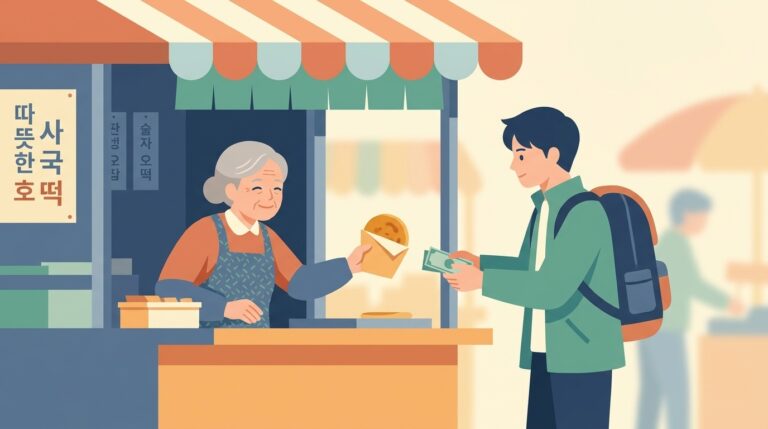
Preparing Cash for Korean Traditional Markets: Don’t Let a Cashless Country Fool You!
안녕하세요! (Annyeonghaseyo!) Welcome back, my dear language learners! It’s your favorite Korean bestie and Daily Hangul’s Senior Editor here. 🇰🇷✨
Imagine this: You are walking through the vibrant, sensory-overloading alleys of Mangwon Market (망원시장). The sweet, nutty aroma of freshly fried Hotteok (호떡 – sweet pancakes) fills the air. You queue up, mouth watering, ready to pay with your shiny international credit card or Apple Pay. But when you reach the front, you see a small handwritten sign: “현금 부탁드립니다” (Cash, please) or a bank account number taped to the stall. Oh no! Your heart sinks. You have zero cash on you.
While South Korea is famously one of the most cashless societies in the world, traditional markets (전통시장 – Jeontong Sijang) are the charming exception. To help you avoid this ultimate foodie heartbreak, today we are mastering the art of preparing and using cash in Korea’s most delicious spots! Let’s dive in!
Phase 2: Core Expressions Deep Dive
Here are three lifesaver expressions you need before stepping into any traditional market.
1. 현금만 돼요? (Hyeon-geum-man dwae-yo?)
- Pronunciation: Hyeon-geum-man dwae-yo? (Rhymes with “yeun-gum-mahn” + “gway-yo”)
- Meaning: “Is it cash only?” / “Do you only take cash?”
- K-Culture Moment: You’ll hear this in variety shows like 2 Days & 1 Night when cast members try to buy street food with their limited allowance.
- Editor’s Insight: The particle -만 (-man) means “only.” Adding it to 현금 (hyeon-geum – cash) makes your question direct but polite. If the vendor nods and says “네, 현금만 돼요,” you know it’s time to open your physical wallet.
- Situation Spectrum: Casual ⚠️ | Semi-formal ✅ | Formal 🚫
- 🤔 Think About It: In your home country, is it common for traditional or open-air markets to reject card payments? How do you usually ask if cash is required?
2. 계좌이체 해 드릴까요? (Gye-jwa-i-che hae deu-ril-kka-yo?)
- Pronunciation: Gye-jwa-i-che hae deu-ril-kka-yo? (Think of “gyeh-jwa-ee-cheh” + “heh-deu-ril-kah-yo”)
- Meaning: “Can I do a bank transfer?” / “Shall I wire the money?”
- K-Culture Moment: In modern K-dramas, you often see characters buying vegetables at a market stall and typing furiously on their phones to transfer 3,000 KRW to the grandmother running the shop.
- Editor’s Insight: If you don’t have cash but have a Korean banking app (or a friend who does), this is the ultimate magic phrase. Traditional market vendors almost always have their bank account numbers printed on a piece of cardboard.
- Situation Spectrum: Casual ⚠️ | Semi-formal ✅ | Formal ✅
- 🤔 Think About It: Why do you think bank transfers became so popular in Korean markets compared to other countries?
3. 잔돈으로 주세요. (Jan-don-eu-ro ju-se-yo.)
- Pronunciation: Jan-don-eu-ro ju-se-yo. (Sounds like “Jahn-don-eu-ro” + “joo-seh-yo”)
- Meaning: “Please give me change in smaller bills/coins.”
- K-Culture Moment: When a character in a drama hands over a 50,000 KRW bill for a 1,000 KRW fish-shaped bread (Bungeoppang), they say this apologetically.
- Editor’s Insight: 잔돈 (jan-don) refers to small change or smaller denominations. If you only have large 50,000 KRW bills, vendors might struggle to give you change. Asking for smaller change politely helps you prepare for the next stall!
- Situation Spectrum: Casual ⚠️ | Semi-formal ✅ | Formal ✅
- 🤔 Think About It: Handling large bills in small local shops can sometimes feel burdensome. How does the concept of consideration (배려 – baeryeo) play into this exchange?
Phase 3: Textbook Korean vs. Real Korean
Let’s upgrade your Korean from “classroom rigid” to “market natural!”
Situation 1: Asking if they accept cards
- 📖 Textbook Korean: 신용카드를 사용할 수 있습니까? (Sin-yong-ka-deu-reul sa-yong-hal su it-seup-ni-ka?) — “Is it possible to use a credit card?” (Way too formal! Sounds like a robot.)
- 🗣️ Real Korean: 카드 돼요? (Ka-deu dwae-yo?) — “Does card work?” (Short, sweet, and used by 99% of Koreans daily.)
- 💡 Why it works: In daily life, Koreans prefer minimizing sentences. “카드 돼요?” is polite enough for any shop or restaurant.
Situation 2: Realizing you don’t have cash
- 📖 Textbook Korean: 저는 현금이 없습니다. (Jeo-neun hyeon-geu-mi eop-seup-ni-da.) — “I do not possess cash.” (Sounds like a tragic statement in a novel.)
- 🗣️ Real Korean: 어떡하지… 현금이 없네요. (Eo-tteok-ha-ji… hyeon-geu-mi eop-ne-yo.) — “Oh, what should I do… I don’t have cash.”
- 💡 Why it works: Adding 어떡하지 (What should I do) out loud shows a natural, soft reaction, while -네요 (-ne-yo) expresses mild surprise or realization about your cashless state.
Phase 4: K-Culture Deep Dive & Non-Verbal Manners
4-1. The Art of “Nunchi” & Market Hands 🤲
When handing cash or a card to an older vendor (Imo-nim or Sajang-nim), never use one hand! Doing so can come across as dismissive. Instead:
1. Use both hands to hand over the money, or
2. Support your right elbow with your left hand.
This small gesture shows immense respect and will instantly win you the vendor’s favor (and maybe even some extra Service / free food!).
4-2. The Drama of the Market
Have you watched Hometown Cha-Cha-Cha or Our Blues? The traditional market is the heart of the community. It’s where gossip spreads, but also where deep warmth (정 – Jeong) is shared. Carrying cash is not just a transactional necessity; it’s part of respecting the older generation’s way of doing business.
Phase 5: Real-Life Roleplay Scenario
Setting: You are standing in front of a famous Hotteok stall in Mangwon Market. The vendor, a warm-looking auntie (Imonim), is frying golden dough.
Characters:
* 이모님 (Imonim – Vendor Auntie)
* 나 (Na – You, the hungry traveler)
이모님: 🎭 (Smiling warmly while turning the hotteok) 어서 오세요! 뭐 드릴까?
(Eoseo oseyo! Mwo deurilkka? / Welcome! What can I get you?)
나: 🎭 (Pointing at the hotteok) 호떡 두 개 주세요. 얼마예요?
(Hotteok du gae juseyo. Eolmayeyo? / Two hotteoks, please. How much is it?)
이모님: 🎭 (Bagging the hotteok) 두 개에 삼천 원이에요.
(Du gaee sam-cheon-won-ieyo. / That’s 3,000 won for two.)
나: 🎭 (Searching your pockets, realizing you only have cards) 저… 혹시 카드 돼요?
(Jeo… hok-si ka-deu dwae-yo? / Uh… by any chance, does card work?)
이모님: 🎭 (Pointing to a small handwritten card on the wall) 미안해, 우리 집은 현금만 돼요. 저기 계좌번호도 적혀 있어.
(Mianhae, uri jibeun hyeon-geum-man dwae-yo. Jeogi gye-jwa-beon-ho-do jeok-hyeo isseo. / Sorry, we only take cash. The bank account number is written over there, too.)
나: 🎭 (Nervously checking your wallet and finding a 50,000 won bill) 아, 다행이다! 만 원 짜리 하나 있어요. 오만 원짜리인데… 잔돈으로 주세요.
(Ah, dahaeng-ida! Man-won-jjari hana isseo. O-man-won-jjari-inde… jan-don-eu-ro ju-se-yo. / Oh, thank goodness! I have one ten-thousand won bill. Wait, it’s actually a fifty-thousand won bill… Please give me change in smaller bills.)
이모님: 🎭 (Laughing and handing over change) 그래요, 오만 원짜리 괜찮아! 여기 잔돈 사만 칠천 원 하고 따뜻한 호떡!
(Geuraeyo, o-man-won-jjari gwaenchanha! Yeogi jan-don sa-man chil-cheon-won hago tatteut-han hotteok! / Sure, fifty-thousand won is fine! Here is your 47,000 won change and your warm hotteok!)
나: 🎭 (Receiving the hotteok with both hands and bowing) 감사합니다! 맛있게 먹을게요!
(Gamsahamnida! Masitge meogeulgeyo! / Thank you! I will enjoy this!)
🔀 Choose Your Next Move!
If you had absolutely no cash at all, what would you say?
* Option A: “그냥 갈게요.” (Geunyang galgeyo. / I’ll just leave.)
* Option B: “계좌이체 해 드릴까요?” (Gye-jwa-i-che hae deu-ril-kka-yo? / Can I do a bank transfer?)
* Option C: “다음에 올게요!” (Daeume olgeyo! / I’ll come back next time!)
💡 Feedback:
- Best Choice (Option B): 🌟 Excellent! Most vendors love this because it’s instant and cashless for you, but direct for them. Just type the account number on your banking app.
- Risk Choice (Option C): ⚠️ Not bad, but you miss out on the hotteok! Plus, if they already packaged it for you, leaving might make them sad.
- Bad Choice (Option A): 🚫 Too abrupt! It feels a bit cold to just walk away after ordering without a warm explanation.
Phase 6: 10-Second Emotion Shadowing Drill 🗣️
Practice saying these out loud with natural rhythm and feeling! The / represents a tiny pause.
- [🥺 Apologetic & Polite]
저… / 혹시 / 현금만 돼요?
(Jeo… / hok-si / hyeon-geum-man dwae-yo?) -
[😊 Helpful & Proactive]
아! / 제가 현금이 없는데… / 계좌이체 해 드릴까요?
(Ah! / je-ga hyeon-geu-mi eop-neun-de… / gye-jwa-i-che hae deu-ril-kka-yo?) -
[🙏 Grateful & Polite]
네! / 오만 원짜리에요. / 잔돈으로 주세요.
(Ne! / o-man-won-jjari-eyo. / jan-don-eu-ro ju-se-yo.)
Phase 7: K-Culture Mini Dictionary
- 계좌이체 (Gye-jwa-i-che): Bank Transfer. Practically every Korean uses mobile banking (like KakaoBank or Toss) to transfer pocket money instantly.
- 온누리상품권 (On-nu-ri Sang-pum-gwon): Onnuri Voucher. Special gift certificates issued by the government to promote traditional markets. You can buy them at banks at a discount!
- 잔돈 (Jan-don): Small change. Usually 1,000 won bills, 5,000 won bills, or 100/500 won coins.
- 이모님 (I-mo-nim): Literally “maternal aunt,” but universally used to friendly call middle-aged female restaurant or market stall owners. It immediately builds a warm connection!
Phase 8: Traveler’s Survival Kit 🧳
Top 3 Survival Phrases
- 카드 단말기 있어요? (Ka-deu dan-mal-gi it-seo-yo?) – Do you have a card terminal?
- 근처에 ATM기 어디 있어요? (Geun-cheo-e ATM-gi eo-di it-seo-yo?) – Where is a nearby ATM?
- 영수증 필요 없어요. (Yeong-su-jeung pil-yo eop-seo-yo.) – I don’t need a receipt.
📝 Editor’s Travel Note
Before you head to markets like Gwangjang Market (광장시장) or Namdaemun Market (남대문시장), make sure to search for a Global ATM inside nearby convenience stores (CU, GS25) or banks. Standard domestic ATMs sometimes reject foreign debit cards. Also, navigate your way around like a local by downloading the Naver Map App—it’s highly detailed and far more accurate in Korea than Google Maps! (Note: Keep in mind that some international cards might incur transaction fees when withdrawing cash!)
Phase 9: “One Step Deeper” (Cultural Reflection)
In Korea’s hyper-digitalized society, where you can buy a luxury bag with a single tap on your phone, traditional markets hold onto cash. Why? For many elderly vendors, setting up complex card systems is technically difficult and costly due to transaction fees. By preparing physical cash, you aren’t just buying food; you are adapting to their pace of life. It’s a beautiful form of cultural empathy.
💬 Your Turn: Do you prefer cashless payments, or do you find a certain charm in carrying physical notes and coins when you travel?
Phase 10: FAQ & Mistake Prevention
Q: Can I use 50,000 KRW bills at traditional markets?
A: Yes, but try to avoid using them for very cheap items (like a 1,000 won snack) as it can deplete the vendor’s small change quickly. Keep some 1,000 won and 5,000 won bills handy!
Q: What if I don’t have a Korean bank account for 계좌이체 (bank transfer)?
A: International tourists cannot easily do bank transfers to local accounts without a Korean bank card. In this case, always carry physical cash to avoid any issues.
Q: Are cards rejected everywhere in the market?
A: No! Fixed-store stalls (with doors and roofs) almost always accept cards. It is mostly the small, open-air street carts in the center of the market alleys that require cash.
🚨 Common Mistakes Board
- Handing money over with one hand: This looks dismissive. Always use two hands!
- Expecting Apple Pay or Google Pay to work everywhere: Mobile payment terminals for foreign phones are still very rare in small traditional markets.
- Asking for a discount too aggressively: While bargaining (Heung-jeong) used to be common, prices are already very low. Asking for discounts on a 3,000 won snack can make vendors uncomfortable.
Phase 11: Action Mission & Engagement
- 🥉 Bronze Mission: Practice the 10-Second Shadowing Drill in front of your mirror.
- 🥈 Silver Mission: Write down “현금만 돼요?” on a sticky note and place it in your wallet as a reminder for your next trip!
- 🥇 Gold Mission: When you visit a local Korean market (or even a Korean grocery store in your city), try paying with cash while saying “잔돈으로 주세요!”
- 🎮 K-Culture Mission: Watch an episode of a Korean food show (like Street Food Fighter or Running Man) and spot the exact moment the cast pays with cash!
Phase 12: Interactive Quiz Challenge
Test your market-ready Korean skills!
1. Which phrase means “Do you only take cash?”
- A) 카드 돼요?
- B) 현금만 돼요?
- C) 계좌이체 해 주세요.
🔍 Show Answer & Explanation
Correct Answer: B
Explanation: “현금만 돼요?” (Hyeon-geum-man dwae-yo?) translates directly to “Is it cash only?”. A means “Does card work?” and C means “Please do a bank transfer.”
2. True or False: It is polite to pass your cash to an older vendor with one hand if you are in a rush.
- A) True
- B) False
🔍 Show Answer & Explanation
Correct Answer: B (False)
Explanation: No matter how rushed you are, always hand cash over with both hands or support your right elbow with your left hand to show respect (Nunchi and Manners!).
See you in the next lesson, where we’ll learn how to order like a local in trendy Seoul cafes! 맛있는 하루 보내세요 (Have a delicious day)! 🍃







