

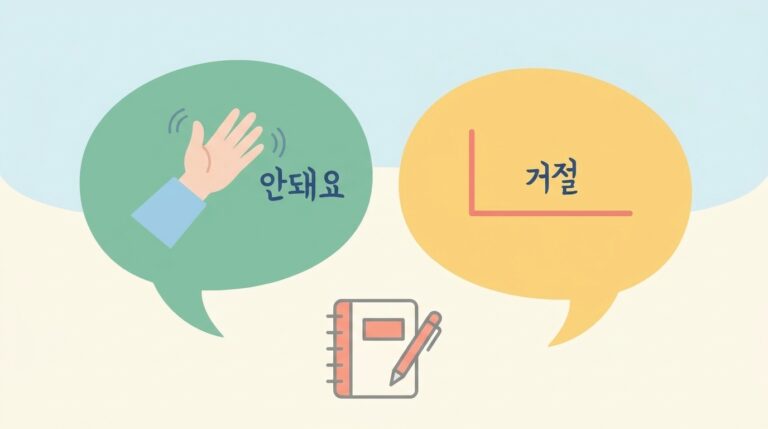
Phase 1: Empathy (공감)
안녕하세요! (Annyeonghaseyo!) It is your trusted Korean bestie and senior editor at Daily Hangul. We have all been there: a coworker asks you to finish their report right before you clock out, or an acquaintance asks to borrow your favorite designer jacket for a weekend. In your head, you are screaming, “Are you kidding me?” But out loud, you stammer because you do not want to sound rude in Korean.
Setting boundaries is a crucial social skill in Korea. Many of our intermediate B1 learners tell us they feel trapped between being “too polite” (and getting taken advantage of) and “too blunt” (and breaking harmony). Today, we are going to learn how to tell someone “Don’t make unreasonable requests” and how to say “No” with confidence, style, and absolute cultural tact. No more passive-aggressive sighing—let’s master the art of the polite refusal!
Phase 2: Core 3 Expressions Deep Dive (핵심 표현 3선)
1. 무리한 부탁은 하지 마 (Mu-ri-han bu-tak-eun ha-ji ma)
- Pronunciation: “Moo-ree-han boo-tahk-eun ha-jee mah” (Sounds like moo-ree as in ‘unreasonable’ + bu-tak ‘request’ + ha-ji ma ‘don’t do’)
- Meaning: “Don’t make unreasonable requests” (Literal: “Do not do unreasonable favors”)
- K-Culture Moment: You will hear this in K-Dramas when one character asks another to lie to their parents or cover up a major mistake. The listener will scoff and say this to draw a hard line.
- Editor’s Insight: “무리” (muri) means strain or excess. When you say this, you are objectively pointing out that the request itself goes beyond normal, acceptable limits.
- Situation Spectrum:
- Casual (Friends): 무리한 부탁은 하지 마 (✅)
- Semi-formal (Colleagues): 무리한 부탁은 하지 마세요 (⚠️ – Use with caution to peers)
- Formal (Boss/Seniors): 무리한 요구는 삼가 주십시오 (🚫 – Too direct; use “곤란합니다” instead)
- 🤔 Think About It: In your culture, do you directly tell someone that their request is “unreasonable,” or do you make an excuse instead? Koreans value harmony, so using “무리” is a strong but clear way to signal that the boundary has been crossed.
2. 선 넘지 마 (Seon neom-ji ma)
- Pronunciation: “Sun num-jee mah” (Sounds like sun ‘line’ + neom-ji ma ‘don’t cross’)
- Meaning: “Don’t cross the line”
- K-Culture Moment: Think of K-Pop idol variety shows where members playfully tease each other. When the teasing goes slightly too far, a member will jokingly (or seriously) say, “야, 선 넘지 마!” (Hey, don’t cross the line!)
- Editor’s Insight: This is a very modern, trendy, yet powerful expression. It metaphorically establishes your personal space (“선” means line). It is incredibly effective because it immediately alerts the other person that they are invading your personal boundary.
- Situation Spectrum:
- Casual (Friends): 선 넘지 마 (✅)
- Semi-formal (Colleagues): 선 넘지 마세요 (⚠️)
- Formal (Boss/Seniors): (🚫 – Absolutely never use this with your boss unless you want to get fired!)
3. 그건 좀 곤란해 (Geu-geon jom gon-ran-hae)
- Pronunciation: “Geu-gun jom gol-lahn-hae” (Sounds like geu-geon ‘that’ + jom ‘a bit’ + gon-ran-hae ‘difficult/awkward’)
- Meaning: “That’s a bit difficult/troublesome” (Actual nuance: “No way, I can’t do that”)
- K-Culture Moment: Used constantly in business settings or polite adult conversations. Instead of saying “No,” Koreans use “곤란하다” to gently but firmly decline a request.
- Editor’s Insight: This is the gold standard of polite refusal. The word “좀” (a bit) is a magic word in Korean that cushions the blow. Even though it sounds soft, it is a definitive “No.”
- Situation Spectrum:
- Casual (Friends): 그건 좀 곤란해 (✅)
- Semi-formal (Colleagues): 그건 좀 곤란해요 (✅)
- Formal (Boss/Seniors): 그건 좀 곤란합니다 (✅)
Phase 3: Textbook Korean vs. Real Korean (교과서 vs. 진짜 한국어)
Situation 1: Rejecting an extra workload from a colleague
- 📖 Textbook Korean: 저는 그 일을 할 수 없습니다. (Jeo-neun geu il-eul hal su eops-seup-ni-da.) – “I cannot do that work.”
- 🗣️ 진짜 한국어: 죄송하지만, 제 선에서 해결하기는 좀 어려울 것 같아요. (Joe-song-ha-ji-man, je seon-e-seo hae-gyeol-ha-gi-neun jom eo-ryeo-ul geot ga-ta-yo.) – “I’m sorry, but I think it might be difficult for me to handle that within my capacity.”
- 💡 왜 다를까? The textbook version sounds like a robotic rebellion. The real-world version uses “제 선에서” (within my boundary/level) and “어려울 것 같아요” (it seems difficult) to soften the rejection while remaining highly professional.
Situation 2: Stopping a friend who keeps asking to borrow money
- 📖 Textbook Korean: 돈을 빌려줄 수 없습니다. 무리한 요구입니다. (Don-eul bil-ryeo-jul su eops-seup-ni-da. Mu-ri-han yo-gu-im-ni-da.) – “I cannot lend you money. It is an unreasonable demand.”
- 🗣️ 진짜 한국어: 야, 아무리 친구라도 돈 얘기는 하는 거 아니야. 그건 선 넘었지. (Ya, a-mu-ri chin-gu-ra-do don yae-gi-neun ha-neun geo a-ni-ya. Geu-geon seon neom-eot-ji.) – “Hey, no matter how close we are as friends, we shouldn’t talk about money. That’s crossing the line.”
- 💡 왜 다를까? Close friends in Korea still respect certain boundaries, especially regarding finances. Speaking frankly with “선 넘었지” shows that you value the relationship enough to be honest about your boundaries.
Phase 4: K-Culture Deep Dive & Non-verbal Manners (문화 딥다이브)
4-1. 눈치 (Nunchi) & Hand Gestures
When saying “그건 좀 곤란해요” (That’s a bit difficult), your body language must match your words to avoid coming off as aggressive.
* The “X” Gesture: Avoid crossing your arms tightly, which looks angry. Instead, raise your hand slightly and wave it side to side (palm facing out) as if brushing away a fly. This represents a soft “No.”
* The Head Tilt: Tilt your head slightly to the side and inhale through your teeth (making a soft tsh sound). This shows that you are actively agonizing over having to refuse them, which reduces their disappointment.
4-2. The “Jeong” (정) vs. Personal Space Clash
In traditional Korean culture, “정” (Jeong – deep attachment/affection) meant helping neighbors without hesitation. However, modern Koreans—especially Gen Z and Millennials—firmly advocate for personal boundaries. K-Dramas beautifully depict this tension. Knowing how to say “선 넘지 마세요” politely is now considered an essential skill for survival in fast-paced Seoul!
Phase 5: Real-life Roleplay (실전 롤플레이)
Scenario: Sora (an overly demanding colleague) is trying to dump her Friday evening presentation prep onto Minjun (you) right before the weekend.
- Sora: 민준 씨, 미안한데 이것 좀 대신 해주면 안 돼요? 주말에 약속이 있어서요.
(Min-jun ssi, mi-an-han-de i-geot jom dae-sin hae-ju-myeon an dwae-yo? Ju-mal-e yak-sok-i is-seo-seo-yo.)
“Minjun, I’m sorry, but can you do this for me? I have plans this weekend.” - Minjun (You): 🎭 [Looking surprised] 어, 그게 뭐예요? 월요일 발표 자료예요?
(Eo, geu-ge mwo-yeo-yo? Wol-yo-il bal-pyo ja-ryo-yeo-yo?)
“Oh, what is that? Is it the presentation material for Monday?” - Sora: 네, 맞아요. 금방 끝날 거예요. 한 두 시간 정도만 하면 돼요!
(Ne, ma-ja-yo. Geum-bang kkeut-nal geo-yeo-yo. Han du si-gan jeong-do-man ha-myeon dwae-yo!)
“Yes, correct. It will end quickly. You only need to work on it for about two hours!” - Minjun (You): 🎭 [Hesitating, scratching head] 저도 오늘 저녁에 중요한 약속이 있어서요…
(Jeo-do o-neul jeo-nyeok-e jung-yo-han yak-sok-i is-seo-seo-yo…)
“I also have an important appointment this evening…” - Sora: 에이, 민준 씨는 착하니까 한 번만 도와주세요. 네?
(E-i, Min-jun ssi-neun chak-ha-ni-kka han beon-man do-wa-ju-se-yo. Ne?)
“Oh come on, Minjun, you’re nice, so please help me out just this once. Please?” - Minjun (You): 🎭 [Taking a deep breath, setting a firm tone] 죄송하지만, 그건 좀 곤란해요. 제 일도 다 못 끝냈거든요.
(Joe-song-ha-ji-man, geu-geon jom gon-ran-hae-yo. Je il-do da mot kkeut-naet-geon-deun-yo.)
“I’m sorry, but that is a bit difficult. I haven’t even finished my own work yet.” - Sora: 치… 너무하시네. 조금만 도와줄 수도 있잖아요.
(Chi… neo-mu-ha-si-ne. Jo-geum-man do-wa-jul su-do it-jan-a-yo.)
“Hmph… you’re mean. You could at least help a little bit.” - Minjun (You): 🎭 [Politely but firmly closing your laptop] 무리한 부탁은 하지 말아주셨으면 좋겠어요. 다음부턴 미리 말씀해 주세요.
(Mu-ri-han bu-tak-eun ha-ji mar-a-ju-syeot-seu-myeon jo-ket-seo-yo. Dae-eum-bu-teon mi-ri mal-sseum-hae ju-se-yo.)
“I would appreciate it if you didn’t make unreasonable requests. Please let me know in advance next time.”
🔀 Interactive Choice Points (선택의 순간!)
If Sora pushes you further, how will you respond?
* A: “진짜 선 넘으시네. 알아서 하세요.”
* B: “어쩔 수 없네요. 제가 해드릴게요.”
* C: “도와드리고 싶지만, 이번에는 정말 제 선에서 어렵겠네요. 미안해요.”
💡 Feedback:
- Choice A (Bad): Too aggressive! Using “선 넘으시네” directly in the workplace can ruin professional relationships permanently.
- Choice B (Risk): You fell into the trap! Agreeing to do it means you’ll be doing her work forever.
- Choice C (Best!): Perfect! It combines empathy (“도와드리고 싶지만”) with a firm, objective boundary (“제 선에서 어렵겠네요”).
Phase 6: 10-second Shadowing Drill (10초 섀도잉 드릴)
Practice saying these with the right emotion and pause points (/).
[🥺 Regretful and apologetic]
죄송하지만, / 그건 좀 / 곤란해요.
(Joe-song-ha-ji-man, / geu-geon jom / gon-ran-hae-yo.)[😑 Firm and serious]
무리한 부탁은 / 하지 말아주세요.
(Mu-ri-han bu-tak-eun / ha-ji mar-a-ju-se-yo.)[😒 Playfully warning a close friend]
야, / 아무리 그래도 / 선 넘지 마라.
(Ya, / a-mu-ri geu-rae-do / seon neom-ji ma-ra.)
Phase 7: K-Culture Mini Dictionary (미니 사전)
- 민폐 (Min-pye): Nuisance / Being a burden. Koreans hate causing “민폐” to others above almost everything else.
- 거절 (Geo-jeol): Refusal / Rejection. Declining politely is seen as an art form in Korea.
- 선배 (Seon-bae): Senior at work or school. Refusing a Seonbae requires extra-polite indirect grammar.
- 선 (Seon): Literally “line”, but colloquially used to refer to personal or emotional boundaries.
Phase 8: Travel Survival Kit (여행자를 위한 생존 키트)
Survival Phrases TOP 3
- 이건 좀 무리예요. (I-geon jom mu-ri-yeo-yo.)
- Meaning: “This is a bit too much / impossible.” (Great when a taxi driver or vendor charges too much!)
- 괜찮습니다, 제가 할게요. (Gwen-chan-seup-ni-da, je-ga hal-ge-yo.)
- Meaning: “It’s okay, I’ll do it myself.” (Use this to decline excessive help.)
- 죄송하지만 안 될 것 같아요. (Joe-song-ha-ji-man an doel geot ga-ta-yo.)
- Meaning: “I’m sorry, but I don’t think it’s possible.” (The ultimate polite ‘No’).
✈️ Editor’s Travel Note:
If you are traveling in Korea and find yourself in a situation where someone is pushing you to buy something or go somewhere you don’t want to, do not hesitate to use the official Korea Tourism Organization helpline by calling 1330. It provides free 24/7 translation services so you never have to agree to an unreasonable request out of confusion!
Phase 9: “One Step Deeper” (한 발 더 깊이)
Korean culture is deeply rooted in collectivism, where saying “No” can sometimes be perceived as disrupting the collective peace. However, as Korea has modernized, young people have coined terms like “소확행” (small but certain happiness) and “워라밸” (Work-Life Balance). Setting personal boundaries is no longer seen as selfish; rather, it is viewed as a healthy way to maintain long-term relationships. By learning how to decline unreasonable requests gracefully, you are actually participating in modern Korean social etiquette!
Phase 10: FAQ & Mistakes (자주 묻는 질문과 실수)
Q: Can I use “선 넘지 마” to my Korean boss?
A: Absolutely not! “선 넘지 마” is highly informal and direct. Using it with a superior will be perceived as incredibly disrespectful. Instead, use soft business terms like “죄송하지만 이번 지시는 제 업무 범위를 벗어나는 것 같습니다” (I am sorry, but this instruction seems to fall outside my scope of work).
Q: Why do Koreans keep saying “죄송합니다” (I’m sorry) even when they are just refusing an unreasonable request?
A: In Korea, apologizing when saying “No” is not an admission of guilt. It is a social cushion used to show that you care about the other person’s feelings and regret that you cannot satisfy their request.
Q: How do I refuse a pushy street salesman in Korea?
A: You do not need to say much. Just say a polite “괜찮습니다” (It’s okay/No thank you) with a gentle hand wave and keep walking. Do not feel pressured to engage!
🚨 Common Mistakes Board
- Mistake 1: Saying “안 돼요!” (An dwae-yo!) aggressively.
- Why: It sounds like a parent scolding a child (“You can’t do that!”).
- Correct Action: Say “어려울 것 같습니다” (It seems difficult) instead.
- Mistake 2: Giving too many detailed lies/excuses.
- Why: Pushy people will try to solve your excuse (e.g., “I have a dinner plan” -> “Then we can do it after dinner!”).
- Correct Action: Keep your refusal general: “개인적인 사정이 있어서 어렵습니다” (It is difficult due to personal circumstances).
Phase 11: Action Mission (액션 미션)
- 🥉 Bronze Mission: Write down “그건 좀 곤란해요” on a sticky note and say it out loud 3 times in front of the mirror with a polite head tilt.
- 🥈 Silver Mission: Leave a comment below telling us about a time you had to say “No” to an unreasonable request in your own culture!
- 🥇 Gold Mission: Next time a colleague asks for an unreasonable favor, use the magic word “좀” (jom) to soften your refusal.
🎮 K-Culture Mission:
Watch an episode of your favorite K-Drama this week and try to spot a scene where someone says “선 넘었네” or “무리야”. Write down the context in your learning journal!
Phase 12: Interactive Quiz Challenge (퀴즈 챌린지)
Test your skills below! Click each question to reveal the correct answer.
Q1: Which expression is best to use when you want to politely refuse your senior colleague’s request to work on Sunday?
- Answer: “그건 좀 곤란해요.” (Geu-geon jom gon-ran-hae-yo.)
- Explanation: This is polite, professional, and clear. Saying “선 넘지 마세요” would be too rude, and “안 해줄 거예요” is childish.
Q2: True or False: Adding “좀” (jom) to your refusal makes you sound less polite.
- Answer: False!
- Explanation: “좀” acts as an emotional buffer that softens the rejection, making it sound more natural and polite.
Q3: Fill in the blank: “아무리 친구라도 돈 빌려 달라는 건 ____ 넘었지!” (Even as friends, asking to borrow money is crossing the line!)
- Answer: “선” (seon / line)
- Explanation: The full idiom is “선 넘다” (to cross the line).







