

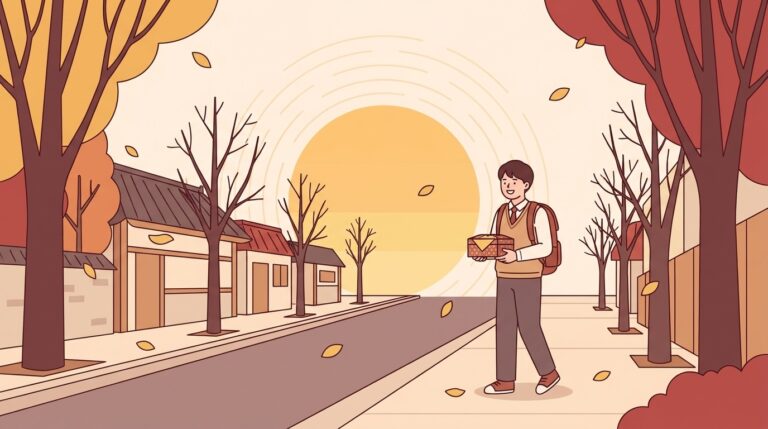
Why Korea Goes Quiet in November: Navigating the Intense Suneung Autumn Vibe like a Local
안녕하세요! (An-nyeong-ha-se-yo!) Hello, dear Daily Hangul family! It’s your friendly local guide and chief editor.
Have you ever noticed a sudden, heavy silence blanketing the streets of Korea on a chilly mid-November morning? The airplanes stop flying, buses run on strict detours, and police motorcycles are busy rushing young students to school. No, it’s not a sci-fi movie. It’s the day of the Suneung (수능)—Korea’s ultra-important College Scholastic Ability Test.
As the golden ginkgo leaves start to fall and the autumn breeze turns icy, the entire nation shifts into a state of collective nervousness. If you are learning Korean at a B1 (Intermediate-Low) level, understanding this emotional season is your golden ticket to deep cultural empathy. Today, we will learn how to read this unique atmosphere, speak the exact encouraging words that Koreans use, and understand why autumn in Korea is so much more than just beautiful foliage.
Phase 2: Core Suneung Expressions Deep-Dive
Let’s master three highly cultural expressions that you will hear constantly on Korean social media and news during November.
1. 수능 한파 (Su-neung Han-pa)
- Pronunciation: Soo-neung Han-pa (Sounds like “soo” as in soup, “neung” as in rung, “han” as in hahn, “pa” as in path without the ‘th’).
- Meaning: The “Suneung Cold Wave” (The mysterious phenomenon where the weather suddenly drops to freezing temperatures exactly on the day of the exam).
- K-Culture Moment: You’ll see news anchors wearing thick winter coats on TV, saying: “올해도 어김없이 수능 한파가 찾아왔습니다.” (“Without fail, the Suneung cold wave has arrived again this year.”)
- Editor’s Insight: Scientifically, it’s just mid-November getting colder, but Koreans emotionally associate this sudden chill with the intense nervousness of the high school seniors. It’s a great conversation starter with locals!
- Situation Spectrum: Casual (✅) | Semi-formal (✅) | Formal (✅)
- 🤔 Think About It: Is there a specific day or season in your country that everyone collectively associates with a certain type of weather or shared tension? How does it compare to Korea’s autumn?
2. 찰떡같이 붙다 (Chal-tteok-ga-chi But-da)
- Pronunciation: Chal-tteok-ga-chi boot-da (The “chal” has a sharp ‘ch’ sound; “tteok” rhymes with duck but with a tense double-t; “but-da” sounds like boot-dah).
- Meaning: To stick like a sticky rice cake (Idiomatic meaning: To pass an exam with flying colors / to get accepted into a college).
- K-Culture Moment: Friends and family buy Yeot (엿 – traditional taffy) or Chaltteok (찰떡 – glutinous rice cake) and give them to test-takers so their answers “stick” to the test paper.
- Editor’s Insight: In Korean, the verb “붙다” means both “to stick/cling” and “to pass an exam.” Hence, sticky foods are symbolic of passing!
- Situation Spectrum: Casual (✅) | Semi-formal (✅) | Formal (⚠️ – slightly too idiomatic for a business interview, but perfect for encouraging colleagues)
- 🤔 Think About It: Food metaphors for success exist in every culture. What is your culture’s equivalent of “sticky rice cake” for wishing someone good luck?
3. 긴장 풀어요 (Gin-jang Pul-eo-yo)
- Pronunciation: Geen-jang pool-uh-yo (“Gin” sounds like geen with a hard G; “jang” like jahng; “pul-eo-yo” like pool-uh-yo).
- Meaning: Please release your tension / Please relax.
- K-Culture Moment: In K-Dramas, when a character is pacing nervously before a big interview or exam, their partner will hand them a warm cup of barley tea and say, “긴장 풀고 평소처럼 해요.” (“Relax and just do as you normally do.”)
- Editor’s Insight: Unlike the English “Don’t worry,” which focuses on the mind, “긴장 풀어요” literally asks the person to physically loosen up their stiffened muscles and nerves.
- Situation Spectrum: Casual (✅ – 긴장 풀어) | Semi-formal (✅ – 긴장 풀어요) | Formal (✅ – 긴장 푸시기 바랍니다)
- 🤔 Think About It: How does focusing on physical relaxation (“releasing tension”) change your mental state compared to just telling someone to “stop worrying”?
Phase 3: Textbook Korean vs. Real-Life Korean
Sometimes, standard textbook phrases can sound a bit dry or too formal during this highly emotional season. Let’s look at how to sound like a genuine Korean friend.
Situation 1: Wishing a younger friend or a student good luck on their big exam
- 📖 Textbook Korean: “시험을 잘 보기를 바랍니다.” (Si-heom-eul jal bo-gi-reul ba-ram-ni-da. – “I hope you take the exam well.”)
- 🗣️ Real-Life Korean: “시험 대박 나길 바래!” (Si-heom dae-bak na-gil ba-rae! – “I hope you hit the absolute jackpot on your exam!”)
- 💡 Why the difference? The textbook version is grammatically flawless but sounds like a formal letter from a high school principal. “대박 나다” (to hit a jackpot/huge success) adds a burst of energetic, warm, and modern encouragement.
Situation 2: Consoling a stressed-out friend who is studying late
- 📖 Textbook Korean: “너무 많이 걱정하지 마십시오.” (Neo-mu man-i geok-jeong-ha-ji ma-sip-si-o. – “Please do not worry too much.”)
- 🗣️ Real-Life Korean: “네 노력을 믿어봐, 다 잘될 거야.” (Ne no-ryeok-eul mid-eo-bwa, da jal-doel geo-ya. – “Trust in your hard work, everything is going to turn out great.”)
- 💡 Why the difference? Telling someone not to worry can sometimes feel dismissive. Pointing out their hard work (“노력”) shows you have observed their dedication, making your support feel deeply personal and sincere.
Phase 4: K-Culture Deep-Dive & Non-Verbal Manners
4-1. Nunchi (눈치) & Silent Support
During early November, “Nunchi” (social sensing/tact) is at an all-time high in Korea. If you have neighbors with high school seniors, it is considered polite to keep noise levels down in the evening.
* The Two-Handed Handover (양손): When giving gifts of encouragement (like a box of chocolates or vitamins) to a student or their parents, always hand it over with both hands, accompanied by a gentle, supportive head bow. Avoid overly loud, boisterous cheers; a quiet, heartfelt delivery is far more appreciated during this high-stress period.
4-2. The Lucky Suneung Gift Culture
Koreans love wordplay, and Suneung gifts are the peak of this humor:
* Forks (포크): Given so that students can “찍다” (jig-da – which means both “to poke/stab with a fork” and “to guess a multiple-choice question correctly”).
* Toilet Paper (휴지): Given so that they can “풀다” (pul-da – meaning both “to unroll toilet paper” and “to solve a difficult problem”).
* Mirrors (거울): Given so that they can “보다” (bo-da – meaning both “to look in the mirror” and “to see/take the exam well”).
Phase 5: Real-Life Roleplay Scenario
Setting: A cozy neighborhood café in Seoul. The autumn wind is howling outside (수능 한파!). Your Korean study-buddy, Min-ji (민지), is feeling incredibly stressed because her younger brother is taking the Suneung tomorrow.
Characters:
- Min-ji (민지): Stressed-out elder sister, sipping hot chamomile tea.
- You (Alex): A caring, supportive foreign friend (B1 Level).
Turn 1
민지: (한숨을 쉬며) 내일이 드디어 수능이네요. 제가 다 떨려요.
Min-ji: (Sighs) Tomorrow is finally the Suneung. I'm the one who's feeling nervous.

Turn 2
Alex: (따뜻하게 미소를 지으며) 맞아요, 오늘 날씨도 갑자기 엄청 추워졌네요. 정말 수능 한파인가 봐요.
Alex: (Smiling warmly) You're right, the weather suddenly got so cold today too. It really must be the Suneung cold wave.

Turn 3
민지: 그러니까요. 동생이 밤새 공부하느라 얼굴이 반쪽이 됐어요. 지켜보는 게 너무 힘드네요.
Min-ji: Tell me about it. My brother’s face has grown so thin from studying all night. It’s so hard to watch.

Turn 4
Alex: (민지의 어깨를 가볍게 토닥이며) 민지 씨가 옆에서 따뜻하게 챙겨줬으니까 동생분도 힘을 낼 거예요.
Alex: (Gently patting Min-ji’s shoulder) Since you took such warm care of him by his side, your brother will find his strength.

Turn 5
민지: 휴, 제발 실수만 안 했으면 좋겠어요. 오늘 저녁엔 무슨 말을 해줘야 할까요?
Min-ji: Whew, I just hope he doesn't make any mistakes. What should I say to him tonight?

Turn 6
Alex: (진지한 눈빛으로) "네 노력을 믿어봐, 다 잘될 거야"라고 말해주는 건 어때요?
Alex: (With sincere eyes) How about telling him, "Trust in your hard work, everything will turn out great"?

Turn 7
민지: 아... 그 말이 정말 큰 힘이 되겠네요. 선물로 찹쌀떡도 사 가야겠어요!
Min-ji: Ah... those words would really be a huge source of strength. I should buy some glutinous rice cakes as a gift on my way home too!

Turn 8
Alex: 좋은 생각이에요! 동생분이 찰떡같이 딱 붙기를 제가 같이 응원할게요.
Alex: That's a great idea! I will cheer along with you so that your brother sticks to his target college like sticky rice cake.
🔀 Choose Your Response! (How would you react next?)
- Option A: “시험 끝나면 동생이랑 맛있는 거 먹으러 가요. 제가 살게요!” (Let’s go eat something delicious with your brother when the exam is over. My treat!)
- Option B: “왜 한국인들은 수능에 그렇게 목숨을 걸어요? 그냥 시험일 뿐이잖아요.” (Why do Koreans risk their lives for the Suneung? It’s just an exam.)
- Option C: “걱정하지 마세요. 공부 안 해도 어떻게든 잘 살 수 있어요.” (Don’t worry. Even if he didn’t study, he can get by somehow.)
🧐 Option Analysis & Feedback:
- Option A (Best Choice): Perfect! Offering to buy a post-exam meal is incredibly warm, culturally appropriate, and gives Min-ji and her brother something joyful to look forward to.
- Option B (Risk/Bad): Oh no! While it might be a curious question academically, asking this when Min-ji is actively stressed feels highly insensitive and lacks Nunchi. It downplays a massive life milestone in Korean society.
- Option C (Risk): Although meant to be comforting, this can sound dismissive of the years of agonizing hard work the student has put in. It’s better to validate their effort rather than downplay the exam’s importance.
Phase 6: 10-Second Emotion Shadowing Drill
Practice saying these high-empathy phrases out loud. Pay attention to the pauses (/) and the emotional guidance in the brackets!
[🥺 Feeling worried but trying to comfort]
“날씨가 / 갑자기 너무 추워졌어요. / 감기 조심하세요.”
(Nal-ssi-ga / gap-ja-gi neo-mu chu-weo-jyeo-sseo-yo. / Gam-gi jo-sim-ha-se-yo.)
“The weather / suddenly got so cold. / Please be careful not to catch a cold.”-
[🔥 Overflowing with positive, bright energy]
“긴장하지 말고! / 하던 대로만 해! / 시험 대박 나자!”
(Gin-jang-ha-ji mal-go! / Ha-deon dae-ro-man hae! / Si-heom dae-bak na-ja!)
“Don’t be nervous! / Just do as you’ve always done! / Let’s hit the jackpot on the exam!”
Phase 7: K-Culture Mini Dictionary
- 수험생 (Su-heom-saeng) | Test-Taker
Specifically refers to students preparing for a major public exam. During November, the entire country treats Su-heom-saeng like fragile VIPs. - 기도명당 (Gi-do-myeong-dang) | Famous Prayer Spots
Temples (like Bongeunsa in Gangnam) or churches known for having high “spiritual energy.” Parents of test-takers will travel miles to bow and pray here for hours during Suneung week. - 응원전 (Eung-won-jeon) | Cheering Rally
The high-energy gathering of junior students outside exam halls at 6:00 AM, beating drums, singing school anthems, and handing out hot tea to entering seniors. - 수능 대박 (Su-heom Dae-bak) | Suneung Jackpot
A slang wish meaning “May you get a much higher score on your Suneung than you did on your practice exams!”
Phase 8: Traveler’s Survival Kit (November Edition)
If you are traveling or living in Korea during Suneung week, keep these survival tips in mind:
Survival Expressions for Autumn
- “오늘 수능 날이라서 차가 많이 막히나요?” (O-neul su-neung nal-i-ra-seo cha-ga man-i mak-hi-na-yo?)
-> “Is traffic very heavy today because it’s Suneung Day?” - “가장 가까운 조용한 카페가 어디에 있나요?” (Ga-jang ga-kka-un jo-yong-han ka-pe-ga eo-di-e in-na-yo?)
-> “Where is the nearest quiet café?” (Many students study intensely in cafés during this season). - “수험표 할인이 되나요?” (Su-heom-pyo hal-in-i doe-na-yo?)
-> “Is there a discount for test-takers?” (After the exam, cinemas, theme parks, and restaurants offer massive discounts if students show their Exam ID card!).
Editor’s Travel Note: On Suneung morning, avoid taking taxis or buses between 7:00 AM and 8:30 AM as roads near schools are heavily congested or blocked. Instead, stick to the subway system. Download the Naver Map App (네이버 지도 앱 다운로드) to check real-time traffic updates and avoid restricted areas around test centers.
Phase 9:
Frequently Asked Questions (FAQ)
Q: What does "수능 한파 (Su-neung Han-pa)" mean in Korean and how do you pronounce it?
A: In Korean, "수능 한파 (Su-neung Han-pa)" is pronounced [Soo-neung Han-pa (Sounds like "soo" as in soup, "neung" as in rung, "han" as in hahn, "pa" as in path without the 'th'] and means: The "Suneung Cold Wave" (The mysterious phenomenon where the weather suddenly drops to freezing temperatures exactly on the day of the exam).
Q: What does "찰떡같이 붙다 (Chal-tteok-ga-chi But-da)" mean in Korean and how do you pronounce it?
A: In Korean, "찰떡같이 붙다 (Chal-tteok-ga-chi But-da)" is pronounced [Chal-tteok-ga-chi boot-da (The "chal" has a sharp 'ch' sound; "tteok" rhymes with duck but with a tense double-t; "but-da" sounds like boot-dah] and means: To stick like a sticky rice cake (Idiomatic meaning: To pass an exam with flying colors / to get accepted into a college).
Q: What does "긴장 풀어요 (Gin-jang Pul-eo-yo)" mean in Korean and how do you pronounce it?
A: In Korean, "긴장 풀어요 (Gin-jang Pul-eo-yo)" is pronounced [Geen-jang pool-uh-yo ("Gin" sounds like geen with a hard G; "jang" like jahng; "pul-eo-yo" like pool-uh-yo] and means: Please release your tension / Please relax.







