

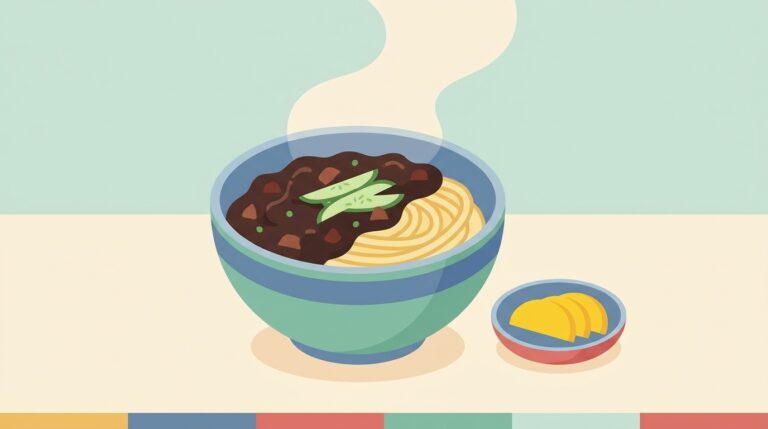
How to Order Jajangmyeon in Korea Like a Pro
Phase 1: Empathy (스토리 몰입형 오프닝)
안녕하세요! (An-nyeong-ha-se-yo!) Hello! I am the lead editor of Daily Hangul, your local Korean culture navigator. Have you ever watched a K-Drama where the main characters, exhausted from moving into a new apartment, sit on the floor among cardboard boxes and slurped delicious black noodles from plastic bowls? That dish is 짜장면 (Jajangmyeon), Korea’s ultimate comfort food.
But when you try to order it yourself, you might freeze. How do you ask for delivery? What if you want extra pickled radish? Today, we will break down the essential, real-world phrases for ordering Jajangmyeon so you can confidently experience this delicious Korean tradition. This guide is based on real feedback from foreign students living in Seoul who successfully ordered delivery on their very first try!
Phase 2: Key Expressions (핵심 표현 3선 심층 분석)
1. 짜장면 하나만 배달해 주세요. (Please deliver just one Jajangmyeon.)
- Pronunciation: Jja-jang-myeon ha-na-man bae-dal-hae ju-seh-yo. (Make the “Jja” sound tense, like the ‘p’ in ‘spit’ but for a ‘j’ sound! It sounds almost like ‘Tcha-jang-myeon’.)
- Meaning: Please deliver just one bowl of black bean noodles.
- K-Culture Moment: You will hear this phrase in almost every slice-of-life K-Drama when characters are too lazy to cook after work.
- Editor’s Insight: In many countries, ordering a single, cheap dish for delivery is impossible due to high minimum order limits. In Korea, however, many traditional Chinese-Korean restaurants will happily deliver a single bowl of Jajangmyeon!
- Situation Spectrum: Casual ✅ / Semi-formal ✅ / Formal ⚠️
- 🤔 Think About It: How does food delivery in your country compare to this quick single-item service?
2. 단무지 많이 주세요. (Please give me lots of yellow pickled radish.)
- Pronunciation: Dan-mu-ji ma-ni ju-seh-yo. (Tip: “ma-ni” sounds exactly like the English word “many”! Easy to remember, right?)
- Meaning: Please give me plenty of yellow pickled radish.
- K-Culture Moment: This is a classic scene at any local restaurant where customers ask the owner (이모님 – Imo-nim) for refills.
- Editor’s Insight: Jajangmyeon is rich and sweet. The crunchy, tangy yellow radish (단무지) cuts through the grease perfectly. Asking for extra side dishes is free and highly expected in Korea!
- Situation Spectrum: Casual ✅ / Semi-formal ✅ / Formal ✅
- 🤔 Think About It: Why do you think Korean food always pairs sweet/greasy dishes with sour/fermented sides?
3. 배달 얼마나 걸려요? (How long will the delivery take?)
- Pronunciation: Bae-dal eol-ma-na geol-ryeo-yo? (Try saying “all-mah-nah” for eol-ma-na.)
- Meaning: How long will delivery take?
- K-Culture Moment: Used by busy students or office workers during tight lunch breaks.
- Editor’s Insight: Korea is famous for its “Palli-Palli” (fast-fast) culture. When you ask this, the staff will usually say “20 minutes” or “30 minutes,” and they actually mean it!
- Situation Spectrum: Casual ⚠️ / Semi-formal ✅ / Formal ✅
- 🤔 Think About It: Do you prefer fast service or do you enjoy waiting patiently for your food?
Phase 3: Textbook Korean vs. Real Korean (교과서 한국어 vs 진짜 한국어)
Situation 1: Ordering a combo set
- 📖 Textbook Korean: “짜장면과 탕수육 세트를 주문하고 싶습니다.” (Jjajangmyeon-gwa tangsuyuk set-teu-reul jumunhago sipseumnida. / I would like to order a Jajangmyeon and Sweet & Sour Pork set.)
- 🗣️ Real Korean: “짜장면 탕수육 세트 하나 주세요.” (Jjajangmyeon tangsuyuk set-teu hana juseyo. / One Jajangmyeon and Tangsuyuk set, please.)
- 💡 Why is it different? Real Koreans drop formal grammar particles (like ~과 and ~을) over the phone or in apps. Keep it simple and direct!
Situation 2: Telling the rider where to leave the food
- 📖 Textbook Korean: “음식을 문 앞에 놓아 주십시오.” (Eumsigeul mun appe noa jusipsio. / Please place the food in front of the door.)
- 🗣️ Real Korean: “문 앞에 두고 가 주세요.” (Mun appe dugo ga juseyo. / Just leave it at the door, please.)
- 💡 Why is it different? The real-life version is friendly, soft, and commonly used as a standard note for contactless delivery in Korea.
Phase 4: K-Culture Deep Dive & Non-verbal Manners (K-Culture 딥다이브 & 비언어적 매너)
4-1. Nunchi & Gestures
When receiving food in person from a delivery rider, never grab the bag instantly. Use both hands to receive the heavy bag as a sign of respect, and give a small, polite head bow (목례) while saying “감사합니다!” (Thank you!).
4-2. The Great Food Debate: Bumeok vs. Jjimgmeok
When you order Jajangmyeon, you almost always order 탕수육 (Tangsuyuk – Sweet and Sour Pork). This dish comes with a sweet glaze sauce on the side. This has created the ultimate cultural debate in Korea:
* 부먹 (Bumeok): Pouring the sauce over the crispy pork.
* 찍먹 (Jjimgmeok): Dipping the pork into the sauce to keep it crunchy.
Before pouring the sauce over a shared plate, always ask your Korean friends first! It is a matter of national food pride.
Phase 5: Real-Life Roleplay Scenario (실전 롤플레이 시나리오)
Setting: Suji (a hungry student) calls the local Chinese restaurant to order lunch.
- 사장님 (Sajangnim): 네, 만리장성입니다! (Ne, Man-ri-jang-seong-im-ni-da! / Yes, this is the Great Wall restaurant!)
- 수지 (Suji): 🎭 [Politely] 안녕하세요, 짜장면 하나 배달해 주세요. (An-nyeong-ha-se-yo, jjajangmyeon hana baedalhae juseyo. / Hello, please deliver one Jajangmyeon.)
- 사장님 (Sajangnim): 네, 짜장면 하나요. 주소가 어떻게 되시죠? (Ne, jjajangmyeon hanayo. Juso-ga eotteoke doesijyo? / Okay, one Jajangmyeon. What is your address?)
- 수지 (Suji): 🎭 [Reading clearly] 한국아파트 101동 202호예요. (Hanguk apateu baek-il-dong i-baek-i-ho-ye-yo. / It is Hanguk Apartment, Building 101, Room 202.)
- 사장님 (Sajangnim): 네, 접수했습니다. 결제는 어떻게 하실 건가요? (Ne, jeopsuhaesseumnida. Gyeoljeneun eotteoke hasil geon-gayo? / Okay, received. How will you pay?)
- 수지 (Suji): 🎭 [Holding out a card] 카드로 결제할게요. 단무지 많이 주세요! (Kadeu-ro gyeolje-halgeyo. Danmuji mani juseyo! / I will pay by card. Please give me lots of pickled radish!)
- 사장님 (Sajangnim): 알겠습니다. 금방 가겠습니다! (Algetseumnida. Geumbang gageutseumnida! / Got it. We will be there soon!)
- 수지 (Suji): 감사합니다! (Gam-sa-ham-ni-da! / Thank you!)
🔀 Choose Your Adventure!
- Option A: You want to eat with a friend. You ask: “짜장면 두 개 주세요.” (Two Jajangmyeon, please.)
- Feedback (Best!): Perfect choice! Easy, grammatically correct, and doubles the food fun.
- Option B: You want to pay with physical paper money. You ask: “현금으로 할게요.” (I will pay with cash.)
- Feedback (Good but Risk): Good, but make sure you have exact change ready because riders rarely carry much cash nowadays.
- Option C: You are super hungry and want a double portion. You ask: “짜장면 곱빼기 주세요!” (Jjajangmyeon gopbaegi juseyo!)
- Feedback (Super Local!): Excellent! “곱빼기” (gopbaegi) means double size. You sound like a real local!
Phase 6: 10-Second Emotion Shadowing Drill (10초 감정 섀도잉 드릴)
Practice saying these lines with the indicated pause points (/) and emotional tones to sound like a native speaker!
- “짜장면 / 곱빼기로 / 주세요!”
- Emotion: [😊 Super excited and hungry! Raise your pitch at the end.]
- “단무지 / 많이 / 주세요~”
- Emotion: [🥺 Cute and pleading. Stretch the “yo~” slightly at the end.]
Phase 7: K-Culture Mini Dictionary (K-Culture 미니 사전)
- 짜장면 (Jajangmyeon): Black bean sauce noodles. Traditionally eaten on April 14th (Black Day) by singles, or on Moving Day.
- 곱빼기 (Gopbaegi): A double-sized portion of any noodle dish. Usually costs 1,000 KRW extra.
- 단무지 (Danmuji): Yellow, pickled sweet radish. Essential side dish for Chinese-Korean food.
- 철가방 (Cheolgabang): The iconic silver metal delivery box traditionally carried by motorcycle delivery riders.
Phase 8: Survival Kit for Travelers (여행자를 위한 생존 키트)
Survival Phrases TOP 3
- “여기 배달 돼요?” (Yeogi baedal dwaeyo? / Do you deliver here?)
- Pro Tip: Use this if you are sitting at a public park like the Han River!
- “문 앞에 두고 문자 주세요.” (Mun appe dugo munja juseyo. / Please leave it at the door and text me.)
- Pro Tip: Perfect for introverts who want contactless delivery.
- “나무젓가락 챙겨주세요.” (Namu-jeotgarak chaeng-gyeo-juseyo. / Please pack wooden chopsticks.)
- Pro Tip: Useful if you are eating outside and have no utensils.
Editor’s Travel Note
To order delivery in Korea, download the Coupang Eats app, which supports English options for foreign travelers! For localized map searching to find local Chinese diners near you, use Naver Map App Download.
Phase 9: One Step Deeper (한 발 더 깊이)
In many Western cultures, ordering delivery is considered a luxury or a lazy weekend habit. In Korea, however, “Baedal” (배달) culture is an essential infrastructure. Because of the high density of apartment buildings in Korean cities, delivery riders can reach hundreds of homes within minutes. It is a shared communal experience that connects neighborhoods together through fast food and warm hospitality.
💬 Your Turn: Have you ever tried Jajangmyeon before? Do you prefer it sweet or with a sprinkle of spicy red pepper powder? Tell us in the comments below!
Phase 10: FAQ & Avoiding Misunderstandings (FAQ & 오해 방지)
Q: Can I order food to a park or outdoor location?
A: Yes! Near places like the Han River, there are designated “Delivery Zones” (배달존 – Baedal Zone) where riders meet you. Just tell them the nearest zone number.
Q: Do I need to return the plastic bowls after eating?
A: Historically, yes, in a blue plastic bag left outside your door. However, nowadays, 90% of places use disposable plastic containers (일회용기) which you can just clean and recycle.
Q: What is the difference between Jajangmyeon and Gan-jajang?
A: Standard Jajangmyeon has pre-made sauce with starch water. 간짜장 (Gan-jajang) is stir-fried instantly without starch water, served with noodles and sauce in separate bowls. It tastes smokier and fresher!
🚨 Common Mistakes Alert!
- Saying ‘Jajangmyeon’ too softly: If you say it like “jah-jahng-myeon,” the clerk might not understand. Tense up the first syllable: Tcha-jang-myeon.
- Throwing away reusable metal containers: If the food came in real heavy ceramic/metal bowls, do NOT throw them away! Put them in the blue bag provided and place it outside your hotel or apartment door for the rider to pick up later.
- Missing your building number (동) and room number (호): Korean apartment addresses must have both. Writing “Hanguk Apartment” is not enough. Always write “101동 202호” (Building 101, Room 202).
Phase 11: Action Mission & Engagement (액션 미션 & 참여 유도)
- Bronze Mission: Write down “짜장면 하나 주세요” on a sticky note and read it aloud 3 times.
- Silver Mission: Take a photo of Korean food you are eating today and tag us on Instagram with the hashtag
#DailyHangul. - Gold Mission: Call a local Korean restaurant (or use a delivery app) and successfully order Jajangmyeon using our “Real Korean” templates!
🎮 K-Culture Mission: Watch a random episode of any Korean drama and count how many times they mention or eat Jajangmyeon! Comment the drama title below.
Phase 12: Interactive Quiz Challenge (인터랙티브 퀴즈 챌린지)
Test Your Knowledge!
- What is the Korean word for “yellow pickled radish”?
- True or False: You should always pour the sweet and sour sauce over Tangsuyuk without asking your friends.
- How do you say “Please give me a double portion” in Korean?
👉 Click here to reveal the answers!
- 단무지 (Danmuji)
- False! Always ask if your friends prefer “Bumeok” (pouring) or “Jjimgmeok” (dipping) first!
- “곱빼기로 주세요” (Gopbaegi-ro juseyo)







