

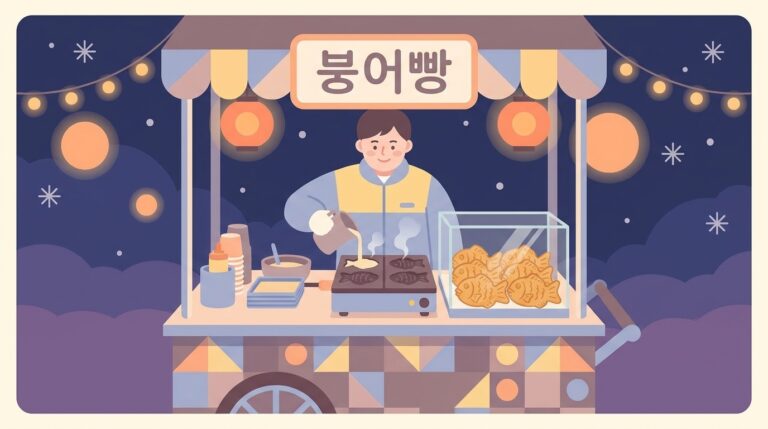
Warm Up Your Korean Winter: How to Order Bungeoppang Like a True Local
Phase 1: Empathy (스토리 몰입형 오프닝)
안녕하세요! Hello! I’m your lead editor at Daily Hangul, your cozy Korean culture navigator.
Imagine this: You are walking down a street in Seoul on a freezing December evening. The wind is biting your cheeks, but suddenly, a sweet, warm aroma wafts through the chilly air. You follow the scent and find a small, glowing street cart covered in a heavy plastic tarp. Inside, an elderly vendor is flipping golden, fish-shaped pastries.
This is 붕어빵 (Bungeoppang)—the ultimate winter soul food of Korea!
You want to try one so badly, but you freeze. “How do I order? Do they take cards? What if I want the custard filling instead of the red bean?”
Don’t worry! Many of our beginner students have felt this exact same hesitation. Today, we will learn the exact survival phrases, cultural manners, and handy tips to order your warm winter snacks confidently. You’ll go from a nervous tourist to a street food pro in no time!
Phase 2: Core Expressions (핵심 표현 3선 심층 분석)
Let’s learn three golden sentences that will make you sound like a local standing in front of a street cart.
1. 붕어빵 삼천 원어치 주세요. (Please give me 3,000 won’t worth of Bungeoppang.)
- Pronunciation: Bung-eop-ppang sam-cheon won-eo-chi ju-se-yo. (Sounds like: Boong-uh-ppang sam-chyun won-uh-chee joo-seh-yo)
- Meaning: “Please give me 3,000 won’t worth of fish-shaped bread.”
- K-Culture Moment: In K-dramas, you often see characters buying a steaming brown paper bag of Bungeoppang for their family after work. They don’t usually ask for “three pieces”; they ask by the budget amount!
- Editor’s Insight: The magic word here is ~어치 (-eo-chi). It means “worth of [amount]”. Since street food prices can change, ordering by money value (e.g., 3,000 won or 5,000 won) is the most natural way to order in Korea.
- Situation Spectrum: Casual ✅ / Semi-formal ✅ / Formal ⚠️
- 🤔 Think About It: In many Western cultures, we buy baked goods by the exact count (e.g., “three cookies”). Why do you think Koreans traditionally buy street snacks by the “monetary value worth” instead?
2. 팥 반, 슈크림 반 섞어 주세요. (Please mix half red bean and half custard cream.)
- Pronunciation: Pat ban, syu-keu-rim ban seok-eo ju-se-yo. (Sounds like: Paht ban, syoo-k’eu-rim ban suhk-uh joo-seh-yo)
- Meaning: “Please mix half red bean and half custard.”
- K-Culture Moment: Korea has a legendary, friendly debate every winter: 팥 (Pat – Red Bean) vs. 슈크림 (Syu-cream – Custard Cream). Even K-pop idols debate this on live streams!
- Editor’s Insight: 반반 (Ban-ban) means “half-half”. If you can’t decide, use this phrase to get a mix of both worlds!
- Situation Spectrum: Casual ✅ / Semi-formal ✅ / Formal ⚠️
- 🤔 Think About It: How does having a “half-and-half” option reflect the sweet, accommodating nature of Korean street food vendors?
3. 계좌이체 해도 돼요? (Can I do a bank transfer?)
- Pronunciation: Gye-jwa-i-che hae-do dwae-yo? (Sounds like: Gyeh-jwa-ee-cheh hae-do dwae-yo?)
- Meaning: “Is a bank transfer okay?”
- K-Culture Moment: Many temporary street carts do not accept credit cards. If you don’t have cash, don’t panic! Look around the cart; you will usually see a bank account number written on a piece of cardboard.
- Editor’s Insight: Bank transfer (계좌이체) via mobile banking apps is incredibly common and widely accepted even at the smallest street stalls in Korea.
- Situation Spectrum: Casual ✅ / Semi-formal ✅ / Formal ⚠️
- 🤔 Think About It: A street food system operating on trust-based instant bank transfers shows a unique side of modern Korean society. What does this tell us about social trust in Korea?
Phase 3: Textbook vs. Real Korean (교과서 한국어 vs 진짜 한국어)
Let’s compare rigid textbook Korean with what you will actually hear on the cold streets of Seoul.
Situation 1: Asking if credit cards are accepted
- 📖 Textbook: “신용카드를 사용할 수 있습니까?” (Sin-yong-ka-deu-reul sa-yong-hal su it-seup-ni-ka? – “Is it possible to utilize a credit card?”)
- 🗣️ Real: “카드 돼요?” (Ka-deu dwae-yo? – “Card okay?”)
- 💡 Why the difference? When standing in the cold, brevity is key! Koreans prefer the short, active verb 돼요 (dwae-yo – Is it okay/feasible?) over long grammatical forms.
Situation 2: Expressing that the food is very hot
- 📖 Textbook: “이 빵은 매우 뜨겁습니다.” (I ppang-eun mae-u tteu-geop-seup-ni-da. – “This bread is highly hot.”)
- 🗣️ Real: “앗, 뜨거워요!” (At, tteu-geo-wo-yo! – “Oh, it’s hot!”)
- 💡 Why the difference? 앗 (At!) is a natural, cute exclamation Koreans use for sudden sensations. Saying “뜨거워요” with a little skip shows authentic emotion!
Phase 4: K-Culture Deep Dive & Non-verbal Manners (K-Culture 딥다이브)
4-1. Nunchi & Street Etiquette
- Two-Handed Respect: When the vendor hands you the hot paper bag, always receive it with both hands (두 손으로). It shows respect and appreciation for their hard work in the freezing weather.
- Step Aside: Don’t stand right in front of the warm window to eat. Step to the side of the cart so other freezing customers can order quickly. This is a subtle but highly appreciated form of 배려 (baeryeo – consideration).
4-2. The Winter Street Food Culture
In Korea, we have a funny slang word: 붕세권 (Bung-se-gwon). It is a play on “station area” (역세권 – premium neighborhood near a subway) but instead means “a neighborhood blessed with a Bungeoppang cart nearby.” Carrying 3,000 won in cash during winter is a warm, romantic habit for Koreans because you never know when you’ll run into a Bungeoppang stall!
Phase 5: Real-Life Roleplay Scenario (실전 롤플레이)
Setting: A warm, orange-tented street stall in Hongdae. The vendor is a friendly Korean auntie (이모님 – Imo-nim).
- You: 안녕하세요! 붕어빵 아직 있어요?
(An-nyeong-ha-se-yo! Bung-eop-ppang a-jik it-seo-yo?)
🎭 [Rubbing your hands together from the cold, smiling warmly]
(Hello! Do you still have Bungeoppang?) - Imo-nim: 네, 따끈따끈한 거 있어! 뭐 줄까?
(Ne, tta-keun-tta-keun-han geo it-seo! Mwo jul-kka?)
🎭 [Flipping the hot cast-iron molds with a spatula]
(Yes, I have warm ones! What can I get you?) - You: 팥 반, 슈크림 반 섞어 주세요.
(Pat ban, syu-keu-rim ban seok-eo ju-se-yo.)
🎭 [Pointing politely at the golden pastries]
(Please mix half red bean and half custard cream.) - Imo-nim: 얼마 치 줄까? 삼천 원? 오천 원?
(Eol-ma chi jul-kka? Sam-cheon won? O-cheon won?)
🎭 [Opening a brown paper bag]
(How much worth? 3,000 won? 5,000 won?) - You: 삼천 원어치 주세요.
(Sam-cheon won-eo-chi ju-se-yo.)
🎭 [Nodding happily]
(Please give me 3,000 won worth.) - Imo-nim: 그래, 팥 세 개, 슈크림 세 개 넣어 줄게!
(Geu-rae, pat se gae, syu-keu-rim se gae neo-eo jul-ge!)
🎭 [Placing the crispy pastries into the bag]
(Sure, I’ll put in three red beans and three custards!) - You: 혹시 카드 안 되면 계좌이체 해도 돼요?
(Hok-si ka-deu an dwae-myeon gye-jwa-i-che hae-do dwae-yo?)
🎭 [Taking out your phone politely]
(By any chance, if cards don’t work, can I do a bank transfer?) - Imo-nim: 그럼! 저기 계좌번호로 보내 줘.
(Geureom! Jeo-gi gye-jwa-beon-ho-ro bo-nae jwo.)
🎭 [Pointing to a handwritten bank account number on the tent wall]
(Of course! Just send it to that account number over there.)
🔀 Interactive Fork: Choose Your Path!
- Choice A: You realize you don’t have cash or a Korean bank app, so you walk away sadly.
- Editor’s Feedback: Bad. You missed out on the warm treats! Always carry some physical 1,000 won bills in winter.
- Choice B: You spot the account number, make the transfer, show the confirmation screen to Imo-nim, and say “보냈어요! (Sent!)”
- Editor’s Feedback: Best! Showing the screen is a polite way to let them verify the transfer instantly.
- Choice C: You try to pay with a credit card anyway, pushing it toward her.
- Editor’s Feedback: Risk. It can embarrass the vendor if they don’t have a card reader. It’s always safer to ask “카드 돼요?” first.
Phase 6: 10-Second Emotion Shadowing Drill (감정 섀도잉)
Try speaking these sentences out loud with the designated emotion. Pay attention to the pauses (/)!
[😊 Excitedly & Warmly]
“와, / 진짜 / 따끈따끈해요!”
(Wa, / jin-ja / tta-keun-tta-keun-hae-yo!)
“Wow, / it’s / so warm and toasty!”-
[🥺 Shivering from the cold]
“너무 추워서 / 붕어빵 / 당겨요.”
(Neo-mu chu-wo-seo / bung-eop-ppang / dang-gyeo-yo.)
“It’s so cold, / I’m craving / Bungeoppang.”
Phase 7: K-Culture Mini Dictionary (미니 사전)
- 겉바속촉 (Geot-ba-sok-chok) | Slang | “Crispy on the outside, soft on the inside.” The golden standard of perfect Bungeoppang.
- 품돈 / 잔돈 (Pum-don / Jan-don) | Noun | “Pocket money / small change.” Keep some 1,000 won bills ready for winter!
- 이모님 (Imo-nim) | Noun | “Auntie.” A warm, respectful way to call middle-aged female street food vendors.
- 슈크림 (Syu-keu-rim) | Noun | “Choux cream / Custard cream.” The popular sweet yellow filling.
Phase 8: Traveler’s Survival Kit (여행자를 위한 생존 키트)
Survival Expressions TOP 3
- 뜨거우니 조심하세요 (Tteu-geo-u-ni jo-sim-ha-se-yo) -> “It’s hot, so be careful.” (What the vendor might say to you!)
- 종이봉투 주세요 (Jong-i-bong-tu ju-se-yo) -> “Please give me a paper bag.”
- 잔돈은 괜찮아요 (Jan-don-eun gwen-cha-na-yo) -> “Keep the change.”
🗺️ Editor’s Travel Note
Before heading out, make sure to use 네이버 지도 앱 다운로드 (Naver Map App) or local neighborhood community boards like “당근마켓” (Daangn) where locals update a real-time “Bungeoppang Map” during the winter season!
Note: Street food vendors are small businesses, and operating hours can change depending on weather conditions.
Phase 9: “One Step Deeper” (생각 질문)
In Korea, Bungeoppang is more than just a sweet treat; it is a symbol of 정 (Jeong – warm affection and community). People rarely buy just one Bungeoppang; they buy a whole bag to share with coworkers, friends, or family. Eating hot bread together in the freezing cold creates a unique sense of closeness.
💬 Your Turn: Do you have a special street food in your country that brings people together in cold weather? Let us know in the comments below!
Phase 10: FAQ & Avoiding Misunderstandings (FAQ Schema)
Q: Can I pay with Apple Pay or Samsung Pay at street carts?
A: Generally, no. Street vendors run tiny operations without NFC terminals. It is best to use physical cash or a direct bank transfer.
Q: Why is it called “fish-shaped bread” if there is no fish inside?
A: The name comes purely from its shape! It is made using a fish-shaped cast iron mold. The fillings are strictly sweet, like red bean or custard.
Q: Should I eat it head-first or tail-first?
A: This is a famous personality test in Korea! Eating the head first means you are quick-tempered and passionate. Eating the tail first means you are cautious and thoughtful!
🚨 Common Mistakes Alert!
- Mistake 1: Assuming all carts take cards. Correction: Always ask “카드 돼요?” first, or have cash ready.
- Mistake 2: Grabbing the pastry directly with your hands. Correction: Wait for the vendor to place it in the brown paper bag.
- Mistake 3: Expecting a receipt. Correction: Street vendors do not typically issue printed receipts.
Phase 11: Action Mission & Engagement (액션 미션)
- 🥉 Bronze Mission: Practice saying “안녕하세요!” with a big smile in front of your mirror.
- 🥈 Silver Mission: Share this post with a friend and text them: “우리 겨울에 붕어빵 먹으러 가자!” (Let’s go eat Bungeoppang this winter!)
- 🥇 Gold Mission: Order “팥 반, 슈크림 반 섞어 주세요” fluently at a real Korean street stall!
Phase 12: Interactive Quiz Challenge (인터랙티브 퀴즈)
Test your knowledge before you hit the streets!
Q1. What is the most natural way to order street food by budget? (Click to see answer)
Answer: Use the magic phrase “~원어치 주세요” (e.g., “삼천 원어치 주세요”). This is much more natural than ordering by exact counts!
Q2. Fill in the blank: “Please mix half red bean and half custard.” -> “팥 __, 슈크림 __ 주세요.” (Click to see answer)
Answer: 반 (ban). The complete sentence is “팥 반, 슈크림 반 주세요.”
Q3. True or False: Bungeoppang contains real carp extract to give it a unique flavor. (Click to see answer)
Answer: False! It is 100% sweet pastry batter with sweet fillings. It is only shaped like a fish!







