

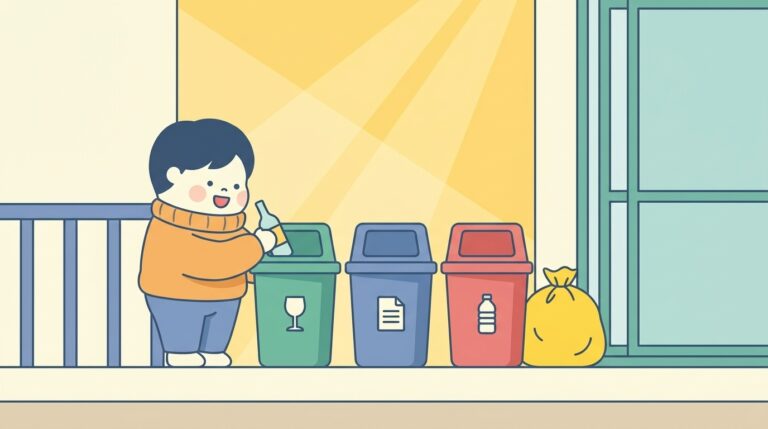
Your Ultimate Guide to Navigating Korean Trash Disposal Like a Local
Phase 1: Empathy (Welcome to the Real Korean Household!)
안녕하세요! (Annyeonghaseyo!) Welcome back to Daily Hangul, your premium cultural navigator. I’m your Chief Editor, and today we are diving into a topic that every single expat, foreign student, and long-term traveler struggles with in Korea: taking out the trash (쓰레기 버리기 – Sseuregi beorigi).
Have you ever watched a K-drama where roommates or newlyweds have a petty fight over who is going to empty the trash bin? Or maybe you’ve stood in front of a row of recycling bins in Seoul, sweat dripping down your neck, under the watchful, laser-sharp gaze of a local Gyeongbi-ajeossi (경비아저씨 – apartment building manager)?
In Korea, trash isn’t just “trash.” It is an intricate, highly organized, and socially binding ritual. If you throw a plastic bottle with its label still attached into the general waste, you might find yourself facing a hefty fine or a very stern lecture. But don’t worry! This guide is built based on real feedback from hundreds of our B1-level learners who successfully mastered Korea’s household chores. By the end of this post, you’ll be able to empty the trash confidently and express yourself like a native roommate!
Phase 2: Core Expressions Deep Dive
Let’s master the 3 most crucial expressions you will use when dealing with trash at home.
1. 쓰레기통 좀 비워 줄래? (Sseuregitong jom biwo jullae?)
- Pronunciation: “Sseu-re-gi-tong jom bee-wo jool-lae?”
- Meaning: “Could you empty the trash can?”
- K-Culture Moment: You will hear this constantly in dramas like Our Beloved Summer or Be Melodramatic when characters are divvying up household chores.
- Editor’s Insight: The word ‘좀’ (jom) literally means “a little,” but here it acts as a magical softener. Without ‘좀’, the command “비워 줄래?” can sound slightly demanding. Adding ‘좀’ makes you sound polite, warm, and natural.
- Situation Spectrum: Casual ✅ | Semi-formal ⚠️ (쓰레기통 좀 비워 줄래요?) | Formal 🚫
- 🤔 Think About It: In English, we often say “take out the trash.” Why do you think Korean specifically uses “empty the trash bin” (비우다 – to empty) when asking someone to handle the indoor bin?
2. 분리수거 해야 돼. (Bunriseugeo haeya dwae.)
- Pronunciation: “Boon-ree-soo-guh hae-ya dwae.”
- Meaning: “We have to sort the recycling.” (Literal: “We must do separate collection.”)
- K-Culture Moment: On reality shows like I Live Alone (나 혼자 산다), celebs are often seen sorting mountain-loads of delivery containers on their balconies.
- Editor’s Insight: ‘분리수거’ (Bunriseugeo) is a compound noun: 분리 (separation) + 수거 (collection). It is a daily mantra in Korea. If you live with Koreans, this phrase is non-negotiable.
- Situation Spectrum: Casual ✅ | Semi-formal ✅ (분리수거 해야 돼요.) | Formal ✅ (분리수거를 해야 합니다.)
- 🤔 Think About It: How does your home country’s approach to recycling compare to Korea’s ultra-strict ‘분리수거’ system?
3. 음식물 쓰레기 봉투 어디 있어? (Eumsikmul sseuregi bongtu eodi isseo?)
- Pronunciation: “Eum-shing-mool sseu-re-gi bong-too eo-dee is-suh?”
- Meaning: “Where is the food waste bag?”
- K-Culture Moment: Characters in family dramas holding small, colorful (often pink or yellow depending on the district) plastic bags with pinched noses.
- Editor’s Insight: In Korea, food waste (음식물 쓰레기) must be disposed of in dedicated, prepaid bags. Putting food waste in general waste bags is illegal!
- Situation Spectrum: Casual ✅ | Semi-formal ✅ (음식물 쓰레기 봉투 어디 있어요?) | Formal 🚫
- 🤔 Think About It: Korean food contains a lot of stews and side dishes, leading to unique disposal bags. How does this system change your perspective on food waste?
Phase 3: Textbook Korean vs. Real-Life Korean
Let’s compare what standard textbooks teach you versus how real Koreans actually talk about trash.
Scenario A: Asking someone to discard some trash
- 📖 Textbook Korean: “쓰레기를 쓰레기통에 넣으십시오.” (Sseuregireul sseuregitonge neoeusipsio. / “Please place the trash in the trash can.”)
- 🗣️ Real-Life Korean: “쓰레기 좀 버려 줘.” (Sseuregi jom beoryeo jwo. / “Can you throw this away for me?”)
- 💡 Why the difference? Textbook Korean sounds like a public safety announcement. In real life, Koreans use the helper verb structure ‘-어/아 줘’ (do it for me) to sound cooperative and friendly.
Scenario B: Checking if something can be recycled
- 📖 Textbook Korean: “이것은 재활용품입니까?” (Igeoseun jaehwalyongpum-imnika? / “Is this a recyclable item?”)
- 🗣️ Real-Life Korean: “이거 분리수거 돼?” (Igeo bunriseugeo dwae? / “Does this go in the recycling?”)
- 💡 Why the difference? Koreans prefer active verbs. Instead of asking if something is a recyclable noun, they ask if it undergoes the process of ‘분리수거’ (sorting/recycling).
Phase 4: K-Culture Deep Dive & Non-verbal Manners
4-1. The “Nunchi” of Trash Disposal
When you go out to the trash collection area, never just dump and run! If you see the Gyeongbi-ajeossi (building manager) nearby, make eye contact, bow slightly, and say “안녕하세요” (Annyeonghaseyo). If you are unsure which bin to use, point to your item and look quizzical. They will gladly help you if they see you are trying. Showing respect for their work is a major green flag in Korean culture.
4-2. The “Jongryangje” (종량제) System
Korea uses the “Volume-rate Waste Disposal System” (종량제). You must buy official, government-approved bags at local convenience stores or supermarkets. Each district (Gu – 구) has its own specific bags. If you live in Mapo-gu, you cannot use a Yongsan-gu bag!
Phase 5: Real-Life Roleplay Scenario
Setting: A cozy share house in Mapo, Seoul. You are roommates with Ji-woo (지우), an organized and sweet Korean university student.
- Ji-woo: (Polishing the kitchen counter) “민준아, 우리 집 쓰레기통이 꽉 찼어.” (Minjun-a, uri jip sseuregitongi kkwak chat-seo.)
“Minjun, our trash can is completely full.” - You: (Looking up from your phone) “아, 정말? 내가 지금 비울까?” (A, jeongmal? Naega jigeum biulkka?)
“Oh, really? Should I empty it now?” - Ji-woo: “응, 고마워! 쓰레기봉투 묶어서 밖에 내놓으면 돼.” (Eung, gomawo! Sseuregibongtu mukkeoseo bakke naenohumyeon dwae.)
“Yeah, thanks! Just tie up the bag and put it outside.” - You: “그런데 분리수거는 어떻게 해? 플라스틱병도 그냥 버려?” (Georeonde bunriseugeoneun eotteoke hae? Peullaseutikbyeongdo geunyang beoryeo?)
“But how do I do the recycling? Do I just throw away plastic bottles as they are?” - Ji-woo: “아니, 페라솔(라벨)은 떼고 씻어서 버려야 돼.” (Ani, rabel-eun ttego siseoseo beoryeoya dwae.)
“No, you have to peel off the labels and rinse them before throwing them away.” - You: “아, 그렇구나. 음식물 쓰레기는 일반 쓰레기봉투에 넣으면 안 되지?” (A, geureokguna. Eumsikmul sseuregineun ilban sseuregibongtue neoeumyeon an doeji?)
“Ah, I see. Food waste shouldn’t go into the general trash bag, right?” - Ji-woo: “맞아! 노란색 음식물 쓰레기 봉투에 따로 담아서 버려 줘.” (Maj-a! Noransaek eumsikmul sseuregi bongtue ttaro damaseo beoryeo jwo.)
“Exactly! Put it separately in the yellow food waste bag and throw it away.” - You: “알겠어. 지금 바로 비우고 올게!” (Algesseo. Jigeum baro biugo olge!)
“Got it. I’ll go empty it right now!”
🔀 Choose Your Path!
How do you handle the chicken bones left over from last night’s delivery?
- Choice A: Throw the chicken bones into the yellow Food Waste Bag.
- Choice B: Throw the chicken bones into the General Waste (일반 쓰레기) Bag.
- Choice C: Throw them in the paper recycling bin because they are dry.
💡 Feedback on Your Choice:
- Choice A (Bad ❌): Oh no! In Korea, chicken bones are considered General Waste because animals cannot digest them. Putting them in food waste can lead to a fine!
- Choice B (Best ✅): Perfect! Bones, shells, and hard seeds are classified as general waste. You’ve nailed the system!
- Choice C (Risk ⚠️): Yikes! Animal bones are definitely not paper. This will upset the building manager!
Phase 6: 10-Second Emotion Shadowing Drill
Practice these sentences out loud to master your Korean tone and emotional delivery! The / represents a natural pause.
[😊 Cheerful & Helpful]
“쓰레기통 / 내가 지금 / 비우고 올게!”
(Sseuregitong / naega jigeum / biugo olge!)
“I will go / empty the trash / right now!”-
[🤔 Confused & Curious]
“이거 / 분리수거 / 해야 돼요?”
(Igeo / bunriseugeo / haeya doeyo?)
“Do I / have to recycle / this?” -
[🥺 Apologetic & Cute]
“음식물 쓰레기 / 봉투가 / 없어요…”
(Eumsikmul sseuregi / bongtuga / eopseoyo…)
“I don’t have / the food waste / bag…”
Phase 7: K-Culture Mini Dictionary
- 일반 쓰레기 (Ilban Sseuregi) | General Waste: Non-recyclable household waste that goes into standard local district bags.
- 음식물 쓰레기 (Eumsikmul Sseuregi) | Food Waste: Biodegradable food waste used for animal feed or compost. Bones and shells excluded!
- 종량제 봉투 (Jongryangje Bongtu) | Pay-as-you-go Trash Bag: The official government bags purchased at convenience stores.
- 대형 폐기물 (Daehyeong Pyegimul) | Bulky Waste: Large items like furniture or electronics that require a special paid sticker from local community centers.
Phase 8: Traveler’s Survival Kit
Survival Expressions TOP 3
- “종량제 봉투 주세요.” (Jongryangje bongtu juseyo.)
- “Please give me the official trash bags.” (Say this at any convenience store counter. They will ask you what size in liters, e.g., 10L, 20L).
- “이거 어디에 버려요?” (Igeo eodie beoryeoyo?)
- “Where do I throw this away?”
- “분리수거 날짜가 언제예요?” (Bunriseugeo naljjaga eonjeyeyo?)
- “When is the recycling collection day?” (Some neighborhoods only collect recycling on specific nights!).
🗺️ Editor’s Travel Note
When you move into a new Airbnb or guesthouse, look up your local community center (주민센터 – Jumin Center) using Naver Map or KakaoMap to understand local disposal rules. Note: Local waste disposal rules can vary by city and are subject to change based on local government policies.
Phase 9: “One Step Deeper” (Cultural Reflection)
In many Western cultures, waste disposal is an individual chore. In Korea, however, waste management is deeply rooted in community mindfulness (우리 의식 – Uri Uisik). Because neighborhoods are densely populated, how you handle your trash directly impacts your neighbors. Sorting trash meticulously is considered a basic social etiquette and a sign of respect for those who live around you. It’s an unspoken social contract: “I care for our shared environment, so you can enjoy it too.”
💬 Your Turn: Have you ever experienced a confusing trash disposal system in another country? Let us know in the comments below!
Phase 10: FAQ & Avoiding Common Mistakes
Q: Can I buy trash bags in another neighborhood and use them in mine?
A: No, you cannot. You must buy and use the bags designated by your specific district (Gu – 구). If you move, you can sometimes get exchange stickers at your new community center, but it is best to buy them locally.
Q: Are eggshells and banana peels considered food waste?
A: Banana peels are soft enough to be processed, so they are food waste. Eggshells, however, are hard and cannot be eaten by livestock, so they must go into the general waste (일반 쓰레기).
Q: Where do I discard empty delivery pizza boxes?
A: If the cardboard is clean, it goes into the Paper recycling bin. However, if the box is heavily stained with oil and sauce, it cannot be recycled and must go into the general waste bag.
🚨 Common Mistakes Alert!
- Mistake 1: Putting plastic bottles with labels directly into the plastic bin.
- Correct Action: Remove the plastic sleeve label first, flatten the bottle, and then recycle it.
- Mistake 2: Using standard black plastic bags for general waste.
- Correct Action: You will be fined! Always use the transparent/white official Jongryangje bags.
- Mistake 3: Treating animal bones, clam shells, and tea bags as food waste.
- Correct Action: Toss them all into the general waste bag.
Phase 11: Action Mission!
- Bronze Medal 🥉: Practice saying “쓰레기 좀 버려 줘” (Can you throw this away for me?) to your pet or roommate today!
- Silver Medal 🥈: Check your own kitchen right now. Take one plastic bottle, peel the label, rinse it out, and say “분리수거 해야 돼” out loud.
- Gold Medal 🥇: Go to a Korean convenience store and ask for “종량제 봉투 주세요” (Please give me the trash bags) successfully in Korean!
Phase 12: Interactive Quiz Challenge
Test your knowledge to see if you’re ready to live in Korea!
1. Which of the following is considered Food Waste (음식물 쓰레기)?
- A) Peach pits
- B) Watermelon rinds
- C) Garlic peels
View Answer & Explanation
Correct Answer: B (Watermelon rinds)
Watermelon rinds are soft enough to be ground up for animal feed. Peach pits and garlic peels are too hard or fibrous and must be discarded as general waste!
2. Fill in the blank: “쓰레기통 좀
줄래?” (Could you empty the trash can?)
* A) 비워 (biwo)
* B) 먹어 (meogeo)
* C) 사 (sa)
View Answer & Explanation
Correct Answer: A (비워 – biwo)
‘비워’ comes from ‘비우다’ (to empty). Choice B means ‘eat’ and Choice C means ‘buy’.







