

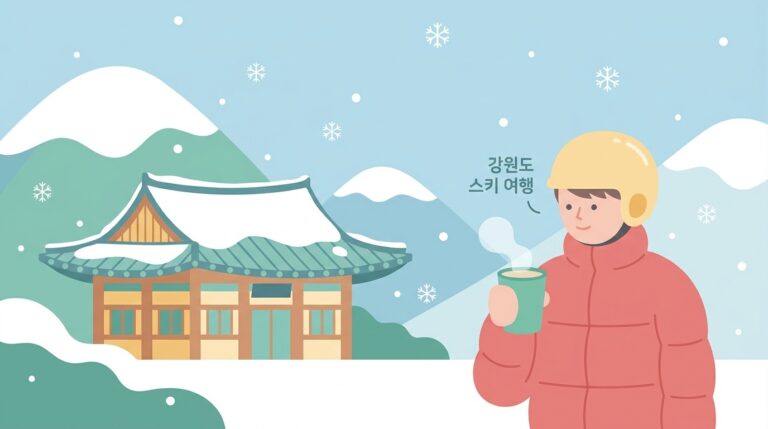
Stay Safe on the Slopes: Why Your Korean Friends Keep Telling You to Wear Safety Gear
Phase 1: Empathy (안녕하세요! 매일한글 에디터입니다.)
안녕하세요! I’m your lead editor at Daily Hangul, your 10-year local culture navigator. As the chilly winter breeze sweeps across the peninsula, thousands of locals and tourists pack their bags for Gangwon-do’s world-class ski resorts.
If you are planning to hit the slopes in Korea, you are in for an absolute treat. However, there’s a common ‘pain point’ many of our intermediate (B2) learners face: understanding the subtle, urgent, and deeply caring safety culture in Korea. You might hear your Korean friends repeatedly nagging you about safety gear. Why do they do this, and how can you naturally talk about safety while renting your gear?
Today, we will master the real conversational nuances of winter sports safety so you can enjoy the snowy peaks of Korea like a seasoned local—safely and confidently!
Phase 2: Core Expressions Deep Dive
1. 안전장비는 필수예요 (Anjeon-jangbi-neun pilsu-yeyo)
- Pronunciation: “An-jeon-jang-bee-neun peel-soo-ye-yo” (Sounds like: Ahn-jeon + jang-bee is peel-soo)
- Meaning: “Safety gear is a must / mandatory.”
- K-Culture Moment: You will hear this constantly from ski resort staff (안전요원) or in modern K-Dramas where the protective male lead fastens a helmet on the female lead’s head before snowboarding.
- Editor’s Insight: ‘필수’ (pilsu) means ‘essential’ or ‘required’. Adding ‘예요’ makes it a polite yet firm statement. Use this to remind your friends that skipping a helmet is not an option.
- Situation Spectrum: Casual (✅) | Semi-formal (✅) | Formal (⚠️)
- 🤔 Think About It: Why does Korean society emphasize communal safety guidelines so deeply? Think about how ‘우리’ (we/our) culture plays a role in keeping each other safe.
2. 다치면 나만 손해예요 (Dachimyeon naman sonhae-yeyo)
- Pronunciation: “Da-chee-myeon na-man son-hae-ye-yo” (Sounds like: Dah-chee-myun nah-mahn sohn-hae-yeh-yo)
- Meaning: “If you get hurt, you’re the only one losing out.” (Literally: “If hurt, only me loss.”)
- K-Culture Moment: This is the ultimate ‘tough love’ phrase used by close Korean friends or family members when you try to act tough and skip wearing knee pads.
- Editor’s Insight: ‘손해’ (sonhae) means loss or damage. This expression highlights a pragmatic Korean worldview: ultimately, physical pain and missed fun only affect you, so be smart and protect yourself!
- Situation Spectrum: Casual (✅) | Semi-formal (⚠️) | Formal (🚫)
- 🤔 Think About It: Is there an equivalent phrase in your language that blends pragmatism with caring advice?
3. 머리 보호대 꼭 쓰세요 (Meori boho-dae kkok sseuseyo)
- Pronunciation: “Meo-ri bo-ho-dae kkok sseu-se-yo” (Sounds like: Muh-ree bo-ho-deh kkohk ssoo-seh-yo)
- Meaning: “Please make sure to wear a helmet/head protector.”
- K-Culture Moment: Heard at rental shops (대여점) near the slopes when the shop owner hands you a glossy helmet.
- Editor’s Insight: While ‘헬멧’ (helmet) is extremely common, older adults or official signs often use ‘머리 보호대’ (head protector). ‘꼭’ (kkok) adds the crucial nuance of “without fail.”
- Situation Spectrum: Casual (✅) | Semi-formal (✅) | Formal (✅)
- 🤔 Think About It: Korean speakers often use ‘쓰다’ (to write/use/wear on head) for helmets, hats, and glasses. How does this compare to your language’s “wear”?
Phase 3: Textbook Korean vs. Real Korean
Scenario 1: Warning someone about the dangers of not wearing a helmet
- 📖 Textbook Korean: “안전을 위해 헬멧을 착용하십시오.” (Please wear a helmet for your safety.)
- 🗣️ Real Korean: “헬멧 안 쓰면 진짜 큰일 나요.” (If you don’t wear a helmet, you’ll be in big trouble!)
- 💡 Why the difference? The textbook version is too robotic and formal for the slopes. Real Koreans use “큰일 나요” (big trouble occurs) to convey immediate, friendly urgency.
Scenario 2: Renting a full set of safety gear
- 📖 Textbook Korean: “보호 장비를 대여하고 싶습니다.” (I would like to rent protective equipment.)
- 🗣️ Real Korean: “장비 풀세트로 빌릴게요.” (I will rent the full gear set.)
- 💡 Why the difference? Koreans love efficiency. Instead of listing ‘보호 장비’ (protective gear), asking for a “풀세트” (full set) instantly lets the rental shop know you want knee pads, elbow pads, and a helmet.
Phase 4: K-Culture Deep Dive & Non-verbal Manners
4-1. Nunchi (눈치) & Slopside Gestures
When on the ski lift or slopes, communication is often non-verbal due to the rushing wind.
* The “Helmet Tap” (머리 톡톡): If someone forgot to buckle their helmet, point at them and gently tap your own helmet twice. This is a warm, universal ‘nunchi’ gesture on Korean slopes.
* Bow of Apology (목례): If you accidentally bump into someone or cause them to fall, immediately bow your head, raise your hand open-palmed, and shout “죄송합니다! (I am sorry!)” or “괜찮으세요? (Are you okay?)” to prevent any escalation.
4-2. The Post-Skiing Reward: K-Food Code
Nothing motivates Koreans to stay safe more than the post-slope feast. After keeping your body intact, head to the resort’s convenience store or cafeteria for:
* 한강라면 (Hangang Ramyeon): Instant ramen cooked on automatic induction plates.
* 꼬치어묵 (Kkochi Eomuk): Hot fishcake skewers in savory broth to instantly melt the cold.
Phase 5: Real-Life Roleplay Scenario
Setting: The bustling rental shop at High1 Ski Resort in Gangwon-do.
Characters:
* Ji-woo (지우): Your enthusiastic but slightly careless Korean snowboarding buddy.
* You (B2 Learner): The smart, safety-conscious friend.
- 지우: 🎭 [Excitedly pointing at the black diamond slope] 와, 오늘 눈 진짜 대박이다! 얼른 타고 올라가자!
- You: 🎭 [Smiling, but holding a helmet] 지우야, 잠깐만. 머리 보호대 꼭 쓰라고 했잖아.
- 지우: 🎭 [Waving hands dismissively] 에이, 나 보드 잘 타잖아. 답답하게 헬멧을 왜 써? 그냥 가자!
- You: 🎭 [With a serious, caring expression] 무슨 소리야. 눈이 얼어서 넘어지면 진짜 위험해. 안전장비는 필수야!
- 지우: 🎭 [Sighing, looking at the rental rack] 귀찮은데… 꼭 빌려야 돼?
- You: 🎭 [Nodding firmly] 다치면 너만 손해라니까. 병원 가느라 야간 스키도 못 타면 어떡해?
- 지우: 🎭 [Realizing you are right, scratching his head] 듣고 보니 그렇네. 알았어, 헬멧도 같이 빌릴게.
- You: 🎭 [Passing him the helmet with a warm smile] 잘 생각했어. 이제 안전하게 풀세트 장착하고 출발하자!
🔀 Interactive Choice Point
What would you do if Ji-woo still refused to wear the helmet?
- Choice A: “귀찮으면 그냥 타. 대신 다쳐도 난 모른다!” (Fine, ride without it. Don’t complain if you get hurt!)
- Feedback: 🚫 Bad. Too harsh! While grammatically correct, it sounds like you are abandoning your friend.
- Choice B: “안 쓰면 나 오늘 같이 안 탈 거야! 안전이 제일 중요해.” (If you don’t wear it, I won’t ride with you today! Safety is number one.)
- Feedback: 🏆 Best! Shows strong care and uses the culturally vital phrase ‘안전이 제일 중요해’ (Safety is most important).
- Choice C: “아 그래? 그럼 나만 빌릴게.” (Oh really? Then I’ll just rent mine.)
- Feedback: ⚠️ Risk. A bit cold. In Korean ‘우리’ (we) culture, looking out for each other is expected.
Phase 6: 10-Second Emotional Shadowing Drill
Let’s practice speaking with real-life emotional dynamics! Pay attention to the pause markers / and the emotional cues.
- “헬멧 안 쓰면 / 진짜 큰일 나요! [🥺 걱정스럽고 진지하게]”
- Translation: If you don’t wear a helmet, you’ll be in big trouble!
- “다치지 말고 / 안전하게 타자! [😊 신나고 격려하며]”
- Translation: Let’s not get hurt and ride safely!
Phase 7: K-Culture Mini Dictionary
- 안전요원 (Anjeon-yowon) | Ski Patrol / Safety Staff | The yellow-jacketed heroes on the slopes who ensure everyone rides safely.
- 장비 대여 (Jangbi daeyeo) | Gear Rental | The process of renting boards, skis, boots, and protective clothing.
- 심야 스키 (Simya seuki) | Midnight Skiing | Skiing from late night (11 PM) to early morning (3 AM). Highly popular among young Koreans!
- 리프트권 (Ripeuteu-gwon) | Lift Pass | The essential ticket/card needed to access the ski lifts.
Phase 8: Survival Kit for Travelers
Survival Phrases TOP 3
- “보호대도 빌릴 수 있나요?” (Bo-ho-dae-do bil-ril su in-na-yo?) – Can I rent protective pads too?
- “이 헬멧은 저한테 좀 작아요.” (I hel-met-eun jeo-han-te jom jag-a-yo.) – This helmet is a bit small for me.
- “안전망이 어디에 있어요?” (An-jeon-mang-i eo-di-e is-seo-yo?) – Where is the safety net?
🗺️ Editor’s Travel Note
When heading to Korean ski resorts from Seoul, do not hassle with local buses. Use the 셔틀버스 예약 (Shuttle Bus Booking) options on official resort websites or apps like 네이버 지도 (Naver Map) which offer direct seasonal shuttles. Note: Shuttle schedules and prices are subject to change depending on the season.
Phase 9: “한 발 더 깊이” (Going Deeper)
In Korea, protecting your friend is considered a core part of ‘정’ (Jeong)—the warm feeling of attachment and communal love. When a Korean friend nags you to buckle your helmet, adjust your goggles, or wear thicker socks, they aren’t trying to control you. It is their way of saying, “I value your presence, and I want us to enjoy this moment together without any pain.”
💬 Your Turn: Have you ever experienced this kind of caring ‘nagging’ from a Korean friend? Let us know in the comments below!
Phase 10: FAQ & Common Mistakes
Q: Do I really need to rent a helmet? Can I just wear a beanie?
A: Yes, you absolutely need a helmet! Korean slopes can get icy, especially during night skiing. A beanie (비니) looks cool but offers zero impact protection. Most resorts now highly encourage or mandate helmets on higher slopes.
Q: How do I ask the rental shop for the cleanest helmet?
A: You can politely say: “가장 깨끗한 헬멧으로 주실 수 있나요?” (Could you please give me the cleanest helmet?).
Q: What should I do if I get injured on the slope?
A: Look for the nearest 안전요원 (Ski Patrol). They are stationed at every slope intersection. You can shout: “도와주세요! 사람이 다쳤어요!” (Help! Someone is hurt!).
🚨 Common Mistakes Warning Board
- Mistake 1: Saying “헬멧 입다” instead of “헬멧 쓰다”.
- Correct Action: Use 쓰다 (sseuda) for things worn on the head.
- Mistake 2: Ignoring the safety net rules (안전망).
- Correct Action: Never cross the safety nets to take photos.
- Mistake 3: Not securing your lift pass (리프트권).
- Correct Action: Keep it in your sleeve pocket; modern gates scan automatically!
Phase 11: Action Mission & Participation
Action Mission 3-Steps
- 🥉 Bronze: Read the Core Expressions aloud 3 times.
- 🥈 Silver: Write a comment below using the phrase “안전장비는 필수예요!”.
- 🥇 Gold: When you visit a ski resort, say “장비 풀세트로 빌릴게요” to the staff.
🎮 K-Culture Mission: Watch a winter episode of your favorite Korean variety show (like Running Man) and spot how many times the cast members tease each other while putting on their safety gear!
Phase 12: Interactive Quiz Challenge
Test your knowledge before hitting the slopes!
1. Which verb is correct for wearing a helmet?
A) 신다 (sinda)
B) 쓰다 (sseuda)
C) 입다 (ipda)
👉 View Answer & Explanation
Correct Answer: B) 쓰다 (sseuda)
Explanation: ‘쓰다’ is used for headwear, ‘신다’ is for footwear, and ‘입다’ is for body clothing.
2. True or False: “다치면 나만 손해예요” means “If you get hurt, I will be sad.”
👉 View Answer & Explanation
Correct Answer: False
Explanation: It pragmatically means “If you get hurt, you are the only one losing out/suffering.”







