

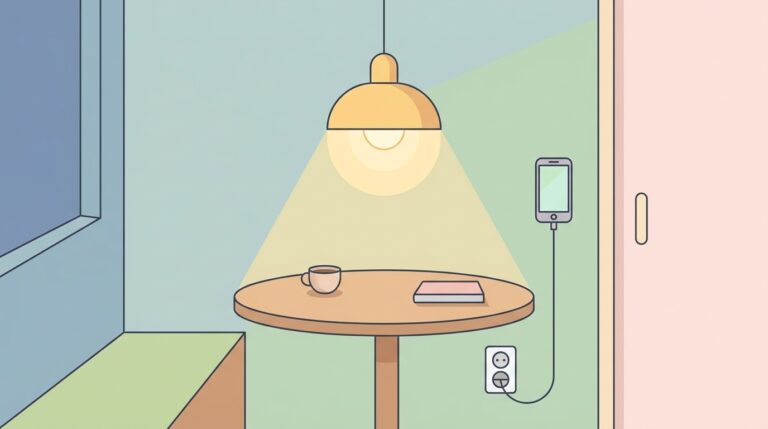
Phase 1: Empathy (Your 1% Battery Savior in Seoul!)
안녕하세요! (An-nyeong-ha-se-yo!) Daily Hangul here, your trusted Korean companion!
Imagine this: You are wandering around the vibrant streets of Hongdae, capturing beautiful storefronts and filming reels. Suddenly, your screen dims. 1% battery. Your map app goes black. You don’t know the way back to your guesthouse, you can’t access your mobile transit card, and you’re meeting a friend in 15 minutes! Panic sets in, right?
Don’t worry! Korea is one of the most digitally connected countries in the world, and finding a place to charge your phone is surprisingly easy—if you know how to ask. Today, we are going to learn how to locate free and automated smartphone charging stations (스마트폰 무료 충전소) and master the exact phrases that will save your day. Based on real feedback from our global learners, this guide focuses on natural, street-smart Korean that will get you out of any battery emergency. Let’s power up your Korean! 🔌✨
Phase 2: Core Expressions 3 Deep Analysis
Here are the three most critical expressions you need to know when your device is on its last breath.
1. 충전기 빌릴 수 있을까요? (Can I borrow a charger?)
- Pronunciation: Chung-jeon-gi bil-ril su is-seul-kka-yo? (Sounds like: “Choong-jun-ghee bill-reel soo eess-eul-gga-yo?”)
- Meaning: “Can I borrow a charger?”
- K-Culture Moment: You’ve probably seen this in countless K-Dramas! A character rushes into a cozy cafe, desperately looking for an outlet to catch an important call from their crush.
- Editor’s Insight: This is the most polite and natural way to ask cafe baristas or hotel receptionists. Even if they don’t have a spare plug, asking politely with this phrase often prompts them to show you where a public USB port is located.
- Situation Spectrum: Casual (⚠️ – with close friends, use: “충전기 있어?”), Semi-formal (✅), Formal (✅).
- 🤔 Think About It: In many Western cafes, asking to charge your phone behind the counter is a huge favor. In Korea, it’s widely accepted as standard hospitality. How does this reflect the tech-first, community-driven culture of Korean society?
2. 보조배터리 대여 어디서 해요? (Where can I rent a power bank?)
- Pronunciation: Bo-jo-bae-teo-ri dae-yeo eo-di-seo hae-yo? (Sounds like: “Bo-jo-baet-uh-ree dae-yuh uh-dee-suh hae-yo?”)
- Meaning: “Where do I rent a portable battery?”
- K-Culture Moment: In modern subway stations or beside convenience store registers, you’ll see sleek yellow or green machines filled with modular power banks.
- Editor’s Insight: Korea uses automated power bank rental services (like Everycharging or Chungjeonmanbaen). Since everything is self-serve via QR code, this phrase is perfect when asking a station worker or convenience store clerk to point you toward the machine.
- Situation Spectrum: Casual (⚠️), Semi-formal (✅), Formal (✅).
- 🤔 Think About It: Renting a battery and returning it at a completely different station is normal in Korea. What kind of social trust does this nationwide ecosystem require?
3. 무료 충전할 수 있는 곳이 있을까요? (Is there a place where I can charge for free?)
- Pronunciation: Mu-ryo chung-jeon-hal su in-neun go-si is-seul-kka-yo? (Sounds like: “Moo-ryoh choong-jun-hal soo een-noon go-shee eess-eul-gga-yo?”)
- Meaning: “Is there a spot where free charging is available?”
- K-Culture Moment: Looking around tourist spots, public parks, or high-speed train stations for those lifesaver municipal “smart benches” equipped with wireless charging pads.
- Editor’s Insight: Excellent phrase for tourist information desks, libraries, or subway customer service offices where free public utilities are provided.
- Situation Spectrum: Casual (🚫), Semi-formal (✅), Formal (✅).
- 🤔 Think About It: Public spaces in Korea are heavily modernized. How does having free charging spots in public parks reshape your perception of city planning?
Phase 3: Textbook Korean vs. Real Korean
Let’s compare stiff, academic phrases with the authentic, native Korean that local millennials and Gen Z actually use daily!
Situation 1: Requesting a charge at a cafe counter
- 📖 Textbook Korean: “핸드폰을 충전해 주십시오.”
(Haen-deu-pon-eul chung-jeon-hae ju-sip-si-o.)
“Please charge my mobile phone.” (Sounds like a military command! It’s way too demanding and stiff.) - 🗣️ Real Korean: “혹시 충전 좀 할 수 있을까요?”
(Hok-si chung-jeon jom hal su is-seul-kka-yo?)
“By any chance, could I charge my phone a bit?” - 💡 Why is it different? The magic word “혹시” (by any chance) and “좀” (a bit) soften your request, making you sound extremely polite, respectful, and natural.
Situation 2: Inquiring about electrical outlets near cafe seats
- 📖 Textbook Korean: “이 테이블에는 전기 콘센트가 존재합니까?”
(I te-i-beul-e-neun jeon-gi kon-sen-teu-ga jon-jae-ham-ni-ka?)
“Does an electrical outlet exist on this table?” (Sounds like an academic science paper!) - 🗣️ Real Korean: “여기 자리 혹시 콘센트 있어요?”
(Yeo-gi ja-ri hok-si kon-sen-teu is-seo-yo?)
“By any chance, is there an outlet near this seat?” - 💡 Why is it different? Real-life spoken Korean cuts out academic verbs like “존재하다” (to exist) and relies on simple nouns paired with “있어요?” (is there?).
Phase 4: K-Culture Deepdive & Non-Verbal Manners
4-1. “Nunchi” (눈치) & Hand Gestures: The Art of Handing Over Your Device
When asking someone behind a counter to charge your phone, never hand it over with one hand. Doing so can come across as dismissive or impolite.
* The Golden Rule: Hold your phone with both hands (두 손으로 주기), bow your head slightly, and make soft eye contact. This simple physical gesture communicates immense respect and immediate appreciation for their assistance!
4-2. Culture Code: Caffeine, Outlets, and the Cafe “Office” Culture
In Korea, cafes are more than just places to grab coffee—they are social sanctuaries and remote workspaces. Because of this, cafes are expected to be equipped with “콘센트 자리” (outlet seats). It is highly common to search online for “콘센트 많은 카페” (cafes with many outlets) before planning a study session. Finding a socket is considered a basic right for customers!
Phase 5: Practical Roleplay Scenario
Let’s travel to a bright, buzzing convenience store near Hongdae Station. Meet Alex, a traveler whose phone is at 2%, and Min-ji, a super-friendly convenience store part-timer.
Characters
- 알렉스 (Alex): Desperate traveler holding a dying smartphone.
- 민지 (Min-ji): A tech-savvy, cheerful local convenience store clerk.
Dialogue
- 알렉스: 🎭 (Anxiously holding up a blank phone screen) 저기요, 죄송한데 핸드폰 배터리가 없어서요…
(Jeo-gi-yo, joe-song-han-de haen-deu-pon bae-teo-ri-ga eop-seo-seo-yo…)
“Excuse me, I’m sorry, but my phone battery is dead…” - 민지: 🎭 (Nodding sympathetically) 아, 정말요? 충전 필요하시겠네요.
(Ah, jeong-mal-yo? Chung-jeon pil-yo-ha-si-get-ne-yo.)
“Oh, really? You must need a charge.” - 알렉스: 🎭 (Pointing hopefully to the register) 혹시 여기서 충전 좀 할 수 있을까요?
(Hok-si yeo-gi-seo chung-jeon jom hal su is-seul-kka-yo?)
“By any chance, could I charge it here?” - 민지: 🎭 (Smiling apologetically) 아쉽게도 저희 카운터 안에서는 개별 충전이 안 돼요.
(A-swip-ge-do jeo-hui ka-un-teo an-e-seo-neun gae-byeol chung-jeon-i an dwae-yo.)
“Unfortunately, we can’t do individual charging inside our counter.” - 알렉스: 🎭 (Shoulders dropping slightly) 아… 그렇군요. 그럼 무료로 충전할 수 있는 곳은 없나요?
(Ah… geu-reok-gun-yo. Geu-reom mu-ryo-ro chung-jeon-hal su in-neun go-seun eop-na-yo?)
“Ah… I see. Then, is there any place where I can charge for free?” - 민지: 🎭 (Pointing to the entrance yellow kiosk) 저기 문 옆에 보조배터리 대여 기계 보이시죠? 저거 사용하시면 돼요!
(Jeo-gi mun yeop-e bo-jo-bae-teo-ri dae-yeo gi-gye bo-i-si-jyo? Jeo-geo sa-yong-ha-si-myeon dwae-yo!)
“Do you see that portable battery rental machine next to the door? You can use that!” - 알렉스: 🎭 (Sighing with absolute relief) 와, 다행이네요! 사용법이 어렵지 않나요?
(Wa, da-haeng-i-ne-yo! Sa-yong-beop-i eo-ryeop-ji an-na-yo?)
“Wow, thank goodness! Is it hard to use?” - 민지: 🎭 (Giving an encouraging thumbs up) 네, 화면에서 영어를 선택하시고 카드로 결제하시면 바로 나와요!
(Ne, hwa-myeon-e-seo yeong-eo-reul seon-taek-ha-si-go ka-deu-ro gyeol-je-ha-si-myeon ba-ro na-wa-yo!)
“Yes, just select English on the screen, pay with your card, and it pops right out!”
🔀 Interactive Choice Point!
How should Alex respond next?
* Choice A: “여기서 충전기 살 수 있어요?” (Can I buy a charger here?)
👉 Best! Perfect pivot! If you want to own a charger rather than rent a battery, convenience stores sell charging blocks and cables right in the aisles.
* Choice B: “그냥 콘센트 좀 쓸게요.” (I’ll just use the outlet.)
👉 Bad! Plugging into arbitrary wall outlets inside stores without permission is heavily frowned upon and considered rude.
* Choice C: “지하철역으로 가야겠네요.” (I guess I should go to the subway station.)
👉 Risk! While true, wandering with 1% battery hoping to spot a station portal is risky. Use the machine right in front of you!
Phase 6: 10-Second Emotion Shadowing Drill
Let’s practice speaking with real-life emotional nuances! Pause briefly at the slashes (/).
[🥺 Desperate & Asking a Favor]
“혹시 / 충전기 좀 / 빌릴 수 있을까요?”
(Hok-si / chung-jeon-gi jom / bil-ril su is-seul-kka-yo?)[😊 Relieved & Delighted]
“와! / 보조배터리 대여 기계가 / 여기 있네요!”
(Wa! / Bo-jo-bae-teo-ri dae-yeo gi-gye-ga / yeo-gi in-ne-yo!)
Phase 7: K-Culture Mini Dictionary
- 완충 (Wan-chung) | Fully Charged | Short for ‘완전 충전’ (Complete Charge). You can say: “내 폰 완충됐다!” (My phone is fully charged!)
- 보배 (Bo-bae) | Portable Battery Slang | Cute slang short for ‘보조배터리’. “너 보배 있어?” (Do you have a power bank?)
- 충전충 (Chung-jeon-chung) | Battery Obsessor | A playful term for someone who panics when their battery dips below 80% and constantly hunts for sockets.
- 콘센트 자리 (Kon-sen-teu Ja-ri) | Outlet Seat | The most coveted seats located in cafes and study lounges, usually placed against walls or under long tables.
Phase 8: Survival Kit for Travelers
Survival Expressions TOP 3
- “충전 케이블 있어요?” (Chung-jeon ke-i-beul is-seo-yo?) – “Do you have a charging cable?”
- Pro Tip: Specify your connector type: “C타입” (C-type) or “아이폰용” (for iPhone).
- “이거 충전 안 돼요.” (I-geo chung-jeon an dwae-yo.) – “This isn’t charging.”
- Pro Tip: Use this if a rented power bank seems faulty.
- “반납 어디에 해요?” (Ban-nap eo-di-e hae-yo?) – “Where do I return this?”
- Pro Tip: Use this when returning rented portable chargers at service counters.
Editor’s Travel Note
Power up your travels in Korea by downloading local navigation tools like Naver Map or KakaoMap. Instead of searching in English, type “보조배터리 대여” (power bank rental) or “무료 충전” (free charging) directly into the search bar to locate nearby rental stations and smart hubs instantly! Please note: Rental rates and interface details are subject to change by vendors.
Phase 9: “One Step Deeper” (Reflective Essay)
Korea’s hyper-connected society operates on an impressive foundation of public trust and shared resources. The presence of free public charging desks, open municipal WiFi, and unattended high-tech kiosks highlights the safe, community-centric nature of Korean city life. It shows how technology and social trust blend seamlessly—leaving a laptop unattended at a cafe table while grabbing a battery from a kiosk is standard practice here.
💬 Your Turn: Have you ever experienced a moment where you desperately needed to charge your phone abroad? How does public utility access in your country compare to Korea? Let us know in the comments below!
Phase 10: FAQ & Common Mistakes (FAQ Schema)
Q: Can I charge my phone for free at any convenience store counter in Korea?
A: Historically, clerks would plug your phone in behind the desk for free. Today, due to security and liability issues, almost all stores have transitioned to automated kiosk rentals (like Chungjeonmanbaen), which charge a very nominal fee.
Q: Do public chargers in Korea support fast charging?
A: Yes! Public charging docks in subway stations and smart city benches are often upgraded with high-speed cables, but it’s always safer to carry your own USB cable for compatibility.
Q: Can foreign travelers use automated mobile battery rental apps without a Korean phone number?
A: Absolutely! Modern kiosk machines accept direct international card payments (Visa/Mastercard) and feature English user interfaces, so you don’t need a local mobile account.
🚨 Common Mistakes Alert!
- Leaving your phone unattended: Never leave your device sitting on public charging docks in subways without watching it. While crime rates are low, public docks are self-serve and unattended.
- Assuming all ports are active: Occasionally, municipal USB slots in parks are deactivated for maintenance. Check for a lit LED light before walking away.
- Plugging in without asking: Avoid plugging your phone into outlets inside small local restaurants without asking the owner first. Always say, “여기 혹시 콘센트 써도 돼요?” (Is it okay to use this outlet?) to show respect.
Phase 11: Action Mission & Participation
Action Mission 3-Steps
- Bronze Medal: Look at your phone right now and say “충전기 빌릴 수 있을까요?” out loud 3 times with emotion!
- Silver Medal: Take a screenshot of a portable power bank rental machine in any K-Drama or vlog, and tag us on Instagram with #DailyHangul!
- Gold Medal: Walk into a local Korean cafe or store and ask the clerk, “혹시 핸드폰 충전기 대여되나요?”
🎮 K-Culture Mission
Watch your favorite modern slice-of-life K-drama today and count how many times characters sit near electrical outlets in cafes. Share the name of the drama in the comments below!
Phase 12: Interactive Quiz Challenge
Test your real-world readiness with this quick, fun interactive quiz!
Question 1: What is the most polite, natural way to ask to charge your phone at a cafe?
- A) 핸드폰 충전해라! (Haen-deu-pon chung-jeon-hae-ra!)
- B) 혹시 충전 좀 할 수 있을까요? (Hok-si chung-jeon jom hal su is-seul-kka-yo?)
- C) 전기 주세요! (Jeon-gi ju-se-yo!)
👉 Click to reveal the answer and explanation!
Correct Answer: B
“혹시 충전 좀 할 수 있을까요?” is the gold standard! Option A is an impolite command, and Option C literally translates to “Give me electricity!”, which will definitely confuse the staff!
Question 2: True or False?
In Korea, it is considered rude to ask to borrow a charger at a cafe counter.
👉 Click to reveal the answer and explanation!
Correct Answer: False
It is completely common and accepted! Just remember to use both hands when handing your phone over and ask politely using our core phrases.







