

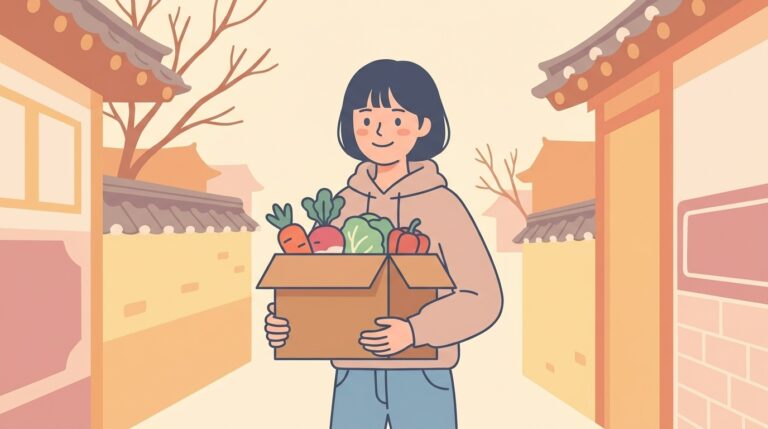
Phew, This is Heavy! Mastering Grocery Shopping and Carrying Heavy Loads in Korean
Phase 1: Empathy & Connection
안녕하세요! (Annyeonghaseyo!) I’m your lead editor and your Korean culture navigator at Daily Hangul. Have you ever gone shopping at a Korean mart like E-Mart or a neighborhood shikjajae (grocery) mart, excited to cook some authentic Korean food, only to realize you bought way too much?
Suddenly, you are walking back to your apartment or the subway station with heavy plastic bags cutting into your fingers. You look like a K-drama character who just lost their job, struggling to carry three water bottle bundles and a watermelon!
If you’ve ever wanted to complain about the weight in a natural way, ask a friend to share the load, or offer to help someone else struggling with their boxes, you are in the right place. Today, we’re going to master the real, everyday Korean expressions for carrying heavy groceries. These aren’t the stiff phrases you find in academic textbooks—this is the real talk that will make your Korean friends say, “Wow, you sound so local!”
Phase 2: Core Expressions Deep Dive
1. 짐이 너무 무거워서 힘드네요 (Jim-i neomu mugeowoseo himdeuneyo)
- Pronunciation: Jeem-ee nuh-moo moo-guh-wuh-suh him-deu-neh-yo (Think of “Jeem” like “Jim”, and “him-deu” like the wind “hissing” out of you in exhaustion).
- Meaning: “The bags are so heavy, it’s really tough.”
- K-Culture Moment: You will hear this in almost every family drama when a mother returns from the traditional market (sijang) and her children run to the door to help her.
- Editor’s Insight: Jim (짐) literally means “luggage” or “load,” but in daily life, it refers to any shopping bags, backpacks, or boxes you are carrying. Adding ~네요 (~neyo) at the end expresses a soft, genuine exclamation about your current state of tiredness.
- Situation Spectrum:
- Casual (with friends): 짐이 너무 무거워서 힘들어. (⚠️)
- Semi-formal (polite/daily): 짐이 너무 무거워서 힘드네요. (✅)
- Formal (business/elders): 짐이 무척 무거워서 힘이 듭니다. (🚫 – Too stiff for grocery shopping!)
- 🤔 Think About It: In English, we often say “These bags are heavy.” But in Korean, we focus on the effort or hardship (himdeuneyo) of the person carrying them. Why do you think Korean emphasizes the feeling of effort over just describing the object?
2. 이것 좀 같이 들어 주실 수 있어요? (Igeot jom gachi deureo jusil su isseoyo?)
- Pronunciation: Ee-guht johm gah-chee deu-ruh joo-sheel soo ee-ssuh-yo? (Make sure to pronounce gachi like “gah-chee”—the ‘t’ sound merges into a ‘ch’ sound naturally!).
- Meaning: “Could you help me carry this for a moment?”
- K-Culture Moment: This is the ultimate “meet-cute” line in romantic K-dramas where the female lead asks a handsome passerby for help with a giant box of office supplies or groceries.
- Editor’s Insight: Jom (좀) means “a little” or “please,” and it is the magic word in Korean politeness. It softens the request so you don’t sound demanding. Deureo juda (들어 주다) means “to lift/carry for someone.”
- Situation Spectrum:
- Casual: 이것 좀 같이 들어 줄래? (✅)
- Semi-formal: 이것 좀 같이 들어 주실 수 있어요? (✅)
- Formal: 이것을 함께 들어 주실 수 있습니까? (⚠️ – A bit too formal for friends, but usable with strangers.)
3. 제가 나눠서 들게요 (Jega nanwoseo deulgeyo)
- Pronunciation: Jeh-gah nah-nwoh-suh deul-geh-yo (The “nwo” sound is like the “nua” in “nuance”).
- Meaning: “I’ll split the load and carry some.”
- K-Culture Moment: This shows ultimate Jeong (affection/warmth). If you are walking with a friend and they have two heavy bags, you grab one and say this with a smile.
- Editor’s Insight: Nanwoseo (나눠서) comes from nanuda (나누다 – to divide/share). By saying deulgeyo (들게요 – I will carry), you are actively taking responsibility to make your companion’s life easier.
- Situation Spectrum:
- Casual: 내가 나눠서 들게. (✅)
- Semi-formal: 제가 나눠서 들게요. (✅)
- Formal: 제가 나누어 들도록 하겠습니다. (🚫 – Sounds like a logistics manager in a factory!)
Phase 3: Textbook Korean vs. Real-Life Korean
Situation 1: Offering to carry heavy bags for someone
- 📖 Textbook Korean: “제가 당신의 무거운 짐을 대리하여 운반하겠습니다.” (Jega dangsin-ui mugeoun jim-eul daelihayeo unbanhagessseumnida.)
- 🗣️ Real-Life Korean: “어우, 무거운데 제가 들게요!” (Eou, mugeounde jega deulgeyo!)
- 💡 Why is it different? Nobody uses words like “transport” (unban) or “on your behalf” (daelihayeo) in daily life. Simply saying “Oh, it looks heavy, let me carry it!” (Mugeounde jega deulgeyo!) sounds incredibly warm and natural.
Situation 2: Complaining about fingers hurting from heavy bags
- 📖 Textbook Korean: “쇼핑백의 끈 때문에 손가락에 통증이 있습니다.” (Syopingbaeg-ui kkeun ttaemune songalag-e tongjeung-i isseumnida.)
- 🗣️ Real-Life Korean: “아고, 손가락 끊어질 것 같아요!” (Ago, songarak kkeun-eojil geot gat-ayo!)
- 💡 Why is it different? Koreans love dramatic, sensory exaggerations. Instead of saying “I have pain in my fingers,” say “My fingers feel like they’re going to snap!” (Kkeun-eojil geot gat-ayo). It gets instant empathy!
Phase 4: K-Culture Deep Dive & Non-verbal Manners
4-1. Nunchi & Body Language
When someone offers to carry your heavy bags, the polite Korean response is to refuse at least once with a wave of the hand: “괜찮아요, 제가 들 수 있어요!” (It’s okay, I can carry it!).
If they insist, you should bow your head slightly, use both hands to hand over one of the lighter bags, and say, “고마워요, 정말 구세주네요!” (Thank you, you’re a lifesaver!). Handing over items with both hands shows deep respect and gratitude.
4-2. The “Self-Packaging” Culture (자율포장대)
If you visit a major Korean supermarket like E-Mart or Lotte Mart, you will see a bustling area called the 자율포장대 (Jayul-pojangdae – Self-packaging counter).
Here, supermarkets provide leftover cardboard boxes, packing tape, and string for free. Instead of buying plastic bags, Koreans love to recycle these boxes to pack their heavy groceries. It’s an eco-friendly, highly organized ritual. If you want to fit in like a local, head to this counter after paying, grab a box, tape it up, and load your groceries!
Phase 5: Real-Life Roleplay Scenario
Setting: You and your Korean friend, Minjun (민준), just finished buying ingredients for a Han River picnic at a local mart. The bags are incredibly heavy, and you still have to walk 10 minutes to the park.
Characters:
* You (B1 Student)
* Minjun (Your friendly Korean classmate)
1. You: (🎭 Panting, holding two massive plastic bags)
   어휴, 생각보다 짐이 너무 많네요!
   (Eohyu, saeng-gakboda jim-i neomu manneyo!)
   "Phew, we have way more bags than I expected!"

2. Minjun: (🎭 Looking at your red hands in concern)
   어머, 손가락 진짜 아프겠다. 제가 좀 들까요?
   (Eomeo, songarak jinja apeugetta. Jega jom deulkkayo?)
   "Oh no, your fingers must really hurt. Shall I carry some?"

3. You: (🎭 Politely refusing once, sweating slightly)
   괜찮아요! 공원까지 얼마 안 남았으니까 제가 들 수 있어요.
   (Gwenchanayo! Gong-wonkkaji eolma an namasseunikka jega deul su isseoyo.)
   "I'm fine! There's not much left until the park, so I can carry it."

4. Minjun: (🎭 Shaking his head, grabbing one of your bags)
   에이, 아니에요. 같이 사온 건데 제가 나눠서 들게요!
   (Ei, anieyo. Gachi saon geonde jega nanwoseo deulgeyo!)
   "Come on, no way. We bought this together, let me split the load and carry some!"

5. You: (🎭 Giving in with a grateful smile)
   그럼... 이것 좀 같이 들어 주실 수 있어요? 이거 정말 무거워요.
   (Geureom... igeot jom gachi deureo jusil su isseoyo? Igeo jeongmal mugeowoyo.)
   "Then... could you help me carry this one? This is really heavy."

6. Minjun: (🎭 Lifting the heavy bag of drinks)
   우와, 진짜 무겁네요! 마트에서 배달 서비스 신청할 걸 그랬어요.
   (Uwa, jinja mugeowneyo! Mateu-eseo baedal seobiseu sincheong-hal geol graesseoyo.)
   "Wow, this really is heavy! We should have signed up for the mart's delivery service."

7. You: (🎭 Laughing naturally)
   맞아요, 다음에는 꼭 박스에 넣어서 들고 가거나 배달시켜요!
   (Majayo, daeum-eneun kkok bakseu-e neoh-eoseo deulgo gageona baedalsikyeoyo!)
   "Exactly! Next time, let's definitely put them in a box to carry or get it delivered!"

8. Minjun: (🎭 Grinning, stepping forward)
   좋아요. 자, 영차! 빨리 가요!
   (Joh-ayo. Ja, yeong-cha! Ppalli gayo!)
   "Sounds good. Alright, heave-ho! Let's go quickly!"
🔀 Interactive Choice Points
If Minjun says, “제가 좀 들까요?” (Shall I carry some?), how will you respond?
* Choice A: “아니요, 거절합니다.” (No, I decline.)
* Feedback: Bad. This sounds extremely cold, robotic, and borderline angry. It breaks the friendly vibe completely.
* Choice B: “정말요? 그럼 이것 좀 나눠서 들어 주세요! 감사합니다!” (Really? Then please carry some of this! Thank you!)
* Feedback: Best! It’s friendly, honest, and immediately accepts his kind gesture while expressing warm gratitude.
* Choice C: “무거우니까 혼자 들기 싫어요.” (Since it’s heavy, I don’t want to carry it alone.)
* Feedback: Risk. This sounds a bit whiny and childish. It might make your friend feel obligated rather than happy to help.
Phase 6: 10-Second Emotion Shadowing Drill
To sound natural, you must practice the rise and fall of emotional speech. Try shadowing these sentences! The / represents a natural pause.
- [🥺 Exhausted & Complaining slightly]
“어휴 / 짐이 / 너무 무거워서 / 힘드네요!”
(Eohyu / jim-i / neomu mugeowoseo / himdeuneyo!) -
[😊 Grateful & Relieved]
“도와주셔서 / 정말 / 감사해요!”
(Dowajusyeoseo / jeongmal / gamsahaeyo!) -
[💪 Energetic & Encouraging]
“자, / 영차! / 빨리 / 들고 가요!”
(Ja, / yeong-cha! / ppalli / deulgo gayo!)
Phase 7: K-Culture Mini Dictionary
- 장바구니 (Jang-baguni) | Reusable Shopping Bag
- Usage: Most Korean marts charge 100–500 KRW for paper or plastic bags. Locals always carry a foldable jang-baguni to save money and the environment.
- 자율포장대 (Jayul-pojangdae) | Self-Packaging Counter
- Usage: The packing tables with free boxes and tape. Use this word to ask employees: “자율포장대 어디에 있어요?” (Where is the self-packaging zone?).
- 배달 서비스 (Baedal Seobiseu) | Mart Delivery Service
- Usage: Many large supermarkets in residential areas offer free or cheap same-day delivery if you spend over a certain amount (usually 30,000 or 50,000 KRW).
- 영차 (Yeong-cha) | Heave-ho! / Ugh!
- Usage: A cute, natural exclamation used when lifting something heavy. Saying this makes you sound incredibly endearing to Koreans!
Phase 8: Survival Kit for Travelers
Survival Expressions TOP 3
- “종이봉투 하나 주세요.” (Jongi-bongtu hana juseyo.)
- -> “Please give me one paper bag.”
- “배달 되나요?” (Baedal doenayo?)
- -> “Do you offer delivery service?”
- “이거 어디에 놓을까요?” (Igeo eodie noheulkkayo?)
- -> “Where should I put this heavy item?”
💡 Editor’s Travel Note
If you don’t want to carry heavy bags at all, download the 쿠팡 (Coupang App) or use the 이마트몰 (SSG.COM App) for rocket-fast delivery straight to your Airbnb or hotel lobby. It is the ultimate lifehack for travelers in Korea who want to avoid the physical labor of grocery shopping!
Phase 9: “Go Deeper” (A Slice of Korean Society)
In Korea, helping others carry heavy loads is deeply tied to the concept of 정 (Jeong – shared affection and community spirit). If you live in a Korean apartment complex, it is extremely common for neighbors to hold the elevator door or even grab a heavy box for an elderly neighbor without being asked.
By learning these phrases, you aren’t just translating words; you are stepping into a culture of mutual care and active helpfulness. Next time you see someone struggling with a heavy cart, don’t just walk by—offer a friendly hand!
💬 Your Turn: Have you ever carried heavy groceries in Korea, or did you try the Jayul-pojangdae box packing? Tell us about your experience in the comments below! We reply to every single student.
Phase 10: FAQ & Common Mistakes
Q: Can I use “무거워요” (Mugeowoyo) to describe a heavy feeling in my heart or a serious atmosphere?
A: Yes! While mugeowoyo literally means physically heavy, Koreans frequently use it metaphorically. For example, “분위기가 무거워요” (The atmosphere is heavy/serious) or “마음이 무거워요” (My heart is heavy with worry) are highly common B1-level expressions.
Q: What is the difference between “들다” (deulda) and “가지고 가다” (gajigo gada)?
A: Deulda means to physically lift or carry in your hands. Gajigo gada means to bring or take something with you (transporting it from one place to another). If you are physically struggling with weight, always use deulda.
Q: Do young Koreans still use the word “영차” (Yeong-cha)?
A: Absolutely! It’s slightly old-school, which makes it incredibly charming, cute, and humorous when a foreigner uses it naturally while lifting a heavy shopping bag.
🚨 Common Mistakes Alert!
- Mistake 1: Saying “이것을 올려 주세요” (Igyeoseul ollyeo juseyo) when you want someone to help you carry a bag.
- Correction: Ollyeo juseyo means “Please put it up/raise it.” Use “같이 들어 주세요” (Please lift/carry this with me).
- Mistake 2: Calling shopping bags “가방” (gabang).
- Correction: Gabang is a personal bag like a backpack or handbag. Shopping bags are “쇼핑백” (syopingbaek) or “봉투” (bongtu).
- Mistake 3: Saying “이거 너무 무겁습니다” to your close friend.
- Correction: It sounds like you are delivering a formal speech! Say “이거 너무 무겁다!” or “이거 너무 무거워!” instead.
Phase 11: Action Mission & Challenge
- 🥉 Bronze Mission: Pronounce “짐이 너무 무거워요” out loud 3 times in front of your mirror with a realistic exhausted face.
- 🥈 Silver Mission: Go to a grocery store, pack your items in a bag, and say “영차!” as you lift them.
- 🥇 Gold Mission: Next time you go shopping with a Korean friend, actively grab one of their bags and say: “무거우니까 제가 나눠서 들게요!”
- 🎮 K-Culture Mission: Watch a food-themed K-drama (like Let’s Eat) and spot the scene where characters carry groceries home. Listen carefully to hear if they use the word “짐” (jim) or “무겁다” (mugeopda)!
Phase 12: Interactive Quiz Challenge
Test your knowledge before you go! Click the toggles below to reveal the answers.
Q1. Which expression is the most natural way to offer to split a heavy load with a friend?
- 제가 배달하겠습니다. (Jega baedalhagessseumnida.)
- 제가 나눠서 들게요. (Jega nanwoseo deulgeyo.)
- 이것을 버려 주세요. (Igeot-eul beoryeo juseyo.)
View Answer & Explanation
Correct Answer: 2
Explanation: “제가 나눠서 들게요” means “I will split the load and carry some.” Option 1 means “I will deliver it,” and Option 3 means “Please throw this away!”
Q2. Fill in the blank: “이것 ___ 같이 들어 주실 수 있어요?”
- 좀 (jom)
- 아주 (aju)
- 매우 (maeu)
View Answer & Explanation
Correct Answer: 1 (좀)
Explanation: “좀” (jom) is the essential polite softening word used when making requests in Korean. “아주” and “매우” mean “very,” which doesn’t fit the grammar here.
Q3. True or False: You should use formal “~습니다” (seumnida) ending when complaining to your same-age friend that grocery bags are too heavy.
View Answer & Explanation
Correct Answer: False
Explanation: Using extremely formal endings with a close friend sounds unnatural and distant. Stick to casual “~어/아” or friendly semi-formal “~요/네요” endings!
With these expressions, you are fully prepared to tackle any shopping trip in Korea without sweating your language skills! Keep practicing, and we’ll see you in the next lesson. 다음에 또 만나요! (See you next time!)







