

Sorry for Keeping You Waiting! Master the Art of Apologizing in Korean (CEFR A2 Guide)
Phase 1: Oh No, I’m Late! Let’s Fix This with Some Warm ‘Jeong’
안녕하세요! (Annyeonghaseyo!) It’s your favorite Daily Hangul editor and your Korean bestie.
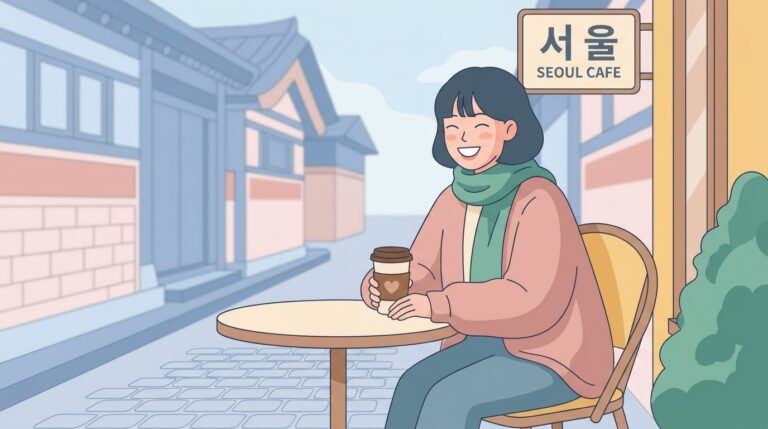
Picture this: You are meeting your Korean friend at a super cute cafe in Hongdae. You planned to arrive 10 minutes early, but Seoul Subway Line 2 is packed, or maybe you got slightly lost in the maze of exits. You look at your phone, and you are 10 minutes late. Your friend is already sitting there, sipping water.
Your heart rate spikes. You want to apologize, but simply saying “Mianhaeyo” (I’m sorry) feels too plain. How do you say “Sorry for making you wait” in natural, warm Korean that instantly melts any potential awkwardness?
Today, we are going to learn how to turn a late arrival into a bonding moment using real-life Korean expressions that show deep care, respect, and a bit of that famous Korean Jeong (정 – affection). Let’s dive in!
Phase 2: Three Magic Phrases to Save Your Appointment
1. 기다리게 해서 미안해요 (Gidari-ge haeseo mian-haeyo)
- Pronunciation: key-dah-ree-gheh-heh-suh mee-ahn-heh-yo
- Meaning: Sorry for making you wait. (Literal: “Because I made you wait, I am sorry.”)
- K-Culture Moment: This is the ultimate classic! In almost every romance K-Drama, you will see one of the characters running through the rain or a crowded street, catching their breath, and saying this to their waiting partner.
- Editor’s Insight: This phrase is beautiful because it focuses on their feelings and patience, rather than just your lateness. It shows high emotional intelligence!
- Situation Spectrum: Casual (기다리게 해서 미안해) ✅ | Semi-formal (기다리게 해서 미안해요) ✅ | Formal (기다리게 해서 죄송합니다) ⚠️
- 🤔 Think About It: Why do you think Korean culture focuses on the act of “making someone wait” rather than just saying “I am late”?
2. 늦어서 미안해요 (Neujeoseo mian-haeyo)
- Pronunciation: nuh-juh-suh mee-ahn-heh-yo
- Meaning: Sorry for being late.
- K-Culture Moment: You are sliding into a BBQ restaurant seat where your friends have already started grilling. You raise your hands apologetically and say this.
- Editor’s Insight: Short, sweet, and to the point. Use this the very second you arrive.
- Situation Spectrum: Casual (늦어서 미안해) ✅ | Semi-formal (늦어서 미안해요) ✅ | Formal (늦어서 죄송합니다) ⚠️
- 🤔 Think About It: Is it easier for you to apologize for the time lost, or do you prefer giving a reason first?
3. 금방 갈게요! (Geumbang gal-geyo!)
- Pronunciation: gum-bahng gahl-gheh-yo
- Meaning: I’ll be there in a second! / I’m coming right now!
- K-Culture Moment: When you are running up the subway escalator and texting your friend who just messaged “Where are you?”
- Editor’s Insight: Send this while you are on your way. It reassures your friend that you are actively moving toward them.
- Situation Spectrum: Casual (금방 갈게) ✅ | Semi-formal (금방 갈게요) ✅ | Formal (곧 도착하겠습니다) 🚫
- 🤔 Think About It: In Korea’s fast-paced society, “Geumbang” (very soon) usually means under 5 to 10 minutes. How fast is “soon” in your country?
Phase 3: Textbook Korean vs. Real-Life Korean
Let’s compare what dry grammar books teach you versus what cool Koreans actually say to their friends.
Scenario A: Giving a warning that you are running late
- 📖 Textbook Korean: “늦을 것 같습니다. 죄송합니다.” (Neujeul geot gatseumnida. Joesonghamnida. – It seems I will be late. My apologies.)
- 🗣️ Real-Life Korean: “차가 막혀서 조금 늦을 것 같아요. 미안해요! 😭” (Chaga makhyeoseo jogeum neujeul geot gatayo. Mianhaeyo! – Traffic is heavy so I think I’ll be a little late. Sorry!)
- 💡 Why the difference? The textbook version sounds like a business email. Real friends use softer sentence endings like “~것 같아요” (~seems like) and explain the reason (traffic, subway delay) with a cute crying emoji to show they feel bad.
Scenario B: Arriving at the meetup spot
- 📖 Textbook Korean: “오래 기다리셨습니까?” (Orae gidarisyeotseumnika? – Have you waited long?)
- 🗣️ Real-Life Korean: “많이 기다렸지? 미안해!” (Manyi gidaryeotji? Mianhae! – Did you wait long? Sorry!)
- 💡 Why the difference? If you are close friends, using super-formal honorifics like “기다리셨습니까” actually creates distance. Keep it warm and casual with “기다렸지?” (Did you wait, right?).
Phase 4: K-Culture Deep-Dive & Non-Verbal Manners
4-1. The “Sorry” Gestures (Nunchi & Body Language)
When apologizing for being late in Korea, your actions speak louder than words:
1. The Bow-and-Jog: When you spot your friend from a distance, do not just walk casually. Do a light jog while bowing your head slightly. It shows that you are rushing and respect their time.
2. The Prayer Hands: Place your hands together like a prayer (🙏) near your chest while saying “Mianhae!”.
3. The Sweet Compensation: The golden rule of Korean friendship—if you make someone wait, you buy the coffee or the bingsu (shaved ice)!
4-2. The “Coffee Savior” Culture
In Korea, appointments often happen at cafes. If you are 10-15 minutes late, it is highly polite to text: “먼저 들어가서 아메리카노 시켜서 마시고 있어! 내가 살게!” (Meonjeo deureogaseo americano sikyeoseo masigo isseo! Naega salge! – Go inside first and order an Americano! I will buy it!)
Phase 5: Real-Life Roleplay
Meet the Characters
- Sujin (수진): Your stylish, kind Korean friend waiting at a cafe in Seongsu-dong.
- You: Rushing out of Exit 3, sweating slightly.
Sujin: (Texting) 어디쯤이야? ㅎㅎ (Whereabouts are you? haha)

You: (Running) 🎭 Running fast while holding phone
     미안! 지금 3번 출구 앞이야! 금방 갈게!
     (Mian! Jigeum sambeon chulgu apiya! Geumbang galge!)
     (Sorry! I'm in front of Exit 3 now! I'll be right there!)

Sujin: 🎭 Waving hand from the cafe outdoor terrace
       여기야! 천천히 와, 다치겠다!
       (Yeogiya! Cheoncheonhi wa, dachigetta!)
       (Over here! Come slowly, you'll hurt yourself!)

You: 🎭 Bowing slightly while catching breath
     수진아, 많이 기다렸지? 기다리게 해서 정말 미안해!
     (Sujin-a, manyi gidaryeotji? Gidari-ge haeseo jeongmal mianhe!)
     (Sujin, did you wait long? I'm so sorry for making you wait!)

Sujin: 🎭 Smiling warmly and shaking head
       아니야, 나도 방금 왔어. 날씨도 좋은데 괜찮아!
       (Aniya, nado banggeum wasseo. Nalssido johende gwaenchanha!)
       (No, I just got here too. The weather is nice so it's okay!)

You: 🎭 Sitting down, wiping brow
     오늘 지하철이 연착돼서 늦었어. 정말 미안해.
     (Oneul jihacheol-i yeonchak-dwaeseo neujeosseo. Jeongmal mianhe.)
     (The subway was delayed today so I was late. I'm really sorry.)

Sujin: 🎭 Nodding understandingly
       아, 오늘 지하철 고장 났다고 뉴스 나오더라. 괜찮아!
       (Ah, oneul jihacheol gojang nattago nyuseu naodeora. Gwaenchanha!)
       (Ah, there was news today saying the subway broke down. It's okay!)

You: 🎭 Pointing to the menu with a bright smile
     미안하니까 오늘 커피랑 디저트는 내가 살게! 뭐 마실래?
     (Mian-hanikka oneul keopi-rang dijeoteu-neun naega salge! Mwo masillae?)
     (Since I'm sorry, today's coffee and dessert are on me! What do you want to drink?)

Sujin: 🎭 Clapping hands happily
       대박! 그럼 나 달달한 바닐라 라떼 먹을래! 고마워!
       (Daebak! Geureom na daldalhan banilla ratte meogulleo! Gomawo!)
       (Awesome! Then I'll have a sweet vanilla latte! Thank you!)
🔀 Interactive Choice Points
How would you respond if Sujin says she has been waiting for 30 minutes?
* A: “진짜 미안해! 오늘 커피랑 비스킷 다 내가 살게!” (Best Choice: Offers instant sweet apology and treats them to heal the waiting pain.)
* B: “어쩔 수 없었어. 지하철이 늦었거든.” (Bad Choice: Sounds defensive and shifts blame without warmth.)
* C: “미안. 근데 나 배고파, 밥 먹으러 가자.” (Risk Choice: Ignores their patience and focuses only on your needs.)
Phase 6: 10-Second Emotion Shadowing Drill
Practice saying this naturally by following the rhythm breaks (/) and emotional cues!
[🥺 Deeply Apologetic and Breathless]- 기다리게 해서 / 정말 미안해요!
- Gidari-ge haeseo / jeongmal mian-haeyo!
[😊 Relieved and Rushing]- 지하철 때문에 늦었어요, / 금방 갈게요!
- Jihacheol ttaemune neujeosseo-yo, / geumbang gal-geyo!
Phase 7: K-Culture Mini Dictionary
- 방금 (Banggeum): “Just now”. When waiting for a friend, even if you waited 15 minutes, saying “나도 방금 왔어” (I just arrived too) is a polite lie to make the late friend feel comfortable.
- 연착 (Yeonchak): “Delay” (usually for trains/subways). A very useful excuse when public transit fails you.
- 내가 살게 (Naega salge): “It’s on me / I’ll buy.” The magic phrase that solves 99% of minor social mistakes in Korea.
- 약속 (Yaksok): “Promise / Plan / Appointment”. Koreans take friendship appointments seriously, often calling them “Yaksok”.
Phase 8: Traveler’s Survival Kit
Survival Expressions for Lateness
- 길을 잃었어요 (Gireul ireosseoyo): “I got lost.” (Perfect for travelers exploring narrow Seoul alleys).
- 거의 다 왔어요 (Geoui da wasseoyo): “I’m almost there.” (Use when you are 2-3 minutes away).
- 천천히 오세요 (Cheoncheonhi oseyo): “Take your time.” (What you say when your friend is late).
Editor’s Travel Note
Always download Naver Map before traveling in Korea! Google Maps is not fully optimized in Korea. Naver Map will give you real-time subway/bus arrival schedules, down to the exact second, helping you avoid being late in the first place.
Phase 9:
Frequently Asked Questions (FAQ)
Q: What does "기다리게 해서 미안해요 (Gidari-ge haeseo mian-haeyo)" mean in Korean and how do you pronounce it?
A: In Korean, "기다리게 해서 미안해요 (Gidari-ge haeseo mian-haeyo)" is pronounced [key-dah-ree-gheh-heh-suh mee-ahn-heh-yo] and means: Sorry for making you wait. (Literal: "Because I made you wait, I am sorry.")
Q: What does "늦어서 미안해요 (Neujeoseo mian-haeyo)" mean in Korean and how do you pronounce it?
A: In Korean, "늦어서 미안해요 (Neujeoseo mian-haeyo)" is pronounced [nuh-juh-suh mee-ahn-heh-yo] and means: Sorry for being late.
Q: What does "금방 갈게요! (Geumbang gal-geyo!)" mean in Korean and how do you pronounce it?
A: In Korean, "금방 갈게요! (Geumbang gal-geyo!)" is pronounced [gum-bahng gahl-gheh-yo] and means: I'll be there in a second! / I'm coming right now!






