

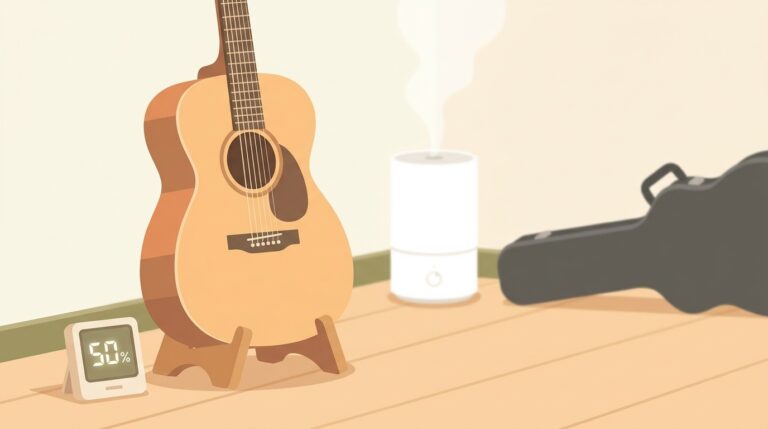
Keeping Your Instrument Singing: The Art of Humidity Control in Korea’s Extreme Seasons
Phase 1: Empathy (스토리 몰입형 오프닝)
안녕하세요! Your favorite language mentor and Korean best friend from Daily Hangul is here!
Imagine this: You’ve just arrived in Seoul with your beloved acoustic guitar or violin, ready to join a cozy busking group in Hongdae or practice in a local studio. But within a few weeks, you notice something horrifying—your guitar strings are buzzing, the action feels incredibly high, or worse, you hear a tiny crack sound. What happened?
Korea is famous for its extreme four seasons. We transition from bone-dry, underfloor-heated (온돌) winters to tropical, mold-inducing monsoon (장마철) summers. For solid-wood instruments, Korea is basically a climate rollercoaster! In this guide, we’ll explore how to discuss instrument maintenance like a seasoned pro. C1-level Korean is all about mastering these highly specific, vivid, and culturally contextual terms so you can confidently walk into any repair shop in Nagwon Instrument Arcade (낙원상가) and get your instrument treated with the respect it deserves.
Phase 2: Three Key Expressions (핵심 표현 3선 심층 분석)
1. 습도를 머금다 (seup-do-reul meo-geum-da)
- Pronunciation: Seup-do-reul meo-geum-da (Sounds like “seup-dough-rule muh-gum-da”)
- Meaning: Lit. “to hold/breathe in moisture in its mouth” -> To absorb humidity.
- K-Culture Moment: You will hear classical musicians or luthier vloggers on YouTube say this when explaining why a violin’s tone suddenly sounds muddy or heavy during the humid summer months.
- Editor’s Insight: The verb 머금다 is incredibly beautiful. It means to hold something gently in your mouth or to carry an emotion/expression (like 미소를 머금다 – to wear a gentle smile). When applied to wood, it poetically describes how the organic material swells up as it drinks in the humid air.
- Situation Spectrum: Casual (⚠️) / Semi-formal (✅) / Formal (✅)
- 🤔 Think About It: How does your native language describe wood absorbing moisture? Is it as poetic as “holding” or “biting” the dampness?
2. 나무가 틀어지다 (na-mu-ga teul-eo-ji-da)
- Pronunciation: Na-mu-ga teul-uh-ji-da (Sounds like “nah-moo-gah tuhl-uh-jee-dah”)
- Meaning: For wood to warp, twist, or bend out of shape.
- K-Culture Moment: In K-Dramas featuring passionate musicians, a ruined acoustic instrument is often described as “이미 틀어질 대로 틀어져서 손쓸 수 없다” (It has warped so much that nothing can be done).
- Editor’s Insight: 틀어지다 is a versatile C1 verb. Beyond physical warping, it is also used colloquially to describe a relationship going south or plans getting ruined (e.g., 계획이 틀어졌다 – My plans went awry).
- Situation Spectrum: Casual (✅) / Semi-formal (✅) / Formal (✅)
- 🤔 Think About It: Why do you think Koreans use the same word for warping wood and failing relationships? (Hint: Both require gentle alignment and care to stay straight!)
3. 적정 습도를 유지하다 (jeok-jeong seup-do-reul yu-ji-da)
- Pronunciation: Jeok-jeong seup-do-reul yu-ji-da (Sounds like “juk-jung seup-dough-rule yoo-jee-hah-dah”)
- Meaning: To maintain the optimal humidity level.
- K-Culture Moment: This is the gold standard phrase written on digital hygrometers and instrument care manuals found in high-end Korean music academies.
- Editor’s Insight: 적정 (appropriate/optimal) is a crucial Hanja-derived word (適正). Mastering this makes you sound incredibly professional compared to just saying “좋은 습도” (good humidity).
- Situation Spectrum: Casual (⚠️) / Semi-formal (✅) / Formal (✅)
- 🤔 Think About It: In Korea, the “적정 습도” for wooden instruments is generally considered to be 45% to 55%. What is the ideal range in your country?
Phase 3: Textbook Korean vs. Real Korean (교과서 한국어 vs 진짜 한국어)
Situation 1: Describing a dry room in the winter
- 📖 Textbook: “방이 아주 건조합니다.” (The room is very dry.)
- 🗣️ 진짜 한국어: “방이 완전 건조해서 쩍쩍 갈라져요.” (The room is so dry it feels like it’s literally splitting/cracking open.)
- 💡 왜 다를까? While “건조합니다” is grammatically flawless, native speakers use the vivid onomatopoeia 쩍쩍 (the sound or visual of cracking open widely) to emphasize the physical discomfort of dry winter air combined with harsh Korean underfloor heating (온돌).
Situation 2: Warning someone to take extra care of their instrument
- 📖 Textbook: “악기를 잘 보관해야 합니다.” (You must store your instrument well.)
- 🗣️ 진짜 한국어: “악기를 거의 상전 모시듯 해야 돼요.” (You practically have to serve your instrument like a royal master.)
- 💡 왜 다를까? 상전 (上典) refers to a master or royalty in old Korea. Saying you serve your instrument like a “상전” humorously highlights the high-maintenance nature of caring for a delicate wooden instrument in Korea’s hostile climate.
Phase 4: K-Culture Deep Dive & Non-verbal Manners (비언어적 매너)
4-1. The Art of “Instrument Nunchi” (눈치)
In Korean music circles, touching someone else’s instrument without asking is a major faux pas. If someone invites you to try their guitar or violin, check the environment first. If you notice they have dry-packs or dampits inside the case, gently acknowledge their effort:
“와, 관리 진짜 열심히 하시네요!” (Wow, you really care for your instrument diligently!)
When holding their instrument, look at the neck alignment with a serious, appreciative gaze. This non-verbal gesture shows you respect their craft and understand the physical struggle of wood preservation.
4-2. The “지하 연습실” (Basement Practice Room) Reality
If you ever visit Hongdae’s indie band scene, you will notice many affordable practice spaces are located underground (지하 연습실). While soundproof and cool, they are notoriously humid. Korean musicians survive this by investing in heavy-duty industrial dehumidifiers (제습기) and leaving them running 24/7. Surviving the underground rehearsal space is a true rite of passage for any musician in Korea!
Phase 5: Real-Life Roleplay Scenario (실전 롤플레이)
- Setting: A high-end acoustic guitar repair shop inside the famous Nagwon Instrument Arcade (낙원상가) in Insadong, Seoul.
- Characters:
- 민준 (Min-jun): A meticulous, middle-aged master luthier who treats guitars like his own children.
- 사라 (Sarah): A C1-level foreign musician who noticed her acoustic guitar’s action has warped.
[Scene Start: Sarah walks into Min-jun's workshop holding her guitar case nervously.]

사라: 안녕하세요, 사장님! 제 기타 넥이 좀 이상해서 왔어요.
      (Hello, boss! I came because my guitar neck feels a bit strange.)

민준: 🎭 (기타 케이스를 조심스레 열며 안경을 고쳐 쓴다)
      어디 봅시다... 어우, 고생 좀 했겠네. 줄 높이가 너무 떴어요.
      (Let's see... Oh, you must have struggled. The action is way too high.)

사라: 🎭 (속상한 표정으로)
      맞아요. 연주할 때 손가락이 너무 아파요. 여름이라 그런가요?
      (Exactly. My fingers hurt so much when I play. Is it because of the summer?)

민준: 그렇지. 장마철이라 나무가 습도를 잔뜩 머금어서 부풀어 올랐어요.
      이대로 두면 넥이 완전히 틀어집니다.
      (Indeed. Because of the monsoon, the wood has sucked in so much moisture and swelled up. If left like this, the neck will warp completely.)

사라: 아... 겨울에는 괜찮았는데, 여름이 되니까 진짜 관리가 힘드네요.
      (Ah... It was fine during winter, but now that it's summer, maintenance is really tough.)

민준: 🎭 (기타의 상판을 부드럽게 두드리며)
      원래 한국 사계절이 악기한테는 쥐약이에요. 겨울엔 온돌 때문에 쩍쩍 갈라지고, 여름엔 눅눅해지니까요.
      (Originally, Korea's four seasons are poison to instruments. In winter, they crack from the underfloor heating, and in summer, they get soggy.)

사라: 제습제나 습도 조절 팩을 케이스에 넣어두면 좀 괜찮아질까요?
      (Would putting dehumidifying packs or humidity control packs in the case help?)

민준: 🎭 (고개를 끄덕이며 미소를 짓는다)
      그럼요! 평소에 악기를 상전 모시듯 습도 관리를 잘해 주셔야 오래 써요. 일단 셋업 다시 잡아 줄 테니까 지켜봅시다.
      (Of course! Usually, you have to treat your instrument like royalty and manage the humidity well to use it for a long time. I'll adjust the setup for you first, so let's see how it goes.)

사라: 정말 감사합니다, 사장님! 잘 부탁드려요.
      (Thank you so much, boss! I appreciate your help.)
🔀 Interactive Choice Point
How would you respond to Min-jun’s advice about treating the instrument like a king (“상전 모시듯”)?
- Option A: “네, 앞으로는 제 기타를 모시고 살아야겠어요!” (Yes, from now on, I guess I’ll have to serve my guitar and live!)
- Feedback (Best!): Perfect! It shows you understood the humorous nuance of “상전 모시듯” and used it back with witty humor. Min-jun will love your personality!
- Option B: “진짜 왕처럼 대해야 하네요.” (I really must treat it like a king.)
- Feedback (Risk): Grammatically correct, but a bit too literal. It lacks the natural native comedic touch of the original idiom.
- Option C: “네, 저는 바보같이 관리 안 했어요.” (Yes, I stupidly didn’t maintain it.)
- Feedback (Bad): Too self-deprecating. Keep the vibe lighthearted and focused on the challenge of Korea’s weather!
Phase 6: 10-Second Shadowing Drill (10초 감정 섀도잉 드릴)
Let’s practice speaking like a native who is genuinely worried about their precious instrument. Pay attention to the pauses (/) and emotional cues!
- [🥺 Worried & Frustrated]
“방이 / 완전 건조해서 / 악기 판이 / 쩍쩍 갈라질 것 같아요.”
(The room is / so incredibly dry / I feel like the instrument body / is going to crack wide open.) -
[😅 Playful & Whiny]
“비싼 악기라 / 아주 그냥 / 상전 모시듯 / 하고 있어요.”
(Since it’s an expensive instrument, / I am literally / serving it / like a royal master.)
Phase 7: K-Culture Mini Dictionary (핵심 키워드 4선)
- 낙원상가 (Nagwon Sangga | Nagwon Instrument Arcade)
- Usage: Located near Insadong, it is the world’s largest indoor instrument shopping mall. A legendary spot where any Korean musician goes to buy, sell, or repair instruments.
- 하드케이스 (Hadeu Keiseu | Hard Case)
- Usage: Essential for protecting acoustic instruments from drastic humidity shifts in Korea. Gig bags (소프트케이스) are discouraged during monsoon season.
- 장마철 (Jangma-cheol | Monsoon Season)
- Usage: Running from late June to mid-July. Humidity often spikes above 80%, making dehumidifiers (제습기) absolute lifesavers.
- 댐핏 (Daempit | Dampit)
- Usage: A tube-like humidifier placed inside stringed instruments. Extremely crucial during dry Korean winters to prevent wood shrinkage.
Phase 8: Survival Kit for Travelers (여행자를 위한 생존 키트)
Survival Expressions TOP 3
- “넥이 좀 휜 것 같아요.” (I think the neck is slightly bent/warped.)
- “줄 높이(셋업) 좀 낮춰 주실 수 있나요?” (Could you lower the string action/setup?)
- “습도 조절 팩 어디서 팔아요?” (Where do you sell humidity control packs?)
💡 Editor’s Travel Note:
If you are looking for local luthiers or want to buy high-quality dampits, do not search on Google Maps as its database in Korea is limited. Instead, open your Naver Map App and search for “낙원상가 악기수리” (Nagwon Arcade Instrument Repair) or “기타 리페어숍” (Guitar Repair Shop) to find highly rated local workshops with hundreds of real user reviews.
Phase 9: One Step Deeper (한 발 더 깊이)
In recent years, the term 반려악기 (Companion Instrument)—patterned after 반려동물 (companion animal/pet)—has become immensely popular among Korean millennials and Gen Z. Many young workers in Seoul take up hobbyist lessons to cope with burnout. Because they view their instrument not just as a tool, but as a living companion that breathes and reacts to the seasons, they dedicate immense care to maintaining it. Caring for your instrument is seen as an act of self-care.
💬 Your Turn: Do you have a “반려악기”? How do you keep it happy and healthy in your local climate? Let us know in the comments below!
Phase 10: FAQ & Common Mistakes (자주 묻는 질문 & 실수)
Q: What is the biggest mistake foreigners make with instruments in Korea?
A: Leaving their instruments on the floor in winter! Korean apartments use 온돌 (underfloor heating). If your wooden instrument case sits directly on the hot floor, the heat will bake the wood, causing rapid shrinkage and irreversible cracks. Always place your case on a stand or a table!
Q: Can I use standard food silica gel packets to dehumidify my instrument case?
A: No! Food silica gel absorbs moisture indiscriminately until it is completely dry, which can dry out your instrument too much. Instead, buy specialty dual-way humidity packs (like Boveda or D’Addario) which maintain a precise 49% humidity level.
🚨 Common Mistakes Alert
- Mistake 1: Hanging an acoustic guitar on a concrete outer wall during winter. (The wall gets freezing cold and accumulates moisture inside, creating localized extreme dryness or mold).
- Correct Action: Keep the instrument in its hard case on an interior partition wall.
Phase 11: Action Mission (참여 유도)
- 🥉 Bronze Mission: Translate this sentence into natural Korean: “My room is so dry that my guitar might crack!” (Scroll up for hints!)
- 🥈 Silver Mission: Take a photo of your instrument or your current setup, post it on social media, and tag us with the hashtag #DailyHangul_반려악기.
- 🥇 Gold Mission: Next time you visit an instrument shop or meet a musical friend, use the phrase: “요즘 습도 관리 어떻게 하세요?” (How are you managing humidity these days?).
Phase 12: Interactive Quiz Challenge (인터랙티브 퀴즈)
1. What does the word “상전 모시듯” imply?
a) Treating someone with disrespect
b) Taking extreme, pamper-like care of something/someone
c) Tuning an instrument perfectly
🔍 Click here for the Answer & Explanation
Correct Answer: b
Explanation: “상전” means royal master or lord. “상전 모시듯” means you are treating your high-maintenance instrument with absolute devotion, like serving a king!
2. Fill in the blank: 장마철이라 나무가 습도를 잔뜩 ________. (Because of the monsoon, the wood has fully absorbed the humidity.)
a) 먹었어요
b) 머금었어요
c) 뱉었어요
🔍 Click here for the Answer & Explanation
Correct Answer: b
Explanation: “머금다” (to hold/absorb) conjugate in the past tense to “머금었어요”. It beautifully expresses the wood drinking in the moisture.
3. True or False: Placing your guitar directly on the floor in a Korean apartment during winter is highly recommended because of the warm Ondol heating.
* [ ] True
* [ ] False
🔍 Click here for the Answer & Explanation
Correct Answer: False
Explanation: Ondol floor heating will directly transfer dry heat to your instrument, causing the wood to warp or crack. Always keep it off the floor on a stand or hanger!







