

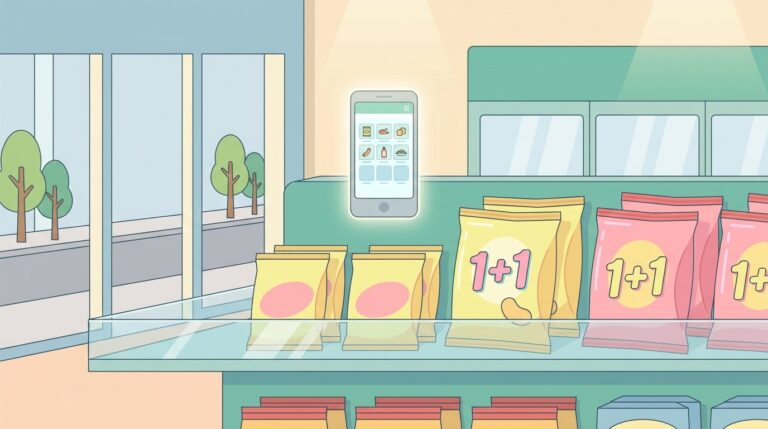
Master of the ‘Buy One, Get One’ Temptation: Deciphering the Psychology of 1+1 and Decoy Marketing in Korean Convenience Stores
Phase 1: Empathy (Dive Into the Scene)
안녕하세요! It’s your friendly neighborhood Daily Hangul editor back with another survival guide for navigating modern Korea like a seasoned local.
Picture this: You step into a brightly lit CU or GS25 near Hongdae just to grab a quick bottle of cold barley tea. As you reach for the shelf, you spot a bright yellow tag: 1+1 (일플러스일 – il-peul-leo-seu-il). Right next to it is a slightly larger size with a 2+1 tag. You hesitate. “Do I actually need two peach oolong teas? I only have one hands, but… it’s practically free?” Before you know it, you are carrying a small mountain of snacks, thinking you won’t fall for it next time.
This is not just a casual discount; it is a highly calculated psychological chess game. If you’ve reached C2 level, you already know how to order food. Now, it’s time to master the socio-economic nuances, the subtle marketing tricks, and the high-level psychological vocabulary Koreans use to describe being “willingly lured” into these convenience store traps. Let’s dive deep into the world of “미끼 상품” (decoy products) and the cultural art of “득템” (unearthing a treasure).
Phase 2: Core Expressions & Deep Linguistic Analysis
Let’s dissect three high-level phrases that will instantly elevate you from a “fluent foreigner” to someone who deeply understands the Korean consumer psyche.
1. 배보다 배꼽이 더 크다 (Bae-boda bae-kkob-i deo keu-da)
- Pronunciation: “Bae-boda bae-kkob-i deo keu-da” (Sounds like “Pae-boda pae-kkobi deo keuda” with a light, rhythmic bounce on bae-kkob).
- Meaning: “The belly button is bigger than the belly.” (The auxiliary costs outweigh the main purchase / The tail wags the dog).
- K-Culture Moment: Think of a K-Drama where a character buys a cheap coffee maker for 10,000 KRW, but ends up spending 100,000 KRW on premium imported coffee pods. Their friend would scoff and say this exact phrase.
- Editor’s Insight: In convenience stores, this happens when you buy a 1,000 KRW ramyun but end up buying 5,000 KRW worth of toppings (cheese, premium sausage, and a soft-boiled egg) because they were bundled under a “cross-promotion” scheme.
- Situation Spectrum: Casual (✅) | Semi-formal (✅) | Formal (⚠️ – Use with caution in academic contexts, though perfectly understood).
- 🤔 Think About It: How does your culture describe the irony of minor details overrunning the primary goal? Is there a physical body part analogy like “belly button” in your language?
2. 호갱 (Ho-gaeng)
- Pronunciation: “Ho-gaeng” (Sharply articulate the ho and slide into the nasal gaeng).
- Meaning: A combination of 호구 (hogu – “pushover/sucker”) and 고객 (gogaeng – “customer”). A gullible customer who gets ripped off easily.
- K-Culture Moment: Frequently featured in webtoons or comedy sketches when a naive character buys a gym membership or a smartphone plan without checking the fine print.
- Editor’s Insight: If you buy a “1+1” item only to realize the base price was marked up by 50% right before the promotion, you’ve just become a “호갱”. Calling oneself a “호갱” is a form of self-deprecating humor highly common among young Koreans.
- Situation Spectrum: Casual (✅) | Semi-formal (⚠️ – Okay with close colleagues) | Formal (🚫).
- 🤔 Think About It: Why does Korean culture use portmanteaus like “호갱” to create light-hearted solidarity over shared consumer regrets?
3. 미끼 상품 (Mikki Sang-pum)
- Pronunciation: “Mik-ki Sang-pum” (The double ‘k’ in mik-ki requires a brief, tense pause in the throat before releasing).
- Meaning: Decoy product / Loss leader. An item sold at a loss or ultra-low price specifically to lure customers into the store.
- K-Culture Moment: Business news segments analyzing the retail strategies of convenience store giants like Emart24 or CU often use this term to describe 500-won coffee or ultra-cheap lunchboxes.
- Editor’s Insight: These products are strategically placed at the back of the store. To get to your 500-won coffee (the bait), you must walk past aisles of tempting, high-margin pastries and imported beers.
- Situation Spectrum: Casual (✅) | Semi-formal (✅) | Formal (✅).
- 🤔 Think About It: How does the physical layout of stores in your country leverage similar consumer pathways to maximize impulse buying?
Phase 3: Textbook Korean vs. The Real Deal
Let’s look at how standard Korean instruction differs from the nuanced vocabulary used by true marketing-savvy locals.
Scenario 1: Discussing an impulse buy because of a deal
- 📖 Textbook Korean: “할인을 하길래 필요 없는 물건을 많이 샀어요.” (I bought many unnecessary items because they were offering a discount.)
- 🗣️ 진짜 한국어: “1+1 영업에 당해서 안 사도 될 것까지 충동구매해 버렸어요.” (I got totally played by their 1+1 sales pitch and impulse-bought things I didn’t even need.)
- 💡 Why the Difference? While textbooks focus on simple cause-and-effect grammar, native speakers use verbs like “당하다” (to be tricked/subjected to) to jokingly depict themselves as “victims” of clever marketing campaigns.
Scenario 2: Expressing regret over a deceptive promotion
- 📖 Textbook Korean: “이 상품은 광고와 달리 아주 저렴하지 않습니다.” (Unlike the advertisement, this product is not very cheap.)
- 🗣️ 진짜 한국어: “이거 완전 미끼 상품이었네. 교묘하게 패키징만 바꿔서 비싸게 파는 거 봐.” (This was a total bait product. Look at how they craftily changed the packaging just to sell it at a premium.)
- 💡 Why the Difference? C2-level speakers use analytical business terms like “미끼 상품” combined with adverbs like “교묘하게” (craftily/subtly) to dissect the vendor’s intent rather than just stating the price.
Phase 4: K-Culture Deep Dive & Non-Verbal Nuances
4-1. The Art of the “Nunchi” Swipe (눈치)
When checking out a 1+1 item, if you don’t want the second free item right away, you don’t have to carry it!
* The Gesture: Instead of awkwardly declining the freebie, simply look at the cashier, raise your smartphone, and ask politely if you can “keep” it on an app. This is called “키핑” (keeping) or using the “나만의 냉장고” (My Own Refrigerator) app (for GS25) or “포켓CU” (for CU).
* Body Language: Maintain a friendly, relaxed posture, nod slightly, and tap your phone screen twice. This shows you are a savvy consumer who knows the digital infrastructure of Korean convenience stores inside out.
4-2. The “Convenience Store Gurus” (편덕후)
In Korea, there is a dedicated subculture known as 편덕후 (pyeon-deok-hu – convenience store otaku/maniacs). These consumers write extensive reviews on the psychological manipulation of store layouts. They analyze “golden zones” (eye-level shelves) and calculate the cost-per-gram of 1+1 versus 2+1 offers. If you want to integrate into Korean digital spaces (like Instiz, DC Inside, or Naver Blogs), commenting on these hacks is the ultimate cultural handshake.
Phase 5: Real-Life Roleplay Scenario
Characters & Setting
- 민우 (Min-woo): Your Korean friend, a self-proclaimed “shrewd consumer” who actually falls for every discount.
- 지현 (Ji-hyun): You, an analytical C2-level observer who points out the marketing traps.
- Setting: Inside a bustling GS25 in Gangnam at 11:30 PM.
민우: (양손에 수입 맥주와 감자칩을 가득 들고) 지현아! 이거 봐. 수입 맥주 4캔에 만 이천 원인데, 이 과자는 2+1이래! 대박이지?

지현: 🎭 (눈살을 살짝 찌푸리며 미소를 짓는다) 민우야, 진정해. 너 저번에 샀던 맥주도 아직 냉장고에 그대로 있잖아.

민우: 아, 그건 그거고! 이건 한정판이잖아. 지금 안 사면 완전 손해 보는 느낌이라니까?

지현: 🎭 (고개를 저으며 가볍게 한숨을 쉰다) 그게 바로 대기업의 '포모(FOMO)' 마케팅이라는 거야. 너 완전히 호갱 당하고 있는 거라고.

민우: 호갱이라니! 난 스마트한 소비를 하는 거야. 하나 더 주는데 왜 안 사?

지현: 🎭 (매대 가격표를 손가락으로 가리키며) 잘 봐. 2+1이라고 적혀 있지만, 개당 단가를 따져보면 원래 가격보다 올려치기 한 거야. 결국 배보다 배꼽이 더 크다고.

민우: 헉... 진짜네? 개당 단가가 지난주보다 올라갔어!

지현: 🎭 (개기 어린 표정으로 어깨를 으쓱하며) 맞지? 그 과자는 그냥 너를 이 구석진 매대까지 끌어들이기 위한 미끼 상품에 불과했던 거야.
🔀 Choose Your Next Move!
What should 지현 (Ji-hyun) say next to seal the victory?
- [Option A] “그냥 우리 물만 사서 나가자. 충동구매는 정신 건강에 해로워.” (Let’s just buy water and leave. Impulse buying is bad for mental health.)
- Feedback (Bad/Too Academic): Correct, but a bit dry for a close friend. Misses the opportunity to use trendy, playful colloquialisms.
- [Option B] “어차피 산 거, 키핑 앱에 넣어두고 다음 주에 하나씩 꺼내 먹자. 그게 남는 장사야.” (Since you bought it anyway, keep it in the app and take it out one by one next week. That’s the real profit.)
- Feedback (Best/Culturally Sharp): Extremely natural, uses realistic convenience store tech hacks (“키핑 앱”), and shows excellent cultural adaptability.
- [Option C] “돈도 없으면서 맨날 이런 거 사더라. 그러니까 맨날 월급 고개지.” (You don’t even have money but you always buy stuff like this. No wonder you struggle at the end of every month.)
- Feedback (Risk/Too Harsh): While “월급 고개” (the lean period before payday) is a great idiom, this might sound overly critical or offensive depending on your friendship level.
Phase 6: 10-Second Emotional Shadowing Drill
To sound truly natural, you must master the cadence of cynical self-awareness. Try speaking these sentences aloud, paying attention to the emotional markers and natural pauses (/).
[😒 Slightly cynical and analytical]
“겉보기에는 / 1+1 행사 같지만, / 사실은 / 마진율을 높이려는 / 대기업의 미끼 상품일 뿐이야.”
(Geot-bo-gi-e-neun / il-peul-leo-seu-il haeng-sa gat-ji-man, / sa-sil-eun / ma-jin-yul-eul nop-i-ryeo-neun / dae-gi-eob-ui mik-ki sang-pum-il ppun-i-ya.)-
[🙄 Playfully self-deprecating]
“아… / 나 또 편의점 마케팅에 / 호갱 당했네. / 진짜 배보다 배꼽이 더 크다니까?”
(Ah… / na tto pyeon-ui-jeom ma-ke-ting-e / ho-gaeng dang-haet-ne. / Jin-jja bae-boda bae-kkob-i deo keu-da-ni-kka?)
Phase 7: K-Culture Mini Dictionary
- 인간 사료 (In-gan Sa-ryo) | “Human Kibble”
- Large-capacity, incredibly cheap snacks (like bulk-packaged chocolate chip cookies or puff snacks) often sold in discount convenience aisles. Used jokingly to describe food bought solely for survival during study sessions.
- 창렬하다 (Chang-ryeol-hada) | “Overpriced and disappointing”
- Originating from a notoriously disappointing convenience store product line, this slang is used when a product looks big or fancy on the outside but has almost nothing inside.
- 혜자스럽다 (Hye-ja-seureop-da) | “Extremely generous / Great value for money”
- The exact opposite of “창렬하다.” Used when a convenience store lunchbox (도시락) is packed with high-quality side dishes at a very low price.
- 골든 존 (Golden Zone) | “Golden Zone”
- The shelves located at a height of 110cm to 140cm from the floor, where products with the highest profit margins (and often deceptive 1+1 labels) are placed to catch your eye instantly.
Phase 8: The Ultimate Survival Kit for Travelers
Survival Phrases TOP 3
- “이거 1+1 행사 상품 맞나요?” (Is this item eligible for the 1+1 promotion?)
- Pro Tip: Use this when a tag is misplaced, which happens often during busy store hours.
- “나머지 하나는 앱에 키핑할게요.” (I’ll keep the other one in the app.)
- Pro Tip: Essential if you want the discount but don’t want to carry double the weight.
- “따로 결제해 주실 수 있나요?” (Can you charge these separately?)
- Pro Tip: Perfect when you are splitting a “2+1” bundle with a friend.
Editor’s Travel Note 🗺️
Before you embark on your convenience store sweep, download the official apps: Pocket CU on Google Play Store or Pocket CU on Apple App Store and Woori Neighborhood GS. These apps allow you to scan your membership barcode to claim and save your “+1” items digitally!
(Note: App features and promotion rules may change depending on regional store policies and carrier updates.)
Phase 9:
Frequently Asked Questions (FAQ)
Q: What does "배보다 배꼽이 더 크다 (Bae-boda bae-kkob-i deo keu-da)" mean in Korean and how do you pronounce it?
A: In Korean, "배보다 배꼽이 더 크다 (Bae-boda bae-kkob-i deo keu-da)" is pronounced ["Bae-boda bae-kkob-i deo keu-da" (Sounds like "Pae-boda pae-kkobi deo keuda" with a light, rhythmic bounce on bae-kkob] and means: "The belly button is bigger than the belly." (The auxiliary costs outweigh the main purchase / The tail wags the dog).
Q: What does "호갱 (Ho-gaeng)" mean in Korean and how do you pronounce it?
A: In Korean, "호갱 (Ho-gaeng)" is pronounced ["Ho-gaeng" (Sharply articulate the ho and slide into the nasal gaeng] and means: A combination of 호구 (hogu - "pushover/sucker") and 고객 (gogaeng - "customer"). A gullible customer who gets ripped off easily.
Q: What does "미끼 상품 (Mikki Sang-pum)" mean in Korean and how do you pronounce it?
A: In Korean, "미끼 상품 (Mikki Sang-pum)" is pronounced ["Mik-ki Sang-pum" (The double 'k' in mik-ki requires a brief, tense pause in the throat before releasing] and means: Decoy product / Loss leader. An item sold at a loss or ultra-low price specifically to lure customers into the store.







