

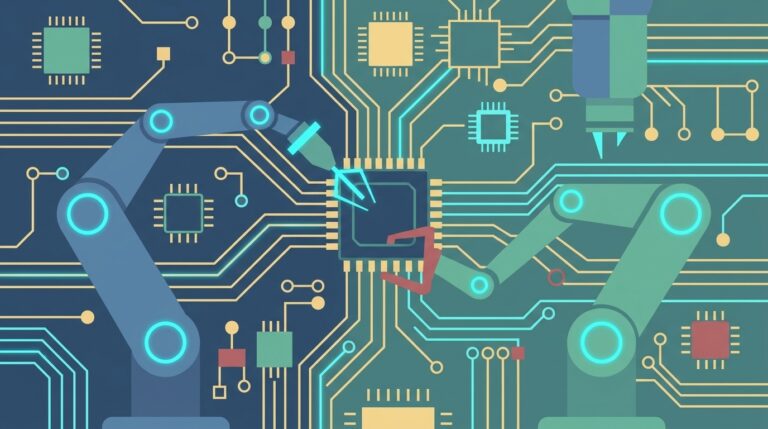
Master Smart Factory and IoT Korean Like a Seoul Tech Insider (C1 Level)
Phase 1: Empathy (Welcome, Tech Enthusiasts!)
안녕하세요! Welcome back to another premium edition of Daily Hangul, your ultimate cultural navigator.
Imagine this: You are standing inside a state-of-the-art smart factory in Gyeonggi-do, Korea’s Silicon Valley. Sleek robotic arms glide seamlessly, automated guided vehicles (AGVs) hum across the floor, and massive digital dashboards flash real-time IoT sensor data. Suddenly, the project director turns to you and asks how to handle a potential bottleneck. Do you freeze, or do you confidently propose an automated solution using native-level business Korean?
For advanced (C1) learners, transitioning from casual daily conversations to high-tech professional jargon is often a daunting hurdle. You know the basics, but expressing complex logical processes like “preventative maintenance” or “real-time system integration” requires a different caliber of vocabulary. Today, we’ll dive deep into the world of Korean IoT and Smart Factory Automation so you can sound like an experienced tech lead at Samsung or Hyundai.
Phase 2: Key Expressions Analysis
1. 공정 자동화를 구축하다 (gong-jeong ja-dong-hwa-reul gu-chuk-ha-da)
- Pronunciation: gong-jeong ja-dong-hwa-reul goo-chook-ha-da (Sounds like “gong-jung jah-dong-wah-reul goo-chook-hah-dah”)
- Meaning: To establish/implement process automation.
- K-Culture Moment: You will hear this phrase in futuristic corporate K-Dramas like Start-Up or Search: WWW, where tech visionaries pitch efficiency overhauls to investors.
- Editor’s Insight: While ‘만들다’ (to make) is too casual, ‘구축하다’ (to build/construct/establish) is the gold standard in Korean corporate and IT settings. Use it to sound incredibly professional during presentations.
- Situation Spectrum: Casual: 🚫 | Semi-formal: ⚠️ | Formal: ✅
- 🤔 Think About It: How does using structured Sino-Korean verbs like ‘구축(構築)하다’ shift the listener’s perception of your expertise compared to native Korean verbs?
2. 실시간 모니터링을 거치다 (sil-si-gan mo-ni-teo-ring-eul geo-chi-da)
- Pronunciation: sil-si-gan moh-nee-tuh-ring-eul guh-chee-dah
- Meaning: To undergo real-time monitoring.
- K-Culture Moment: Seen on big screens in control rooms during industrial disaster movies or high-stakes corporate thrillers.
- Editor’s Insight: ‘거치다’ means to pass through or undergo a process. Combining it with ‘실시간 모니터링’ implies that a product or system is systematically verified at every step, reflecting the Korean business emphasis on flawless execution.
- Situation Spectrum: Casual: ⚠️ | Semi-formal: ✅ | Formal: ✅
- 🤔 Think About It: In your culture, is constant monitoring viewed as micromanagement or a guarantee of quality?
3. 오작동을 미연에 방지하다 (o-jak-dong-eul mi-yeon-e bang-ji-ha-da)
- Pronunciation: oh-jak-dong-eul mee-yun-eh bang-jee-hah-dah
- Meaning: To prevent malfunctions in advance.
- K-Culture Moment: A phrase frequently printed in bold on factory safety banners and safety manuals throughout Korean industrial complexes.
- Editor’s Insight: ‘미연에’ (未然에) is a beautiful literary adverb meaning “beforehand” or “pre-emptively.” Using this instead of just ‘미리’ (in advance) instantly elevates your Korean to an executive, polished C1 level.
- Situation Spectrum: Casual: 🚫 | Semi-formal: ⚠️ | Formal: ✅
- 🤔 Think About It: Why does Korean business discourse place such high linguistic weight on pre-emptive prevention (‘미연에 방지’)?
Phase 3: Textbook Korean vs. Real Korean
Situation 1: Reporting a system crash
- 📖 Textbook Korean: “시스템에 오류가 발생했습니다.” (A system error has occurred.)
- 🗣️ 진짜 Korean: “시스템에 에러가 터졌어요.” (An error blew up in the system.)
- 💡 Why the difference?: In real-world IT environments, engineers use the active verb ‘터지다’ (to explode/pop) to describe sudden server crashes or bugs, conveying urgency.
Situation 2: Starting up the automated production line
- 📖 Textbook Korean: “자동화 설비 작동을 개시하겠습니다.” (I will initiate the operation of the automated equipment.)
- 🗣️ 진짜 Korean: “자동화 라인 돌릴게요.” (I’m going to run the automation line.)
- 💡 Why the difference?: Real factory floors prefer active, dynamic verbs. ‘돌리다’ (to spin/run) is the standard slang/colloquialism for operating machinery or software pipelines.
Phase 4: K-Culture Deep-Dive & Non-Verbal Manners
4-1. The Korean Smart Factory Gesture: “No-Look” Dashboard Pointing
In Korean corporate-industrial culture, confidence is key. When presenting real-time IoT metrics to directors, avoid turning your back completely to the audience. Practice the ‘측면 자세’ (side-stance)—pointing to the screen with your palm open (never point with a single finger, as it’s considered impolite) while maintaining brief eye contact with the decision-makers to project authority and ‘눈치’ (nunchi/situational quick-wittedness).
4-2. The “Ppalli-Ppalli” (빨리빨리) Meets Industry 4.0
Korea’s legendary speed culture has evolved. Today, it’s not just about physical speed; it’s about algorithmic speed. Real-time sensor integration is highly valued because it feeds the Korean desire for immediate results and instant troubleshooting.
Phase 5: Real-Life Roleplay Scenario
Characters:
- 지민 (Jimin): Smart Factory Tech Lead (Senior)
- 마크 (Mark): C1-level Foreign IoT Consultant (You)
- 지민: [심각한 표정으로 대시보드를 보며] 마크 씨, 지금 3번 조립 라인 센서 데이터가 좀 이상하지 않아요?
- 마크: [태블릿을 확인하며] 네, 저도 보고 있었습니다. 진동 수치가 기준치를 초과해서 오작동을 미연에 방지해야 할 것 같습니다.
- 지민: [이마를 짚으며] 아, 오늘 납품 물량이 많아서 라인이 멈추면 곤란한데… 예방 정비를 바로 들어갈 수 있을까요?
- 마크: [서두르지 않고 차분하게] 실시간 모니터링을 거친 데이터를 보면, 전체 라인을 세우지 않고도 3번 라인만 우회시킬 수 있습니다.
- 지민: [안도의 한숨을 쉬며] 다행이네요. 그럼 즉시 공정 자동화 경로를 재구축할 수 있겠어요?
- 마크: [자신감 있게 고개를 끄덕이며] 네, 지금 제어부 시스템 소프트웨어를 수정해서 무중단으로 자동화 라인을 돌릴게요.
- 지민: [마크의 어깨를 두드리며] 역시 마크 씨네요! 신속하게 대응해 준 덕분에 큰 고비를 넘겼어요.
- 마크: [미소를 지으며] 아닙니다. 모니터링 시스템이 잘 구축되어 있어 조기에 감지할 수 있었습니다.
🔀 Interactive Choice Points
How should Mark respond when Jimin asks for a quick system modification?
- Option A: “시간이 없으니 대충 수동으로 세팅하겠습니다.” (Let’s set it manually and roughly since there’s no time.)
- Feedback (Bad): High-tech Korean systems rely on automated protocols. Suggesting a rough manual fix (‘대충 수동으로’) ruins your professional credibility.
- Option B: “제가 지금 바로 자동화 라인을 우회하도록 패치코드를 배포하겠습니다.” (I will deploy the patch code to bypass the automation line immediately.)
- Feedback (Best!): Highly technical, precise, and proactive. Demonstrates C1 business fluency.
- Option C: “안전제일이니까 일단 공장 가동을 전면 중단합시다.” (Safety first, let’s shut down the entire factory operation for now.)
- Feedback (Risk): Overly dramatic and costly. You might get scolded for ruining the day’s KPI unnecessarily.
Phase 6: 10-Second Shadowing Drill
Practice breathing, pacing, and emotional nuance. Focus on the pauses (/).
- Sentence: [😊 차분하고 전문적인 어조로] “실시간 모니터링을 거친 데이터를 활용하면 / 오작동을 / 미연에 방지할 수 있습니다.”
- Pronunciation Guide: Sil-si-gan mo-ni-teo-ring-eul geo-chin dae-i-teo-reul hwal-yong-ha-myeon / o-jak-dong-eul / mi-yeon-e bang-ji-hal su it-seum-ni-da.
- Meaning: If we utilize data that has undergone real-time monitoring, we can prevent malfunctions in advance.
Phase 7: K-Culture Mini Dictionary
- 스마트팩토리 (seumateu-paektori) | Smart Factory: Fully integrated, digitized manufacturing facilities using AI and IoT.
- 예방 정비 (yebang jeongbi) | Preventive Maintenance: Pre-planned servicing of equipment to avoid unexpected failures.
- 센서 데이터 (senseo deiter) | Sensor Data: Real-time feedback from IoT sensors measuring temperature, vibration, etc.
- 자동화 라인 (jadonghwa rain) | Automation Line: Automated conveyor belts and assembly systems on a modern factory floor.
Phase 8: Survival Kit for Travelers & Expats
Top 3 Smart Tech Office Phrases:
- “서버가 터졌어요.” (seobeoga teojyeosseoyo): The server crashed.
- “자동 업데이트 돌려놓으세요.” (jadong eopdeiteu dollyeonohuseyo): Please run the automatic update.
- “데이터 동기화 완료되었습니다.” (deiteo donggihwa wanryeodoeeotseumnida): Data synchronization is complete.
💡 Editor’s Travel Note: When working with or visiting Korean corporate offices, ensure your collaboration apps like KakaoWork or Line Works are synced. To navigate around modern industrial complexes like Pangyo Techno Valley seamlessly, download Naver Map for pinpoint real-time walking and transit layouts inside multi-layered modern corporate parks.
Phase 9: Deep Thoughts (Thinking Beyond Words)
In Korean corporate philosophy, the term ‘정교함’ (Jeong-gyo-ham – exquisite precision) coexists with ‘신속함’ (Sinsok-ham – rapid speed). The smart factory is the ultimate realization of this synthesis. While traditional factories prioritized raw manual labor, modern Korean work culture values tech-savvy employees who can oversee automation strategically. Understanding this shift allows you to speak to Korean managers not as mere task-doers, but as valuable strategic thinkers.
💬 Your Turn: Have you ever experienced smart technology or automation in your professional field? Let us know in the comments below!
Phase 10: FAQ & Common Mistakes
Q: Can I use ‘에러가 폭발했다’ instead of ‘에러가 터졌다’?
A: No. While ‘폭발하다’ also means to explode, it is used for literal physical explosions (like a bomb). In IT slang, ‘터지다’ is exclusively used to mean a software crash, bug occurrence, or server overload.
Q: What is the difference between ‘예방’ and ‘방지’?
A: ‘예방’ (prevention/precaution) is usually used for health (예방접종 – vaccination) or general maintenance (예방 정비). ‘방지’ (prevention/obstruction) is used to stop a specific negative event or action from occurring (오작동 방지 – prevention of malfunction, 사고 방지 – prevention of accidents).
🚨 Common Mistakes Alert:
- Mistake: “기계를 무조건 멈추세요!” (Stop the machine no matter what!)
- Why it’s wrong: It sounds panic-stricken and lacks professional nuance.
- Correct Action: Say, “비상 정지 프로토콜을 가동하십시오.” (Initiate the emergency stop protocol.)
Phase 11: Action Missions
- 🥉 Bronze Mission: Pronounce “오작동을 미연에 방지하다” aloud 3 times with your eyes closed.
- 🥈 Silver Mission: Write a mock email to an imaginary Korean supervisor explaining why real-time monitoring (실시간 모니터링) is necessary for your current project.
- 🥇 Gold Mission: Next time you face a technical glitch, explain the situation out loud in Korean using “서버가 터졌어요” or “에러가 터졌어요.”
Phase 12: Interactive Quiz Challenge
1. Which word means “to build or construct” in a formal business/IT context?
a) 만들다
b) 구축하다
c) 짓다
2. Fill in the blank: “오작동을
View Answers & Explanations
- Correct Answer: b) 구축하다
- Explanation: ‘만들다’ is too generic, and ‘짓다’ is used for physical buildings or naming. ‘구축하다’ is correct for networks, systems, and automation.
- Correct Answer: 미연에
- Explanation: ‘미연에 방지하다’ is the advanced C1 collocation meaning “to prevent in advance/before it happens.”







