

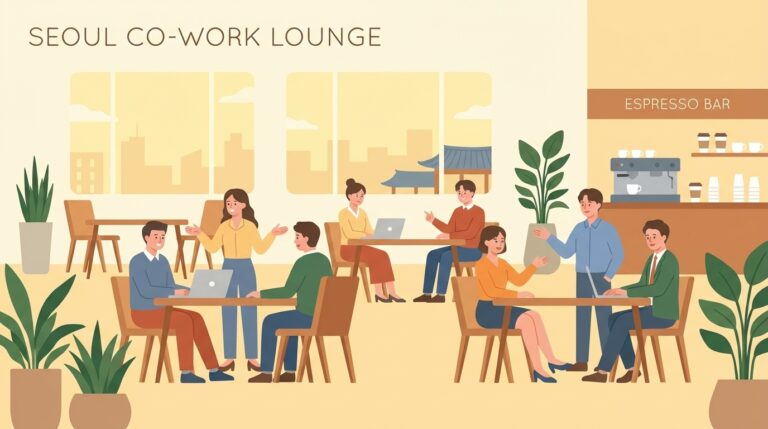
Redefining the Workspace: How Shared Offices (공유 오피스) Are Reshaping Seoul’s Office Culture
안녕하세요! It’s your friendly local guide and senior editor from Daily Hangul (매일한글). Have you ever stepped into a coworking space in Gangnam or Yeouido and felt a sudden shift in how professionals interact?
As someone who has navigated the corporate corridors of Seoul for a decade, I’ve watched our traditional, rigid office setups—with those tall, grey cubicle walls and the intimidating head-desk layout—melt away. Today, Seoul’s ambitious professionals are flocking to premium gong-yu opiseu (공유 오피스) to escape hierarchical spatial politics and embrace a dynamic, fluid work style.
At a C2 mastery level, you aren’t just looking to order coffee; you need to navigate delicate socio-spatial dynamics, articulate opinions on modern architectural shifts, and seamlessly blend into high-level networking sessions. Let’s dive deep into the spatial revolution and the sophisticated Korean expressions that define it.
Phase 2: Key Expressions Deep Dive (핵심 표현 3선 심층 분석)
1. 공간을 타협하다 (gong-gan-eul ta-hyeob-ha-da)
- Pronunciation: gong-gan-eul tah-hyup-hah-dah (Think of “gong-gan” as “gong-gone” and “ta-hyeob” as “tah-yup”)
- Meaning: To compromise/negotiate space (balancing private focus zones and open, collaborative areas).
- K-Culture Moment: In office-centered K-Dramas like Start-Up (스타트업) or Search: WWW (검색어를 입력하세요 WWW), you often see young founders arguing over whether to allocate premium square footage to a communal lounge or private call booths.
- Editor’s Insight: Beyond physical walls, this expression reflects a mental shift. Historically, Korean work culture prized visible presence at one’s desk (cha-sar-i). To “compromise space” means acknowledging that productivity isn’t bound to a fixed seat, but is rather a fluid negotiation between autonomy and collaboration.
- Situation Spectrum: Casual (⚠️) / Semi-formal (✅) / Formal (✅)
- 🤔 Think About It: How does your native culture negotiate physical workspace? Do you value high-walled cubicles (visual privacy) or open tables (collaborative speed)?
2. 네트워킹을 도모하다 (ne-teu-wo-king-eul do-mo-ha-da)
- Pronunciation: neh-teu-wo-king-eul doh-moh-hah-dah (The verb “do-mo-hada” sounds like “doh-moh-ha-da”)
- Meaning: To foster, promote, or actively seek networking opportunities.
- K-Culture Moment: Seen in documentaries focusing on the tech boom in Pangyo Techno Valley, where companies host casual craft beer nights in shared pantries to spark accidental collaborations.
- Editor’s Insight: While the English word “networking” is borrowed directly, coupling it with the sophisticated verb 도모하다 (to plan, promote, or foster something positive) elevates your register instantly. It signals that you aren’t just socializing casually, but strategically constructing a professional ecosystem.
- Situation Spectrum: Casual (🚫) / Semi-formal (✅) / Formal (✅)
- 🤔 Think About It: Is “networking” in your country viewed as a transactional necessity or a natural community-building exercise? How does the spatial design of your office facilitate this?
3. 유연근무제를 채택하다 (u-yeon-geun-mu-je-reul chae-taek-ha-da)
- Pronunciation: oo-yuhn-geun-moo-jeh-reul chae-taek-hah-dah
- Meaning: To adopt a flexible working system (e.g., flextime, remote work, hot-desking).
- K-Culture Moment: Often discussed in Korean economic talk shows (like SamproTV) when discussing how traditional conglomerates (Chaebols) are restructuring their corporate real estate to retain Gen Z talent.
- Editor’s Insight: This phrase represents the legal and structural counterpart to shared spaces. A shared office is physically useless unless a company actively chaet-aek-hada (adopts/implements) a flexible policy that allows employees to be there in the first place.
- Situation Spectrum: Casual (⚠️) / Semi-formal (✅) / Formal (✅)
- 🤔 Think About It: How does the linguistic framing of “flexible work” (유연/flexible vs. 통제/control) affect employee morale in your country?
Phase 3: Textbook Korean vs. Real-World Korean (교과서 한국어 vs. 진짜 한국어)
Situation 1: Describing a hot-desking or unassigned seating system.
- 📖 Textbook Korean: “우리 회사는 고정된 자리가 없고 자유롭게 앉습니다.” (Our company doesn’t have fixed seats; we sit freely.)
- 🗣️ Real-World Korean: “저희 회사는 이번에 자율좌석제(핫데스크)를 도입해서 매일 원하는 자리로 출근해요.” (Our company recently introduced an autonomous seating system [hot-desking], so we choose where we work every day.)
- 💡 Why the Difference? While the textbook description is grammatically correct, it sounds overly simplistic. Professionals use the precise corporate term 자율좌석제 (autonomous seating system) to describe hot-desking in professional settings.
Situation 2: Suggesting moving a meeting to a casual office lounge.
- 📖 Textbook Korean: “회의실이 없으니 휴게실에서 이야기합시다.” (Since there are no meeting rooms, let’s talk in the breakroom.)
- 🗣️ Real-World Korean: “회의실 잡기 애매한데, 라운지 공간에서 가볍게 티타임 겸 얘기 나눌까요?” (Booking a meeting room is a bit awkward right now, shall we have a quick chat over tea in the lounge space instead?)
- 💡 Why the Difference? “휴게실” evokes a clinical, old-school breakroom. Modern coworking tenants prefer “라운지 공간” (lounge space) and frame casual meetings as “티타임” (tea time) to reduce psychological pressure and foster smoother creative discussions.
Phase 4: K-Culture Deep Dive & Non-verbal Etiquette (비언어적 매너)
4-1. The Silent Code of Coworking (눈치 & Spatial Manners)
- The Hot-desking Boundary: In Korean shared offices, even without physical walls, visual boundaries are strictly respected. Placing your laptop or notebook on a table temporarily stakes your claim. However, leaving your belongings to “reserve” a prime window seat for more than an hour while you go out for lunch is considered a major lack of 눈치 (Nunchi).
- Headphone Etiquette: Wearing noise-canceling headphones is the ultimate universal “Do Not Disturb” sign. In Korean shared offices, if you must approach someone wearing headphones, do not tap their shoulder directly. Stand slightly in their line of sight, bow your head slightly, and wait for them to remove their headphones before speaking.
4-2. The Aesthetic of “Saba-Saba” & The Lounge Culture
In K-Dramas, you’ll notice that key business deals or office romances often spark not in formal boardrooms, but around the communal espresso machine. This spatial transition has diluted the traditional Korean hierarchy. Junior employees can naturally strike up conversations with C-level executives over a cup of oat milk latte in the shared pantry—a cultural phenomenon known as “horizontal communication” (수평적 소통).
Phase 5: Real-World Roleplay Scenario (실전 롤플레이 시나리오)
The Setting
The chic, sunlit communal lounge of “FastFive” (a popular local coworking chain) in Gangnam.
* Ji-min (지민): A forward-thinking Project Manager at a tech startup who loves spatial agility.
* Ken (켄): An expatriate Regional Director struggling to adapt to the lack of private executive offices.
지민: 🎭 (따뜻한 커피 두 잔을 들고 라운지 테이블로 다가오며) 켄 씨, 오늘 아침에 출근할 때 보니까 공유 오피스 라운지에서 계속 일하고 계시더라고요. 새로운 공간은 좀 어떠세요?
       (Ken, I noticed you were working in the shared office lounge all morning. How are you liking the new space?)

켄: 🎭 (안경을 고쳐 쓰며 한숨을 살짝 쉰다) 솔직히 말하면, 아직 적응 기간이 필요해요. 사방이 트여 있으니까 집중하기가 좀 어렵고, 개인 공간이 침해받는 기분이에요.
    (To be honest, I still need an adjustment period. Since everything is open, it's hard to focus and I feel like my personal space is being invaded.)

지민: 🎭 (공감한다는 듯 고개를 끄덕이며) 맞아요. 벽이 없어져서 처음엔 그렇게 느끼실 수 있어요. 하지만 공간을 어떻게 타협하느냐에 따라 업무 효율이 완전히 달라지거든요.
       (Right. You can definitely feel that way at first since the walls are gone. But depending on how you negotiate the space, your work efficiency can change completely.)

켄: 🎭 (의아한 표정으로) 공간을 타협한다고요? 구체적으로 어떤 의미인가요?
    (Negotiating the space? What do you mean by that specifically?)

지민: 🎭 (노트북 화면의 일정을 가리키며) 오전의 깊은 몰입이 필요한 업무는 '포커스 존' 부스에서 처리하고, 오후의 가벼운 소통이나 이메일 회신은 이곳 라운지에서 네트워킹을 도모하며 해결하는 거죠.
       (You handle tasks requiring deep focus in the 'Focus Zone' booths in the morning, and solve light communication or email replies here in the lounge while fostering networking in the afternoon.)

켄: 🎭 (눈이 번쩍 뜨이며) 아, 공간을 고정해서 쓰지 않고 업무 성격에 맞춰서 이동하며 쓰는 거군요!
    (Ah! So instead of using a fixed space, you move around depending on the nature of your work!)

지민: 🎭 (미소를 지으며) 바로 그거예요! 저희가 이번에 유연근무제를 채택한 것도 결국 이런 공간의 자율성을 극대화하기 위해서였으니까요. 켄 씨도 곧 이 자유로움에 중독되실 걸요?
       (Exactly! The reason we adopted a flexible working system this time was ultimately to maximize this spatial autonomy. You’ll be addicted to this freedom soon, Ken!)

켄: 켄: 🎭 (미소를 지으며 커피를 한 모금 마신다) 듣고 보니 설득력이 있네요. 내일부터는 저도 저 '포커스 존'을 적극적으로 공략해 봐야겠어요!
    (That sounds convincing now that I hear it. Starting tomorrow, I should actively target that 'Focus Zone'!)
🔀 Interactive Choice Points (인터랙티브 분기점)
How should Ken respond to Ji-min’s suggestion to start hot-desking tomorrow?
* Option A: “라운지가 너무 시끄러운데 그냥 재택근무 하면 안 될까요?” (The lounge is too noisy, can’t I just work from home?)
* Option B: “공유 오피스의 커뮤니티 매니저한테 협업 이벤트를 제안해서 우리 부서 네트워킹을 더 도모해봐야겠어요.” (I should propose a collaboration event to the coworking community manager to foster more networking for our department.)
* Option C: “네, 그냥 참아볼게요.” (Yeah, I’ll just bear with it.)
💡 Feedback on Your Choice:
- Option A (Risk): While honest, it bypasses the opportunity to utilize the spatial benefits discussed and might sound slightly passive-aggressive or avoidant in a professional setting.
- Option B (Best – C2 Level Mastery!): Superb! You are actively linking spatial characteristics (community management) with high-level corporate goals (“네트워킹을 도모하다”). This shows you understand both the linguistic nuance and the strategic value of modern offices.
- Option C (Bad): Too passive. “참다” (to endure) completely misses the proactive, self-negotiating spirit of gong-yu opiseu culture.
Phase 6: 10-Second Emotion Shadowing Drill (10초 감정 섀도잉 드릴)
Master the natural cadence, pauses (/), and emotional micro-intonations of native speakers.
- [😊 Expressing spatial freedom with high energy]
- “공간이 트이니까 / 아이디어도 더 잘 떠오르고 / 업무 효율도 엄청 올라가는 것 같아요!”
- Gong-gan-i teu-i-ni-kka / a-i-di-eo-do deo jal tteo-o-reu-go / eob-mu hyo-yul-do eom-cheong ol-la-ga-neun geot gat-a-yo!
- (Since the space opened up, / ideas flow better / and work efficiency seems to skyrocket!)
- [🤔 Expressing polite reservation about hot-desking]
- “자율좌석제는 좋은데 / 가끔은 제 전용 책상이 / 좀 그리울 때가 있어요.”
- Ja-yul-jwa-seok-je-neun jo-eun-de / ga-kkeum-eun je jeon-yong chaek-sang-i / jom geu-ri-ul ttae-ga is-seo-yo.
- (The flexible seating is nice, / but sometimes / I do miss my own dedicated desk a bit.)
Phase 7: K-Culture Mini-Dictionary (K-Culture 미니 사전)
- 공유 오피스 (Gong-yu Opiseu) | Coworking Space: Shared offices equipped with communal lounges, meeting rooms, and amenities, heavily populated by startups and satellite offices in Korea.
- 거점 오피스 (Geo-jeom Opiseu) | Satellite/Hub Office: Decentralized offices set up by major corporations in residential or accessible hubs (like Mapo or Bundang) to reduce commuting stress for employees.
- 커뮤니티 매니저 (Keo-myu-ni-ti Mae-ni-jeo) | Community Manager: The glue of shared offices. They manage amenities, coordinate networking events, and connect tenants for potential business partnerships.
- 워케이션 (Wo-key-i-shyeon) | Workation: A blend of work and vacation, increasingly popular among Korean IT firms providing shared workspace access in scenic destinations like Jeju Island or Busan.
Phase 8: Nomad Traveler’s Survival Kit (여행자를 위한 생존 키트)
Survival Phrases TOP 3:
- “여기 일일 패스 끊을 수 있나요?”
- Yeo-gi il-il pae-seu kkeun-eul su in-na-yo?
- Pro Tip: Use this to ask for a day-pass at popular coworking spots like FastFive, Sparkplus, or WeWork Seoul.
- “콘센트 있는 자리 어디예요?”
- Kon-sen-teu in-neun ja-ri eo-di-ye-yo?
- Pro Tip: In Korea, “outlet” is called “콘센트” (derived from ‘concentric plug’). Useful when seeking charging ports.
- “라운지 무료 음료나 간식은 어디서 이용해요?”
- Ra-un-ji mu-ryo eum-ryo-na gan-sik-eun eo-di-seo i-yong-hae-yo?
- Pro Tip: Most premium Korean shared offices offer free craft beer, espresso, or cereal. Don’t miss out on these perks!
📍 Editor’s Travel Note
Looking for a place to work in Seoul without a commitment? You can easily search for near-by independent work cafes and book daily passes using local apps. To navigate your way around like a native, search for these spaces on the Naver Map App rather than Google Maps, which lacks transit precision in Korea.
Phase 9: “Going Deeper” (한 발 더 깊이)
The rise of shared offices in Seoul is more than just a real estate trend; it represents a spatial democratization of the Korean workplace. Historically, corporate Korea utilized space to reinforce hierarchy—senior executives sat at the back of the room with a full view of subordinates’ screens, physically asserting authority. The transition to shared lounges, hot-desking, and collaborative booths breaks down these invisible lines of power. It shifts the corporate focus from “time spent visible under the manager’s eye” to “output and collaborative synergy.”
💬 Your Turn: Has your workspace undergone a physical transformation recently? How do you think office architecture affects your daily stress and productivity? Share your thoughts in the comments below!
Phase 10: FAQ & Common Mistakes (FAQ & 오해 방지)
Q: Can foreigners sign up for shared offices in Korea easily?
A: Yes! Major local brands like FastFive and Sparkplus, as well as global brands like WeWork, have multilingual English services. You can easily book a tour online or purchase day passes.
Q: Is it rude to take a phone call in the open lounge area of a Korean coworking space?
A: Generally, brief, low-volume calls are acceptable in the lounge. However, for confidential business discussions or extended video calls, you should absolutely use the designated soundproof phone booths (폰부스) to maintain professional courtesy.
Q: Do shared offices in Korea offer networking events open to non-residents?
A: Occasionally! Many host open tech-talks, startup pitch days, or cultural workshops that are open to the public, often advertised on local platform apps like Frip or Festa.
🚨 Common Mistakes Alert!
- Mistake 1: Direct translation of “I will reserve this seat” as “이 자리를 예약할게요” (I-ja-ri-reul ye-yak-hal-ge-yo) for hot-desks.
- Correct Action: “예약하다” is for formal bookings (like flights or restaurants). For daily hot-desking, say: “여기 사용 중이에요” (This seat is currently in use).
- Mistake 2: Walking around barefoot or in excessively casual slippers inside premium shared lounges.
- Correct Action: While comfortable, keeping business-casual footwear intact is highly appreciated in communal professional spaces.
Phase 11: Action Mission (액션 미션)
- 🥉 Bronze: Practice saying “자율좌석제” (ja-yul-jwa-seok-je) out loud three times. Focus on the sharp transition from jwa to seok.
- 🥈 Silver: Write a comment below describing your dream workspace using the expression 공간을 타협하다.
- 🥇 Gold: Next time you visit a coworking space or a work-friendly cafe, ask the manager or host: “회의실 대여 가능한가요?” (Is meeting room rental available?) to test your spoken corporate Korean.
Phase 12: Interactive Quiz Challenge (인터랙티브 퀴즈 챌린지)
1. Which term describes the flexible working system of changing desks daily without a fixed assignment?
- A) 유연근무제
- B) 자율좌석제
- C) 거점 오피스






