

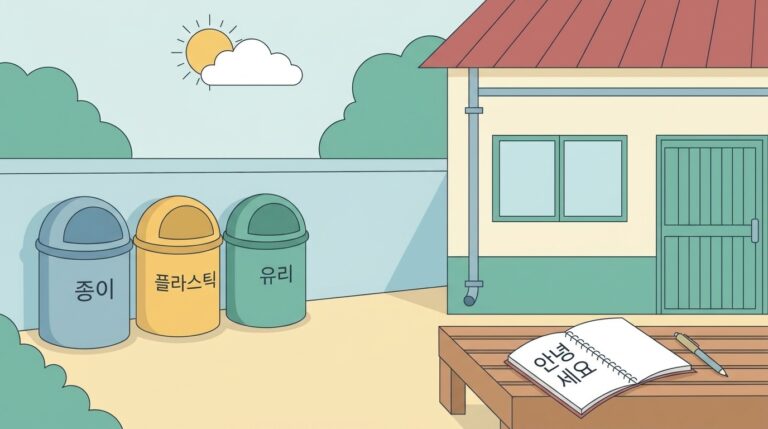
Housework Series: Demystifying Korean Trash Disposal (쓰레기 버리기)
Phase 1: Empathy (An Open Door to Korean Daily Life)
안녕하세요! (Annyeonghaseyo!) Hello there, lovely language learners! It’s your friendly neighborhood Daily Hangul editor, and today we’re tackling a topic that strikes fear into the hearts of even the most seasoned expats in South Korea: garbage disposal (쓰레기 버리기 – sseuregi beorigi).
Picture this: You’ve just moved into a charming studio apartment in Seoul. You’ve unpacked your bags, ordered a delicious bowl of Jajangmyeon, and now you’re left with empty plastic containers, food scraps, and a cardboard box. You confidently head out to the trash area, only to find a complex maze of colorful bags, net baskets, and strict neighborhood signs in Korean. A kind neighbor gently shakes their head and says, “여기다 버리면 안 돼요!” (You can’t throw it here!).
Don’t worry! We have all been there. Sorting trash in Korea is an art form, but once you master just a few basic survival phrases and habits, you’ll feel like a true local. Our readers have told us that learning these simple phrases saved them from embarrassing neighborly encounters and even hefty fines! Let’s turn this daily chore into your first major cultural win.
Phase 2: Key Expressions (Deep Dive)
Let’s look at the three most essential phrases you need when dealing with trash in Korea. Since this is our A1 (Beginner) level, we will keep them short and super practical!
1. 쓰레기 봉투 어디에 있어요? (Sseuregi bongtu eodie isseoyo?)
- Pronunciation: Ssuh-reh-gee bong-too uh-dee-eh eet-suh-yo? (Think of “ssu” as the sharp ‘s’ sound in ‘super’, and “bongtu” like ‘bong-too’)
- Meaning: Where are the trash bags?
- K-Culture Moment: You will say this at your local convenience store (편의점 – pyeonuijeom) or supermarket. In Korea, you cannot use regular plastic bags for general waste; you must buy official, government-approved district bags (종량제 봉투 – jongryangje bongtu).
- Editor’s Insight: Each district (Gu – 구) has its own specific bags. A bag bought in Mapo-gu cannot be used in Gangnam-gu! Always ask for the bag of the district you currently live in.
- Situation Spectrum:
- Casual: 쓰레기 봉투 어디 있어? (Sseuregi bongtu eodi isseo?) ⚠️
- Semi-formal: 쓰레기 봉투 어디에 있어요? (Sseuregi bongtu eodie isseoyo?) ✅ (Best for stores!)
- Formal: 쓰레기 봉투는 어디에 있습니까? (Sseuregi bongtuneun eodie isseumnikka?) 🚫 (Too stiff!)
- 🤔 Think About It: In many countries, waste management is funded through flat taxes. In Korea, you pay for what you discard by purchasing official bags. How does this system change how people view the waste they produce?
2. 이거 일반 쓰레기예요? (Igeo ilban sseuregiyeyo?)
- Pronunciation: Ee-guh eel-bahn ssuh-reh-gee-yeh-yo?
- Meaning: Is this general waste?
- K-Culture Moment: In K-Dramas, you often see characters meticulously sorting plastic, paper, and food waste. If you are unsure whether an item goes into the recycling pile or the general waste bag, you can point to it and ask a roommate or neighbor this question.
- Editor’s Insight: A great rule of thumb in Korea: if an animal can eat it, it’s food waste (음식물 쓰레기). If not (like chicken bones, eggshells, or tea bags), it is “general waste” (일반 쓰레기).
- Situation Spectrum:
- Casual: 이거 일반 쓰레기야? (Igeo ilban sseuregiya?) ⚠️
- Semi-formal: 이거 일반 쓰레기예요? (Igeo ilban sseuregiyeyo?) ✅
- Formal: 이것은 일반 쓰레기입니까? (Igeoseun ilban sseuregiimnikka?) 🚫
- 🤔 Think About It: Why do you think Korea separates food waste so strictly? (Hint: It’s recycled into animal feed or biofuel!)
3. 분리수거 해 주세요. (Bunrisugeo hae juseyo.)
- Pronunciation: Boon-ree-soo-guh hae joo-seh-yo.
- Meaning: Please do the recycling / please separate the trash.
- K-Culture Moment: If you live with Korean flatmates or stay at a guesthouse, the host might politely ask you to recycle using this phrase. “Bunrisugeo” means “separation and collection.”
- Editor’s Insight: Recycling is not optional in Korea; it is a highly cooperative community duty. Doing “Bunrisugeo” properly is considered a sign of a respectable, mature adult.
- Situation Spectrum:
- Casual: 분리수거 해 줘. (Bunrisugeo hae jwo.) ⚠️
- Semi-formal: 분리수거 해 주세요. (Bunrisugeo hae juseyo.) ✅
- Formal: 분리수거 해 주시기를 바랍니다. (Bunrisugeo hae jusigireul baramnida.) 🚫
- 🤔 Think About It: Cooperation is a core value in Korean society. How does recycling together reflect this collective community mindset?
Phase 3: Textbook vs. Real Korean
Let’s compare what textbooks teach you versus how Koreans actually speak in daily life!
Situation 1: Asking where to throw away a cup
- 📖 Textbook Style: 쓰레기를 어디에 버립니까? (Sseuregireul eodie beorimnikka?) – “Where does one discard trash?”
- 🗣️ Real Life Style: 이거 어디에 버려요? (Igeo eodie beoryeoyo?) – “Where do I throw this?”
- 💡 Why the difference? The textbook version is grammatically perfect but sounds like an official audio guide. Real locals simply point (“이거” – this) and use the soft conversational ending “-요”.
Situation 2: Asking for a trash bag at a convenience store counter
- 📖 Textbook Style: 일반 쓰레기 봉투를 판매합니까? (Ilban sseuregi bongtureul panmaehamnikka?) – “Do you retail general waste bags?”
- 🗣️ Real Life Style: 쓰레기 봉투 20리터(이십 리터)짜리 하나 주세요. (Sseuregi bongtu isip-riteo-jjari hana juseyo.) – “Give me one 20-liter trash bag, please.”
- 💡 Why the difference? At a convenience store, speed is key! Instead of asking if they sell it, just directly state the size you want (20-liter is the standard household size) and add “주세요” (please give me).
Phase 4: K-Culture Deep Dive & Non-verbal Manners
4-1. Nunchi (눈치) & Bowing Etiquette at the Trash Stand
When you go out to discard your trash, you might meet older neighbors (often called Ajumma or Ajeossi). In Korea, your non-verbal cues matter as much as your words!
* The Nod & Smile: If you make eye contact with a neighbor while carrying your recycling, give a polite, slight bow of your head and say “안녕하세요” (Annyeonghaseyo).
* The “Nunchi” Look: Before putting your bag down, quickly observe (눈치 – tact/situational awareness) how other bags are piled. Are they neatly lined up? Follow their lead! Leaving your trash messy or in the wrong spot is considered highly impolite.
4-2. The “Garbage Day” Drama Trope
Have you ever noticed in K-Dramas how often characters meet, chat, or argue at the neighborhood recycling station? This is because “Bunrisugeo” is a routine outdoor chore where neighbors naturally cross paths. It’s the ultimate setting for slice-of-life interactions!
Phase 5: Real-Life Roleplay Scenario
Setting: You are standing in front of your apartment complex’s recycling bins on a Thursday evening. An elderly neighbor, Mr. Kim (the building manager), is organizing plastic bottles.
Characters:
* You (A1 Korean learner, trying your best!)
* Mr. Kim (김 씨) (The warm but strict building supervisor)
[Roleplay Dialogue]
- You: (Holding a plastic delivery container, bowing politely)
“안녕하세요!”
(Annyeonghaseyo! – Hello!) -
Mr. Kim: (Smiling, wipes his brow)
“아이구, 안녕하시오. 분리수거 하러 왔어요?”
(Aigu, annyeonghasio. Bunrisugeo hareor wasseoyo? – Ah, hello. Are you here to do recycling?) -
You: (Showing the container nervously)
“네. 저… 이거 일반 쓰레기예요?”
(Ne. Jeo… igeo ilban sseuregiyeyo? – Yes. Um… is this general waste?) -
Mr. Kim: (Peering closely at the clean plastic)
“아니에요. 이건 깨끗하니까 플라스틱이에요.”
(Anieyo. Igeon kkaekkeuthanikkan peullaseutigi-eyo. – No. Since this is clean, it is plastic.) -
You: (Relieved, pointing to a red bin)
“아, 플라스틱! 여기에 버려요?”
(Ah, peullaseutik! Eodie beoryeoyo? – Ah, plastic! Do I throw it here?) -
Mr. Kim: (Nodding warmly, pointing to the label)
“그렇지! 빨간 통에 넣으세요.”
(Geureotji! Ppalgan tonge neouseyo. – That’s right! Put it in the red bin.) -
You: (Dropping it in, smiling)
“감사합니다! 좋은 하루 되세요.”
(Gamsahamnida! Joheun haru doeseyo. – Thank you! Have a nice day.) -
Mr. Kim: (Pleased with your politeness)
“네, 잘 가요! 젊은이가 참 착하네.”
(Ne, jal gayo! Jeolmeuniga cham chakhane. – Yes, go safely! The young foreigner is very kind.)
🔀 Interactive Choice Point
Now you have filled your general trash bag. But it’s not quite full yet! What do you do?
- Option A: Just tie it up half-empty and leave it outside immediately.
- Option B: Ask Mr. Kim: “오늘 쓰레기 버리는 날이에요?” (Is today trash collection day?)
- Option C: Hide it behind a public street tree in the middle of the night.
[Result Feedback]
- Option A (Risk): You will waste money because trash bags are expensive! Also, some districts only collect trash on specific days. Leaving a half-empty bag out might attract street cats.
- Option B (Best!): Excellent choice! Mr. Kim will happily tell you the exact schedule (e.g., “No, general waste is only on Mondays!”). You save money and follow neighborhood rules.
- Option C (Bad!): Oh no! Illegal dumping (무단투기 – mudantugi) is highly illegal and monitored by CCTV cameras. You could receive a fine of up to 200,000 KRW!
Phase 6: 10-Second Emotion Shadowing Drill
Let’s practice speaking naturally! Pay attention to the pauses (/) and try to mimic the emotional tones.
[😊 Politeness & Warmth]
안녕하세요! / 이거 어디에 / 버려요?
(An-nyeong-ha-se-yo! / ee-guh uh-dee-eh / buh-ryuh-yo?)
“Hello! Where do I throw this?”-
[🤔 Curiosity & Care]
이거 / 음식물 쓰레기 / 맞아요?
(Ee-guh / eum-sik-mul ssuh-reh-gee / ma-ja-yo?)
“Is this food waste, correct?” -
[🙏 Extreme Gratitude & Respect]
가르쳐 주셔서 / 정말 / 감사합니다!
(Ga-reu-chyeo joo-shyeo-seo / jeong-mal / gam-sa-ham-ni-da!)
“Thank you so much for teaching me!”
Phase 7: K-Culture Mini Dictionary
- 종량제 봉투 (Jongryangje Bongtu) | Volume-rate garbage bag
The official, prepaid plastic bag required for general household waste in Korea. - 분리수거 (Bunrisugeo) | Separation and collection of waste
The systematic practice of separating plastics, paper, glass, vinyl, and cans. - 음식물 쓰레기 (Eumsikmul Sseuregi) | Food waste
Discarded organic food waste. It is processed separately and must be free of non-food items like bones or shells. - 무단투기 (Mudantugi) | Illegal dumping
Discarding waste in unauthorized bags or unauthorized areas. Strongly prohibited and monitored.
Phase 8: Travel Survival Kit
Top 3 Survival Phrases
- 쓰레기통 어디에 있어요? (Sseuregitong eodie isseoyo?) – Where is the trash can? (Perfect for shopping streets or subway stations where public trash cans are rare!).
- 봉투 하나 주세요. (Bongtu hana juseyo.) – Please give me a bag. (Handy at convenience stores when purchasing a trash bag).
- 이거 그냥 버려도 돼요? (Igeo geunyang beoryeodo dwaeyo?) – Can I just throw this away? (Ask your hotel clerk or host when unsure).
📌 Editor’s Travel Note
When navigating Korea, public trash cans on the street can be incredibly hard to find. Locals often hold onto their empty take-out cups until they find a subway station or head back into a cafe. To avoid wandering aimlessly, use the Naver Map App to locate nearby public facilities or restrooms where bins are occasionally available.
Phase 9: “A Step Deeper” (Cultural Insight)
In South Korea, recycling is not merely a government policy—it is a community pact. Known as one of the world’s leaders in recycling rates, the country transitioned to the prepaid bag system in 1995. This system encourages collective responsibility. By participating in Bunrisugeo, you are actively respecting your neighbors and keeping the shared living space beautiful. It is one of the quickest ways to show locals that you care about their society.
💬 Your Turn: How does trash disposal work in your home country? Is it separated as strictly as it is in South Korea? Leave a comment below, and let’s discuss!
Phase 10: FAQ & Common Mistakes
Q: Can I buy trash bags at any supermarket?
A: Yes, you can buy them at almost all local convenience stores (CU, GS25, Seven-Eleven) and local supermarkets. Simply ask the cashier at the counter, as they are kept behind the desk.
Q: What happens if I put food waste in the general waste bag?
A: If caught, you may receive a warning or fine from your local district office. Furthermore, building managers inspect bags, and improper disposal can cause odors and friction with your neighbors.
Q: Are banana peels general waste or food waste?
A: Soft fruit skins like banana, apple, and orange peels are food waste because they can be ground up and processed. Hard shells, like nuts or crab shells, go into general waste.
🚨 Common Mistakes Alert!
- Mistake 1: Buying the wrong district bag. (e.g., using a Mapo bag in Yongsan). Fix: Always ask for local district bags at the nearest store to your house.
- Mistake 2: Putting unwashed plastic delivery bowls directly into the recycling. Fix: Rinse plastic items thoroughly with water before discarding them.
- Mistake 3: Leaving trash out on non-designated days. Fix: Ask your landlord or look at the sign outside your building lobby for the weekly schedule.
Phase 11: Action Mission
- Bronze Medal 🥉: Find a convenience store near you and purchase a single 10L or 20L general waste bag (일반 쓰레기 봉투) using the phrase: “쓰레기 봉투 주세요!”
- Silver Medal 🥈: Successfully sort your recycling into three categories: Paper (종이), Plastic (플라스틱), and Cans (캔).
- Gold Medal 🥇: Take a picture of your neatly sorted recycling stand and share it with your language exchange partner with the caption: “오늘 분리수거 끝!” (Recycling done for today!)
Phase 12: Interactive Quiz Challenge
Test your knowledge with these quick questions!
1. Match the word to its meaning:
- A. 분리수거 (Bunrisugeo)
- B. 일반 쓰레기 (Ilban Sseuregi)
- C. 음식물 쓰레기 (Eumsikmul Sseuregi)
🔍 Click here for the Answer!
- A = Recycling (Separation and collection)
- B = General Waste
- C = Food Waste
2. True or False?
“Eggshells and chicken bones are considered food waste in Korea.”
🔍 Click here for the Answer!
False! Because animals cannot digest hard eggshells or chicken bones, they must be disposed of as General Waste (일반 쓰레기).
Great job today! You are now officially ready to conquer the world of Korean housework. See you in the next lesson! 다음에 또 만나요! (See you next time!)







