

Speak Like a Local: Playful Tricks to Practice Spoken Korean Without Fear!
Phase 1: Empathy (Welcome, My Friend!)
안녕하세요! (An-nyeong-ha-se-yo!) Daily Hangul’s Chief Editor here, your ultimate K-culture navigator! 👋
Picture this: You are watching your favorite K-drama, and the characters are talking so fast, laughing, and throwing around cool words. You practice in front of the mirror, but the moment you try to speak Korean in real life, your mind goes completely blank. Your throat tightens, and you worry, “What if I sound silly?”
We hear you! So many of our premium learners tell us that speaking practice is the scariest part of learning Korean. But here is a secret: Koreans love when you try, even if it is just a simple phrase! This guide is created based on real student breakthroughs to help you break the ice, speak with confidence, and sound like a natural friend—not a textbook. Let’s start this fun journey together!
Phase 2: Deep Dive into Top 3 Speaking Formulas
To start speaking today, you only need these 3 magical formulas. They are easy, highly reactive, and will make you sound instantly local!
1. 진짜요? (Jin-jja-yo?)
- Pronunciation: Jin-jja-yo? (Sounds like “Jean-jah-yo?” with a rising tone at the end)
- Meaning: “Really?” or “Is that true?”
- K-Culture Moment: You will hear this in every single K-drama when a character hears shocking gossip or exciting news. The eyes go wide, and they lean in.
- Editor’s Insight: This is the ultimate conversation-saver. If you don’t know what to say next, just say “진짜요?” with an interested look. It shows you are listening!
- Situation Spectrum: Casual: 진짜? (⚠️) | Semi-formal: 진짜요? (✅) | Formal: 정말입니까? (🚫 – too stiff for daily chat)
- 🤔 Think About It: In English, we often say “Really?” but in Korean, “진짜요?” is also used to show warmth and active listening. Why do you think showing active reaction is so important in Korean friendships?
2. 천천히 말씀해 주세요 (Cheon-cheon-hi mal-sseum-hae ju-se-yo)
- Pronunciation: Chon-chon-hee mal-sseum-hae-ju-seh-yo (Think of “Chon-chon” as slowly ticking clocks)
- Meaning: “Please speak slowly.”
- K-Culture Moment: Essential when ordering delicious Street Food in Myeongdong or asking for directions in Hongdae.
- Editor’s Insight: Do not feel ashamed to use this! Korean speakers love to accommodate. Saying this politely shows respect and a genuine desire to understand.
- Situation Spectrum: Casual: 천천히 말해줘 (⚠️) | Semi-formal: 천천히 말씀해 주세요 (✅) | Formal: 천천히 말씀해 주시겠습니까? (✅)
- 🤔 Think About It: Asking for help in Korean shows that you trust the other person. How does asking someone to speak slowly change your nervous energy into a connection?
3. 한국어 연습 중이에요 (Han-gug-eo yeon-seub jung-i-e-yo)
- Pronunciation: Han-gook-uh yon-seup joong-ee-eh-yo (Think of “jung” as being “in the middle of” something)
- Meaning: “I am in the middle of practicing Korean.”
- K-Culture Moment: Use this when a taxi driver starts speaking super fast, or when a friendly cafe owner asks how you know Korean.
- Editor’s Insight: This is your magic shield! The moment you say this, Koreans will immediately smile, cheer you on, and speak much more simply to help you.
- Situation Spectrum: Casual: 한국어 연습 중이야 (⚠️) | Semi-formal: 한국어 연습 중이에요 (✅) | Formal: 한국어를 연습하는 중입니다 (✅)
- 🤔 Think About It: Sharing your learning journey makes you vulnerable but highly relatable. How does stating your goal out loud help your confidence?
Phase 3: Textbook Korean vs. Real-Life Korean
Let’s compare the stiff expressions in old textbooks with what cool Koreans actually say!
Situation 1: Saying “I don’t know”
- 📖 Textbook Korean: 잘 모르겠습니다 (Jal mo-reu-get-seum-ni-da) – “I do not know well.”
- 🗣️ Real-Life Korean: 잘 모르겠어요 (Jal mo-reu-get-eo-yo) – “I’m not quite sure!” (With a soft, friendly shrug)
- 💡 Why the difference? The textbook version is for military or high-business settings. The real-life version is polite, soft, and perfect for daily encounters.
Situation 2: Asking “Is that so?”
- 📖 Textbook Korean: 그렇습니까? (Geu-reop-seum-ni-ka?) – “Is that so?”
- 🗣️ Real-Life Korean: 아, 그래요? (Ah, geu-rae-yo?) – “Ah, really? / Is that right?”
- 💡 Why the difference? “그렇습니까” sounds like an interview. “아, 그래요?” is the natural, conversational glue that keeps friendly chats flowing.
Phase 4: K-Culture Deep Dive & Non-verbal Manners
4-1. The Magic of Nodding & “Nunchi” (눈치)
When practicing Korean speaking, your body language is half the battle!
* The Head Nod (고개 끄덕이기): While the other person is speaking, nod your head gently. It shows you are actively engaged.
* Soft Eye Contact: Avoid staring intensely, which can feel aggressive. Softly look at the bridge of their nose or eyes, and smile.
* The Politeness Tilt: When expressing that you don’t understand, slightly tilt your head with a warm, apologetic smile. It melts away any tension instantly!
4-2. The Cafe Icebreaker
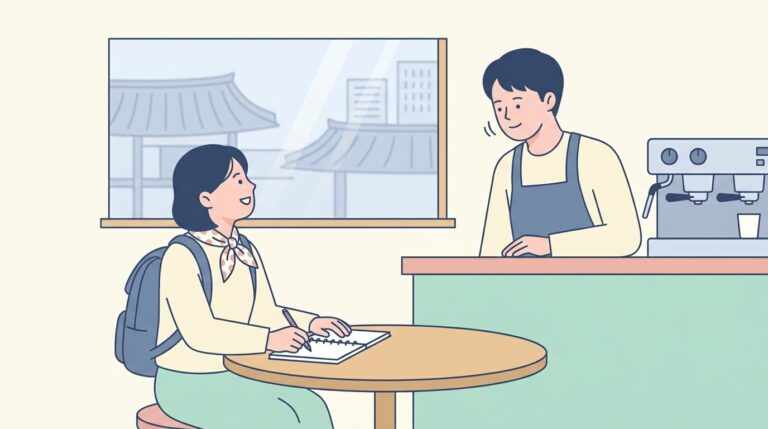
In Korea’s vibrant cafe culture, baristas are used to meeting global tourists. Cafes are the absolute best low-stakes environments to practice speaking. Ordering a simple “아이스 아메리카노 하나 주세요” (Ice Americano, please) is your gateway to real-world practice!
Phase 5: Real-Life Roleplay Scenario
Meet Ji-hoon (지훈), a friendly Korean university student working part-time at a cozy cafe in Seoul. He loves meeting new people!
- Setting: A cute wooden cafe filled with the aroma of roasted coffee beans in Hongdae.
Ji-hoon: 어서 오세요! 주문 도와드릴까요?
         (Eo-seo o-se-yo! Ju-mun do-wa-deu-ril-kka-yo?)
         🎭 [Smiling warmly, bowing slightly]
         "Welcome! May I take your order?"

You: 안녕하세요! 아메리카노 하나 주세요.
     (An-nyeong-ha-se-yo! A-me-ri-ka-no ha-na ju-se-yo.)
     🎭 [Nervous but smiling, pointing to the menu]
     "Hello! One Americano, please."

Ji-hoon: 따뜻한 걸로 드릴까요, 아이스로 드릴까요?
         (Tta-tteut-han geol-lo deu-ril-kka-yo, a-i-seu-ro deu-ril-kka-yo?)
         🎭 [Waiting patiently with a pen in hand]
         "Would you like it hot or iced?"

You: 아이스로 주세요. 그리고... 한국어 공부하고 있어요!
     (A-i-seu-ro ju-se-yo. Geu-ri-go... Han-gug-eo gong-bu-ha-go is-seo-yo!)
     🎭 [Taking a deep breath, speaking bravely]
     "Iced, please. And... I am studying Korean!"

Ji-hoon: 와, 진짜요? 한국어 되게 잘하시네요!
         (Wa, jin-jja-yo? Han-gug-eo doe-ge jal-ha-si-ne-yo!)
         🎭 [Eyes sparkling with surprise, clapping hands]
         "Wow, really? Your Korean is so good!"

You: 고맙습니다. 하지만 천천히 말씀해 주세요.
     (Go-map-seum-ni-da. Ha-ji-man cheon-cheon-hi mal-sseum-hae ju-se-yo.)
     🎭 [Laughing shyly, making a soft slowing-down gesture with hands]
     "Thank you. But please speak slowly."

Ji-hoon: 아, 네! 천.천.히. 말할게요. 한국어 공부 재미있어요?
         (Ah, ne! Cheon. Cheon. Hi. mal-hal-ge-yo. Han-gug-eo gong-bu jae-mi-is-seo-yo?)
         🎭 [Nodding supportively, speaking clearly and slowly]
         "Ah, yes! I will speak slow-ly. Is studying Korean fun?"

You: 네, 정말 재미있어요! 한국어 연습 중이에요.
     (Ne, jeong-mal jae-mi-is-seo-yo! Han-gug-eo yeon-seub jung-i-e-yo.)
     🎭 [Beaming with pride, nodding happily]
     "Yes, it is really fun! I am practicing my Korean."
🔀 Choose Your Path!
What will you say next to Ji-hoon to keep the friendly vibe going?
* A) “네, 감사합니다!” (Ne, gam-sa-ham-ni-da! / “Yes, thank you!”)
* B) “오빠, 커피 맛있어요?” (Oppa, keo-pi ma-si-seo-yo? / “Oppa, is the coffee delicious?”)
* C) “한국 친구를 사귀고 싶어요.” (Han-guk chin-gu-reul sa-gwi-go si-po-yo. / “I want to make Korean friends.”)
Feedback on Your Choice:
- A (Safe & Polite – Best for Beginners): Perfect! It wraps up the interaction warmly. Ji-hoon will hand over your coffee with a bright smile.
- B (Slight Risk): Calling a barista “Oppa” on your first meeting can be a bit too sudden or awkward unless you are already close friends. Stick to polite semi-formal tones!
- C (Brave & Friendly – Highly Recommended): Great job! This is an amazing way to open up a real conversation. Ji-hoon might introduce you to local language exchange meetups!
Phase 6: 10-Second Emotional Shadowing Drill
Let’s practice speaking with real emotions! Imitate the pause points (/) and feel the mood.
- [😊 Super excited and proud]
- “진짜요? / 저 / 한국어 공부 / 정말 좋아해요!”
- Jin-jja-yo? / Jeo / han-gug-eo gong-bu / jeong-mal jo-a-hae-yo!
- (Really? / I / Korean study / really love it!)
- [🥺 Shy, cute, and asking for help]
- “조금만… / 천천히 / 말씀해 주세요 / 헤헤.”
- Jo-geum-man… / cheon-cheon-hi / mal-sseum-hae ju-se-yo / hehe.
- (Just a little… / slowly / please speak / hehe.)
Phase 7: K-Culture Mini Dictionary
- 맞장구 (Mat-jang-gu) | Conversation Reactions / Backchanneling | The art of nodding, saying “네~” (yes) or “아, 그래요?” to show you are actively listening to the speaker.
- 화이팅 (Hwai-ting) | Fighting! / You can do it! | The ultimate Korean encouragement phrase used to cheer someone up before speaking or taking a test.
- 울렁증 (Ul-leong-jeung) | Stage Fright / Speaking Anxiety | Literally meaning “nausea,” used playfully to describe the nervous shaking feeling when you have to speak a foreign language.
- 인싸 (In-ssa) | Insider / Social Butterfly | Someone who is outgoing, makes friends easily, and is great at initiating conversations.
Phase 8: Survival Kit for Travelers
Survial Phrases TOP 3
- 이거 어떻게 읽어요? (I-geo eo-tteoh-ge il-geo-yo?)
- Pro Tip: Use this to ask how to pronounce a menu item or street sign!
- 영어로 말씀해 주셔도 돼요. (Yeong-eo-ro mal-sseum-hae ju-syeo-do dwae-yo)
- Pro Tip: “You can speak in English if you prefer.” Use this if you get completely stuck!
- 도와주셔서 감사합니다! (Do-wa-ju-syeo-seo gam-sa-ham-ni-da!)
- Pro Tip: “Thank you for helping me!” Always say this with a warm bow to your conversational partner.
🗺️ Editor’s Travel Note
When practicing Korean on the go, navigating safely is key. Forget Google Maps (which doesn’t work well in Korea) and download Naver Map (네이버 지도 App). Use the search bar to find cozy local cafes where you can test your speaking skills in quiet, cozy environments.
Note: App interface and local transit fees may change over time; please check the official app store for the latest updates.
Phase 9:
Frequently Asked Questions (FAQ)
Q: What does "진짜요? (Jin-jja-yo?)" mean in Korean and how do you pronounce it?
A: In Korean, "진짜요? (Jin-jja-yo?)" is pronounced [Jin-jja-yo? (Sounds like "Jean-jah-yo?" with a rising tone at the end] and means: "Really?" or "Is that true?"
Q: What does "천천히 말씀해 주세요 (Cheon-cheon-hi mal-sseum-hae ju-se-yo)" mean in Korean and how do you pronounce it?
A: In Korean, "천천히 말씀해 주세요 (Cheon-cheon-hi mal-sseum-hae ju-se-yo)" is pronounced [Chon-chon-hee mal-sseum-hae-ju-seh-yo (Think of "Chon-chon" as slowly ticking clocks] and means: "Please speak slowly."
Q: What does "한국어 연습 중이에요 (Han-gug-eo yeon-seub jung-i-e-yo)" mean in Korean and how do you pronounce it?
A: In Korean, "한국어 연습 중이에요 (Han-gug-eo yeon-seub jung-i-e-yo)" is pronounced [Han-gook-uh yon-seup joong-ee-eh-yo (Think of "jung" as being "in the middle of" something] and means: "I am in the middle of practicing Korean."







