

Master Art Museum Etiquette: Navigating K-Art & Docent Tours in Seoul
Phase 1: Empathy (스토리 몰입형 오프닝)
안녕하세요! Daily Hangul Editor here, your native cultural navigator.
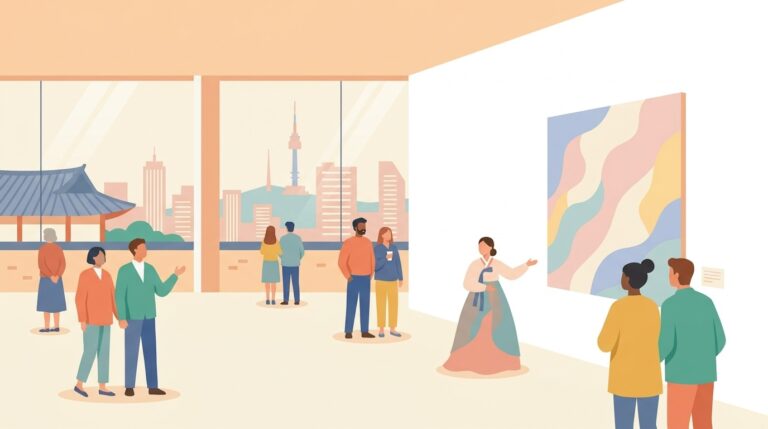
Imagine walking into the sleek, high-ceilinged galleries of MMCA (National Museum of Modern and Contemporary Art, Seoul) or the trendy spaces of Leeum Museum of Art in Hannam-dong. The atmosphere is buzzing, and you spot a group of people gathered around a striking, abstract installation. A charismatic museum docent is explaining the artist’s complex philosophy in rapid-fire, poetic Korean.
You step closer, eager to dive into Korea’s vibrant contemporary art scene. But suddenly, you hesitate. What if I want to ask a deep question about the artist’s perspective without sounding like a tourist translating through an app? How do I politely engage with the docent or discuss the provocative themes of modern art with fellow art lovers?
If you’ve felt that intellectual itch but held back due to language anxiety, this guide is for you. Based on feedback from our advanced learners, we’ve crafted this comprehensive cultural roadmap so you can confidently converse about modern art, grasp the deepest nuances of a docent’s explanation, and express your artistic opinions like a sophisticated Seoulite.
Phase 2: Core Expressions Deep Dive (핵심 표현 3선 심층 분석)
To truly appreciate contemporary art, you need to go beyond simple adjectives like 예뻐요 (It’s pretty). Let’s master three highly sophisticated expressions commonly used in Korean art circles.
1. 작품에 담긴 의도를 파악하다 (jak-pum-e dam-gin ui-do-reul pa-ak-ha-da)
- Pronunciation: Jak-poom-eh dam-geen wee-doh-reul pah-ahk-hah-dah (Rhymes with “dock” in pa-ak)
- Meaning: To grasp/discern the intention embedded within the artwork.
- K-Culture Moment: You will hear this in art documentaries on SBS or when watching sophisticated curators discuss masterpieces on channels like KBS World. It refers to looking past the physical surface of a canvas or sculpture to decode the artist’s mind.
- Editor’s Insight: 파악하다 (to grasp/understand thoroughly) is a high-level cognitive verb. Using this instead of simply 알다 (to know) instantly elevates your academic and intellectual standing in Korean conversation.
- Situation Spectrum: Casual: 🚫 | Semi-formal: ⚠️ | Formal: ✅
- 🤔 Think About It: Why does Korean culture emphasize reading the 의도 (intention) and 맥락 (context) of the artist so deeply, rather than just focusing on pure individual aesthetic interpretation?
2. 작가의 세계관이 고스란히 묻어나다 (jak-ga-ui se-gye-gwan-i go-seu-ran-hi mut-eo-na-da)
- Pronunciation: Jahk-gah-wee seh-gyeh-gwan-ee goh-seu-rahn-hee moot-uh-nah-dah (Pronounce mut-eo-na-da smoothly like moo-tuh-nah-dah)
- Meaning: The artist’s worldview is vividly/fully revealed (literally: “stains/seeps through beautifully”).
- K-Culture Moment: This expression is a favorite among Korean art critics writing for design magazines or reviewing major K-Art exhibitions.
- Editor’s Insight: 고스란히 is a beautiful native Korean adverb meaning “intactly” or “just as it is.” 묻어나다 implies that the worldview is not aggressively forced onto the viewer, but rather gently seeps out of the medium itself.
- Situation Spectrum: Casual: ⚠️ | Semi-formal: ✅ | Formal: ✅
- 🤔 Think About It: How does the English concept of “expressing oneself” differ from the Korean concept of 묻어나다 (seeping through naturally)?
3. 여백의 미가 돋보이다 (yeo-baek-ui mi-ga dot-bo-i-da)
- Pronunciation: Yuh-baek-wee mee-gah doht-boh-ee-dah (The t sound in dot is a soft stop)
- Meaning: The beauty of empty space (minimalism) stands out.
- K-Culture Moment: Essential when discussing traditional Korean ink paintings or modern Korean monochrome movement, Dansaekhwa (단색화).
- Editor’s Insight: 여백의 미 (the beauty of margins/empty space) is a foundational Asian aesthetic principle. It refers to leaving parts of the canvas empty to invite contemplation. 돋보이다 means to stand out in a highly refined, elegant way.
- Situation Spectrum: Casual: ✅ | Semi-formal: ✅ | Formal: ✅
- 🤔 Think About It: In our fast-paced, hyper-connected digital lives in Seoul, how does 여백의 미 serve as a form of mental therapy?
Phase 3: Textbook Korean vs. Real-Life Korean
| Situation | 📖 Textbook Korean | 🗣️ Real-Life Native Korean |
|---|---|---|
| Asking about the guide program | 도슨트 설명은 몇 시에 시작합니까? (At what time does the docent explanation start?) |
혹시 오늘 도슨트 투어 몇 시 타임 있어요? (By any chance, what times are the docent tours scheduled for today?) |
| Sharing your impression | 이 그림은 아주 추상적이어서 이해하기 어렵습니다. (This painting is very abstract, so it is hard to understand.) |
이 작품은 은유적이라서 되게 심오한 느낌이 드네요. (This artwork is metaphorical, so it gives off a really profound vibe.) |
- 💡 Why is it different? While textbooks rely heavily on formal question endings like -ㅂ니까, real-life Koreans use softer, indirect phrases like 혹시~ 있어요? to sound polite yet natural. Additionally, modern art lovers prefer words like 심오하다 (profound) or 은유적 (metaphorical) over 어렵다 (difficult) to describe complex abstract works.
Phase 4: K-Culture Deep Dive & Non-Verbal Etiquette
4-1. Nunchi (눈치) & Docent Etiquette in Korea
Korean gallery-goers highly value 정숙 (silence/quietness). When joining a docent tour, it is essential to practice high-level 눈치 (situational awareness):
* The “Half-Step Back” Rule: Never block the path between the docent and the artwork. Stand slightly to the side at a 45-degree angle.
* Eye Contact and Nodding: In Korean culture, light nodding (끄덕임) while the docent speaks is a sign of respect and deep cognitive engagement.
* Subtle Hand Gestures: If pointing to a specific detail in a painting during a question, use an open palm facing upward rather than pointing with a single finger, which can seem aggressive.
4-2. The Rise of the “Cultural Curator” in K-Media
In contemporary K-Dramas, art galleries are no longer just passive backgrounds; they are spaces of intense intellectual and romantic tension. Characters in dramas like Her Private Life or Our Beloved Summer use sophisticated art vocabulary to project social status, professional competence, or deep internal turmoil. Understanding this lexicon allows you to decode subtexts in Korean media that standard subtitles often fail to capture.
Phase 5: Real-Life Roleplay Scenario
Character Profiles
- 민우 (Min-woo): An experienced museum docent at a contemporary art museum. Passionate and articulate.
- 클로이 (Chloe): An advanced Korean learner who loves contemporary art and wants to discuss artistic concepts deeply.
Scenario
Chloe is attending a solo exhibition of a famous Korean installation artist. She approaches Min-woo after his docent session.
- 민우 (Docent): 혹시 오늘 전시 보시면서 특별히 인상 깊었던 작품이 있으셨나요?
(Did any artwork stand out to you in particular during today’s exhibition?) - 클로이 (Chloe): 🎭 (생각에 잠긴 듯 고개를 끄덕이며) 네, 저기 2전시실에 있는 대형 설치 미술품이 아주 인상적이었어요.
(Yes, the large-scale installation in Gallery 2 was very impressive.) - 민우 (Docent): 아, 그 작품은 관객과의 소통을 주제로 한 메인 설치작이죠. 어떤 면이 와닿으셨나요?
(Ah, that piece is the main installation themed around communication with the audience. What aspect resonated with you?) - 클로이 (Chloe): 🎭 (손으로 부드럽게 작품 방향을 가리키며) 기하학적인 오브제들이 얽혀 있는 모습에서 현대인의 외로움이 고스란히 묻어나는 것 같았어요.
(The way the geometric objects are intertwined made me feel as though the loneliness of modern people was vividly seeping through.) - 민우 (Docent): 정확히 짚어내셨네요! 작가님도 도시인들의 관계망을 그 오브제로 시각화하려 하셨거든요.
(You pointed it out exactly! The artist also intended to visualize the relational network of urbanites through those objects.) - 클로이 (Chloe): 역시 그랬군요. 그리고 복잡한 오브제 주변의 널찍한 빈 공간 덕분에 여백의 미도 아주 잘 느껴졌어요.
(I thought so. And thanks to the spacious empty areas around the complex objects, I could really feel the beauty of the empty spaces as well.) - 민우 (Docent): 와, 한국 현대 미술의 미적 특징까지 정확히 꿰뚫어 보고 계시네요. 설명해 드린 보람이 있습니다.
(Wow, you truly pierce through the aesthetic characteristics of Korean contemporary art. It makes explaining it very rewarding.) - 클로이 (Chloe): 🎭 (가볍게 고개를 숙이며 인사하며) 도슨트님 덕분에 작품에 담긴 의도를 훨씬 더 입체적으로 파악하게 된 것 같아요. 정말 감사합니다.
(Thanks to you, I feel like I’ve grasped the intention behind the artwork in a much more multi-dimensional way. Thank you so much.)
🔀 Choose Your Response! (Interactive Branching)
Imagine Min-woo asks Chloe: “현대 미술은 난해하다는 의견도 많은데, 클로이 씨는 어떻게 생각하세요?” (Many think modern art is incomprehensible. What are your thoughts?)
- [Option A] “너무 어려워서 솔직히 잘 모르겠어요.” (Honestly, it’s too hard so I don’t really know.)
- [Option B] “난해한 만큼 감상자가 상상할 수 있는 여백이 더 많아진다고 봐요.” (I believe that the more complex it is, the more margin/space there is for the viewer to imagine.)
- [Option C] “그냥 대충 그린 것 같은데 왜 비싼지 이해 안 돼요.” (It looks like they drew it haphazardly, so I don’t get why it’s expensive.)
💡 Feedback on Your Choice
- Selecting Option A (Bad): While honest, it shuts down the intellectual flow of the conversation.
- Selecting Option B (Best): Fantastic! You used the concept of “여백” (margin/space) metaphorically to explain cognitive flexibility. Highly sophisticated.
- Selecting Option C (Risk): Too blunt and potentially disrespectful in an art gallery context. Might make the docent defensive.
Phase 6: 10-Second Emotional Shadowing Drill
Master the natural rise and fall of professional art discussions. Pay attention to the pauses (/) and the emotional markers.
-
[😊 Expressing deep appreciation with intellectual joy]
도슨트님 덕분에 / 작품에 담긴 의도를 / 훨씬 더 / 입체적으로 파악하게 되었어요.
(Do-seun-teu-nim deok-bun-e / jak-pum-e dam-gin ui-do-reul / hweol-shin deo / ip-che-jeok-eu-ro pa-ak-ha-ge doe-eot-eo-yo.) -
[🤔 Reflective, deeply impressed tone]
작품 구석구석에서 / 작가의 치열한 고민이 / 고스란히 묻어나는 게 / 느껴집니다.
(Jak-pum gu-seok-gu-seok-e-seo / jak-ga-ui chi-yeol-han go-min-i / go-seu-ran-hi mut-eo-na-neun ge / neu-ggeo-jim-ni-da.)
Phase 7: K-Culture Mini-Dictionary
- 도슨트 (Do-seun-teu) | Docent | An exhibition guide who volunteers or works professionally to explain artworks to visitors. In Korea, popular docents have massive cult followings similar to indie rock stars!
- 단색화 (Dan-saek-hwa) | Monochrome Painting | A highly influential Korean modern art movement from the 1970s characterized by repetitive actions, neutral tones, and physical manipulation of materials.
- 오브제 (O-beu-je) | Objet / Found Object | An everyday object integrated into modern installations to challenge conventional art values.
- 도록 (Do-rok) | Exhibition Catalogue | A printed art catalog of the exhibition. Buying the 도록 at the end of a show is a classic ritual for Korean art enthusiasts.
Phase 8: Survivor’s Travel Kit for Art Lovers
Survival Expressions TOP 3
Frequently Asked Questions (FAQ)
Q: What does "작품에 담긴 의도를 파악하다 (jak-pum-e dam-gin ui-do-reul pa-ak-ha-da)" mean in Korean and how do you pronounce it?
A: In Korean, "작품에 담긴 의도를 파악하다 (jak-pum-e dam-gin ui-do-reul pa-ak-ha-da)" is pronounced [Jak-poom-eh dam-geen wee-doh-reul pah-ahk-hah-dah (Rhymes with "dock" in pa-ak] and means: To grasp/discern the intention embedded within the artwork.
Q: What does "작가의 세계관이 고스란히 묻어나다 (jak-ga-ui se-gye-gwan-i go-seu-ran-hi mut-eo-na-da)" mean in Korean and how do you pronounce it?
A: In Korean, "작가의 세계관이 고스란히 묻어나다 (jak-ga-ui se-gye-gwan-i go-seu-ran-hi mut-eo-na-da)" is pronounced [Jahk-gah-wee seh-gyeh-gwan-ee goh-seu-rahn-hee moot-uh-nah-dah (Pronounce mut-eo-na-da smoothly like moo-tuh-nah-dah] and means: The artist’s worldview is vividly/fully revealed (literally: "stains/seeps through beautifully").
Q: What does "여백의 미가 돋보이다 (yeo-baek-ui mi-ga dot-bo-i-da)" mean in Korean and how do you pronounce it?
A: In Korean, "여백의 미가 돋보이다 (yeo-baek-ui mi-ga dot-bo-i-da)" is pronounced [Yuh-baek-wee mee-gah doht-boh-ee-dah (The t sound in dot is a soft stop] and means: The beauty of empty space (minimalism) stands out.







