

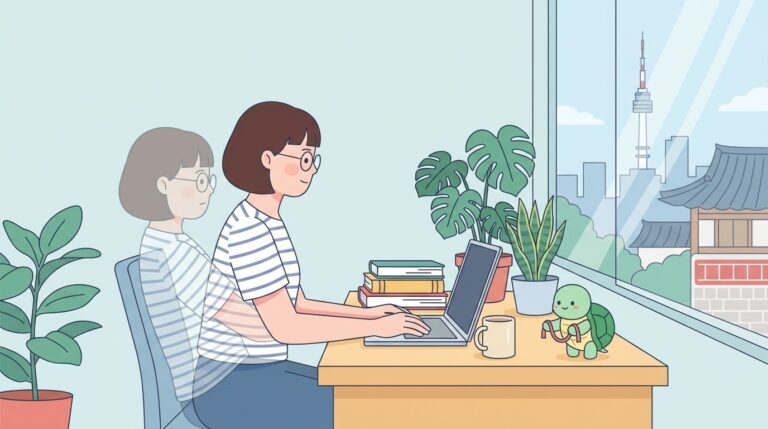
Say Goodbye to “Turtle Neck”! How to Talk About Posture and Wellness in Korean
Phase 1: Empathy (Welcome to the Daily Hangul Fam!)
안녕하세요! (An-nyeong-ha-se-se-yo!) It’s your favorite Korean study bestie and Senior Editor at Daily Hangul.
Let’s be honest for a second. Are you reading this while slouching? Is your chin sticking out toward your screen like a turtle trying to peek out of its shell? 🐢 If yes, don’t worry—you are definitely not alone! In Korea, where we practically live on our smartphones and work long hours at desks, we have a very famous word for this: 거북목 (Geobukmok – literally “Turtle Neck”).
If you’ve watched K-Dramas like Start-Up or office realities, you’ve probably seen characters stretching their necks, using strange-looking posture correctors, or complaining about their stiff shoulders. Today, we’re going to dive deep into how Koreans talk about posture, physical wellness, and how you can naturally express your pain (and recovery!) in Korean like a true local. Knowing these expressions won’t just help you chat with Korean friends; it will literally save your neck during your next long study session!
Phase 2: Deep Dive into 3 Essential Posture Expressions
Let’s look at three high-yield expressions that intermediate (B2) learners must know to talk about posture and physical health.
1. 거북목 증후군 (Geobukmok Jeunghugun)
- Pronunciation: Geo-buk-mok Jeung-hu-gun (Sounds like: “Go-book-moke Jung-hoo-goon”)
- Meaning: Tech Neck / Forward Head Posture (Literally: “Turtle Neck Syndrome”)
- K-Culture Moment: In K-Beauty and wellness vlogs on YouTube, creators often share “거북목 교정 스트레칭” (Turtle neck correction stretches) to get that elegant, straight shoulder line (어깨 라인) highly prized in Korean beauty standards.
- Editor’s Insight: Geobuk (거북) means turtle, and mok (목) means neck. When you add jeunghugun (증후군 – syndrome), it becomes a semi-medical term used widely in daily conversation to describe the stiff neck caused by looking down at phones.
- Situation Spectrum: Casual (✅) / Semi-formal (✅) / Formal (✅)
- 🤔 Think About It: In English, we often say “slouching” or “bad posture,” but Korean vividly uses animal imagery (“turtle”). Why do you think Korean culture focuses so much on the visual shape of the neck and shoulders in daily wellness conversations?
2. 자세가 구부정하다 (Jasega gubujeonghada)
- Pronunciation: Ja-se-ga goo-boo-jeong-ha-da (Sounds like: “Jah-seh-gah goo-boo-jung-hah-dah”)
- Meaning: To have a hunched, slouchy posture
- K-Culture Moment: You will hear parents in K-Dramas nagging their children studying at desks: “자세 구부정하게 있지 말고 어깨 좀 펴!” (Don’t slouch, open up your shoulders!).
- Editor’s Insight: Jase (자세) means posture. Gubujeonghada (구부정하다) is an mimetic-adjctive describing a slightly bent or curved shape. It has a very descriptive, visual nuance compared to the simple “나쁜 자세” (bad posture).
- Situation Spectrum: Casual (✅) / Semi-formal (✅) / Formal (⚠️ – use ‘바르지 못한 자세’ instead)
- 🤔 Think About It: How does your native language describe someone who is slouching? Is there a specific visual word like gubujeong in your language?
3. 어깨가 결리다 (Eokkaega gyeollida)
- Pronunciation: Eo-kkae-ga gyul-li-da (Sounds like: “Up-kae-gah gyul-lee-dah”)
- Meaning: To have stiff/achy shoulders (muscle knots)
- K-Culture Moment: Office workers in Korea often put on pain relief patches called 파스 (Paseu) on their stiff shoulders and say, “아구구, 어깨가 왜 이렇게 결리지?” (Oh my, why are my shoulders so stiff?).
- Editor’s Insight: While apuda (아프다) means general pain, gyeollida (결리다) specifically refers to that tight, aching sensation where muscles feel knotted up or blocked.
- Situation Spectrum: Casual (✅) / Semi-formal (✅) / Formal (✅)
- 🤔 Think About It: Koreans frequently use “결리다” for shoulders and back. Recognizing this specific pain descriptor helps you explain your symptoms accurately at a Korean pharmacy or clinic!
Phase 3: Textbook Korean vs. Real-Life Korean
Let’s bridge the gap between classroom Korean and the actual words rolling off native speakers’ tongues.
Situation 1: Telling someone to sit up straight
- 📖 Textbook Korean: “자세를 바르게 하세요.” (Jase-reul bareuge haseyo. – “Please make your posture correct.”)
- 🗣️ Real-Life Korean: “허리 좀 펼치고 앉아봐. 어깨 좀 피고!” (Heori jom pyeolchigo anjaba. Eokkae jom pigo! – “Stretch your back and sit up. Open your shoulders!”)
- 💡 Why the difference? While “바르게” is grammatically flawless, native speakers prefer physical action verbs like 펴다 (pyeoda – to unfold/straighten) to tell someone to correct their slouching in real time.
Situation 2: Expressing extreme fatigue/stiffness from working
- 📖 Textbook Korean: “오랫동안 일해서 등이 아픕니다.” (Oraet-dong-an ilhaeseo deung-i apeumnida. – “My back hurts because I worked for a long time.”)
- 🗣️ Real-Life Korean: “하루 종일 모니터 봤더니 담 걸릴 것 같아.” (Haru jong-il moniteo bwatdeoni dam geollil geot gata. – “I stared at the monitor all day, I feel like I’m getting a muscle spasm.”)
- 💡 Why the difference? 담 (Dam) is a traditional Korean concept of muscle stiffness/spasms caused by blocked energy or bad posture. Saying “담 걸릴 것 같다” shows a deep understanding of natural Korean idioms.
Phase 4: K-Culture Deep Dive & Non-Verbal Manners
4-1. The Body Language of Wellness in Korea
When talking about physical pain or posture to an older person or doctor, it is polite to slightly touch the affected area (like your neck or shoulder) with one hand while supporting your elbow with your other hand. This non-verbal cue shows respect and politeness while expressing discomfort.
4-2. The “Stretching” Trend in K-Beauty & Wellness
In Korea, posture is directly connected to 자기관리 (jagi-gwanri – self-management). Having a “straight collarbone” (일자 쇄골) and a long, straight neck line (여신 목선 – goddess neckline) is highly trendy. This has led to an explosion of Pilates studios and specialized physical therapy clinics (도수치료 – manual therapy) across Seoul. It’s not just about health; it’s considered a key element of elegance and professional presentation!
Phase 5: Live Roleplay Scenario
Setting: A trendy Pilates & Posture Clinic in Gangnam, Seoul.
Characters:
* 민우 (Minwoo): A friendly, experienced physical therapist who uses professional yet warm semi-formal tone.
* You (B2 Learner): An office worker struggling with chronic neck stiffness.
[Scene: Minwoo is assessing your posture in front of a grid mirror.]

1. 민우: (친절하게 미소를 지으며) 어서 오세요! 최근에 목이나 어깨 쪽이 많이 불편하셨나 봐요?
   Minwoo: (Smiling kindly) Welcome! It looks like your neck and shoulders have been bothering you a lot lately?

2. You: (어깨를 만지며) 네, 요즘 하루 종일 컴퓨터를 해서 그런지 어깨가 너무 결려요.
   You: (Touching your shoulder) Yes, maybe because I work on the computer all day lately, my shoulders are so stiff.

3. 민우: (고개를 끄덕이며) 아, 그렇군요. 옆모습을 보니 확실히 거북목 증후군 증세가 조금 보이네요.
   Minwoo: (Nodding) Ah, I see. Looking at your profile, you definitely show some signs of turtle neck syndrome.

4. You: (걱정스러운 표정으로) 맞아요. 스마트폰을 볼 때 저도 모르게 자세가 구부정해져요.
   You: (With a worried look) That's right. When looking at my phone, my posture slouched before I even know it.

5. 민우: (바른 자세를 직접 보여주며) 허리를 세우고 날개뼈를 모으는 느낌으로 어깨를 쭉 펴셔야 해요.
   Minwoo: (Demonstrating correct posture) You need to sit up straight and roll your shoulders back, like you're squeezing your shoulder blades together.

6. You: (민우의 자세를 따라하며) 이렇게요? 아, 생각보다 평소에 제 자세가 많이 무너져 있었네요.
   You: (Following Minwoo's posture) Like this? Ah, my posture was much worse than I thought in daily life.

7. 민우: (격려하듯 박수를 살짝 치며) 네, 아주 좋아요! 1시간에 한 번씩 꼭 가벼운 목 스트레칭을 해주세요.
   Minwoo: (Clapping lightly to encourage) Yes, perfect! Make sure to do light neck stretches once every hour.

8. You: (밝게 웃으며) 네, 선생님! 오늘부터 알려주신 대로 거북목 교정 스트레칭을 열심히 해볼게요.
   You: (Smiling brightly) Yes, Teacher! Starting today, I will work hard on the turtle neck correction stretches you taught me.
🔀 Interactive Choice Points
What would you say if Minwoo asks: “혹시 평소에 잠잘 때 어떤 베개를 쓰시나요?” (What kind of pillow do you usually use when you sleep?)
- Choice A: “저는 베개 없이 자요. 베개 없으면 거북목에 좋지 않아요?” (I sleep without a pillow. Isn’t no pillow good for turtle neck?)
- Feedback (Best): Excellent B2-level grammar! This invites a helpful medical tip from Minwoo. (No pillow can actually strain your neck muscles further!)
- Choice B: “베개 몰라요. 아무거나 사용해요.” (Pillow I don’t know. I use anything.)
- Feedback (Bad): A bit too simple and abrupt for a B2 level. Try using “아무 베개나 쓰는데, 그래서 아픈 걸까요?” (I use any pillow, could that be why it hurts?)
- Choice C: “목 베개 진짜 사랑해요. 매일 써요!” (I really love neck pillows. I use it every day!)
- Feedback (Risk): Using “사랑해요” (love) for inanimate objects in daily medical contexts sounds slightly unnatural in Korean. Use “선호해요” (prefer) or “자주 써요” (use often) instead.
Phase 6: 10-Second Emotional Shadowing Drill
Practice saying these lines with the exact emotional intonation marked by / pauses!
- Line 1: [😩 Stiff and exhausted after work]
- “하루 종일 / 컴퓨터를 했더니 / 목이 아예 / 안 돌아가요…”
- Ha-ru jong-il / keom-pyu-teo-reul haet-deo-ni / mog-i a-ye / an do-ra-ga-yo…
- (I worked on the computer all day / and now my neck / won’t turn / at all…)
- Line 2: [😊 Proud of correcting your posture]
- “선생님 덕분에 / 이제는 / 허리를 곧게 펴고 / 앉는 습관이 생겼어요!”
- Seon-saeng-nim deok-bun-e / i-je-neun / heo-ri-reul got-ge pyeo-go / an-neun seub-gwan-i saeng-gyeot-seo-yo!
- (Thanks to you, teacher / now / I have a habit of / sitting with my back straight!)
Phase 7: K-Culture Mini Dictionary
- 도수치료 (Dosu-chiryo) | Manual Therapy / Chiropractic Care
- Extremely popular physical therapy in Korea where therapists align your joints and muscles with their hands to treat geobukmok.
- 파스 (Paseu) | Pain Relief Patch
- Derived from “Plaster”. A must-have item in Korean convenience stores for muscle pain. You’ll smell the strong menthol scent in every university library during exam weeks!
- 폼롤러 (Pom-roller) | Foam Roller
- The ultimate home training (홈트) item in Korea. Most young Koreans have one in their room to roll out their stiff backs after work.
- 스트레칭 (Seuteureching) | Stretching
- Loanword used constantly in Korean wellness. Often paired with “생활화” (making it a daily lifestyle habit).
Phase 8: Survivor Kit for Travelers
Survival Expressions TOP 3
- “어깨 마사지 좀 세게 해주세요.” (Eokkae masaji jom sege hae-juseyo.)
- Pro Tip: Use this at a Korean spa/massage shop to get those deep knots out! (“Please massage my shoulders stronger.”)
- “거북목에 좋은 베개 추천해 주실 수 있나요?” (Geobukmoke joeun begae chucheonhae jusil su innayo?)
- Pro Tip: Ask this at a home goods store like Kakao Friends, Line Friends, or JAJU to find specialized ergonomic neck pillows.
- “어깨 결릴 때 붙이는 파스 어디 있어요?” (Eokkae gyeollil ttae butchireun paseu eodi isseoyo?)
- Pro Tip: Ask this at any pharmacy (약국) or convenience store (편의점).
🗺️ Editor’s Travel Note
If you are traveling in Seoul and your back hurts from carrying heavy backpacks, you don’t need to suffer! Open the Naver Map App (네이버 지도) and search for “도수치료” (Manual Therapy) or “타이 마사지” (Thai Massage) nearby. Many orthopedic clinics (정형외과) have physical therapy centers where travelers can get professional treatment.
(Note: Always check if your travel insurance covers physical therapy before booking!)
Phase 9: “Going Deeper” (Sociolinguistic Insight)
In Korea, the concept of posture goes beyond physical health—it’s deeply tied to 인성 (in-seong – character) and respect. Sitting slouched in front of elders or superiors during a business meeting is often perceived as a sign of laziness or a lack of attention. This cultural expectation is why Korean parents and teachers are so strict about “바른 자세” (correct posture) from a very young age. Keeping your back straight is not just healthy for your spine; it’s a silent form of respect in Korean social hierarchy.
💬 Your Turn!
How is posture viewed in your culture? Is slouching seen simply as a personal physical habit, or does it carry social meanings like in Korea? Let us know in the comments below!
Phase 10: FAQ & Avoiding Common Mistakes
Q: Is
Frequently Asked Questions (FAQ)
Q: What does "거북목 증후군 (Geobukmok Jeunghugun)" mean in Korean and how do you pronounce it?
A: In Korean, "거북목 증후군 (Geobukmok Jeunghugun)" is pronounced [Geo-buk-mok Jeung-hu-gun (Sounds like: "Go-book-moke Jung-hoo-goon"] and means: Tech Neck / Forward Head Posture (Literally: "Turtle Neck Syndrome")
Q: What does "자세가 구부정하다 (Jasega gubujeonghada)" mean in Korean and how do you pronounce it?
A: In Korean, "자세가 구부정하다 (Jasega gubujeonghada)" is pronounced [Ja-se-ga goo-boo-jeong-ha-da (Sounds like: "Jah-seh-gah goo-boo-jung-hah-dah"] and means: To have a hunched, slouchy posture
Q: What does "어깨가 결리다 (Eokkaega gyeollida)" mean in Korean and how do you pronounce it?
A: In Korean, "어깨가 결리다 (Eokkaega gyeollida)" is pronounced [Eo-kkae-ga gyul-li-da (Sounds like: "Up-kae-gah gyul-lee-dah"] and means: To have stiff/achy shoulders (muscle knots)







