

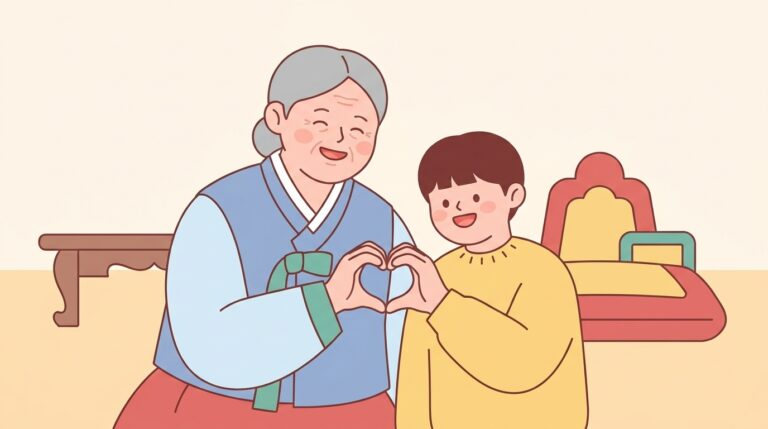
Talk About Your Grandparents Like a Native: Easy Korean Family Words
안녕하세요! (An-nyeong-ha-se-yo!) I’m your friendly Korean editor from Daily Hangul! 🌸
Have you ever watched a heartwarming K-Drama and noticed how characters talk about their Halmoni (grandmother) or Haraboji (grandfather)? Maybe they are eating delicious warm soup together, or getting scolded with a lot of love.
Talking about grandparents in Korean isn’t just about translating “grandma” and “grandpa.” It is a beautiful window into Korean culture, where showing respect to elders is a super important way of saying “I love you.”
If you are an absolute beginner (A1), you might feel worried: “What if I use the wrong word? Is it disrespectful?” Don’t worry! Today, we are going to learn how to introducing your grandparents easily and naturally, like a real Korean friend.
Phase 2: Key Expressions Deep Dive
Here are the three most important words you need to know to talk about your grandparents.
1. 할머니 (Hal-mo-ni)
- Pronunciation: Hal-mo-ni (Sounds like “Hal” as in halogen + “mo” as in more + “ni* as in knee)
- Meaning: Grandmother / Grandma
- K-Culture Moment: You will hear this word in almost every family K-Drama! Think of the sweet grandmother in Start-Up who owns the corn dog truck.
- Editor’s Insight: In Korea, we also call elder ladies in the street “Halmoni” to show friendliness, even if they aren’t our real family!
- Situation Spectrum: Casual (✅) / Semi-formal (✅) / Formal (⚠️ – Hal-mo-nim is better for very formal times)
- 🤔 Think About It: In your country, do you call stranger elders “Grandma” or “Grandpa”? Why do you think Koreans do this?
2. 할아버지 (Ha-ra-bo-ji)
- Pronunciation: Ha-ra-bo-ji (Sounds like “Ha” + “ra” as in run + “bo” as in boy + “ji” as in jeep)
- Meaning: Grandfather / Grandpa
- K-Culture Moment: Think of the cool, fashion-forward grandfather in the K-Drama Navillera who learns ballet!
- Editor’s Insight: Just like “Halmoni,” you can call an elderly man “Haraboji” politely when helping them with heavy bags.
- Situation Spectrum: Casual (✅) / Semi-formal (✅) / Formal (⚠️)
- 🤔 Think About It: Respecting the elderly is a core value in Korea. How does your language show respect to grandparents?
3. 우리 (U-ri)
- Pronunciation: U-ri (Sounds like “Oo” as in oops + “ri” as in read)
- Meaning: Our / My
- K-Culture Moment: Koreans always say “Our grandma” (Uri halmoni) instead of “My grandma” (Nae halmoni).
- Editor’s Insight: Korean culture is all about community! Even if she is your grandma, saying “Uri Halmoni” makes it sound warm and welcoming to others.
- Situation Spectrum: Casual (✅) / Semi-formal (✅) / Formal (✅)
- 🤔 Think About It: Why does saying “Our Grandma” feel warmer than saying “My Grandma”?
Phase 3: Textbook Korean vs. Real Korean
Let’s look at how textbooks teach you, versus how Koreans actually talk!
Situation 1: Introducing your grandmother
- 📖 Textbook: 저의 할머니입니다. (Jeo-ui hal-mo-ni-im-ni-da. – This is my grandmother.)
- 🗣️ Real Korean: 우리 할머니예요! (U-ri hal-mo-ni-ye-yo! – Our/My grandma!)
- 💡 Why is it different? The textbook is too stiff. Real Koreans use “우리 (Uri – Our)” to sound warm and friendly.
Situation 2: Saying your grandfather is healthy
- 📖 Textbook: 할아버지가 건강합니다. (Ha-ra-bo-ji-ga geon-gang-ham-ni-da. – Grandfather is healthy.)
- 🗣️ Real Korean: 할아버지 아주 건강하셔요! (Ha-ra-bo-ji a-ju geon-gang-ha-shyeo-yo! – Grandpa is super healthy!)
- 💡 Why is it different? Adding “하셔요 (ha-shyeo-yo)” adds a soft, respectful tone specifically used for elders.
Phase 4: K-Culture Deep Dive & Non-Verbal Manners
4-1. Bowing & Eye Contact
When greeting your grandparents (or any elder in Korea), a polite bow is crucial!
* How to do it: Bend your upper body about 15 to 30 degrees. Do not make direct, intense eye contact while bowing; look slightly down to show respect.
* Hands: Keep your hands neatly folded in front of your stomach.
4-2. Food and Respect
If you ever eat with Korean grandparents, remember this golden rule: Do not lift your spoon before the oldest person at the table takes their first bite! This is a huge sign of respect in Korean food culture.
Phase 5: Real-Life Roleplay Scenario
Let’s practice! You are visiting your Korean friend Minjun’s house and meeting his sweet grandmother.
Characters:
- Minjun (민준): Your supportive Korean friend.
- Grandmother (할머니): A warm, smiling lady offering you snacks.
Dialogue:
- Minjun: “할머니, 제 외국인 친구예요!” (Grandma, this is my foreign friend!)
- You: 🎭 [Bowing politely] “안녕하세요, 할머니!” (Hello, Grandmother!)
- Grandmother: “아이고, 반가워요. 밥 먹었어요?” (Oh, nice to meet you. Have you eaten?)
- You: “네, 먹었어요! 할머니는요?” (Yes, I ate! How about you, grandmother?)
- Grandmother: “나도 먹었지. 이거 과일 좀 먹어요.” (I ate too. Have some of this fruit.)
- You: 🎭 [Taking the plate with both hands] “감사합니다, 할머니!” (Thank you, grandmother!)
- Grandmother: “한국말 아주 잘하네!” (You speak Korean so well!)
- You: 😊 [Smiling modestly] “아니에요, 감사합니다!” (No, but thank you!)
🔀 Interactive Choice:
If Grandmother offers you more food but you are too full, what do you say?
* A. “싫어요!” (Sil-eo-yo! – I hate it/No!)
* B. “할머니, 배불러요. 감사합니다!” (Hal-mo-ni, bae-bul-leo-yo. Gam-sa-ham-ni-da! – Grandma, I’m full. Thank you!)
* C. “안 먹어.” (An meo-geo. – Not eating. [Casual/Informal] )
Feedback:
- Best Choice: B! It is polite, explains you are full (bae-bul-leo-yo), and thanks her.
- Bad Choice: A! Saying “싫어요” sounds very rude and harsh to elders.
- Risk Choice: C! Using informal language (반말 – Banmal) with grandparents is disrespectful.
Phase 6: 10-Second Emotion Shadowing Drill
Let’s practice reading with raw emotion! Pay attention to the pauses (/).
- [😊 Happy & Proud]
- “우리 / 할머니예요!” (U-ri / hal-mo-ni-ye-yo! – This is my grandma!)
- [🥺 Grateful & Polite]
- “할머니, / 감사합니다!” (Hal-mo-ni, / gam-sa-ham-ni-da! – Grandma, thank you!)
- [💖 Respectful Greeting]
- “할아버지, / 안녕하세요!” (Ha-ra-bo-ji, / an-nyeong-ha-se-yo! – Grandfather, hello!)
Phase 7: K-Culture Mini Dictionary
- 친할머니 (Chin-hal-mo-ni) | Father’s mother | In Korea, we specify which side of the family. “Chin” means paternal.
- 외할머니 (Oe-hal-mo-ni) | Mother’s mother | “Oe” means maternal.
- 효도 (Hyo-do) | Filial piety | Doing nice things to respect and care for your parents and grandparents.
- 건강하세요 (Geon-gang-ha-se-yo) | Please be healthy | The most common and loving wish you can say to older family members.
Phase 8: Survival Kit for Travelers
Survival Expressions TOP 3:
- “할머니, 이거 맛있어요!” (Hal-mo-ni, i-geo ma-shi-sseo-yo!)
- Pro Tip: “Grandma, this is delicious!” Say this at traditional market food stalls to make the grandmothers smile!
- “도와드릴까요?” (Do-wa-deu-ril-kka-yo?)
- Pro Tip: “Shall I help you?” Use this if you see an elderly person carrying heavy items on the subway.
- “먼저 앉으세요.” (Meon-jeo an-jeu-se-yo.)
- Pro Tip: “Please sit first.” Say this when giving up your seat on the bus or subway.
📌 Editor’s Travel Note:
When traveling in Korea, you can use the Naver Map App to find traditional markets like Mangwon Market, where you can meet many friendly Halmonis serving delicious street food! (Note: Real-time map details may vary depending on network connections.)
Phase 9: Deepening Your Thoughts
In many Western cultures, calling an older stranger “Grandma” might feel awkward or even offensive. However, in Korea, calling senior citizens “Halmoni” or “Haraboji” shows that you view them as part of your extended social family. It reflects Korea’s collective, community-focused culture where everyone is connected.
💬 Your Turn: How do you address elderly people in your country? Let me know in the comments below!
Phase 10: FAQ & Common Mistakes
Q: Can I use “안녕” (An-nyeong) with my grandparents?
A: No! “안녕” is casual. You must always use the polite form “안녕하세요” (An-nyeong-ha-se-yo) with grandparents to show proper respect.
Q: Is there a difference between mother’s side and father’s side grandparents?
A: Yes! We use “외” (Oe) prefix for the maternal side. So, maternal grandma is “외할머니” (Oe-hal-mo-ni).
Q: How do I tell my grandfather “I love you”?
A: You can say “할아버지, 사랑해요!” (Ha-ra-bo-ji, sa-rang-hae-yo!).
🚨 Common Mistakes Alert!
- Mistake 1: Calling your grandfather “너” (Neo – You).
- Correct Action: Never say “you” to elders. Just call them “할아버지” (Haraboji).
- Mistake 2: Giving things with one hand.
- Correct Action: Always use two hands when giving or receiving things from your grandparents!
Phase 11: Action Mission
- Bronze Mission: Write “우리 할머니” (My grandma) on a piece of paper and practice saying it out loud 3 times!
- Silver Mission: Share this post on your Instagram and tag us with your favorite K-Drama grandparent character!
- Gold Mission: If you have Korean friends, ask them: “할머니 건강하셔요?” (Is your grandmother healthy?). They will be amazed by your polite Korean!
Phase 12: Interactive Quiz Challenge
1. Which word means “Grandfather”?
- A) 할머니 (Hal-mo-ni)
- B) 할아버지 (Ha-ra-bo-ji)
Click for the Answer!
💡 Answer: B! Halmoni is grandmother, Haraboji is grandfather.
2. True or False: You should use one hand when passing a glass of water to your grandmother.
- A) True
- B) False
Click for the Answer!
💡 Answer: B (False)! You must always use two hands to show respect to elders in Korea!







