

Stay Hooked: Navigating South Korea’s Fishing Zones and Avoiding Fines Safely!
Phase 1: Empathy (스토리 몰입형 오프닝)
안녕하세요! (Annyeonghaseyo!) Your friendly neighborhood guide and Daily Hangul Editor is back!
Imagine this: You’ve packed your rods, bought some fresh bait, and headed to a serene riverbank in Gapyeong after watching a soothing episode of the Korean variety show The Fishermen and the City (도시어부). The water is glistening, and you’re ready to catch “the big one.” You cast your line, feeling like a true local. But suddenly, a local officer approaches, pointing at a small sign hidden behind a bush, shaking their head. You hear the words 벌금 (beolgeum – fine) and 금지 구역 (geumji guyeok – restricted zone). Your heart sinks. Your perfect weekend getaway has just turned into an expensive, stressful misunderstanding.
At Daily Hangul, we’ve heard countless stories from intermediate learners who faced this exact dilemma. Korea is a paradise for anglers, but its environmental protection laws are incredibly strict. Knowing where you can and cannot fish isn’t just about following the law; it’s about respecting the local ecosystem and the community. Today, we’re diving deep into the essential Korean vocabulary, cultural nuances, and real-life survival skills so you can enjoy Korea’s beautiful waters completely stress-free!
Phase 2: Core Expressions (핵심 표현 3선 심층 분석)
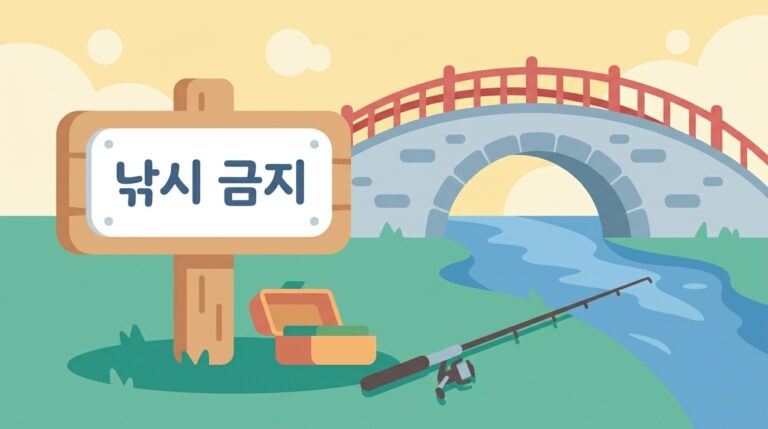
1. 낚시 금지 구역 (Nakssee Geum-jee Goo-yeok)
- Pronunciation: nak-ssi geum-ji gu-yeok (Sounds like: “Knock-she geum-jee goo-yuck”)
- Meaning: No-Fishing Zone / Restricted Fishing Area
- K-Culture Moment: You will see this bold red-and-white phrase on vinyl banners near reservoirs, public parks, and harbors. In Korean dramas, characters looking for a quiet place to clear their heads often end up staring at these signs, sighing because they can’t cast their lines.
- Editor’s Insight: The word 금지 (geum-ji) means prohibition, and 구역 (gu-yeok) means zone. Together, it’s an absolute term. If you see this, do not even unpack your gear! Even holding an assembled rod near the water in these areas might cause locals to give you the “side-eye.”
- Situation Spectrum: Casual: ⚠️ | Semi-formal: ✅ | Formal: ✅
- 🤔 Think About It: In many Western countries, fishing regulations are based on licensing systems. In Korea, it’s heavily zone-based to protect public water sources. How does your country balance environmental protection with recreational hobbies?
2. 과태료가 부과됩니다 (Gwa-tae-ryo-ga Boo-gwa-deom-ni-da)
- Pronunciation: gwa-tae-ryo-ga bu-gwa-deom-ni-da (Sounds like: “Gwah-teh-ryo-gah boo-gwah-deum-nee-dah”)
- Meaning: A fine/administrative penalty will be imposed.
- K-Culture Moment: This is the chilling warning printed in smaller text right under “낚시 금지.” It sounds very official, like a line spoken by a strict officer in a K-thriller.
- Editor’s Insight: While 벌금 (beolgeum) refers to criminal fines, 과태료 (gwa-tae-ryo) refers to administrative civil fines. For fishing violations, you will usually face a 과태료, which can range from 100,000 KRW to 3,000,000 KRW (approx. $75 to $2,200 USD) depending on the area.
- Situation Spectrum: Casual: 🚫 | Semi-formal: ⚠️ | Formal: ✅
- 🤔 Think About It: Korean formal written language often uses the passive voice (부과됩니다 – is imposed) to sound objective and authoritative. How does official signage in your language convey warnings?
3. 단속을 피하다 (Dan-sok-eul Pee-ha-da)
- Pronunciation: dan-sog-eul pi-ha-da (Sounds like: “Dahn-soke-eul pee-hah-dah”)
- Meaning: To evade/avoid crackdowns or inspections.
- K-Culture Moment: In comedy movies, suspicious characters might whisper this when they spot police. However, in real life, trying to “단속을 피하다” is a recipe for disaster.
- Editor’s Insight: 단속 (dan-sok) refers to law enforcement crackdowns or inspections. Korean coastal guards and local district officials carry out regular, unannounced inspections, especially during peak seasons. Trying to avoid them will only lead to heavier penalties.
- Situation Spectrum: Casual: ✅ | Semi-formal: ✅ | Formal: ⚠️
- 🤔 Think About It: Why is public compliance highly valued in Korean society, and how does “눈치” (situational awareness) play a role in following local rules?
Phase 3: Textbook vs. Real Korean (교과서 한국어 vs 진짜 한국어)
Situation 1: Asking if fishing is allowed in a certain spot
- 📖 Textbook Korean: “여기서 낚시를 해도 안전합니까?” (Yeo-gi-seo nak-si-reul hae-do an-jeon-ham-ni-ka? / Is it safe to fish here?)
- 🗣️ Real Korean: “여기 낚시 해도 되는 곳이에요?” (Yeo-gi nak-si hae-do doe-neun got-i-e-yo? / Is this a place where fishing is allowed?)
- 💡 Why the difference? Textbooks focus on safety (안전), but in reality, your main concern is legality. Using “되는 곳” (a place where it is allowed/okay) sounds much more natural to local ears.
Situation 2: Warning a friend about a potential fine
- 📖 Textbook Korean: “당신은 과태료 처분을 받을 것입니다.” (Dang-sin-eun gwa-tae-ryo cheo-bun-eul ba-deul geot-im-ni-da. / You will receive a fine punishment.)
- 🗣️ Real Korean: “여기서 낚시하면 벌금 대박 많이 나와요.” (Yeo-gi-seo nak-si-ha-myeon beol-geum dae-bak man-i na-wa-yo. / If you fish here, you’ll get hit with a crazy huge fine!)
- 💡 Why the difference? Textbook phrasing sounds like a robotic court order. Real friends use “벌금… 나와요” (fines come out) paired with the colloquial intensifier “대박” (crazy/huge) to sound genuinely warning and conversational.
Phase 4: K-Culture Deep Dive & Non-verbal Manners (비언어적 매너)
4-1. Nunchi (눈치) and Coastal Gestures
If you are unsure whether a spot is a restricted zone, use your 눈치 (Nunchi – situational quick-wittedness). Look around. Are there local elderly fishermen (affectionately called * 조사님/josanim* – master anglers) casting their lines? If the area is completely empty of locals despite looking like a perfect spot, that is a huge red flag!
If an officer or local resident approaches you and makes an “X” shape with their forearms, stop immediately. In Korea, this gesture is a universal sign for “Forbidden/No.” Do not argue or make excuses; instead, bow slightly (about 15 degrees) and say “죄송합니다” (joe-song-ham-ni-da – I am sorry) to show respect.
4-2. The “Trot” and Fishing Culture of Korea
In Korea, fishing is deeply connected to Heung (흥 – joy and excitement) and food! Unlike quiet Western fly-fishing, Korean fishing trips often involve listening to Trot music (traditional fast-tempo pop) on small speakers and enjoying 라면 (Ramyun) or 삼겹살 (Samgyeopsal) on the shore. However, because of the littering associated with this, many zones have banned 취사 (chwi-sa – cooking outdoors). Knowing whether a zone bans both fishing and cooking is key to a smooth trip!
Phase 5: Real-Life Roleplay Scenario (실전 롤플레이)
Characters:
- 민우 (Min-woo): Your enthusiastic Korean friend who loves fishing but is sometimes a bit careless.
- 단속원 (Dansokwon): A strict but fair local district officer patrolling the Han River area.
Scenario:
Min-woo has set up his rods in a beautiful, quiet spot near the Han River bridge, unaware that it’s a strictly protected ecological zone.
[Scene: A breezy riverbank near a bridge. Min-woo is adjusting his bait.]

민우: (Excitedly) 와, 날씨 진짜 좋다! 여기서 낚시하면 대물 잡을 것 같아!
      (Wa, nal-ssi jin-jja jot-da! Yeo-gi-seo nak-si-ha-myeon dae-mul ja-beul geot gat-a!)
      "Wow, the weather is amazing! I feel like I'll catch a giant fish here!"

단속원: (Walking over briskly, pointing at a sign) 저기요, 선생님. 여기서 낚시하시면 안 됩니다.
        (Jeo-gi-yo, seon-saeng-nim. Yeo-gi-seo nak-si-ha-si-myeon an doem-ni-da.)
        "Excuse me, sir. You cannot fish here."

민우: (Confused) 네? 왜요? 다른 사람들도 저기 멀리서 하는 것 같은데요?
      (Ne? Wae-yo? Da-reun sa-ram-deul-do jeo-gi meol-ri-seo ha-neun geot gat-eun-de-yo?)
      "Yes? Why? It looks like other people are doing it way over there too."

단속원: (Sighing, tapping the sign board) 저기는 허용 구역이고, 여기는 생태계 보전 구역이라 낚시 금지 구역입니다.
        (Jeo-gwi-neun heo-yong gu-yeok-i-go, yeo-gi-neun saeng-tae-gye bo-jeon gu-yeok-i-ra nak-si geum-ji gu-yeok-im-ni-da.)
        "Over there is an allowed zone, but here is an ecological conservation area, so it's a restricted fishing zone."

민우: (Nervously checking his pockets) 아... 몰랐어요. 한 번만 봐주시면 안 될까요?
      (Ah... mol-las-seo-yo. Han beon-man bwa-ju-si-myeon an doel-ka-yo?)
      "Ah... I didn't know. Could you let me off just this once?"

단속원: (Firmly, taking out an official pad) 여기 현수막도 크게 붙어 있잖아요. 과태료 부과 대상입니다. 신분증 좀 보여주세요.
        (Yeo-gi hyeon-su-mak-do keu-ge but-eo it-ja-na-yo. Gwa-tae-ryo bu-gwa dae-sang-im-ni-da. Sin-bun-jeung jom bo-yeo-ju-se-yo.)
        "There is a big banner hanging right here. You are subject to a fine. Please show me your ID."

민우: (Apologetically bowing) 죄송합니다. 지금 바로 대를 접겠습니다. 정말 몰랐습니다.
      (Joe-song-ham-ni-da. Ji-geum ba-ro dae-reul jeop-get-sseum-ni-da. Jeong-mal mol-las-seum-ni-da.)
      "I am sorry. I will pack up my rods right now. I really did not know."

단속원: (Relenting slightly but writing a warning ticket) 이번에는 경고장으로 처리하겠지만, 다음에는 진짜 벌금 나옵니다. 조심하세요.
        (I-beon-e-neun gyeong-go-jang-eu-ro cheo-ri-ha-get-ji-man, da-eum-e-neun jin-jja beol-geum na-owm-ni-da. Jo-sim-ha-se-yo.)
        "I will process it as a warning letter this time, but next time you will get a real fine. Please be careful."
🔀 Choose Your Adventure!
If you were Min-woo, how would you respond when the officer asks for your ID?
* A. “외국인이라서 몰랐어요! 한국 법 몰라요!” (I didn’t know because I’m a foreigner! I don’t know Korean law!)
* 🚨 Feedback (Bad): Playing the foreigner card aggressively will annoy the officer and likely result in the maximum fine. Korean laws apply to everyone!
* B. “죄송합니다. 제가 낚시 금지 구역 표지판을 못 봤습니다. 바로 정리하겠습니다.” (I am sorry. I didn’t see the no-fishing sign. I will pack up immediately.)
* 🏆 Feedback (Best): Polite, respectful, and cooperative. Showing immediate intent to pack up (대를 접다) is the best way to get a warning instead of a fine.
* C. “벌금 얼마 안 하죠? 그냥 지금 낼게요.” (The fine isn’t much, right? I’ll just pay now.)
* ⚠️ Feedback (Risk): Extremely rude and arrogant. This might escalate the situation, and attempting to hand over cash on the spot can be misunderstood as a bribery attempt.
Phase 6: 10-Second Emotion Shadowing Drill (10초 감정 섀도잉 드릴)
Practice speaking like a native by mimicking the emotional tone and natural pauses (/) below!
- [🥺 Apologetic and desperate for a break]
- 아… 몰랐어요! / 한 번만 / 봐주시면 안 될까요?
- Ah… mol-las-seo-yo! / Han beon-man / bwa-ju-si-myeon an doel-ka-yo?
- “Ah… I didn’t know! Could you let me off / just this once, please?”
- [😊 Genuinely polite and cooperative]
- 죄송합니다! / 지금 바로 / 대를 접겠습니다.
- Joe-song-ham-ni-da! / Ji-geum ba-ro / dae-reul jeop-get-sseum-ni-da.
- “I am sorry! / I will pack up / my rods right now.”
Phase 7: K-Culture Mini-Dictionary (K-Culture 미니 사전)
- 대물 (Dae-mul) | Big Fish / Monster Catch | Used enthusiastically by fishers to describe an exceptionally large catch.
- 손맛 (Son-mat) | The “hand-taste” (Pulling sensation) | The exciting, physical vibration and tension felt through the rod when a fish bites.
- 입질 (Ip-jil) | Nibble / Bite | The action of a fish touching the bait. Koreans say “입질이 오다” (The bites are coming) when they feel lucky.
- 짬낚 (Jjam-nak) | Quick/Spare-time fishing | A compound word of 짬 (spare time) and 낚시 (fishing). It refers to going on a quick 1-2 hour fishing trip after work.
Phase 8: Traveler’s Survival Kit (여행자를 위한 생존 키트)
Survival Phrases TOP 3
- “여기 낚시 금지 구역인가요?” (Yeo-gi nak-si geum-ji gu-yeok-in-ga-yo?)
- Pro Tip: Ask locals nearby before casting your rod to prevent any issues.
- “미끼는 어디서 살 수 있어요?” (Mik-ki-neun eo-di-seo sal su it-eo-yo?)
- Pro Tip: Useful for finding the local bait shop (낚시점/nak-si-jeom).
- “과태료 고지서 주지 마세요, 잘 몰랐어요.” (Gwa-tae-ryo go-ji-seo ju-ji ma-se-yo, jal mol-las-seo-yo.)
- Pro Tip: Use this with a very soft, polite tone to ask for mercy if caught.
Editor’s Travel Note
Before heading out, download the “어신 (Eosin)” app or check the Naver Map App to view official marine and river safety zones. Also, please note that coastal regions often have variable tides that can leave you stranded on rocks, so always check local tide times! (Disclaimer: Local regulations and fine amounts may change based on seasonal municipal laws.)
Phase 9: A Step Deeper (생각 질문)
In Korea, public waterways are treated as shared community spaces. The strictness of “낚시 금지 구역” reflects a collective mindset: protecting the environment so that everyone can enjoy clean nature, rather than prioritizing individual leisure. This is why littering or illegal fishing is highly looked down upon by the public.
💬 Your Turn: Do you prefer strict environmental rules that keep nature pristine, or do you think recreational fishers should have more freedom? Let us know in the comments below!
Phase 10: FAQ & Common Mistakes (FAQ Schema)
Q: Can I fish anywhere if there is no “낚시 금지” sign?
A: Not necessarily! Many ecological reserves, national parks, and harbor walls are designated as restricted zones even without a physical banner. It is always best to check with local bait shops or municipal websites first.
Q: What is the average fine if I get caught?
A: If caught in a strictly restricted zone, you can face an administrative fine starting from 100,000 KRW up to 3,000,000 KRW for repeated offenses.
Q: Can I cook the fish I caught on the shore?
A: No, most public riversides and beaches prohibit “취사” (cooking outdoors with fire). Doing so will yield a separate, heavy fine.
🚨 Common Mistakes Alert!
- Mistaking “No Swimming” for “No Fishing”: Some zones allow fishing but ban swimming. Do not assume they are the same!
- Leaving trash behind: This is the #1 reason why a free fishing zone gets converted into a restricted “낚시 금지 구역” by angry local districts.
- Catching underage fish: Catching fish below the legal size limit (금지체장 – geum-ji-che-jang) is strictly illegal and heavily fined.
Phase 11: Action Mission (참여 유도)
- 🥉 Bronze Mission: Pronounce “여기 낚시 해도 돼요?” (Is fishing allowed here?) out loud three times.
- 🥈 Silver Mission: Share this post on your social media and tag your favorite fishing buddy!
- 🥇 Gold Mission: Next time you pass a river in Korea, look for a red-and-white banner and try to find the word 금지 (Prohibition)!
Phase 12: Interactive Quiz Challenge (인터랙티브 퀴즈)
1. What is the Korean term for a “No-Fishing Zone”?
- A) 생태계 구역 (Saeng-tae-gye Gu-yeok)
- B) 낚시 금지 구역 (Nak-si Geum-ji Gu-yeok)
- C) 낚시 허용 구역 (Nak-si Heo-yong Gu-yeok)
🔍 Show Answer
Correct Answer: B) 낚시 금지 구역
Explanation: 금지 (Geum-ji) means forbidden/no, so 낚시 금지 구역 is the exact term for No-Fishing Zone.
2. True or False: If you are a foreign tourist, you are exempt from paying fishing fines.
- A) True
- B) False
🔍 Show Answer
Correct Answer: B) False
Explanation: Korean administrative laws apply equally to all residents and visitors. Playing the foreigner card will not save you from a 과태료 (fine)!







