

Clear the Air: How to Survive Fine Dust in Korea with ‘공기청정기 켜다’ (A1 Beginner)
Phase 1: Empathy (Your Korean Bestie’s Guide to Breathing Easy)
안녕하세요! (Annyeonghaseyo!) Hello! It’s your Korean bestie and Daily Hangul Editor here.
Picture this: You wake up in your cozy Seoul Airbnb, ready to explore the bustling streets of Hongdae or grab a beautiful sweet potato latte. But you look out the window, and instead of a crisp blue sky, the city is covered in a mysterious grey haze. Your throat feels a little scratchy.
Welcome to 미세먼지 (Mise-meon-ji – Fine Dust) season in Korea.
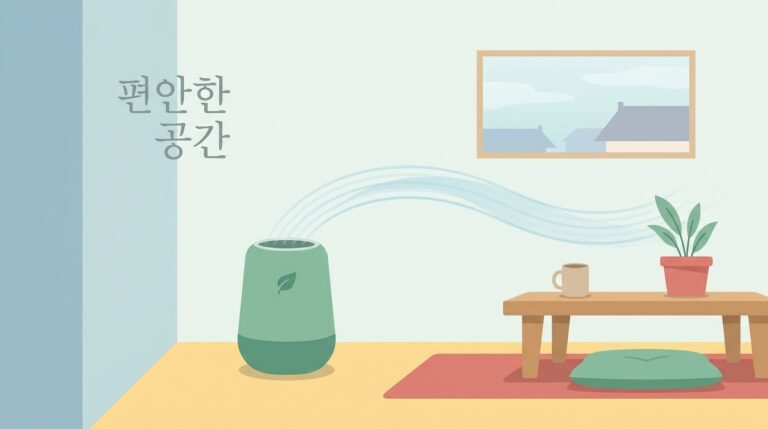
Don’t panic! This is a super common part of daily life in Korea, especially during spring and winter. Every Korean household and cafe has a secret weapon: the 공기청정기 (Gong-gi-cheong-jeong-gi – Air Purifier). Today, we are going to learn how to ask someone to turn on this life-saving machine. By the end of this guide, you’ll be able to keep your lungs happy and sound like a local while doing it! Let’s dive in!
Phase 2: Key Expressions Analysis (The Big Three)
Here are the three most essential phrases you need to survive a dusty day in Korea.
1. 공기청정기 켜 주세요 (Gong-gi-cheong-jeong-gi kyeo ju-se-yo)
- Pronunciation: Gong-gee-cheong-jeong-ghee kyeo joo-seh-yo (Think of “kyeo” as “cure” without the ‘r’ sound).
- Meaning: “Please turn on the air purifier.”
- K-Culture Moment: You will hear this in almost every K-drama office scene when a character walks in coughing dramatically after commuting.
- Editor’s Insight: This is the gold standard phrase. It is polite, clear, and uses the magic helpful pattern -아/어 주세요 (-a/eo ju-se-yo) which means “please do this for me.”
- Situation Spectrum: Casual ⚠️ | Semi-formal ✅ | Formal ✅
- 🤔 Think About It: In English, we say “turn on.” In Korean, we use 켜다 (kyeo-da) for electrical devices. How does your language express turning on appliances?
2. 미세먼지 심해요 (Mise-meon-ji sim-hae-yo)
- Pronunciation: Mee-seh-meon-jee sheem-hae-yo
- Meaning: “The fine dust is bad/severe.”
- K-Culture Moment: This is the ultimate small talk opener in Korea. Instead of talking about the rain, Koreans bond over how bad the air quality is today.
- Editor’s Insight: 심하다 (sim-ha-da) means “to be extreme/severe.” Using this before asking for the air purifier explains why you need it, making you sound incredibly polite and natural.
- Situation Spectrum: Casual ✅ | Semi-formal ✅ | Formal ✅
- 🤔 Think About It: Why do you think talking about fine dust has become a daily social ritual in Korea?
3. 이거 켜도 돼요? (I-geo kyeo-do dwae-yo?)
- Pronunciation: Ee-geo kyeo-doh dwae-yo?
- Meaning: “Can I turn this on?”
- K-Culture Moment: You are studying at a quiet study cafe in Sinchon, and the air purifier next to you is plugged in but turned off. You point to it and ask this to your neighbor.
- Editor’s Insight: 이거 (I-geo) means “this.” -도 돼요? (-do dwae-yo?) is the beginner-friendly way to ask “Is it okay if I…?”
- Situation Spectrum: Casual ✅ | Semi-formal ✅ | Formal ⚠️
- 🤔 Think About It: How does pointing and saying “this” help reduce language anxiety when you are a beginner?
Phase 3: Textbook Korean vs. Real Korean
Let’s look at how textbooks teach this versus how Koreans actually talk in real life!
Situation 1: Asking a friend to turn on the machine
- 📖 Textbook Korean: 공기청정기를 가동해 주십시오. (Gong-gi-cheong-jeong-gi-reul ga-dong-hae ju-sip-si-o.) – “Please operate the air-cleaning machine.” (Too robotic! Nobody talks like this unless they are a manual.)
- 🗣️ Real Korean: 공기청정기 좀 켜 줘. (Gong-gi-cheong-jeong-gi jom kyeo jwo.) – “Turn on the air purifier, please.”
- 💡 Why the difference? Koreans use 좀 (jom – a little/please) as a softener to make requests sound friendlier, and drop particles like 를 (reul) in casual speech.
Situation 2: Expressing that the room is stuffy
- 📖 Textbook Korean: 실내 공기가 탁합니다. (Sil-nae gong-gi-ga tak-ham-ni-da.) – “The indoor air is turbid.”
- 🗣️ Real Korean: 목이 너무 칼칼해요. (Mog-i neo-mu kal-kal-hae-yo.) – “My throat feels so scratchy.”
- 💡 Why the difference? Koreans love sensory and onomatopoeic words. 칼칼하다 (kal-kal-ha-da) perfectly describes that dry, dusty feeling in your throat.
Phase 4: K-Culture Deep Dive & Non-Verbal Manners
4-1. The “Nunchi” (눈치) of Air Quality
In Korea, sharing a space means being considerate of others’ physical comfort.
* The Gesture: If you want to ask to turn on the air purifier, gently clear your throat (not too loudly!), point slightly to the machine, and make soft eye contact with the person closest to it.
* The Mask Etiquette: If the fine dust level is “Bad” (나쁨 – Na-ppeum), it is polite to wear a KF94 mask indoors until the air purifier has cleared the air.
4-2. The “Mise-meon-ji” App Culture
Koreans check the air quality app before they even look out the window. If you want to blend in like a local, download an app like 미세미세 (MiseMise). It uses cute emojis (from a crying devil face for toxic air to a smiling blue face for clean air) to show the daily dust levels.
Phase 5: Real-Life Roleplay Scenario
Setting: You are visiting your Korean friend Minji’s apartment on a hazy afternoon in Seoul.
Characters:
- Minji (민지): Your warm-hearted Korean friend who loves hosting.
- You (학습자): A smart traveler whose throat is feeling a bit dry.
- 민지: 오늘 날씨가 진짜 흐리네요.
(O-neul nal-ssi-ga jin-jja heu-ri-ne-yo.)
(🎭 Sighing while looking out the window)
“The weather is so cloudy today.” -
You: 맞아요. 오늘 미세먼지 심해요?
(Ma-ja-yo. O-neul mise-meon-ji sim-hae-yo?)
(🎭 Touching your throat gently)
“That’s right. Is the fine dust bad today?” -
민지: 네, 오늘 ‘매우 나쁨’ 단계예요.
(Ne, o-neul ‘mae-u na-ppeum’ dan-gye-ye-yo.)
(🎭 Checking her phone)
“Yes, today it is at the ‘Very Bad’ level.” -
You: 어쩐지 목이 너무 칼칼해요.
(Eo-jjeon-ji mog-i neo-mu kal-kal-hae-yo.)
(🎭 Coughing lightly)
“No wonder my throat feels so scratchy.” -
민지: 아, 미안해요! 제가 환기를 시켜놔서 그렇네요.
(A, mi-an-hae-yo! Je-ga hwan-gi-reul si-kyeo-nwa-seo geu-reohn-ne-yo.)
(🎭 Hurrying to close the window)
“Oh, sorry! It’s because I left the window open to ventilate.” -
You: 저기… 공기청정기 좀 켜 주세요.
(Jeo-gi… gong-gi-cheong-jeong-gi jom kyeo ju-se-yo.)
(🎭 Pointing politely to the air purifier)
“Um… please turn on the air purifier.” -
민지: 당연하죠! 바로 켤게요.
(Dang-yeon-ha-jyo! Ba-ro kyeol-ge-yo.)
(🎭 Pressing the power button on the machine)
“Of course! I will turn it on right away.” -
You: 감사합니다! 이제 살 것 같아요.
(Gam-sa-ham-ni-da! I-je sal geot gat-ae-yo.)
(🎭 Smiling and taking a deep breath)
“Thank you! Now I feel like I can live (breathe).”
🔀 Interactive Choice Point!
What would you say if Minji’s air purifier is off, but you want to turn it on yourself?
- Choice A: “내가 켠다!” (Nae-ga kyeon-da!)
- Choice B: “이거 켜도 돼요?” (I-geo kyeo-do dwae-yo?)
- Choice C: “공기 청소해라.” (Gong-gi cheong-so-hae-ra.)
Feedback:
- Choice A (Risk): This means “I turn on!” in a very blunt, rude, non-polite way. Minji might be startled!
- Choice B (Best – Correct!): Perfectly polite! Asking “Can I turn this on?” shows respect for her home while getting the fresh air you need.
- Choice C (Bad): This literally commands, “Clean the air!” as if you are talking to a robot servant. Avoid this!
Phase 6: 10-Second Emotional Shadowing Drill
Let’s practice speaking with real Korean emotion! Pause at the / marks.
- [🥺 Worried and scratchy-voiced]
오늘 / 미세먼지 / 심해요?
(O-neul / mi-se-meon-ji / sim-hae-yo?) -
[😊 Super polite and pleading]
공기청정기 / 좀 / 켜 주세요!
(Gong-gi-cheong-jeong-gi / jom / kyeo ju-se-yo!) -
[😮💨 Relieved and happy]
이제 / 살 것 같아요!
(I-je / sal geot / gat-ae-yo!)
Phase 7: K-Culture Mini Dictionary
- 미세먼지 (Mise-meon-ji) | Fine Dust / Yellow Dust blowing from the desert regions of East Asia.
- 공기청정기 (Gong-gi-cheong-jeong-gi) | Air Purifier. A must-have appliance in 99% of modern Korean homes.
- 마스크 (Ma-seu-keu) | Face Mask. Essential outdoor gear during high-dust days.
- 환기 (Hwan-gi) | Ventilation. The act of opening windows to let fresh air in (but never do this on bad dust days!).
Phase 8: Survivor Kit for Travelers
Survival Phrases TOP 3
- 창문 닫아 주세요. (Chang-mun dad-a ju-se-yo.) | “Please close the window.” (Use this in taxis or cafes on dusty days).
- 오늘 미세먼지 어때요? (O-neul mi-se-meon-ji eo-ttae-yo?) | “How is the fine dust today?”
- 목캔디 있어요? (Mok-kaen-di is-seo-yo?) | “Do you have throat lozenges?” (Buy these at any convenience store to soothe your throat!).
📝 Editor’s Travel Note
Before heading out, download the Naver Map App to check your travel routes. It also displays real-time weather and fine dust warnings directly on the home screen! Also, note that while masks are cheap in Korea, purchasing a designated “KF94” mask from a local pharmacy or GS25 convenience store provides the best protection against micro-particles.
Phase 9:
Frequently Asked Questions (FAQ)
Q: What does "공기청정기 켜 주세요 (Gong-gi-cheong-jeong-gi kyeo ju-se-yo)" mean in Korean and how do you pronounce it?
A: In Korean, "공기청정기 켜 주세요 (Gong-gi-cheong-jeong-gi kyeo ju-se-yo)" is pronounced [Gong-gee-cheong-jeong-ghee kyeo joo-seh-yo (Think of "kyeo" as "cure" without the 'r' sound] and means: "Please turn on the air purifier."
Q: What does "미세먼지 심해요 (Mise-meon-ji sim-hae-yo)" mean in Korean and how do you pronounce it?
A: In Korean, "미세먼지 심해요 (Mise-meon-ji sim-hae-yo)" is pronounced [Mee-seh-meon-jee sheem-hae-yo] and means: "The fine dust is bad/severe."
Q: What does "이거 켜도 돼요? (I-geo kyeo-do dwae-yo?)" mean in Korean and how do you pronounce it?
A: In Korean, "이거 켜도 돼요? (I-geo kyeo-do dwae-yo?)" is pronounced [Ee-geo kyeo-doh dwae-yo?] and means: "Can I turn this on?"







