

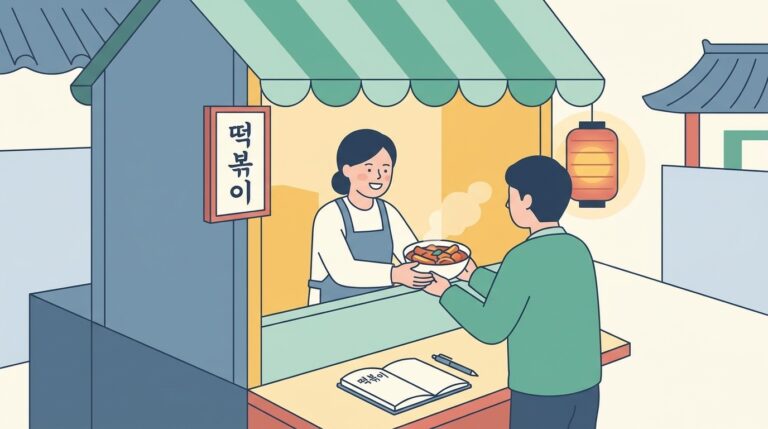
Phase 1: Empathy (Your Friendly Kitchen Companion)
Annyeonghaseyo! (안녕하세요!) I\’m your Daily Hangul Editor and your personal Korean culture guide. Imagine this: You are standing inside a bustling, warm, and delicious-smelling Korean tteokbokki joint in Hongdae. The spicy aroma of simmering rice cakes fills the air, and your mouth is watering.
You step up to the counter. The friendly cashier smiles and asks a rapid-fire question: “드시고 가세요?” (Deusi-go ga-se-yo? – Eating here?)
Suddenly, your mind goes blank. You know you want to sit at that cozy corner table and enjoy your meal, but how do you say “For here, please” naturally without sounding like an outdated textbook?
Don\’t worry! We\’ve all been there. It is one of the most common “sweaty-palm moments” for new learners in Korea. Today, we are going to unlock the perfect, natural way to say “I\’m eating here” so you can order with total confidence. Let\’s dive in!
Phase 2: Deep Dive into 3 Core Expressions
1. 여기서 먹고 갈게요 (Yeo-gi-seo meok-go gal-ge-yo)
- Pronunciation: Yuh-gi-suh muk-go gal-ge-yo (Sounds like “Yo-gi” + “saw” + “muck” + “go” + “gal-gay-yo”)
- Meaning: I will eat here (literally: “I will eat here and then go”).
- K-Culture Moment: You\’ll hear this constantly in K-Dramas whenever friends meet up for lunch at a local convenience store or a cozy kimbap restaurant.
- Editor\’s Insight: This is the most polite, natural, and friendly way to tell a cashier you want to dine in. The ending ~게요 (~ge-yo) shows a friendly promise of your action, making you sound extremely polite and approachable!
- Situation Spectrum: Casual: ⚠️ (Omit “yo” for close friends) | Semi-formal: ✅ (Perfect for restaurants!) | Formal: 🚫
- 🤔 Think About It: Why do you think Koreans say “eat and go” (먹고 갈게요) instead of just “eat here”? It reflects the active, forward-moving pace of daily life in Korea!
2. 포장해 주세요 (Po-jang-hae ju-se-yo)
- Pronunciation: Po-jang-hae joo-seh-yo (Sounds like “poe” + “jahng” + “hay” + “ju-say-yo”)
- Meaning: Please wrap it up / To go, please.
- K-Culture Moment: Think of classic K-Drama scenes where characters bring a box of warm fried chicken to eat by the Han River. They always ask for “포장” (po-jang)!
- Editor\’s Insight: While English speakers say “To go” or “Take out,” Koreans focus on the action of packaging. 포장 (Pojang) means packaging or wrapping.
- Situation Spectrum: Casual: ⚠️ | Semi-formal: ✅ | Formal: ✅
3. 먹고 갈 거예요 (Meok-go gal geo-ye-yo)
- Pronunciation: Muk-go gal guh-yeh-yo
- Meaning: I am going to eat here (I plan to eat and go).
- K-Culture Moment: Used when answering a direct question about your plans at a busy cafe counter.
- Editor\’s Insight: This uses the future tense ~ㄹ 거예요 (~l geo-ye-yo). It is slightly more objective than “갈게요” and sounds like you are stating your pre-decided plan.
- Situation Spectrum: Casual: ⚠️ | Semi-formal: ✅ | Formal: ⚠️
Phase 3: Textbook Korean vs. Real Korean
Let\’s compare what robotic textbooks teach you versus what actual Koreans say at the counter!
Scenario 1: Ordering to eat inside
- 📖 Textbook Korean: 매장에서 식사하겠습니다. (Mae-jang-eseo sik-sa-ha-get-seum-ni-da.)
- “I will dine in the store.” (Sounds like a corporate announcement!)
- 🗣️ Real Korean: 여기서 먹고 갈게요. (Yeo-gi-seo meok-go gal-ge-yo.)
- “I\’ll eat here.” (Natural, warm, and highly conversational.)
- 💡 Why the difference? The textbook version is too formal and grammatically heavy. Real Koreans prefer light, fluid verbs that focus on the simple action of “eating and leaving.”
Scenario 2: Ordering to go
- 📖 Textbook Korean: 테이크아웃 하겠습니다. (Te-i-keu-a-ut ha-get-seum-ni-da.)
- “I will do a take-out.” (Very formal Konglish.)
- 🗣️ Real Korean: 포장해 주세요. (Po-jang-hae ju-se-yo.)
- “Please package it for me.”
- 💡 Why the difference? While “테이크아웃” (Take-out) is understood at modern western-style cafes, local Korean restaurants and street food stalls exclusively use “포장해 주세요.”
Phase 4: K-Culture Deep Dive & Non-verbal Manners
4-1. Nunchi (눈치) & Table Gestures
When saying “여기서 먹고 갈게요”, use your Nunchi (situational quick-wittedness) and non-verbal cues:
1. The Hand Wave: Gently wave your hand toward the seating area inside the restaurant as you say “여기서” (here).
2. Receiving Cards: When paying, always give and receive the credit card or cash with both hands as a sign of respect.
3. The Quick Nod: A slight, polite nod of the head when receiving your buzzer or receipt shows you appreciate their service!
4-2. The “Eco-Cup” Culture Code
Did you know Korea has strict eco-friendly laws? If you say “여기서 먹고 갈게요” (eating here), cafes are legally not allowed to serve your drink in a single-use plastic cup. You will be given a glass or reusable mug. If you try to take this mug outside, it\’s a big etiquette mistake! If you plan to leave soon, always ask for “포장” (to go) beforehand.
Phase 5: Real-Life Roleplay Scenario
Let\’s practice! You are at a hip street-food joint in Seoul called “달콤분식” (Sweet Snack Bar). The friendly owner, Minjun, is ready to take your order.
- Minjun (Cashier): 어서 오세요! 주문 도와드릴까요?
(Eo-seo o-se-yo! Ju-mun do-wa-deu-ril-kka-yo?)- 🎭 Smiling warmly behind the register.
- “Welcome! Can I help you order?”
- You (Customer): 떡볶이 하나 주세요.
(Tteok-bok-ki ha-na ju-se-yo.)- 🎭 Pointing politely at the menu board.
- “One order of tteokbokki, please.”
- Minjun (Cashier): 네, 떡볶이 하나요. 드시고 가세요, 아니면 포장이세요?
(Ne, tteok-bok-ki ha-na-yo. Deu-si-go ga-se-yo, a-ni-myeon po-jang-i-se-yo?)- 🎭 Holding a pen ready to mark the order.
- “Sure, one tteokbokki. Eating here, or is it to go?”
- You (Customer): 여기서 먹고 갈게요!
(Yeo-gi-seo meok-go gal-ge-yo!)- 🎭 Smiling and pointing toward an empty table.
- “I\’ll eat here!”
- Minjun (Cashier): 네, 확인했습니다. 진동벨 가져가세요.
(Ne, hwa-gin-haet-seum-ni-da. Jin-dong-bel ga-jyeo-ga-se-yo.)- 🎭 Handing you a buzz alert with both hands.
- “Okay, noted. Please take this buzzer.”
- You (Customer): 감사합니다!
(Gam-sa-ham-ni-da!)- 🎭 Taking the buzzer with both hands and bowing slightly.
- “Thank you!”
🔀 Choose Your Path!
How do you respond when the cashier asks: “드시고 가세요?” (Eating here?)
- Choice A: “네, 가세요!” (Ne, ga-se-yo!)
- Choice B: “여기서 먹고 갈게요.” (Yeo-gi-seo meok-go gal-ge-yo.)
- Choice C: “그냥 먹을게요.” (Geu-nyang meog-eul-ge-yo.)
Feedback on your choices:
- Choice A (Bad): 🚫 Oh no! “가세요” means “Please go.” You just told the cashier to leave their own shop!
- Choice B (Best): Excellent! You nailed it. This is perfectly natural, polite, and displays great fluency.
- Choice C (Risk): ⚠️ A bit awkward. This translates to “I\’ll just eat.” It\’s a bit blunt and doesn\’t clarify if you want to eat here or take it away.
Phase 6: 10-Second Emotional Shadowing Drill
Let\’s practice speaking with real-life emotions! Pay attention to the pauses (/).
- [😊 Brightly and politely]
- 여기서 / 먹고 / 갈게요!
- Yeo-gi-seo / meok-go / gal-ge-yo!
- [🙏 Quickly and helpfully]
- 포장 / 해주세요!
- Po-jang / hae-ju-se-yo!
Phase 7: K-Culture Mini Dictionary
- 포장 (Po-jang) | Packaging / To-go | Used in any restaurant or market to ask for takeout.
- 매장 (Mae-jang) | The inside store / Shop premises | You\’ll see this on self-service kiosk screens.
- 진동벨 (Jin-dong-bel) | Vibration bell / Buzzer | The small plastic disc that shakes when your food is ready.
- 일회용품 (Il-hoe-yong-pum) | Disposable/Single-use items | Cafes might ask if you need plastic straws or forks.
Phase 8: Survival Kit for Travelers
Top 3 Survival Phrases
- 이거 주세요 (I-geo ju-se-yo)
- This one, please. (Perfect for pointing at menus!)
- 물은 어디에 있어요? (Mul-eun eo-di-e is-seo-yo?)
- Where is the water? (Most Korean places have self-service water stations!)
- 계산해 주세요 (Gye-san-hae ju-se-yo)
- Please check/bill me.
🗺️ Editor\’s Travel Note
When navigating restaurants in Seoul, paper maps won\’t work well. Download the Naver Map App on App Store to find local gourmet spots and view real-time user reviews. Note: Store operations and visual menus on apps may change without prior notice.
Phase 9: “One Step Deeper” (Cultural Reflection)
In Korean food culture, eating is rarely just about “consuming food.” It is a communal, shared experience. Even when you eat simple street food like tteokbokki, sitting in the store (여기서 먹고 갈게요) connects you to the warm, fast-paced rhythm of Korean life. It is an invitation to pause, enjoy the steam rising from your bowl, and watch the world go by.
💬 Your Turn: Do you prefer dining in cozy restaurants, or do you love bringing takeout to a scenic park? Tell us your favorite dining style in the comments below!
Phase 10: FAQ & Mistake Prevention
Q: Can I use “테이크아웃” (Take-out) instead of “포장”?
A: Yes, you can! Most younger staff at modern cafes will understand you perfectly. However, at traditional markets or older local diners, “포장해 주세요” is much more natural and highly appreciated.
Q: What should I say if I change my mind and want to take the leftover food home?
A: You can politely say: “남은 것 포장해 주세요” (Nam-eun geot po-jang-hae ju-se-yo) which means “Please wrap up the remaining food.”
Q: Is tipping required when dining in Korean restaurants?
A: No, absolutely not! Tipping is not a part of Korean culture. Good service is already included in the food price.
🚨 Common Mistakes Board
- Mistake 1: Pointing and saying “여기요!” (Yeo-gi-yo) to mean “Here.”
- Why: “여기요” actually means “Excuse me, over here!” to call a waiter. Don\’t use it to mean “I will eat here.”
- Correct Action: Say “여기서 먹고 갈게요.”
- Mistake 2: Saying “가져가요” (Ga-jyeo-ga-yo) roughly to mean “Takeout.”
- Why: It sounds too blunt or demanding.
- Correct Action: Always use the polite form “포장해 주세요.”
Phase 11: Action Mission
- 🥉 Bronze Mission: Read “여기서 먹고 갈게요” out loud 5 times in front of your mirror with a bright smile!
- 🥈 Silver Mission: Write “여기서 먹고 갈게요” in the comments of our latest Instagram post and tag a friend you want to eat Korean food with.
- 🥇 Gold Mission: Next time you visit a local Korean restaurant or order food in Korean, use this phrase proudly!
🎮 K-Culture Mission: Watch any eating scene (Mukbang) in a K-drama this week and listen closely to see if they say “포장” or “여기서.”
Phase 12: Interactive Quiz Challenge
Let\’s test your knowledge! Try answering these questions before looking at the key.
1. Match the Phrase
What is the most natural way to say “Please wrap it up to go” in Korean?
* A) 여기서 먹고 갈게요
* B) 포장해 주세요
* C) 테이크아웃 없어요
2. True or False
In South Korea, it is legal to use disposable plastic cups when you choose to dine inside a cafe.
* True / False
🔍 Click here to reveal the Answers & Explanations!
- Answer: B) 포장해 주세요 (Po-jang-hae ju-se-yo). This is the ultimate standard phrase for taking food to go!
- Answer: False. To protect the environment, eco-laws prohibit cafes from providing single-use plastic cups for dine-in customers. You must drink from a glass or mug if you stay!







