

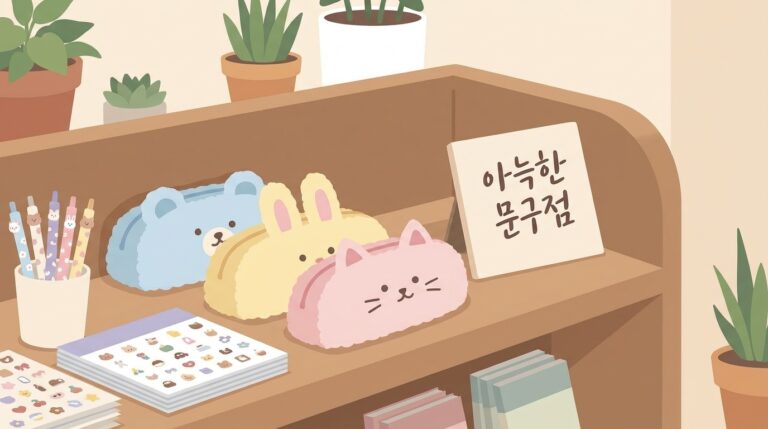
Stationery Store Magic: Finding Your Perfect Korean Pencil Case (필통)
Phase 1: Empathy – A Cute Stationery Adventure!
안녕하세요! (An-nyeong-ha-se-yo!) Hello there, language explorers! It’s your K-Culture Navigator and Daily Hangul Editor, ready to guide you on another fun journey!
Have you ever walked into a Korean stationery store like ARTBOX or Kyobo Hottracks? If you have, you know it is absolute heaven! There are cute characters everywhere, pastel highlighters, and rows of gorgeous notebooks. But then, you see a shelf full of incredibly stylish, fluffy, or minimalist pencil cases. You want to buy one, but you freeze. How do you ask for a pencil case? How do you ask if they have a bigger one or a specific color?
Don’t worry! Many of our actual A1-level students felt intimidated walking into these big, busy stores, thinking they could only point and say “This one.” Today, we’re going to give you the confidence to ask for exactly what you want like a local friend would. Let’s dive in!
Phase 2: Deep Dive into 3 Key Expressions
1. 필통 있어요? (Pil-tong is-seo-yo?)
- Pronunciation: peel-tong ees-suh-yo? (Sounds like “peel” + “tongue” with “is-se-yo”)
- Meaning: Do you have pencil cases? / Is there a pencil case?
- K-Culture Moment: You will hear this friendly
-있어요?structure in almost every K-Drama when a character walks into a local neighborhood shop looking for a specific item. - Editor’s Insight:
필통(pil-tong) comes from the hanja붓 필(brush/pen) and통 통(container). Literally, it’s a “pen container”!-있어요?is the magic key for any beginner in Korea. - Situation Spectrum: Casual (⚠️ – use only with friends: 필통 있어?), Semi-formal (✅ – 필통 있어요?), Formal (🚫)
- 🤔 Think About It: In English, we ask “Do you have…?” but in Korean, we ask “Does it exist?” (
있어요). How does this shift your focus from ownership to existence?
2. 이거 더 큰 거 있어요? (I-geo deo keun geo is-seo-yo?)
- Pronunciation: ee-guh duh keun guh ees-suh-yo?
- Meaning: Do you have a bigger version of this? (Literal: “Is there a bigger thing of this?”)
- K-Culture Moment: Korean aesthetic culture values efficiency. Sometimes a pencil case looks incredibly cute but is too small for all your pens. This phrase is a lifesaver!
- Editor’s Insight:
이거means “this”,더means “more”, and큰 거means “bigger thing”. It’s incredibly handy when shopping for anything in Korea! - Situation Spectrum: Casual (⚠️ – 이거 더 큰 거 있어?), Semi-formal (✅ – 이거 더 큰 거 있어요?), Formal (🚫)
- 🤔 Think About It: Koreans love modifying nouns with adjectives on the spot. Here,
크다(to be big) turns into큰 거(big thing).
3. 다른 색깔도 있어요? (Da-reun saek-kkal-do is-seo-yo?)
- Pronunciation: dah-reun saek-kahl-doh ees-suh-yo?
- Meaning: Are there other colors too?
- K-Culture Moment: Korean stationery brands love releasing products in pastel series (pink, lavender, mint, milk tea). If you see a blue one but want pink, this is your go-to question!
- Editor’s Insight:
다른means “other”,색깔means “color”, and the particle-도means “also/too”. - Situation Spectrum: Casual (⚠️ – 다른 색깔도 있어?), Semi-formal (✅ – 다른 색깔도 있어요?), Formal (🚫)
- 🤔 Think About It: Adding
-도(too/also) is a very polite and natural way to ask for options without sounding demanding.
Phase 3: Textbook Korean vs. Real-Life Korean
Situation 1: Asking for a pencil case
- 📖 Textbook Korean: 필통은 어디에 존재합니까? (Pil-tong-eun eo-di-e jon-jae-hap-ni-kka? – “Where does the pencil case exist?”) – Too robotic and formal!
- 🗣️ 진짜 Korean: 필통 어디 있어요? (Pil-tong eo-di is-seo-yo? – “Where is the pencil case?”)
- 💡 Why the difference? Real Koreans love short, efficient sentences. Dropping unnecessary particles like
-은/는makes you sound 10 times more natural!
Situation 2: Choosing a color
- 📖 Textbook Korean: 저는 분홍색 필통을 원합니다. (Jeo-neun bun-hong-saek pil-tong-eul won-hap-ni-da. – “I desire a pink pencil case.”) – Nobody talks like a 19th-century novel!
- 🗣️ 진짜 Korean: 핑크색 있어요? (Ping-keu-saek is-seo-yo? – “Do you have pink?”)
- 💡 Why the difference? English loanwords like
핑크(Pink) are extremely common and trendy in modern Korea, especially in fashion and stationery!
Phase 4: K-Culture Deep Dive & Non-Verbal Manners
4-1. The “Two-Handed” Card Handover (수줍은 두 손)
When paying for your beautiful new 필통 at the counter, never swipe or toss your card or cash onto the counter. Always hold your payment card with both hands (or support your right wrist/elbow with your left hand) and bow slightly. It shows amazing respect and will immediately make the store clerk smile!
4-2. The “Da-Kku” (다꾸) Culture
Have you heard of 다꾸 (Da-Kku)? It is short for 다이어리 꾸미기 (Diary Decorating). In Korea, decorating your planner, notebook, and even your pencil case with stickers, keyrings (키링), and colorful pens is a massive trend. Your 필통 isn’t just a utility; it’s an extension of your personality!
Phase 5: Real-Life Roleplay Scenario
Setting: A trendy ARTBOX store in Hongdae, Seoul. You are standing in front of the desk organizer section, looking for a fluffy dog-shaped pencil case.
NPC Character: Min-ji (민지) – A helpful, smiley store clerk wearing a cute yellow apron.
- Clerk Min-ji: 어서 오세요! 찾으시는 거 있으세요?
(Eo-seo o-se-yo! Chat-eu-si-neun geo is-seo-se-yo?)
🎭 Smiling warmly, waving slightly.
“Welcome! Are you looking for something?” -
You: 저기… 혹시 필통 어디 있어요?
(Jeo-gi… hok-si pil-tong eo-di is-seo-yo?)
🎭 Pointing politely toward the shelf.
“Excuse me… by any chance, where are the pencil cases?” -
Clerk Min-ji: 아, 필통은 저쪽 코너에 있어요. 같이 갈까요?
(A, pil-tong-eun jeo-jjok ko-neo-e is-seo-yo. Gat-i gal-kka-yo?)
🎭 Walking toward the back of the store.
“Ah, the pencil cases are in that corner over there. Shall we go together?” -
You: 우와, 감사합니다! 이거 진짜 귀여워요.
(U-wa, gam-sa-hap-ni-da! I-geo jin-jja gwi-yeo-wo-yo.)
🎭 Picking up a cute, small bear pencil case.
“Wow, thank you! This is really cute.” -
You: 혹시… 이거 더 큰 거 있어요?
(Hok-si… i-geo deo keun geo is-seo-yo?)
🎭 Holding up the small case with both hands.
“By any chance… do you have a bigger version of this?” -
Clerk Min-ji: 네, 그 디자인은 큰 것도 있어요! 잠깐만요.
(Ne, geu di-ja-in-eun keun geot-do is-seo-yo! Jam-kan-man-yo.)
🎭 Nodding and searching the drawer below.
“Yes, we have a bigger one for that design too! Just a moment.” -
Clerk Min-ji: 여기요! 어때요, 마음에 드세요?
(Yeo-gi-yo! Eo-ttae-yo, ma-eum-e deu-se-yo?)
🎭 Handing you a larger plush pencil case.
“Here you go! How is it, do you like it?” -
You: 네, 완전 마음에 들어요! 다른 색깔도 있어요?
(Ne, wan-jeon ma-eum-e deul-eo-yo! Da-reun saek-kkal-do is-seo-yo?)
🎭 Looking around at other shelves.
“Yes, I absolutely love it! Do you have other colors too?”
🔀 Choose Your Path!
What will you say next to buy the pencil case?
* Option A: “이걸로 주세요! (I-geol-lo ju-se-yo!)” -> I’ll take this one, please!
* Option B: “카드 돼요? (Ka-deu dwae-yo?)” -> Can I pay with a card?
* Option C: “너무 비싸요! (Neo-mu bi-ssa-yo!)” -> It’s too expensive! (At a fixed-price stationery shop)
💡 Feedback on Your Choice:
- Best Choice (A): Perfect! “이걸로 주세요” is the most natural way to lock in your purchase at the counter.
- Good Option (B): Great survival question! Card payment is accepted almost everywhere in Korea, so they will say “Yes!”.
- Risk Option (C): Oh no! Standard stationery chain stores have fixed prices. Asking for a discount might make the clerk super flustered!
Phase 6: 10-Second Emotion Shadowing Drill
Let’s practice speaking with local feelings! Pause at / and emphasize the bold words.
[😊 Excited & Polite]
저기… / 필통 / 어디 있어요?
(Jeo-gi… / pil-tong / eo-di is-seo-yo?)-
[🤔 Curious & Hopeful]
이거 / 더 큰 거 / 있어요?
(I-geo / deo keun geo / is-seo-yo?) -
[💖 Excited & Happy]
와! / 다른 색깔도 / 있어요?
(Wa! / da-reun saek-kkal-do / is-seo-yo?)
Phase 7: K-Culture Mini Dictionary
- 문구점 (Mun-gu-jeom) | Stationery Store | A magical place selling pens, paper, and cute character merchandise.
- 필통 (Pil-tong) | Pencil Case | An essential fashion item for Korean students and office workers.
- 스티커 (Seu-ti-keo) | Stickers | The holy grail of decorating. Used extensively for “Da-Kku” (다꾸).
- 키링 (Ki-ring) | Keyring | Cute plush charms that Koreans hang onto their zippers of their pencil cases or bags.
Phase 8: Survivor’s Travel Kit
Survival Vocab TOP 3
- 펜 (Pen): Pen | Pro Tip: If you need a smooth writing pen, ask for “볼펜 (Bol-pen)”.
- 지우개 (Ji-u-gae): Eraser | Pro Tip: If you dropped yours, say “지우개 주세요 (Ji-u-gae ju-se-yo)”.
- 얼마예요? (Eol-ma-yeo-yo?): How much is it? | Pro Tip: Point to the item while asking this.
Editor’s Travel Note
Before heading out to shop in Seoul, make sure to search for nearby spots on the Naver Map App. Google Maps doesn’t work perfectly in Korea! Search for “소품샵” (Sopoomsop – cute prop/gift shop) or “문구점” (Mungujeom) to find hidden local treasures in places like Yeonnam-dong or Ikseon-dong.
Phase 9: “Going One Step Deeper”
In Korea, stationery is not just for children. Even adults in university or corporate jobs carry incredibly cute or beautifully organized pencil cases. It’s a form of small self-expression in a highly structured society. Carrying a cute pencil case with your favorite character is a low-stress way to bring a little bit of joy into a busy workday or study session.
💬 Your Turn: What kind of pencil case do you prefer? A simple, clean one, or a super fluffy, cute animal one? Let us know in the comments below!
Phase 10: FAQ & Common Mistakes
Q: Can I use “필통” for makeup bags too?
A: Usually, no. A makeup bag is called a “파우치” (pa-u-chi – pouch). “필통” is strictly for writing utensils.
Q: How do I ask if a pen writes well?
A: You can pick up a tester pen and ask, “이거 잘 나와요?” (I-geo jal na-wa-yo?), which means “Does this write/draw well?”
Q: Is it rude to touch the pencil cases on display?
A: Not at all! It is completely normal to touch, feel the texture, and open them to see the inside slots before purchasing.
🚨 Common Mistakes Alert!
- Mistake 1: Saying “Big pencil case” as “큰 필통”. While grammatically okay, if you want a bigger size of the specific one you are holding, say “이거 더 큰 거 (I-geo deo keun geo)”.
- Mistake 2: Forgetting the polite
-요(-yo) ending. Saying just “필통 있어?” to an older store clerk can sound rude!
Phase 11: Action Mission!
- 🥉 Bronze: Say “필통 (Pil-tong)” out loud three times right now!
- 🥈 Silver: Draw your dream pencil case and write “내 필통” (My pencil case) on it, then share it on Instagram tagging #DailyHangul!
- 🥇 Gold: Next time you visit a stationery shop or store, ask the clerk: “이거 다른 색깔도 있어요?” (Even if you already see the other colors! Practice makes perfect!)
Phase 12: Interactive Quiz Challenge
1. What does “필통” (Pil-tong) mean?
- A) Notebook
- B) Pencil Case
- C) Eraser
2. How do you ask “Do you have a bigger one?”
- A) 이거 더 작은 거 있어요? (I-geo deo ja-geun geo is-seo-yo?)
- B) 이거 더 큰 거 있어요? (I-geo deo keun geo is-seo-yo?)
- C) 이거 예뻐요? (I-geo yeo-ppeo-yo?)
🔍 Click here to see the Answers & Explanations!
- Answer: B) Pencil Case. “필” means pen/brush, and “통” means container!
- Answer: B) 이거 더 큰 거 있어요?. “큰 거” means “bigger thing”. Option A is asking for a smaller one (“작은 거”), and Option C asks “Is this pretty?”.







