

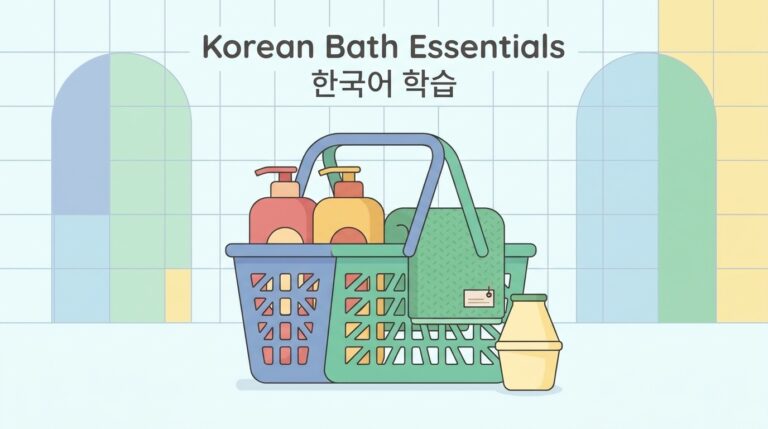
Master the Art of the Korean Bathhouse: Essential Guide to the ‘Mokyok Baguni’ (Bath Basket)
Phase 1: Empathy (Welcome to the K-Bathhouse World! 🛁)
안녕하세요! (Annyeonghaseyo!) Daily Hangul here, your ultimate local guide and Korean bestie!
Have you ever watched a K-Drama where the characters are relaxing in a cozy Korean sauna (Jjimjilbang, 찜질방), wearing cute sheep-head towels, and cracking hard-boiled eggs on their foreheads? It looks amazing, right? But if you decide to visit a local neighborhood bathhouse (Mokyoktang, 목욕탕) to experience the real deal, you might face a sudden, confusing moment at the entrance.
As you walk in, you notice local regulars carrying these colorful, plastic baskets filled with bottles and scrub mitts. You realize the bathhouse doesn’t provide free shampoo or body lotion for free! Don’t panic. Today, we are going to learn how to pack, talk, and behave like a true Korean bathhouse expert. By the end of this guide, you will confidently carry your 목욕 바구니 (Mokyok Baguni – Bath Basket) and blend in like a local!
Phase 2: Deep Dive into 3 Key Expressions
1. 목욕 바구니 챙겼어요? (Mokyok baguni chaeng-gyeot-seo-yo?)
- Pronunciation: moh-kyohk bah-goo-nee chaeng-gyuht-suh-yo? (Sounds like “moh-yok” but with a soft ‘k’ at the end of the first syllable).
- Meaning: “Did you pack/bring your bath basket?”
- K-Culture Moment: You will hear this constantly in neighborhood dramas. A mother asks her daughter before they head out to the local bathhouse on a Sunday morning.
- Editor’s Insight: The verb 챙기다 (chaeng-gida) is a magical Korean word. It means “to pack,” “to take care of,” or “to not forget to bring.” Asking someone if they “chaeng-gyeot-eo” shows warm care.
- Situation Spectrum: Casual (챙겼어? ✅) | Semi-formal (챙겼어요? ✅) | Formal (챙기셨습니까? ⚠️ – a bit too dramatic for bath time!)
- 🤔 Think About It: In Korea, bathhouse visits are often social and communal. Why do you think sharing bath items or asking if someone packed theirs is a sign of closeness in Korean culture?
2. 일회용으로 주세요 (Il-hoe-yong-euro ju-se-yo)
- Pronunciation: eel-hweh-yong-eu-roh joo-seh-yo (Think of “eel” like the fish, and “yong” like the end of ‘gong’).
- Meaning: “Please give me the single-use/disposable ones.”
- K-Culture Moment: When you forget your big bottles at home, you walk up to the counter at the bathhouse entrance and buy tiny, single-use packets of shampoo or conditioner.
- Editor’s Insight: 일회용 (Il-hoe-yong) means “single-use” (literally: one-time use). Adding -으로 (-euro) means “as” or “by choosing.” It’s the perfect phrase when buying travel-sized toiletries.
- Situation Spectrum: Casual (일회용으로 줘 ⚠️) | Semi-formal (일회용으로 주세요 ✅) | Formal (일회용으로 부탁드립니다 ✅)
3. 등 좀 밀어줄래? (Deung jom mireo-jullae?)
- Pronunciation: deung johm mee-ruh-jool-leh? (“Deung” sounds like ‘dung’ but with a flatter ‘eu’ sound).
- Meaning: “Can you scrub my back?”
- K-Culture Moment: The ultimate bonding ritual. Family members or best friends sit on tiny plastic stools and take turns scrubbing each other’s backs with an exfoliating “Italy towel” (이태리 타월).
- Editor’s Insight: 밀다 (milda) means to push, but in a bathhouse context, it means to scrub off dead skin cells (ddaee, 때). Asking someone to scrub your back is the ultimate sign of trust and intimacy in Korea!
- Situation Spectrum: Casual (등 좀 밀어줘 ✅) | Semi-formal (등 좀 밀어주실래요? ⚠️ – used between close older/younger acquaintances) | Formal (🚫 Never use with strangers or in formal settings!)
Phase 3: Textbook Korean vs. Real-Life Korean
Situation 1: Asking if they sell shampoo
- 📖 Textbook: 샴푸를 판매합니까? (Syam-pu-reul pan-mae-hap-ni-ka? – “Do you sell shampoo?”)
- 🗣️ Real-Life: 샴푸 있어요? (Syam-pu isseo-yo? – “Do you have shampoo?”)
- 💡 Why the difference? While the textbook version is grammatically perfect, it sounds like you are a robot reading a store catalog. Simply asking “Do you have…?” is much more natural and friendly.
Situation 2: Asking someone to help scrub your back
- 📖 Textbook: 저의 등을 밀어 주십시오. (Jeo-ui deung-eul mireo ju-sip-si-o. – “Please scrub my back.”)
- 🗣️ Real-Life: 등 좀 밀어줄래? (Deung jom mireo-jullae? – “Can you scrub my back?”)
- 💡 Why the difference? The textbook version sounds like a military command. Using 좀 (jom – please/a little) softens the request and makes it sound natural among friends.
Phase 4: K-Culture Deep Dive & Non-Verbal Manners
4-1. Nunchi (눈치) & Bathhouse Etiquette
- The Visual Check: When you enter the locker room, do not rush. Use your Nunchi (tact/situational awareness). Watch how others rinse themselves before entering the hot tubs.
- The Basket Placement: When you go into the wet bath area, do not leave your bath basket on the edge of the hot tub. Place it on the designated shelves or under the shower station you are actively using.
- Hair Up! If you have long hair, tie it up before entering the hot tubs. Letting your hair float in the communal water is considered a huge etiquette mistake.
4-2. The “Italy Towel” Mystery
Why is the famous exfoliating mitt called an 이태리 타월 (Italy Towel)? In the 1960s, a Korean businessman imported a specific rough viscose fabric from Italy to create a skin-scrubbing glove. It became an instant national sensation! Today, it is an essential item in every Korean’s bath basket.
Phase 5: Real-Life Roleplay Scenario
Setting: The reception desk of “Green Spa” (초록 목욕탕), a cozy neighborhood bathhouse in Seoul.
Character: Min-ji (민지), the friendly bathhouse owner who knows everyone in the neighborhood.
- Min-ji: 어서 오세요! 오늘 날씨가 많이 춥죠?
(Eoseo oseyo! Oneul nalssiga mani chupjyo?)
“Welcome! It’s really cold today, isn’t it?” - You: 네, 너무 추워요. 목욕하러 왔어요.
(Ne, neomu chuwoyo. Mokyok-hareo wasseoyo.)
“Yes, it’s so cold. I’m here to take a bath.” - Min-ji: 앗, 그런데 목욕 바구니 안 가져오셨네요?
(At, geureonde mokyok baguni an gajyeo-osyeot-ne-yo?)
“Ah, but you didn’t bring your bath basket?” - You: (🎭 Embarrassed, scratching your head) 아, 깜빡했어요! 안에서 살 수 있어요?
(Ah, kkam-ppak-haesseoyo! An-eseo sal su isseoyo?)
“Ah, I totally forgot! Can I buy them inside?” - Min-ji: 네, 일회용 샴푸랑 린스 다 팔아요. 어떤 걸로 드릴까요?
(Ne, il-hoe-yong syampu-rang rinseu da parayo. Eotteon geol-ro deurilkka?)
“Yes, we sell single-use shampoo and conditioner. Which ones would you like?” - You: 일회용으로 주세요. 샴푸 하나랑 바디워시 하나요.
(Il-hoe-yong-euro ju-se-yo. Syampu hana-rang badi-wosi hana-yo.)
“Single-use ones, please. One shampoo and one body wash.” - Min-ji: 여기 있어요. 수건 두 장이랑 락커 열쇠도 받아 가세요.
(Yeogi isseoyo. Sugeon du jang-irang rak-keo yeol-soe-do bada gaseyo.)
“Here you go. Take these two towels and your locker key too.” - You: 감사합니다! 따뜻하게 지지고 올게요.
(Gamsahamnida! Ttatteuthage jijigo olgeyo.)
“Thank you! I’ll go warm up my body.”
🔀 Interactive Choice Point
You realize you forgot your exfoliating mitt (Italy Towel). What do you say to Min-ji?
* Option A: “이태리 타월 하나 주세요.” (I-tae-ri ta-wol hana ju-se-yo.)
* Option B: “이탈리아 수건 있어요?” (I-tal-li-a su-geon isseo-yo?)
* Option C: “저기요, 때밀이 장갑 어디서 사요?” (Jeogiyo, ddae-miri jang-gap eodiseo sayo?)
Feedback:
- Best Choice (A): Perfect! “이태리 타월” is the exact cultural term everyone uses. Min-ji will hand you one immediately.
- Literal Translation Risk (B): “이탈리아 수건” literally means “Italian towel.” Min-ji might understand, but she will giggle because it sounds very cute and formal.
- Slightly Aggressive (C): “때밀이 장갑” (scrub glove) is understandable, but “저기요” (excuse me) sounds a bit abrupt if you are already in the middle of a friendly conversation.
Phase 6: 10-Second Emotion Shadowing Drill
Practice speaking with the right emotion and rhythm! / means a short pause.
- [🥺 Realizing your mistake – Sad & Cute]
아, / 깜빡했다! / 목욕 바구니 / 안 가져왔어.
(Ah, / kkam-ppak-haet-da! / moh-kyohk bah-goo-nee / an gah-jyuh-was-suh.) -
[😊 Relieved & Polite]
다행이다! / 일회용으로 / 주세요.
(Dah-haeng-ee-da! / eel-hweh-yong-eu-roh / joo-seh-yo.)
Phase 7: K-Culture Mini Dictionary
- 목욕탕 (Mokyoktang) | Bathhouse | A traditional Korean public bathhouse focused on washing and soaking (different from a large Jjimjilbang which has dry saunas and sleeping areas).
- 이태리 타월 (Italy Towel) | Exfoliating Mitt | The iconic green, yellow, or red textured mitt used to scrub off dead skin.
- 바나나맛 우유 (Banana-mat Uyu) | Banana Flavored Milk | The legendary sweet milk drink that every Korean drinks immediately after coming out of the bath.
- 지지다 (Jijida) | To soak/warm up | A cozy verb used when soaking in hot water or lying on a hot floor to relieve muscle pain.
Phase 8: Survivor Kit for Travelers
Survival Phrases TOP 3
- 수건 더 주세요. (Sugeon deo ju-se-yo.) | “Please give me more towels.”
- 남탕/여탕 어디에요? (Namtang/Yeotang eodi-eyo?) | “Where is the men’s bath/women’s bath?”
- 바나나 우유 하나 주세요. (Banana uyu hana ju-se-yo.) | “One banana milk, please.”
💡 Editor’s Travel Note: To find the best local neighborhood bathhouses, don’t use global maps. Use the KakaoMap App or Naver Map App and search for 목욕탕 near your location. Don’t forget to bring 1,000 to 2,000 KRW in coins/cash for hair dryers, which sometimes require coin insertion!
Phase 9:
Frequently Asked Questions (FAQ)
Q: What does "목욕 바구니 챙겼어요? (Mokyok baguni chaeng-gyeot-seo-yo?)" mean in Korean and how do you pronounce it?
A: In Korean, "목욕 바구니 챙겼어요? (Mokyok baguni chaeng-gyeot-seo-yo?)" is pronounced [moh-kyohk bah-goo-nee chaeng-gyuht-suh-yo? (Sounds like "moh-yok" but with a soft 'k' at the end of the first syllable] and means: "Did you pack/bring your bath basket?"
Q: What does "일회용으로 주세요 (Il-hoe-yong-euro ju-se-yo)" mean in Korean and how do you pronounce it?
A: In Korean, "일회용으로 주세요 (Il-hoe-yong-euro ju-se-yo)" is pronounced [eel-hweh-yong-eu-roh joo-seh-yo (Think of "eel" like the fish, and "yong" like the end of 'gong'] and means: "Please give me the single-use/disposable ones."
Q: What does "등 좀 밀어줄래? (Deung jom mireo-jullae?)" mean in Korean and how do you pronounce it?
A: In Korean, "등 좀 밀어줄래? (Deung jom mireo-jullae?)" is pronounced [deung johm mee-ruh-jool-leh? ("Deung" sounds like 'dung' but with a flatter 'eu' sound] and means: "Can you scrub my back?"







