

Talk Like a Local: Navigating the Bustling Vibe of a Korean Traditional Market!
Phase 1: Empathy (Welcome to the Hustle & Bustle!)
안녕하세요! (Annyeonghaseyo!) Welcome back, my dear friend! It’s your K-culture companion and senior editor from Daily Hangul.
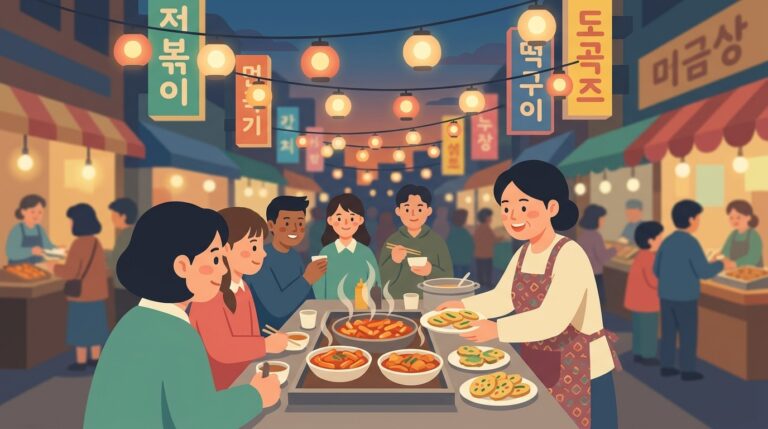
Imagine this: You step into a traditional Korean market (시장 – sijiang) like Mangwon Market or Gwangjang Market. Your senses are immediately hit with the savory aroma of freshly fried jeon (Korean pancakes), the bright reds of spicy tteokbokki, and… a massive wave of people! Merchants are shouting their daily specials, and locals are squeezing past each other. It is loud, alive, and incredibly energetic.
You want to turn to your friend and say, “Wow, this place is so lively and packed!” but your mind goes blank. Standard textbooks only taught you “사람이 많습니다” (There are many people), which feels so cold and clinical. It doesn’t capture the warm, buzzing heart of a true Korean market!
Don’t worry. Today, we are going to learn how to describe that amazing, bustling Korean market vibe like a true local. Our actual learners often tell us, “Once I used these phrases, the market grandmas (이모 – imo) smiled and gave me extra food!” Let’s dive in!
Phase 2: Top 3 Essential Expressions Deep-Dive
1. 사람 진짜 많다! (Saram jinjja manta!)
- Pronunciation: sah-rahm jeen-jjah mahn-tah (Sounds like “sah-ram” + “gin-jah” + “mahn-tah”)
- Meaning: “There are so many people!” / “It’s so crowded!”
- K-Culture Moment: You will hear this in almost every travel K-Variety show (like 2 Days & 1 Night) when the cast members arrive at a famous hot spot.
- Editor’s Insight: While textbook Korean teaches “사람이 많아요,” dropping the subject marker ‘이’ and adding “진짜” (really/honestly) makes you sound instantly natural. Using the casual “~다” ending to yourself or close friends expresses pure exclamation.
- Situation Spectrum: Casual (✅) / Semi-formal (⚠️ – use “사람 진짜 많네요”) / Formal (🚫)
- 🤔 Think About It: In Korea, crowded places are often associated with high energy and good food. How does your culture view crowded markets?
2. 북적북적하네요! (Bukjeok-bukjeokhameyo!)
- Pronunciation: book-jeok-book-jeok-hah-neh-yo (Like “book-juck” repeated twice with a soft “ha-neh-yo”)
- Meaning: “It’s so bustling!” / “It’s buzzing!”
- K-Culture Moment: Often used by food vloggers on YouTube as they pan their camera over a lively street market.
- Editor’s Insight: “북적북적” (bukjeok-bukjeok) is an onomatopoeic/mimetic word describing a place crowded with people moving and talking. Saying this shows you understand the poetic, sensory side of Korean!
- Situation Spectrum: Casual (✅ – 북적북적해) / Semi-formal (✅ – 북적북적하네요) / Formal (⚠️)
- 🤔 Think About It: Onomatopoeias are very popular in Korean to describe feelings. Why do you think Korean has so many words for sounds and movements?
3. 정신없다! (Jeongsin-eopda!)
- Pronunciation: jung-shin-up-dah (Sounds like “jung-shin” + “up-da”)
- Meaning: “It’s chaotic!” / “My mind is spinning!” (Literally: “I have no mind/spirit”)
- K-Culture Moment: Think of a busy scene in a K-drama where a character is trying to navigate a crazy, crowded subway station or market during rush hour.
- Editor’s Insight: This isn’t necessarily negative! It just means there is so much sensory input (sounds, sights, smells) that you can’t focus. It’s the ultimate local way to describe a hectic, fun market.
- Situation Spectrum: Casual (✅) / Semi-formal (⚠️ – use “정신없어요”) / Formal (🚫)
- 🤔 Think About It: Why does “having no spirit” translate to being busy or distracted? It shows how Koreans view mental focus and environment.
Phase 3: Textbook Korean vs. Real-Life Korean
Let’s look at how textbooks compare to what you actually hear on the streets of Seoul!
Situation A: Commenting on the crowd size
- 📖 Textbook: 시장에 사람이 아주 많습니다. (Sijange sarami aju manksumnida.) – “There are very many people in the market.”
- 🗣️ Real Life: 와, 여기 사람 대박 많다! (Wa, yeogi saram daebak manta!) – “Wow, there are super many people here!”
- 💡 Why the difference? Textbooks teach formal written forms. Locals use “대박” (daebak – awesome/huge jackpot) as an intensifier to show genuine excitement.
Situation B: Describing the noisy, lively atmosphere
- 📖 Textbook: 이곳은 소란스럽습니다. (Igoseun soranseuropsumnida.) – “This place is noisy.”
- 🗣️ Real Life: 여기 진짜 시끌벅적하네요! (Yeogi jinjja sikkeul-beok-jeok-ha-ne-yo!) – “It’s really noisy and lively here!”
- 💡 Why the difference? “소란스럽다” sounds like a complaint or a police report. “시끌벅적하다” captures the cheerful, chaotic, and friendly noise of a happy crowd.
Phase 4: K-Culture Deep-Dive & Non-Verbal Manners
4-1. The Art of
Frequently Asked Questions (FAQ)
Q: What does "사람 진짜 많다! (Saram jinjja manta!)" mean in Korean and how do you pronounce it?
A: In Korean, "사람 진짜 많다! (Saram jinjja manta!)" is pronounced [sah-rahm jeen-jjah mahn-tah (Sounds like "sah-ram" + "gin-jah" + "mahn-tah"] and means: "There are so many people!" / "It's so crowded!"
Q: What does "북적북적하네요! (Bukjeok-bukjeokhameyo!)" mean in Korean and how do you pronounce it?
A: In Korean, "북적북적하네요! (Bukjeok-bukjeokhameyo!)" is pronounced [book-jeok-book-jeok-hah-neh-yo (Like "book-juck" repeated twice with a soft "ha-neh-yo"] and means: "It’s so bustling!" / "It’s buzzing!"
Q: What does "정신없다! (Jeongsin-eopda!)" mean in Korean and how do you pronounce it?
A: In Korean, "정신없다! (Jeongsin-eopda!)" is pronounced [jung-shin-up-dah (Sounds like "jung-shin" + "up-da"] and means: "It's chaotic!" / "My mind is spinning!" (Literally: "I have no mind/spirit")







