

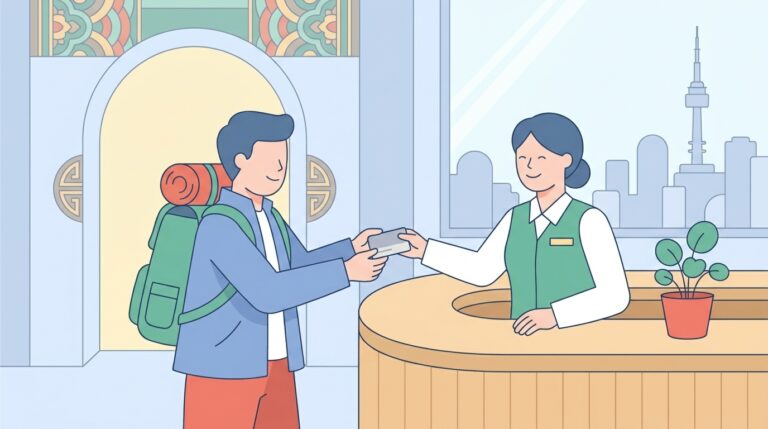
Lost Your Hotel Room Key? No Panic! Simple A1 Korean Phrases to Save Your Day
Phase 1: Empathy (스토리 몰입형 오프닝)
안녕하세요! Welcome back to another friendly guide from Daily Hangul, your cozy Korean-learning corner. I’m your senior editor, your virtual Korean bestie!
Imagine this: You’ve had a magical, long day exploring the bustling streets of Hongdae, eating delicious street food in Myeongdong, and taking countless aesthetic photos. You finally arrive back at your gorgeous hotel, ready to crash onto that fluffy bed. You reach into your pocket… and cold sweat. Your hotel card key is gone. 😱
Your heart races, and you stare at the front desk. “How do I explain this in Korean? Will they be mad?”
Don’t worry! This is a super common mishap, and Korean hotel staff are incredibly helpful and used to this. Today, we are going to learn exactly what to say so you can get a brand-new key in less than 30 seconds, even if you are an absolute beginner (A1). Based on feedback from hundreds of our travelers, these three phrases are absolute life-savers!
Phase 2: 핵심 표현 3선 심층 분석 (3 Core Expressions)
Let’s break down the three magic phrases you need to know.
1. 방 키 잃어버렸어요 (방 키 잃어버렸어요)
- Pronunciation: Bang ki ireobeoryeosseoyo. (Sounds like: “Bahng kee ee-ruh-buh-ryuh-ssuh-yo”)
- Meaning: “I lost my room key.”
- K-Culture Moment: You might hear this in a romantic K-drama when the main leads accidentally get locked out of their room, leading to a heart-fluttering moment in the hallway!
- Editor’s Insight: The word 방 (bang) means room, and 키 (ki) is just the English word “key” written in Korean. 잃어버렸어요 (ireobeoryeosseoyo) means “I lost it.” The “-어버리다” grammar part shows that you did something accidentally and feel a bit sorry or regretful about it. It naturally sounds very polite and sincere!
- Situation Spectrum: Casual ⚠️ (방 키 잃어버렸어) | Semi-formal ✅ (방 키 잃어버렸어요) | Formal ✅ (방 키를 분실했습니다)
- 🤔 Think About It: In English, we just say “I lost my key.” But in Korean, expressing your regret through the verb structure itself (잃어버렸어요) builds instant empathy with the listener. How does your language express accidental regrets?
2. 카드 키 하나 더 주실 수 있나요? (카드 키 하나 더 주실 수 있나요?)
- Pronunciation: Kadeu ki hana deo jusil su innayo? (Sounds like: “Kah-deu kee ha-na duh joo-shil soo een-nah-yo?”)
- Meaning: “Can I get one more card key?”
- K-Culture Moment: If you are staying with a friend but want to go out separately to explore a late-night Hanriver convenience store, this is the exact phrase you need.
- Editor’s Insight: 하나 더 (hana deo) means “one more.” 주실 수 있나요? (jusil su innayo?) is the golden beginner-friendly phrase for “Can you please give me…?” in a super soft, polite tone.
- Situation Spectrum: Casual ⚠️ (카드 키 하나 더 줘) | Semi-formal ✅ (카드 키 하나 더 주실 수 있나요?) | Formal ✅ (카드 키를 추가로 발급해 주시겠습니까?)
- 🤔 Think About It: Notice how “주실 수 있나요?” uses the honorific “시 (si)” to show respect to the hotel staff. It’s a great way to show your polite manners!
3. 방 번호는 502호예요 (방 번호는 502호예요)
- Pronunciation: Bang beonhoneun o-baek-i-ho-yeyo. (Sounds like: “Bahng buhn-ho-noon oh-baek-ee-ho-yeh-yo.”)
- Meaning: “My room number is 502.”
- K-Culture Moment: In Korean hotels, they will always ask for your room number to verify your identity before handing over a new key.
- Editor’s Insight: 방 번호 (bang beonho) means room number. 호 (ho) is the counter used specifically for room/house numbers. To say your room number, you just say the Sino-Korean numbers (일, 이, 삼, 사, 오…) followed by 호예요 (ho-yeyo).
- Situation Spectrum: Casual ⚠️ (방 번호 502호야) | Semi-formal ✅ (방 번호는 502호예요) | Formal ✅ (방 번호는 502호입니다)
- 🤔 Think About It: Koreans read room numbers digit-by-digit or as a whole number. 502 can be “오-영-이 호” (Five-Zero-Two) or “오백이 호” (Five hundred and two). Don’t worry, both work perfectly!
Phase 3: 교과서 한국어 vs 진짜 한국어 (Textbook vs. Real Korean)
Let’s compare stiff, textbook Korean with what you’ll actually hear and use!
Situation 1: Reporting the lost key
- 📖 교과서 한국어 (Textbook): “객실 열쇠를 분실하였습니다.” (Gaeksil yeolsoereul bunsilhayeotseumnida. – “I have lost the guest room key.”)
- Why it’s stiff: This sounds like a formal police report or a written document. If you say this, the receptionist might think you are a robot!
- 🗣️ 진짜 한국어 (Real Life): “방 키 잃어버렸어요.” (Bang ki ireobeoryeosseoyo. – “I lost my room key.”)
- 💡 왜 다를까? It’s friendly, immediate, and perfectly natural for daily life conversational interactions.
Situation 2: Asking for a reissue
- 📖 교과서 한국어 (Textbook): “카드 키를 재발급해 주십시오.” (Kadeu kireu jaebalgeup-hae jusipsio. – “Please re-issue the card key.”)
- Why it’s stiff: “재발급 (re-issue)” is highly bureaucratic and sounds demanding.
- 🗣️ 진짜 한국어 (Real Life): “새로 하나 해 주세요.” (Saero hana hae juseoyo. – “Please make a new one for me.”)
- 💡 왜 다를까? “새로 (newly/freshly) 하나 (one) 해 주세요 (please do/make for me)” is incredibly natural and conversational.
Phase 4: K-Culture 딥다이브 & 비언어적 매너 (Cultural Insights)
4-1. 눈치 (Nunchi) & Gestures
When interacting with Korean hotel staff, your body language speaks volumes.
* The Two-Hand Rule: In Korea, whenever you receive your new card key, always accept it with both hands. You can place your left hand gently under your right forearm as a sign of respect.
* The Polite Head Nod: When saying “감사합니다” (Thank you), a slight, gentle nod of your head (about 15 degrees) shows wonderful manners and will instantly make the staff smile.
4-2. The Digital Card Culture in Korea
Korea is highly digitalized. Most modern hotels use sleek contactless RFID cards, and some boutique hotels even use smartphone-based digital keys! Because of this, losing a plastic card key is extremely common and usually doesn’t carry a heavy penalty. The staff can instantly deactivate your lost card and program a new one in 5 seconds. So, take a deep breath—nobody is mad at you!
Phase 5: 실전 롤플레이 시나리오 (Interactive Roleplay)
Let’s practice! You are standing at the front desk of Hotel Moonlight in Hongdae. The receptionist, Minho (민호), is smiling warmly at you.
민호: 안녕하세요! 무엇을 도와드릴까요?
      (Annyeonghaseyo! Mueoseul dowadeurilkkayo?)
      [🎭 Smiling warmly behind the desk]
      "Hello! How can I help you?"

나: 저기... 방 키 잃어버렸어요.
    (Jeogi... bang ki ireobeoryeosseoyo.)
    [🎭 Looking slightly embarrassed, rubbing the back of your neck]
    "Um... I lost my room key."

민호: 아, 괜찮습니다! 혹시 몇 호실이세요?
      (Ah, gwenchansumnida! Hoksi myeot hosiriseyo?)
      [🎭 Nodding reassuringly, typing on the computer]
      "Oh, that's okay! What room number are you in?"

나: 방 번호는 304호예요.
    (Bang beonhoneun sam-baek-sa-hoyeyo.)
    [🎭 Pointing slightly upwards towards the elevator]
    "My room number is 304."

민호: 성함이 어떻게 되세요?
      (Seonghami eotteoke doeseyo?)
      [🎭 Looking at the monitor with a polite smile]
      "May I have your name, please?"

나: 제 이름은 Eugene 이에요.
    (Je ireumeun Eugene-ieyo.)
    [🎭 Speaking clearly, presenting your passport if needed]
    "My name is Eugene."

민호: 네, 확인되었습니다. 여기 새 카드 키 있습니다.
      (Ne, hwagindoeeotseumnida. Yeogi sae kadeu ki itseumnida.)
      [🎭 Handing over the card key using both hands]
      "Yes, confirmed. Here is your new card key."

나: 감사합니다! 정말 감사합니다.
    (Gamsahamnida! Jeongmal gamsahamnida.)
    [🎭 Receiving the key with both hands and bowing slightly]
    "Thank you! Thank you so very much."
🔀 Interactive Choice Point! What do you say next?
- Option A: “돈 내야 돼요?” (Don naeya dweyo? – “Do I have to pay money?”)
- Feedback (Risk): It’s direct, but a bit blunt. Better to ask “추가 비용이 있나요?” (Chuga biyongi innayo? – “Is there an extra charge?”) if you are worried about fees.
- Option B: “카드 키 하나 더 주실 수 있나요?” (Kadeu ki hana deo jusil su innayo? – “Can I get one more card key?”)
- Feedback (Best!): Perfect! If you are sharing the room, having a spare card is always a smart idea.
- Option C: “방 키 줘요.” (Bang ki jwoyo. – “Give me room key.”)
- Feedback (Bad): Too demanding! It lacks politeness. Stick to “~주세요” or “~주실 수 있나요?”
Phase 6: 10초 감정 섀도잉 드릴 (10-Second Shadowing)
Speak with feeling! Try matching the emotional cues and pauses (/ marks a tiny pause to breathe).
방 키 / 잃어버렸어요...- [🥺 Apologetic & cute, looking a bit sad]
- Bang ki / ireobeoryeosseoyo…
카드 키 / 하나 더 / 주실 수 있나요?- [😊 Hopeful and extremely polite, with a bright smile]
- Kadeu ki / hana deo / jusil su innayo?
Phase 7: K-Culture 미니 사전 (Mini Dictionary)
- 프런트 데스크 (Peureonteu deseukeu) | Front Desk
- Korea uses many English words adapted to the Korean alphabet (Konglish). Just say “프런트” (Peureonteu) and everyone will understand!
- 여권 (Yeogwon) | Passport
- If you lose your key, the staff will often ask for your “여권” to verify your identity.
- 잃어버리다 (Ireobeorida) | To lose (something)
- A vital verb for travelers. Use it for bags, wallets, or passports!
- 새로 (Saero) | Newly / Freshly
- Used whenever you want something brand new, like “새로 해주세요” (Please make it new).
Phase 8: 여행자를 위한 생존 키트 (Survival Kit)
Survival Phrases Top 3
- 도와주세요! (Dowajuseoyo!) – “Help me!”
- 문이 안 열려요. (Muni an yeollyeoyo.) – “The door won’t open.”
- 비밀번호가 뭐예요? (Bimilbeonhoga mwoyeyo?) – “What is the password?” (Great for hotel Wi-Fi!)
📝 Editor’s Travel Note:
When traveling in Korea, Google Maps won’t work well due to security laws. For seamless navigation to your hotel, make sure to use the 네이버 지도 앱 다운로드 (Naver Map App) to find your way back easily!
(Note: App interfaces and details are subject to updates by developers.)
Phase 9: “한 발 더 깊이” (Cultural Essay)
In Western countries, losing a hotel key can sometimes feel like an annoying bureaucratic process. However, in Korea, the hotel service culture is heavily centered around extreme hospitality and efficiency. The staff will prioritize solving your problem immediately so you do not experience discomfort. This is rooted in the Korean concept of 정 (Jeong)—a warm feeling of attachment and mutual care.
💬 Your Turn: Have you ever lost something in Korea? How did the people help you? Let us know in the comments below! We love reading your stories!
Phase 10: FAQ & 오해 방지 (FAQ Schema)
Q: Do Korean hotels charge you for losing a plastic card key?
A: In 95% of cases, no. Modern card keys are cheap to reproduce, and hotels treat them as consumable items. However, some traditional Hanok guesthouses with physical brass keys may charge a replacement fee.
Q: Can I get a replacement key if my roommate is already in the room?
A: Yes! Simply go to the front desk, say “카드 키 하나 더 주실 수 있나요?” (Can I get one more card key?), and provide your room number and name.
Q: What if I forget my room number entirely?
A: Don’t worry. Go to the front desk, show your ID/Passport, and they will look up your room number instantly.
🚨 Common Mistakes Alert!
- Saying “방 키 잃었어요” (X): While “잃었어요” is grammatically okay, “잃어버렸어요” is far more natural for expressing accidental loss.
- Shouting “저기요!” (X) aggressively: Use “저기…” (Excuse me…) softly to politely grab the receptionist’s attention.
- Using Banmal (Casual language) (X): Avoid saying “방 키 잃어버렸어.” Always end with “~요” (~yo) to show respect to the staff.
Phase 11: 액션 미션 & 참여 유도 (Action Mission)
- 🥉 Bronze Mission: Read the 3 core expressions out loud 3 times in front of your mirror!
- 🥈 Silver Mission: Write “방 키 잃어버렸어요” in the comment section below from memory!
- 🥇 Gold Mission: Next time you watch a K-drama set in a hotel, listen closely to see if you can hear the word “방” (room) or “키” (key)!
Phase 12: 인터랙티브 퀴즈 챌린지 (Interactive Quiz)
Let’s test your skills!
1. What is the most natural way to say “I lost my room key” in Korean?
- A) 방 키 잃었어요
- B) 방 키 잃어버렸어요
- C) 방 키 분실해요
🔍 Click to see the Answer & Explanation
Correct Answer: B) 방 키 잃어버렸어요
Explanation: “잃어버렸어요” is the perfect, natural colloquial expression showing accidental loss with a touch of polite regret.
2. True or False: You should use both hands when receiving a new key card in Korea.
- A) True
- B) False
🔍 Click to see the Answer & Explanation
Correct Answer: A) True
Explanation: Using both hands is a vital sign of respect and good manners in Korean culture!






