

Listening to History: How to Understand Korean Historical Sites Like a Local
Phase 1: Empathy (Welcome back, my friend!)
안녕하세요! (An-nyeong-ha-se-yo!) I’m your Daily Hangul editor and your local culture guide.
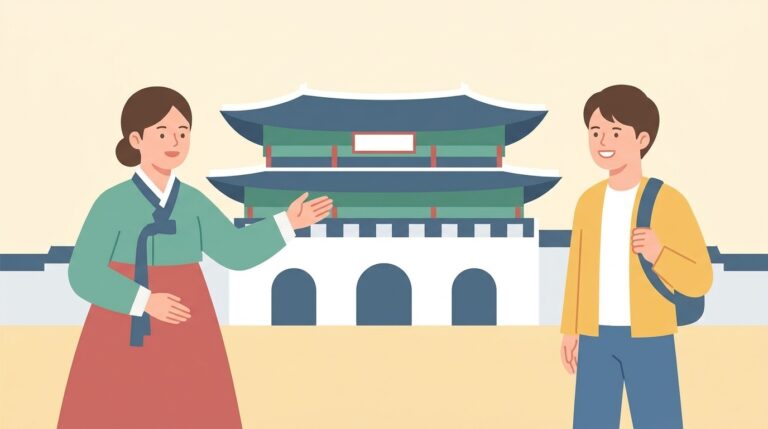
Imagine walking through Gyeongbokgung Palace in Seoul. The autumn wind gently blows, the red and green paint of the wooden palace glows in the sunlight, and you are surrounded by people wearing beautiful Hanbok. You see a guide explaining the rich history behind the throne room, but you feel completely lost. You want to ask questions or at least follow along with the basic explanation, but textbook Korean feels too stiff.
Don’t worry! Today, we are going to learn how to ask for and understand historical explanations in easy, natural A2-level Korean. By the end of this guide, you will feel confident interacting with local guides and making your travel memories much richer!
Phase 2: 3 Key Expressions Deep Dive
Let’s learn three simple but powerful expressions you can use at any historical site in Korea.
1. 여기는 어떤 곳이에요? (Yeo-gi-neun eo-tteon gos-i-e-yo?)
- Pronunciation Analogy: “Yuh-ghee-noon ut-tuhn gosh-ee-yo?” (Sounds like “ghee” as in clarified butter, and “gosh” with a soft ‘ee’ at the end).
- Meaning: What kind of place is this?
- K-Culture Moment: In K-Dramas, whenever a modern character travels back in time to the Joseon Dynasty, they look around in confusion and ask this exact question.
- Editor’s Insight: This is much more natural than asking “What is the history of this place?” It’s friendly and invites the listener to give a brief, easy-to-understand summary.
- Situation Spectrum: Casual (✅ with friends) | Semi-formal (✅ to a guide) | Formal (⚠️)
- 🤔 Think About It: In English, we often ask “What is this place?” directly. In Korean, adding “어떤” (what kind of / what sort of) makes the question sound softer, showing curiosity and respect for the location.
2. 설명해 주세요. (Seol-myeong-hae ju-se-yo.)
- Pronunciation Analogy: “Suhl-myung-hae joo-seh-yo.” (Think of “Suhl” like the first syllable of Seoul, and “joo-seh-yo” like “juice” + “hey-yo”).
- Meaning: Please explain (this to me).
- K-Culture Moment: You will hear tourists say this to local guides wearing traditional vests at palaces, or even at museum reception desks.
- Editor’s Insight: “주세요” means “please give me.” By combining it with “설명해” (explain), you are politely asking someone to give you the gift of knowledge!
- Situation Spectrum: Casual (⚠️) | Semi-formal (✅ highly recommended) | Formal (✅)
- 🤔 Think About It: Koreans love sharing their history. Simply saying “설명해 주세요” with a warm smile will instantly turn any local guide into an enthusiastic storyteller!
3. 언제 만들어졌어요? (Eon-je man-deul-eo-jyeos-seo-yo?)
- Pronunciation Analogy: “Uhn-jeh mahn-deul-uh-jyuss-uh-yo?” (Sounds like “Uhn” as in under, and “jyuss” like juice with a ‘y’ sound).
- Meaning: When was it made / built?
- K-Culture Moment: On popular Korean travel shows like 2 Days & 1 Night, cast members frequently ask this when visiting ancient temples.
- Editor’s Insight: While “만들다” means to make, “만들어지다” means to be made/built. It is the most natural way to ask about the age of a palace, pagoda, or statue.
- Situation Spectrum: Casual (✅) | Semi-formal (✅) | Formal (⚠️)
- 🤔 Think About It: Why do we ask “when was it made” instead of “which century”? In Korean, asking for the action of creation (“만들어지다”) feels much more vivid and connected to the people who built it.
Phase 3: Textbook Korean vs. Real Korean
Let’s compare stiff textbook phrases with what Koreans actually say in real life.
Scenario 1: Asking when a building was constructed
- 📖 Textbook Korean: 이 건물은 몇 년도에 건립되었습니까? (I geon-mul-eun myeot nyeon-do-e geon-립-doe-eot-seup-ni-ka? / In what year was this building erected?)
- 🗣️ Real Korean: 이거 언제 지어졌어요? (I-geo eon-je ji-eoh-jyeot-seo-yo? / When was this built?)
- 💡 Why is it different? “건립” (erection/construction) is a heavy Hanja (Chinese characters) word. In real life, locals use the simple verb “짓다” (to build) in its passive form “지어지다” (to be built).
Scenario 2: Asking if there is a guided tour
- 📖 Textbook Korean: 문화유산 해설 서비스가 제공됩니까? (Mun-hwa-yu-san hae-seol seo-bi-seu-ga je-gong-doep-ni-ka? / Is cultural heritage commentary service provided?)
- 🗣️ Real Korean: 설명 들을 수 있을까요? (Seol-myeong deu-reul su is-seul-kka-yo? / Can I listen to an explanation?)
- 💡 Why is it different? Koreans prefer soft, indirect questions using “~을 수 있을까요?” (Could I possibly…?) instead of asking for official “services.”
Phase 4: K-Culture Deep Dive & Non-verbal Manners
4-1. Nunchi & Respectful Gestures at Historical Sites
- The Soft Nod: When a guide is explaining, Koreans don’t just stand still. They lightly nod their heads while making soft agreement sounds like “아~” (Ah~) or “그렇구나” (I see). This shows you are actively engaged.
- Two-Handed Pointing: If you want to point at a beautiful detail on a palace ceiling, do not use a single index finger. Instead, open your hand with palm facing slightly up and point with your whole hand. This is a sign of deep respect for sacred or historical spaces.
4-2. Cultural Code: The Joseon Dynasty in K-Dramas
Most palaces you visit in Seoul (like Gyeongbokgung or Changdeokgung) belong to the Joseon Dynasty (조선왕조). When you see the king’s throne, you might notice a painting of five mountain peaks, a sun, and a moon. This is called Irworobongdo (일월오봉도). Knowing this small detail and saying “일월오봉도 맞아요?” (Is this Irworobongdo?) to a guide will instantly make you their favorite visitor!
Phase 5: Real-world Roleplay Scenario
Meet Min-su (민수), a friendly volunteer guide at Gyeongbokgung Palace. Let’s practice talking to him!
- 🎭 Min-su (Guide): 안녕하세요! 경복궁에 오신 것을 환영합니다. (An-nyeong-ha-se-yo! Gyeong-bok-gung-e o-sin geos-eul hwan-yeong-ham-ni-da.)
[😊 Smiling warmly and bowing slightly] - 🎭 You: 안녕하세요! 여기 정말 아름다워요. (An-nyeong-ha-se-yo! Yeo-gi jeong-mal a-reum-da-wo-yo.)
[😲 Looking around in awe] - 🎭 Min-su (Guide): 감사합니다. 여기가 바로 왕이 일하던 곳이에요. (Gam-sa-ham-ni-da. Yeo-gi-ga ba-ro wang-i il-ha-deon gos-i-e-yo.)
[👉 Pointing with an open hand toward the main hall] - 🎭 You: 아, 그렇군요! 여기는 어떤 곳이에요? (Ah, geu-reot-gun-yo! Yeo-gi-neun eo-tteon gos-i-e-yo?)
[💡 Nodding your head to show interest] - 🎭 Min-su (Guide): 이곳의 이름은 근정전입니다. 국가 행사를 하던 곳이죠. (I-gots-ui i-reum-eun Geun-jeong-jeon-im-ni-da. Guk-ga haeng-sa-reul ha-deon gos-i-jyo.)
[📖 Gesturing towards the grand courtyard] - 🎭 You: 우와, 신기해요! 이거 언제 지어졌어요? (U-wa, sin-gi-hae-yo! I-geo eon-je ji-eoh-jyeot-seo-yo?)
[✨ Eyes shining with curiosity] - 🎭 Min-su (Guide): 1395년에 처음 지어졌지만, 나중에 다시 지었어요. (Cheon-sam-baek-gu-sip-o-nyeon-e cheo-eum ji-eoh-jyeot-ji-man, na-jung-e da-si ji-eot-seo-yo.)
[☝️ Raising one finger to emphasize the year] - 🎭 You: 그렇군요! 조금 더 설명해 주세요. (Geu-reot-gun-yo! Jo-geum deo seol-myeong-hae ju-se-yo.)
[🙏 Placing your hands together politely]
🔀 Choose Your Path!
What will you say next to Min-su?
* A) “진짜 오래되었네요! 감사해요.” (Jin-cha o-rae-doe-eot-ne-yo! Gam-sa-hae-yo.)
* B) “이거 진짜예요?” (I-geo jin-cha-ye-yo?)
* C) “너무 지루해요.” (Neo-mu ji-ru-hae-yo.)
Select your answer to see the feedback:
* Path A (Best!): Perfect! You acknowledged the long history (“Wow, it’s really old!”) and thanked the guide. Min-su will likely offer to take a photo of you in front of the palace!
* Path B (Risk): Meaning “Is this real/authentic?” While not rude, it might sound a bit skeptical about the historical restoration. Better to ask “reconstructed” (복원되었어요?).
* Path C (Bad!): Meaning “It’s so boring.” This is highly impolite and will hurt the volunteer guide’s feelings!
Phase 6: 10-second Emotion Shadowing Drill
Let’s practice speaking with real Korean feelings! Pay attention to the pauses (/) and the emotional tones.
- [😲 Amazed and Curious]
- 우와! / 여기 / 진짜 / 예뻐요!
- (U-wa! / Yeo-gi / jin-jja / ye-bpeo-yo!)
- “Wow! This place is really pretty!”
- [😊 Friendly and Polite]
- 조금 더 / 설명해 / 주세요.
- (Jo-geum deo / seol-myeong-hae / ju-se-yo.)
- “Please explain a little bit more.”
- [💡 Nodding in understanding]
- 아~ / 그렇군요! / 감사합니다.
- (Ah~ / geu-reot-gun-yo! / gam-sa-ham-ni-da.)
- “Ah, I see! Thank you.”
Phase 7: K-Culture Mini Dictionary
- 문화유산 (Mun-hwa-yu-san) | Cultural Heritage | Used to talk about palaces, ancient temples, or traditions registered as UNESCO heritage.
- 해설사 (Hae-seol-sa) | Historical Commentator/Guide | The official name for the professional or volunteer guides at historical sites.
- 왕조 (Wang-jo) | Dynasty | Usually refers to the Joseon Dynasty (조선왕조) or Goryeo Dynasty (고려왕조) in conversations about history.
- 복원 (Bok-won) | Restoration | Because many Korean wooden buildings were damaged during history, guides often use this word to explain rebuilt structures.
Phase 8: Survival Kit for Travelers
TOP 3 Survival Phrases
- 팜플렛 있어요? (Pam-pleot is-seo-yo?) – Do you have a brochure?
- 사진 찍어도 돼요? (Sa-jin jjik-eo-do dwae-yo?) – Can I take photos?
- 영어 가이드 있어요? (Yeong-eo ga-i-deu is-seo-yo?) – Is there an English guide?
Editor’s Travel Note
When traveling to places like Gyeongju or Gyeongbokgung, make sure to use the Naver Map App to check the exact opening hours and find local English tours. Also, many palaces offer free admission if you wear a Hanbok! You can easily rent one nearby.
Phase 9: “One Step Deeper” (Thinking Corner)
In Korea, history is not just about the past; it is a living part of the present. You will notice high-rise modern buildings sitting right next to 600-year-old palace walls. This coexistence shows how Koreans respect their roots while moving rapidly into the future. By asking questions about the past, you show Koreans that you respect their identity, which instantly opens their hearts to you.
💬 Your Turn: Which Korean historical site do you want to visit the most? Tell us in the comments below!
Phase 10: FAQ & Common Mistakes
Q: Can I use “이거 뭐야?” (I-geo mwo-ya?) to ask what something is?
A: No, “이거 뭐야?” is very casual and can sound childish or rude to a guide. Always use “여기는 어떤 곳이에요?” (What kind of place is this?) or “이건 이름이 뭐예요?” (What is the name of this?).
Q: How do I say “Thank you” when leaving?
A: Simply say “설명해 주셔서 감사합니다” (Seol-myeong-hae ju-shyeo-seo gam-sa-ham-ni-da), which means “Thank you for explaining.”
Q: Are historical sites open on Mondays?
A: Many royal palaces in Seoul are closed on Tuesdays, while others are closed on Mondays. Please check the schedules online before visiting!
🚨 Common Mistakes Board
- Mistake 1: Calling every historic building a “집” (jib – house).
- Correct Action: Use “궁” (gung) for palaces or “절” (jeol) for temples.
- Mistake 2: Speaking informally (Ban-mal) to older guides.
- Correct Action: Always end your sentences with “~요” (~yo) to show respect!
Phase 11: Action Mission
- Bronze Medal: Read the three key expressions out loud three times while looking in the mirror!
- Silver Medal: Share this post on your social media and tag a friend you want to visit Gyeongbokgung Palace with!
- Gold Medal: Next time you visit a Korean temple or museum, ask a staff member: “설명해 주세요” (Seol-myeong-hae ju-se-yo).
Phase 12: Interactive Quiz
Try this quick quiz to test your memory!
1. How do you ask a guide “When was this built?” in natural Korean?
Click to see the Answer
Answer: 이거 언제 지어졌어요? (I-geo eon-je ji-eoh-jyeot-seo-yo?)
2. True or False: Pointing at a historical painting with one finger is considered highly polite in Korea.
Click to see the Answer
Answer: False! You should use an open palm to point respectfully.
See you in the next lesson! 다음에 또 만나요! (Da-eum-e tto man-na-yo!)






