

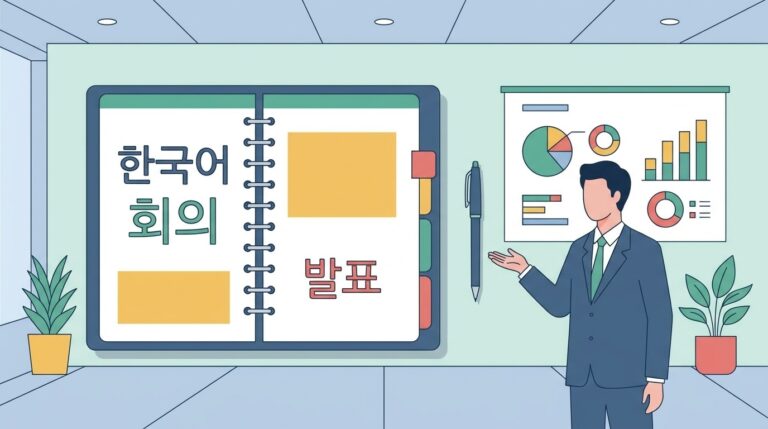
Presenting Like a K-Startup CEO: Master the Logical PREP Method in Korean
Phase 1: Empathy (스토리 몰입형 오프닝)
안녕하세요! (Annyeonghaseyo!) Your friendly Daily Hangul Editor is back! Have you ever stood in front of your Korean colleagues or clients, delivering a presentation you spent weeks preparing, only to realize their eyes were glazing over? You knew your data was solid, but somehow, your explanation sounded like a endless maze: “We should do this because of that, and also this happened, and in conclusion, maybe…”
If you’ve watched the hit K-Drama Start-Up (스타트업), you probably remember Seo Dal-mi (played by Suzy) standing on stage during Demo Day. What made her pitch so electric? It wasn’t just her passion; it was her razor-sharp logic. In Korean corporate and professional culture, presenting your thoughts logically and concisely is a highly valued superpower.
Today, we are going to master the PREP (Point, Reason, Example, Point) method using natural, sophisticated C1-level Korean. No more rambling. By the end of this guide, you’ll know how to hook your audience, back up your claims, and close with an impact that leaves everyone nodding in agreement. Let’s dive in!
Phase 2: Core Expressions (핵심 표현 3선 심층 분석)
To master the PREP method, you need specific linguistic anchors. Let’s analyze the three most critical expressions for structuring your logical body.
1. 핵심은 ~라는 점입니다 (The core point is that ~)
- Pronunciation: [Haek-si-meun ~ra-neun jeo-mip-ni-da] (Think of haek-sim as “heck-seem” and jeom as the point of a pen)
- Meaning: The core point/essence is that ~
- K-Culture Moment: You will hear this phrase constantly in corporate K-Dramas like Misaeng (미생), during intense boardroom battles where managers cut straight to the chase to save time.
- Editor’s Insight: While textbook Korean teaches “제 생각은 ~입니다” (My thought is ~), C1 speakers use “핵심은 ~라는 점입니다” to sound objective, authoritative, and analytical. Using “점” (point/fact) instead of “것” (thing) adds a layer of professional polish.
- Situation Spectrum: Casual 🚫 | Semi-formal ⚠️ | Formal ✅
- 🤔 Think About It: Why do you think modern Korean business culture values “핵심” (the core) so much early in a speech? How does this compare to the more indirect introductions in your native language?
2. 제가 이렇게 말씀드리는 이유는 ~ 때문입니다 (The reason I say this is because ~)
- Pronunciation: [Je-ga i-reo-ke mal-sseum-deu-ri-neun i-yu-neun ~ ttae-mun-im-ni-da] (Pronounce mal-sseum like “mahl-seum”)
- Meaning: The reason I am telling you this is because ~
- K-Culture Moment: Used by project managers in high-stakes strategy meetings when they need to defend their budget proposals against skeptical executives.
- Editor’s Insight: Instead of just jumping into your reasons with a simple “왜냐하면” (Because), this longer, elegant transition signals to your audience that you are about to provide logical, evidence-backed justification. It shows respect for the audience’s intellect.
- Situation Spectrum: Casual 🚫 | Semi-formal ✅ | Formal ✅
- 🤔 Think About It: How does starting a sentence with “제가 이렇게 말씀드리는 이유는” establish your authority as a speaker compared to just saying “왜냐하면”?
3. 구체적인 사례를 들자면 (To give you a concrete example)
- Pronunciation: [Gu-che-jeo-gin sa-rye-reul deul-ja-myeon] (Think of gu-che like “goo-cheh” and sa-rye like “sah-ryeh”)
- Meaning: If I were to give a concrete/specific example
- K-Culture Moment: Often used by tech startup founders on Korean investment pitching shows when illustrating user pain points with real-world case studies.
- Editor’s Insight: The word “사례” (case/instance) is much more professional than the common word “예” (example). By adding “구체적인” (concrete/specific), you tell the audience that your argument is not just theoretical but grounded in reality.
- Situation Spectrum: Casual ⚠️ | Semi-formal ✅ | Formal ✅
- 🤔 Think About It: Why is presenting a “구체적 사례” (concrete case) highly valued in Korean business negotiations where trust (신뢰) is paramount?
Phase 3: Textbook Korean vs. Real Korean (교과서 한국어 vs 진짜 한국어)
Let’s compare the flat, robotic sentences found in standard textbooks with the dynamic, professional phrasing used by native corporate experts.
Situation 1: Presenting your main argument
- 📖 Textbook Korean: 제 주장은 이것입니다. [Je ju-jang-eun i-geot-im-ni-da.] (My claim is this.)
- 🗣️ 진짜 한국어: 제가 가장 강조하고 싶은 부분은 ~입니다. [Je-ga ga-jang gang-jo-ha-go sip-eun bu-bun-eun ~im-ni-da.] (The part I want to emphasize the most is ~.)
- 💡 Why the difference? Saying “제 주장” (my claim/argument) can sound overly confrontational or self-centered. Shifting the focus to “강조하고 싶은 부분” (the part I want to emphasize) sounds collaborative yet highly professional.
Situation 2: Transitioning to data or examples
- 📖 Textbook Korean: 예를 들겠습니다. [Ye-reul deul-get-seup-ni-da.] (I will give an example.)
- 🗣️ 진짜 한국어: 이해를 돕기 위해 실제 데이터를 보여드리겠습니다. [I-hae-reul dop-gi wi-hae sil-je de-i-teo-reul bo-yeo-deu-ri-get-seup-ni-da.] (To facilitate your understanding, I will show you actual data.)
- 💡 Why the difference? “예를 들겠습니다” is grammatically correct but feels elementary. “이해를 돕기 위해” (to help your understanding) shows empathy toward your audience, making them feel respected and engaged.
Phase 4: K-Culture Deep-Dive & Non-Verbal Manners
4-1. Nunchi (눈치) & Non-Verbal Presenting Manners
In Korean presentations, delivery is not just about your voice; it’s about your physical presence and spatial awareness.
* The Soft Anchor Hand Gesture: Avoid pointing directly at the audience or screen with a single finger. Instead, use an open palm (손바닥) facing upward to gently guide their eyes to the slides. This gesture displays deep respect.
* The Head Nod (끄덕임): When concluding a key point (the final “P” in PREP), hold eye contact with key decision-makers and give a slow, subtle single nod. It projects confidence and invites them to nod back in agreement.
4-2. The Evolution of Korean Business Logic
Traditionally, Korean communication was highly indirect, relying heavily on a “미괄식” (tail-first/inductive) structure where the conclusion is hidden until the very end to preserve harmony. However, in modern globalized Korea (often mirrored in competitive industries like K-Beauty, tech, and entertainment), “두괄식” (head-first/deductive) structure is king. The PREP method is the ultimate implementation of “두괄식” thinking, saving valuable time for busy decision-makers who value efficiency.
Phase 5: Real-Life Roleplay Scenario
Here is a high-stakes scenario. You are Jimin (지민), a senior marketing specialist pitching a new digital campaign. Your interlocutor is Team Leader Kang (강 팀장님), a sharp, busy boss who values clear logic.
Characters:
- Jimin (지민): Sharp, prepared, and aiming for a promotion (The Learner).
- Team Leader Kang (강 팀장님): Pragmatic, analytical, but supportive of logical ideas (The NPC).
1. 지민: (🎭 Confidently steps up to the screen) 안녕하십니까, 강 팀장님. 이번 신제품 마케팅 전략 발표를 맡은 지민입니다. 오늘 제 제안의 핵심은 2030 세대를 타겟으로 한 숏폼 마케팅에 예산을 집중해야 한다는 점입니다.
   [An-nyeong-ha-si-myeon-ga, Kang tim-jang-nim. I-beon sin-je-pum ma-ke-ting jeon-ryak bal-pyo-reul mat-eun Ji-min-im-ni-da. O-neul je je-an-ui haek-si-meun i-gong-sam-gong se-dae-reul ta-get-eu-ro han syot-pom ma-ke-ting-e ye-san-eul jip-jung-hae-ya han-da-neun jeo-mip-ni-da.]
   (Hello, Team Leader Kang. I am Jimin, in charge of this new product marketing strategy presentation. The core of my proposal today is that we must focus our budget on short-form marketing targeting the 20-30 generation.)

2. 강 팀장님: (🎭 Looks up from his tablet, interested) 숏폼 마케팅이라... 요즘 대세이긴 하죠. 하지만 기존 매체 예산을 줄이면서까지 집중해야 하는 구체적인 이유가 있습니까?
   [Syot-pom ma-ke-ting-i-ra... Yo-jeum dae-se-i-gin ha-jyo. Ha-ji-man gi-jon mae-che ye-san-eul jul-i-myeon-seo-kka-ji jip-jung-hae-ya ha-neun gu-che-jeo-gin i-yu-ga it-seup-ni-kka?]
   (Short-form marketing... It is the trend these days. But is there a concrete reason why we should focus on it even to the point of reducing our budget for traditional media?)

3. 지민: (🎭 Nods respectfully) 네, 제가 이렇게 말씀드리는 이유는 현재 우리 브랜드의 인지도가 젊은 층 사이에서 급격히 하락하고 있기 때문입니다.
   [Ne, je-ga i-reo-ke mal-sseum-deu-ri-neun i-yu-neun hyeon-jae u-ri beu-raen-deu-ui in-ji-do-ga jeolm-eun cheung sa-i-e-seo geup-gyeok-hi ha-rak-ha-go it-gi ttae-mun-im-ni-da.]
   (Yes, the reason I say this is because our brand's awareness among the younger demographic is currently declining rapidly.)

4. 강 팀장님: (🎭 Crosses his arms) 하락세라... 수치나 확실한 근거가 필요하겠는데요.
   [Ha-rak-se-ra... Su-chi-na hwak-sil-han geun-geo-ga pil-yo-ha-get-neun-de-yo.]
   (A decline... We are going to need figures or clear evidence.)

5. 지민: (🎭 Changes the slide) 구체적인 사례와 데이터를 들자면, 지난달 실시한 설문조사에서 20대의 브랜드 인지도가 전년 대비 15% 감소한 것으로 나타났습니다. 반면, 숏폼 콘텐츠를 노출했던 대조군은 구매 전환율이 30% 이상 상승했습니다.
   [Gu-che-jeo-gin sa-rye-wa de-i-teo-reul deul-ja-myeon, ji-nan-dal sil-si-han seol-mun-jo-sa-e-seo i-gong-dae-ui beu-raen-deu in-ji-do-ga jeon-nyeon dae-bi sip-o-pro gam-so-han geos-eu-ro na-ta-nat-seup-ni-da. Ban-myeon, syot-pom kon-ten-cheu-reul no-chul-haet-deon dae-jo-gun-eun gu-mae jeon-hwan-yul-i sam-sip-pro i-sang sang-seung-haet-seup-ni-da.]
   (To give you a concrete example and data, in the survey conducted last month, brand awareness among those in their 20s decreased by 15% compared to last year. On the other hand, the control group exposed to short-form content showed an increase in purchase conversion of over 30%.)

6. 강 팀장님: (🎭 Nods slowly, impressed) 음, 데이터가 확실하군요. 설득력이 있어요.
   [Eum, de-i-teo-ga hwak-sil-ha-gun-yo. Seol-deuk-ryeok-i it-seo-yo.]
   (Hmm, the data is solid. It is persuasive.)

7. 지민: (🎭 Delivers the concluding blow with a confident smile) 그렇기 때문에 결론적으로, 이번 기획을 통해 예산을 효율적으로 재배치하여 초기 시장 점유율을 확실히 잡아야 합니다.
   [Greot-gi ttae-mun-e gyeol-ron-jeok-eu-ro, i-beon gi-hoek-eul tong-hae ye-san-eul hyo-yul-jeok-eu-ro jae-bae-chi-ha-yeo cho-gi si-jang jeom-yu-yul-eul hwak-sil-hi jap-a-ya ham-ni-da.]
   (Therefore, in conclusion, through this project, we must efficiently reallocate the budget to firmly secure our initial market share.)

8. 강 팀장님: (🎭 Smiles and writes notes) 좋습니다. 지민 씨 기획안대로 추진해 봅시다. 바로 보고서 작성해서 올려주세요.
   [Jot-seup-ni-da. Ji-min ssi gi-hoek-an-dae-ro chu-jin-hae bop-si-da. Ba-ro bo-go-seo jak-seong-hae-seo ol-ryeo-ju-se-yo.]
   (Great. Let's proceed with Jimin's plan. Please write up the formal report and submit it right away.)
🔀 Choose Your Next Move (인터랙티브 분기점)
How would you respond if Team Leader Kang asked, “Do you think our competitors will stay quiet while we do this?”
- Option A: “경쟁사 분석도 마쳤습니다. 핵심은 경쟁사보다 우리가 2주 빠르게 움직인다는 점입니다.” (I have completed the competitor analysis. The core point is that we move two weeks faster than them.)
- Feedback: Best! (100%) You immediately redirected to the core point (P) using the target structure and showed preemptive analysis.
- Option B: “글쎄요, 경쟁사 동향은 아직 잘 모르겠습니다… 알아보고 올게요.” (Well, I don’t really know about competitor trends yet… I’ll check and come back.)
- Feedback: Bad. (30%) This ruins the logical momentum built by your PREP structure. It shows a lack of preparation.
- Option C: “걱정하지 마세요! 우리 제품이 무조건 이깁니다.” (Don’t worry! Our product will win no matter what.)
- Feedback: Risk! (50%) High passion, zero logic. It sounds like empty bragging rather than a strategic business decision.
Phase 6: 10-Second Emotion Shadowing Drill (섀도잉 드릴)
Practice these sentences with the correct pauses (/) and emotional tone to maximize your professional impact.
- [🔥 Confident & Authoritative]
“오늘 제 제안의 / 핵심은 / 2030 세대를 타겟으로 한 / 숏폼 마케팅에 / 예산을 집중해야 한다는 / 점입니다.”
(Today, the core of my proposal is that we must focus our budget on short-form marketing targeting the 2030 generation.) -
[😊 Trustworthy & Calm]
“이해를 돕기 위해 / 지난 분기 / 실제 매출 데이터를 / 화면에 띄워 드리겠습니다.”
(To help your understanding, I will bring up the actual sales data from the last quarter on the screen.) -
[⚡ Firm & Decisive]
“그렇기 때문에 / 결론적으로, / 지금 당장 / 시장 선점을 위한 / 투자를 진행해야 합니다.”
(Therefore, in conclusion, we must invest right now to preoccupy the market.)
Phase 7: K-Culture Mini Dictionary (핵심 키워드 4개)
| Word (Pronunciation) | Meaning | Professional Business Context |
|---|---|---|
| 두괄식 [Du-gal-sik] | Head-first deduction structure | Putting the most important point in the very first sentence of your report. |
| 미괄식 [Mi-gal-sik] | Tail-first induction structure | Saving the conclusion for the end, often used in gentle negotiations to build rapport. |
| 설득력 [Seol-deuk-ryeok] | Persuasive power / Credibility | Used to evaluate if an argument is logical: “그 보고서는 설득력이 있네요” (That report is persuasive). |
| 공감대 [Gong-gam-dae] | Consensus / Common ground | Aligning interests before pitching: “의견의 공감대를 형성했습니다” (We built a consensus). |
Phase 8: Traveler’s Survival Kit for Professionals
If you find yourself in Korea attending business meetings, here are three survival sentences you need:
- 잠시 화면을 봐 주시겠습니까? [Jam-si hwa-myeon-eul bwa ju-si-get-seup-ni-kka?]
- Pro Tip: Use this when directing attention to the projector or screen during a slide transition.
- 제 발표는 여기까지입니다. 경청해 주셔서 감사합니다. [Je bal-pyo-neun yeo-gi-kka-ji-im-ni-da. Gyeong-cheong-hae ju-syeo-seo gam-sa-ham-ni-da.]
- Pro Tip: The ultimate standard way to conclude a formal presentation. “경청” means listening with respect.
- 질문이 있으시면 편하게 말씀해 주시기 바랍니다. [Jil-mun-i it-seu-si-myeon pyeon-ha-ge mal-sseum-hae ju-si-gi ba-rap-ni-da.]
- Pro Tip: Open up the Q&A session with this polite and inviting sentence.
💡 Editor’s Travel Note: When preparing a presentation in Seoul, download the Naver Map App to find local quiet shared offices or study cafes (스터디카페) where you can practice out loud. Always check localized business etiquette; things change rapidly in Korea’s fast-moving business world.
Phase 9: “한 발 더 깊이” (Deep Dive Into Korean Mindset)
In Western communication, being direct is often seen as a sign of honesty and efficiency. In traditional Korean culture, however, directness was sometimes misconstrued as a lack of respect (예의) or lack of emotional consideration for the other person’s feelings (기분).
This is why older managers might start a conversation by talking about the weather, health, or lunch before getting to the point. However, the modern Korean office is a hybrid space. By using the PREP method with polite honorifics (존댓말), you balance the modern demand for efficiency (두괄식) with the traditional Korean value of respectful boundary-keeping. You get straight to the point without making the other person feel rushed or cornered.
💬 Your Turn:
Have you ever experienced a cultural clash when presenting to someone of a different culture? How do you balance being direct versus polite in your own language? Share your experiences in the comments below!
Phase 10: FAQ & Common Mistakes
Q: Can I use the PREP method when talking to friends in Korean?
A: Yes! But you must change the formal ending ~입니다/습니다 to the polite informal ~에요/아요. For example: “핵심은 우리 오늘 떡볶이 먹어야 된다는 점이야!” (The core point is we have to eat Tteokbokki today!).
Q: What is the difference between “왜냐하면” and “제가 이렇게 말씀드리는 이유는”?
A: Both mean “because.” However, “왜냐하면” is a basic conjunction. “제가 이렇게 말씀드리는 이유는” is a sophisticated rhetorical transition that builds suspense and shows high-level professional fluency.
Q: Why do Korean bosses sometimes react poorly even if my logic is perfect?
A: It might be because of “눈치” (Nunchi). If you present a logical point that openly embarrasses someone senior in the room, they may resist. Always frame your logic as a win-win solution for the team, not just your personal success.
🚨 Common Mistakes Board (외국인 학습자의 흔한 실수)
- Overusing “그리고” (And… and…): Avoid linking all sentences with “그리고”. Use logical connectors like “따라서” (Therefore) or “하지만” (However) to guide the logic.
- Ending with “~인 것 같습니다” (It seems to be): Many learners use this to sound humble, but in a logical business presentation, it makes you sound unsure. Use “~입니다” (It is) or “~로 분석됩니다” (It is analyzed as) to sound confident.
- Using casual terms like “나” (I) instead of “저”: In any formal business setting, always refer to yourself as “저” [jeo] and use formal honorifics.
Phase 11: Action Missions (실전 액션 미션)
- 🥉 Bronze Mission: Write one paragraph in the comments using “핵심은 ~라는 점입니다” to explain your favorite K-Drama.
- 🥈 Silver Mission: Record a 30-second audio clip practicing the Shadowing Drill in Phase 6 and upload it to your social media, tagging
#DailyHangul. - 🥇 Gold Mission: Use the PREP method in your next actual Korean email or meeting, and notice how differently your Korean team reacts!
-
🎮 K-Culture Mission: Watch an episode of a Korean business-themed drama (like Start-Up or Search: WWW). Write down at least one instance where a character uses “핵심은” or “구체적인” to make a point.
Phase 12: Interactive Quiz Challenge (퀴즈 챌린지)
1. Which of the following expressions is best suited for introducing a logical reason in a C1-level business meeting?
a) 왜냐하면 나는 그렇게 생각해요.
b) 제가 이렇게 말씀드리는 이유는 현재 데이터가 부족하기 때문입니다.
c) 그냥 이게 더 나아 보입니다.
Click for Answer & Explanation
Correct Answer: b
Explanation: Option ‘b’ uses the professional, polite transition







